




Pre-Engineered Agricultural Steel Buildings for Commercial Livestock, Grain Storage & Farm Operations
KAFA designs, fabricates, and installs prefabricated metal farm buildings for commercial livestock producers, grain handlers, equipment operators, and agribusiness developers. Single-span structures from 500 m² to multi-bay agricultural complexes exceeding 6,000 m², engineered to use type, climate zone, and corrosivity class.
Why Steel for Farm Buildings
Why Steel Farm Buildings Outperform Pole Barns for Commercial Agricultural Operations
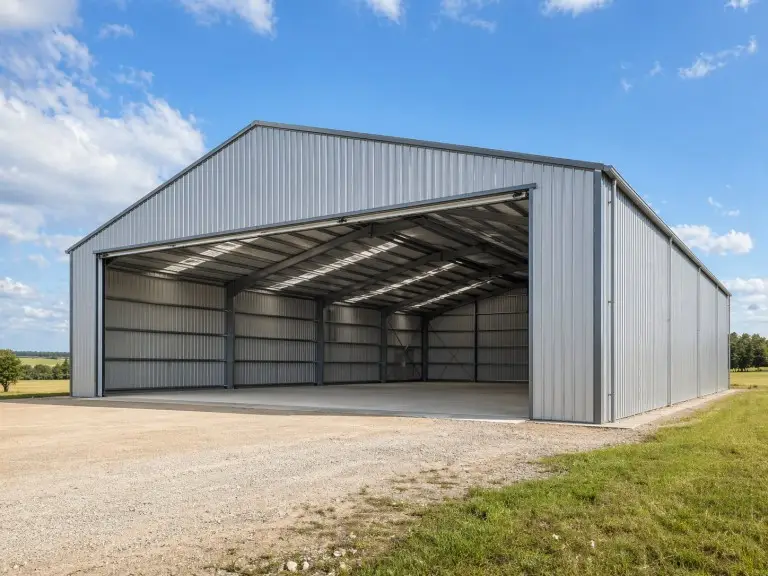
Pre-engineered steel farm buildings deliver clear-span column-free interiors, longer structural service life, and lower per-square-metre construction cost than timber pole barns, and greater span flexibility than masonry structures. For commercial agricultural operations, the structural performance difference between a correctly specified steel frame and a timber alternative becomes measurable within the first decade of operation.
Because prefabricated farm buildings are fabricated to order and shipped as modular components, the on-site programme is compressed to erection and envelope installation. Grain, produce, and livestock operations with seasonal storage deadlines benefit from a weather-tight structure within 40–50 days of steel delivery — a timeline that poured concrete structures cannot match. Larger agribusiness operations often pair agricultural buildings with adjacent steel structure warehouses for commercial-scale bulk storage and distribution.
Key Structural Advantages
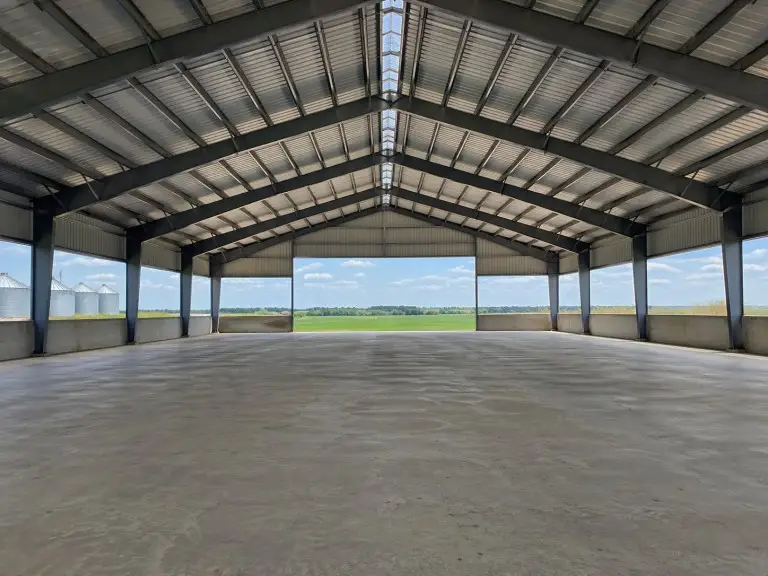
- Column-free interior spans — unrestricted equipment manoeuvring and livestock layout
- No moisture absorption or ground-up rot — steel framing is not susceptible to pole barn failure modes
- Coating specification matched to corrosivity class at fabrication, not retrofitted
- 45-day erection programme for standard single-span structures under 5,000 m²
- All structural members factory-fabricated under ISO 9001:2015 quality controls
Configuration by Use Type
Agricultural Steel Buildings Require Use-Type-Specific Structural Design
Specifying a building without confirming use type first is the most direct route to a structure that underperforms from the first season. Use type determines ventilation design, door sizing, eave height, insulation, and corrosion protection class — all locked into the structural design before fabrication begins. This applies equally to prefabricated agricultural buildings and custom-engineered farm structures.
Grain Storage & Hay Barns
Moisture exclusion is the primary structural design variable. Ridge detailing, panel overlap, base trim, and the foundation-to-wall interface all serve the same purpose: preventing moisture ingress that causes mould, grain heating, and hay combustion risk. Ventilation is controlled and directional. Door openings must accommodate grain trailers and front-end loaders — clear width and height are confirmed before the column grid is set, not estimated after.
Livestock Barns & Poultry Houses
Continuous high-volume natural airflow is a structural design priority in steel livestock buildings — the opposite of grain storage. Ridge ventilators, side-wall louvres, and adjustable openings are positioned and sized during the structural design phase based on building volume, stocking density, and climate zone. In tropical Southeast Asia, sub-Saharan Africa, and the Arabian Peninsula, inadequate natural ventilation causes heat stress and productivity losses that no later-stage retrofit can fully correct.
Farm Equipment Sheds & Workshops
Eave heights and door opening dimensions are determined by the largest equipment to be stored or serviced inside. Combine harvesters, large tractors with attachments, and grain transport vehicles have specific clearance requirements that must be confirmed before portal frame heights and column positions are finalised. Rolling doors and sliding doors are sized to equipment dimensions, not personnel access standards.
Crop Processing & Packing Facilities
A hygiene design layer is added to the structural brief. Wall-to-floor junctions, drainage provision, and panel surface finishes affect cleanability and, in some jurisdictions, compliance with food handling standards. These parameters are confirmed during scoping alongside structural span, eave height, and equipment layout — not treated as fit-out decisions after the structure is erected. Agribusiness developers combining processing with retail distribution often also require commercial metal buildings on the same site.
How We Work
KAFA’s Delivery Process for Agricultural Steel Buildings
Five defined stages from structural brief to installed structure — one engineering and production team from design through export.
Requirements Intake
Site dimensions, storage type, intended product, eave height, door sizes, ventilation requirements, floor loading, and target completion date.
Design & Quotation
Structural drawings, panel schedule, ventilation layout, and detailed price proposal within 3 business days of confirmed parameters.
Fabrication
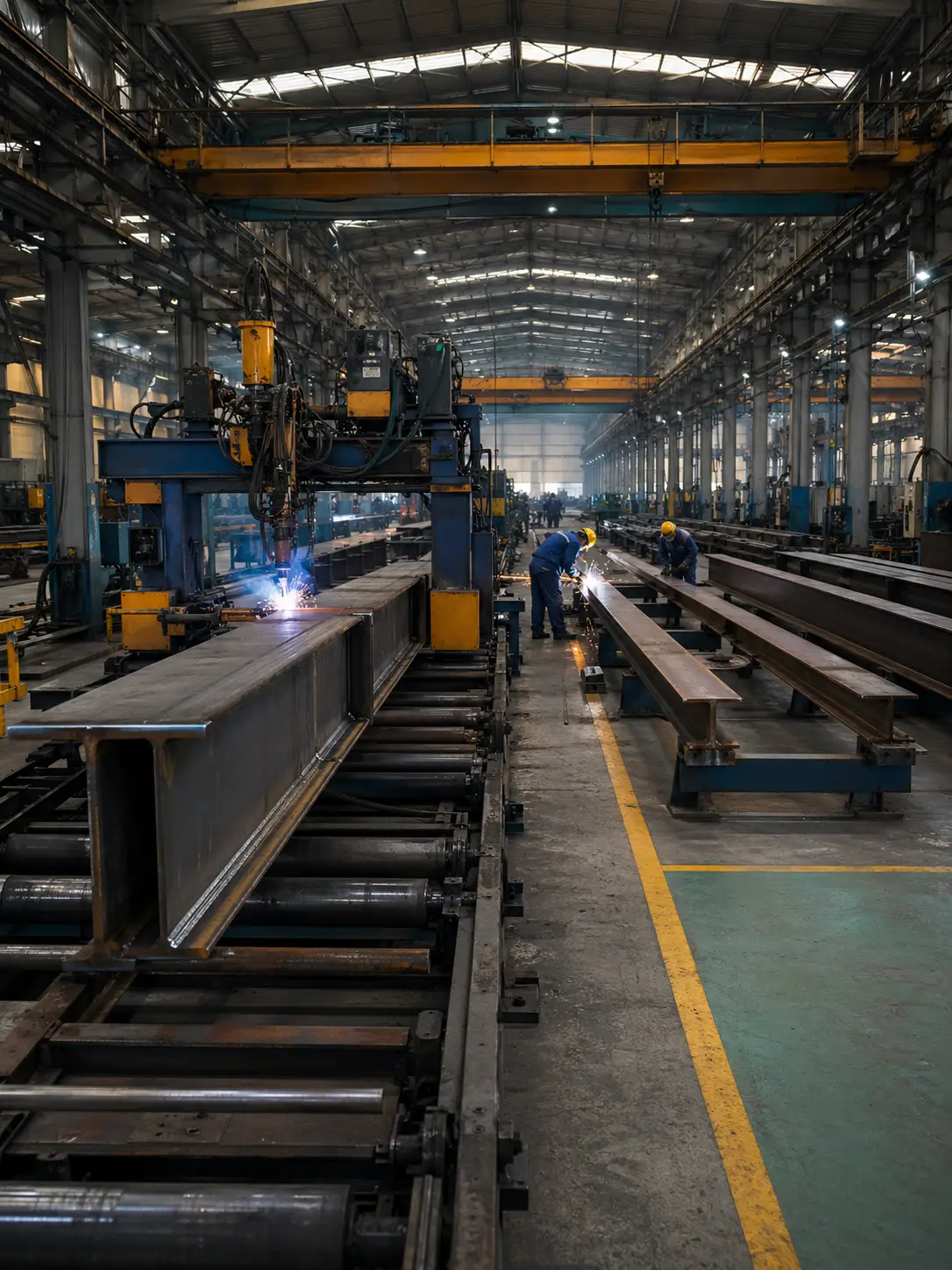
All structural components manufactured at our 20,000 m² facility and inspected under ISO 9001:2015 before surface treatment and container packing.
Logistics & Export
Modular container packing and export documentation coordinated to your destination port — Africa, Southeast Asia, Middle East, and Pacific.
Installation
Erection by our team or a locally supervised crew. Weather-tight completion in approximately 45 days for standard single-span structures under 5,000 m².
Timelines confirmed in writing at scoping based on project scale, production queue, and site conditions.
Design Variables
Three Design Variables for Prefabricated Farm Buildings Confirmed at Requirements Intake — Not After Fabrication
The most consistent source of agricultural building underperformance is applying generic shed specifications to a commercial farm operating environment. These three variables are confirmed before structural drawings are issued.
Corrosion Protection & Coating Specification
Corrosivity classification is determined by climate zone, proximity to coastal areas, livestock stocking density, manure exposure, and cleaning chemical use. Agricultural environments in tropical or high-humidity regions require heavier coating systems than standard industrial specifications.
Structures specified with standard epoxy primer finishes in high-humidity livestock or coastal environments show corrosion at panel fasteners and base members within 2–3 years. The remedial cost over 10 years routinely exceeds the cost difference between standard and agriculture-grade specification at the time of original fabrication.
Ventilation Design
Ridge ventilator sizing, side-wall louvre positioning, and adjustable opening ratios are structural elements built into the primary frame and envelope during fabrication — they cannot be effectively retrofitted without significant structural disruption and additional cost.
Ventilation design parameters — building volume, stocking density, prevailing wind orientation, and climate zone — must be confirmed during the structural design stage. When ventilation openings are sized from a generic building reference rather than the thermal load of the specific operation, interior temperatures exceed safe operating ranges during peak periods.
Door Sizing & Machinery Clearance
Door clear width and clear height are determined by the largest equipment that will regularly enter or exit the building, including front-mounted or towed attachments. Combine harvesters, large tractors, and grain transport trailers all have specific clearance requirements that differ significantly from personnel access door standards.
We ask clients to provide equipment dimensions — or equipment model numbers so our team can confirm clearance requirements — at requirements intake, before the structural column grid and portal frame heights are finalised.
Our Delivery Process
Steel Building Design
Structural drawings and load calculations delivered within 3 business days from confirmed site dimensions, location, and intended use.
Metal Building Plans
Standard and custom floor plan configurations for warehouses, workshops, hangars, and industrial facilities across common clear-span ranges.
Metal Building Colors
Colour coating options for wall panels and roof sheets — including Colorbond-equivalent finishes and custom RAL matching for commercial projects.
Metal Building Components
Primary frames, secondary members, roof and wall cladding, gutters, doors, and windows — all fabricated in-house to ISO 9001:2015 standards.
Metal Building Insulation
PU, PIR, rock wool, and glass wool systems specified by climate zone — from tropical ambient buildings to cold storage facilities at −25 °C.
Metal Building Construction
45-day on-site erection programme from foundation handover to structural completion, covering anchor bolt setting, frame erection, and cladding.
Metal Building Foundation
Anchor bolt layout drawings, concrete grade and dimension requirements, and ±3 mm placement tolerances provided with every structural package.
Site Preparation
Ground levelling, drainage gradient, access road, and temporary power requirements confirmed before steel components leave the fabrication facility.
Metal Building Erection
6-stage installation sequence: foundation verification, column erection, rafter setting, bracing installation, cladding, and final handover inspection.
Project References
Agricultural Steel Building Projects Delivered by KAFA
Representative examples across poultry production, grain storage, and farm equipment storage — spanning Southeast Asia, Sub-Saharan Africa, and the Pacific.
Commercial Poultry Production House
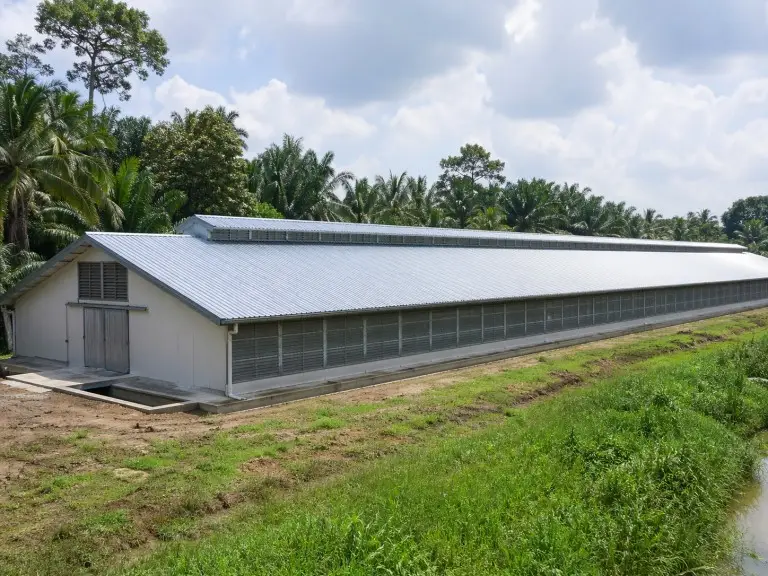
Four-bay broiler production house designed for a high-humidity tropical coastal site. Continuous ridge ventilation and side-wall louvres sized to stocking density and prevailing wind orientation. C4 zinc-aluminium coating specified for coastal corrosivity classification.
Grain Storage & Handling Barn
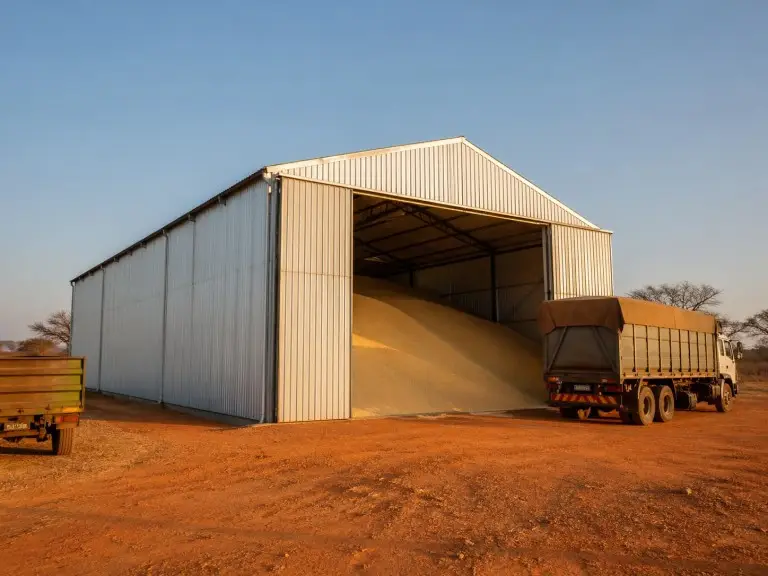
Single-span grain storage barn with controlled directional ventilation for moisture management. Sliding access doors confirmed to grain trailer and front-end loader clearance dimensions. Ridge detailing and base-trim specification prioritised for moisture exclusion.
Multi-Bay Farm Equipment Storage Complex
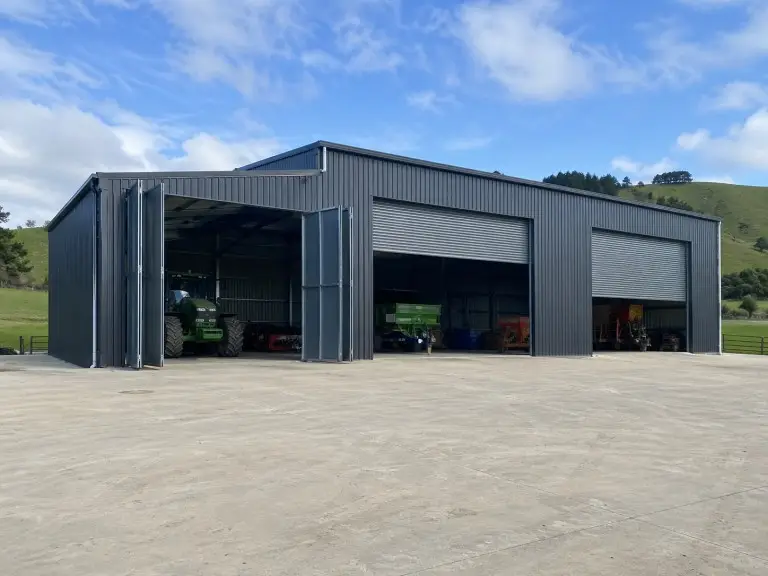
Three-bay equipment storage and servicing complex for a large-scale grain and livestock operation. Portal frame heights and column positions confirmed against combine harvester and articulated grain trailer clearance requirements. Roller shutter and bi-fold doors at two bays.
Project Fit
Who This Service Is Designed For — and Where It Is Not the Right Fit
- Commercial grain barns, hay storage, and bulk handling facilities from 500 m² to 6,000 m²+
- Livestock barns — cattle, sheep, and pig housing — and commercial poultry houses requiring engineered ventilation
- Farm equipment storage sheds and farm workshops — from single-bay structures to multi-bay complexes
- Agricultural processing and packing facilities for crop producers and agribusiness developers
- Projects in Southeast Asia, the Middle East, Africa, Oceania, and North America where container shipping is a viable supply route
- Sites requiring corrosivity-class-matched coating — tropical, coastal, high-humidity, or high-stocking-density environments
- Refrigerated or temperature-controlled agricultural storage requiring an active cold-chain building envelope with integrated refrigeration systems — for dedicated cold-chain requirements, see our steel cold storage buildings
- Projects with food-grade wall and floor certification requirements — compliance verification is the client’s responsibility and varies by jurisdiction and commodity type
- Residential hobby farm or small-scale rural sheds under 200 m² — our delivery model is optimised for commercial-scale agricultural operations
- Controlled-atmosphere grain stores or refrigerated dairy facilities requiring mechanical engineering integration beyond our standard delivery scope
Verified Project Outcomes
What Agricultural Storage Clients Say — and What the Projects Delivered
Engineering challenge, structural outcome, and client response are presented together so you can assess the result, not just the sentiment.
Variable soil bearing identified at initial site investigation. Foundation parameters adjusted before fabrication was committed — the structural frame anchor bolt layout was revised in the design stage, not after slab pour. Skylight coverage specified at 15% of roof area to eliminate daytime artificial lighting.
Soil bearing capacity is the one ground condition that affects the structural design most directly and costs the most to correct after the foundation slab is poured. When the site investigation returned a bearing capacity lower than the client’s original assumption, we paused the anchor bolt finalisation, revised the foundation pad size and pile depth, and confirmed the updated layout before issuing the fabrication drawing set. The additional design time was two working days. The alternative — discovering the discrepancy after the slab was cast — would have been a structural rework measured in weeks, not days.
“KAFA flagged the soil bearing issue in the first scoping call. That single conversation prevented what would have been a very costly foundation rework mid-programme.”
Produce export facility requiring clean-span interior for pallet movement and cold chain loading zone integration. Future expansion bay declared at design stage — end-frame detailing and anchor bolt layout specified to accommodate one additional bay without foundation modification.
Expansion bay pre-specification is a design stage decision that costs almost nothing to implement and is impossible to retrofit without significant expense. The end-frame of an expansion-ready building is detailed to carry the additional rafter load of the future bay — the column is sized, the connection plate is fabricated, and the anchor bolts are positioned in the original foundation pour. When the client extended the building three years later, the only structural work required was erecting the new bay frame and connecting it to the pre-designed interface. The foundation was untouched.
“Three years after construction, we added the expansion bay without touching the original foundation. That was only possible because KAFA incorporated it into the original design at no additional cost.”
Manufacturing Credentials
Certifications, Accreditations, and Production Capacity
KAFA’s production credentials are verified by independent third-party accreditation bodies against defined benchmarks for metal building system manufacturers — not self-declared.
ISO 9001:2015 Certified
Our quality management system covers the full production sequence — structural fabrication, surface treatment, and component inspection — against the ISO 9001:2015 standard. Each production batch is inspected before leaving the facility.
IAS AC472 Accredited
Independent accreditation from the International Accreditation Service verifies our engineering documentation, production processes, and quality controls against defined benchmarks for metal building system manufacturers. Independently audited.
20,000 m² Production Facility
Dedicated fabrication facility with over 500 production and engineering staff, certified 2,000 MT monthly output, and 24+ years of delivery experience across agricultural projects in tropical, arid, and temperate climate zones.
Frequently Asked Questions
Technical and Commercial Questions, Answered Directly
For light equipment storage in dry, low-traffic environments, a pole barn can be a cost-effective short-term option. For commercial agricultural operations — including livestock housing, poultry production, grain storage at scale, or any facility in a high-humidity or coastal climate — steel portal frame construction offers meaningfully better structural performance over the building’s service life. The wood post embedments in a pole barn absorb ground moisture and begin deteriorating from the base up, often without visible warning. Steel framing is not susceptible to this failure mode, and when surface treatment is correctly matched to the operating environment at the fabrication stage, structural performance is predictable. The total cost of ownership comparison favours steel for most commercial farm operations when maintenance, inspection, and eventual replacement costs are included in the calculation.
Cost depends on a combination of structural variables that must be confirmed at scoping: covered floor area and building footprint, required eave height and roof profile, structural span and column spacing, corrosivity class of the operating environment (which determines coating specification), ventilation and door opening requirements, insulation specification, and site location relative to the nearest container port. Fabrication cost, shipping cost, and installation cost each vary by these parameters and cannot be accurately estimated without confirmed project dimensions and use-type requirements. We provide a detailed price proposal within 3 business days of receiving confirmed project parameters.
Yes. Ridge ventilator sizing, side-wall louvre positioning, and adjustable opening ratios are structural elements built into the primary frame and envelope system during fabrication. They cannot be effectively retrofitted after erection without significant structural disruption and additional cost. Ventilation design parameters — based on building volume, stocking density, prevailing wind orientation, and climate zone — must be confirmed during the design stage before structural drawings are finalised.
Door clear width and clear height are determined by the dimensions of the largest equipment that will regularly enter or exit the building, including any front-mounted or towed attachments. Combine harvesters, large tractors, and grain transport trailers all have specific clearance requirements that differ significantly from personnel access door standards. We ask clients to provide equipment dimensions — or equipment model numbers so our team can confirm clearance requirements — at the requirements intake stage, before the structural column grid and portal frame heights are finalised.
Corrosion protection specification is based on the corrosivity classification of the operating environment, determined by climate zone, proximity to coastal areas, livestock or poultry stocking density, manure exposure, and cleaning chemical use. Agricultural environments in tropical or high-humidity regions, or those housing livestock at high stocking densities, require heavier coating systems than standard industrial specifications. We confirm corrosivity classification at the requirements intake stage and select surface treatment accordingly before fabrication begins. Applying the correct specification at build time is substantially less expensive than remedial recoating after corrosion onset.
No. Refrigerated or temperature-controlled agricultural storage requiring an active cold-chain envelope — such as produce cool rooms, controlled-atmosphere grain stores, or refrigerated dairy facilities — is outside our standard agricultural building scope. Our insulation options, rock wool and glass wool, are appropriate for thermal comfort in livestock facilities and passive temperature moderation in grain or hay storage in moderate climates. Active refrigeration system integration requires specialist cold-chain building design and mechanical engineering coordination that we do not provide as part of our standard delivery process.
Start Your Project
Drawings & Proposal in 3 Business Days
Share your intended building use, site dimensions, climate zone, ventilation requirements, machinery clearance dimensions, and target completion date. Our engineering team responds with initial structural drawings and a detailed proposal within 3 business days.
Submit Requirements Directly
Ready to Send Your Project Brief?
Submit your agricultural building specifications — use type, span, eave height, corrosivity zone, ventilation requirements, and target programme — and our team will prepare a detailed structural proposal without a preliminary call.