




Pre-Engineered Steel Industrial Buildings & Prefab Industrial Metal Structures
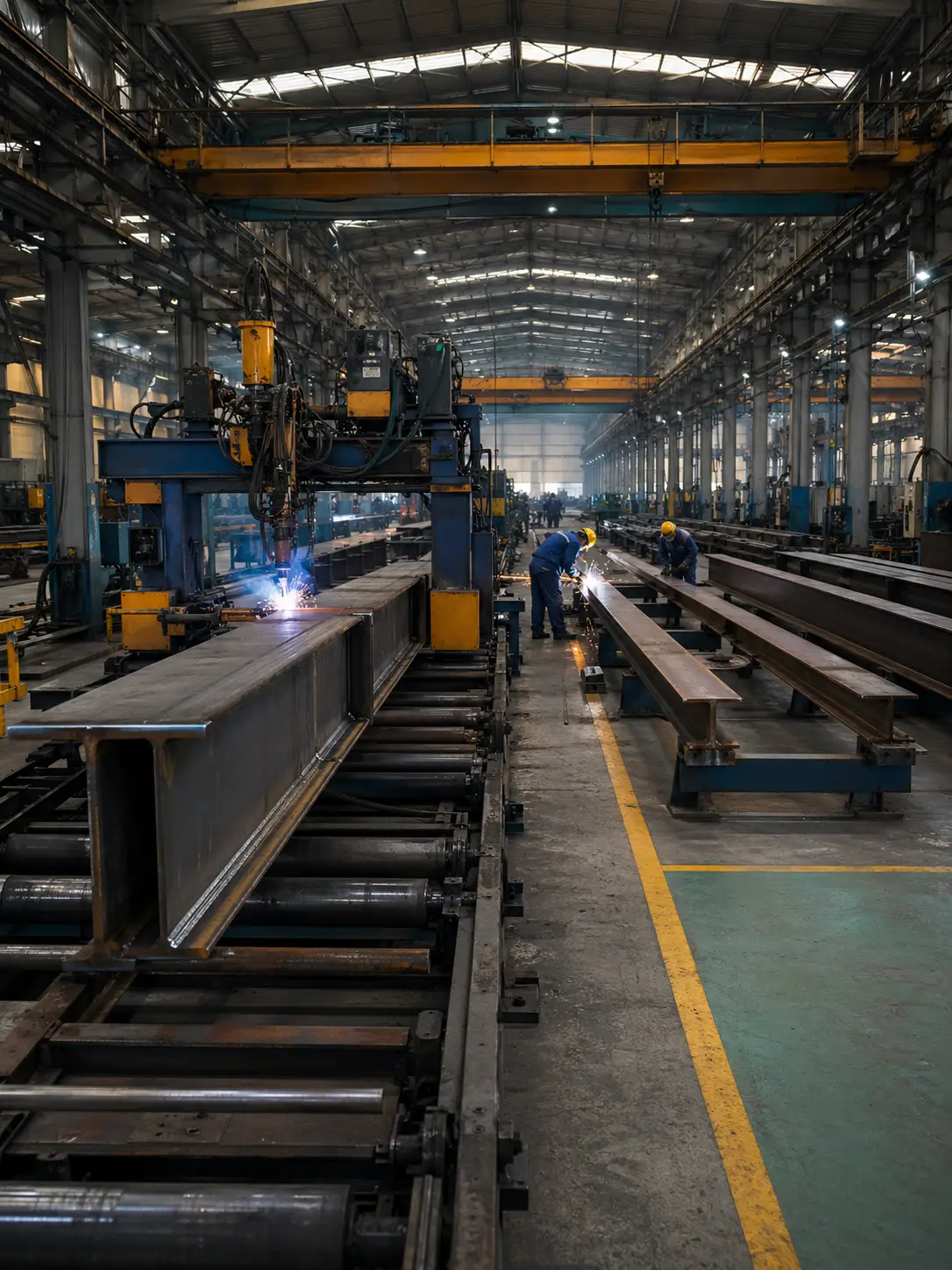
KAFA designs, fabricates, and delivers pre-engineered steel industrial buildings for heavy manufacturing plants, processing facilities, mining operations, food and beverage production, and multi-bay industrial complexes across Africa, Southeast Asia, and the Middle East. Structural inputs confirmed from industrial use type before a single column is positioned.
Steel vs Concrete
Why Pre-Engineered Steel Is the Default Choice for Industrial Metal Buildings
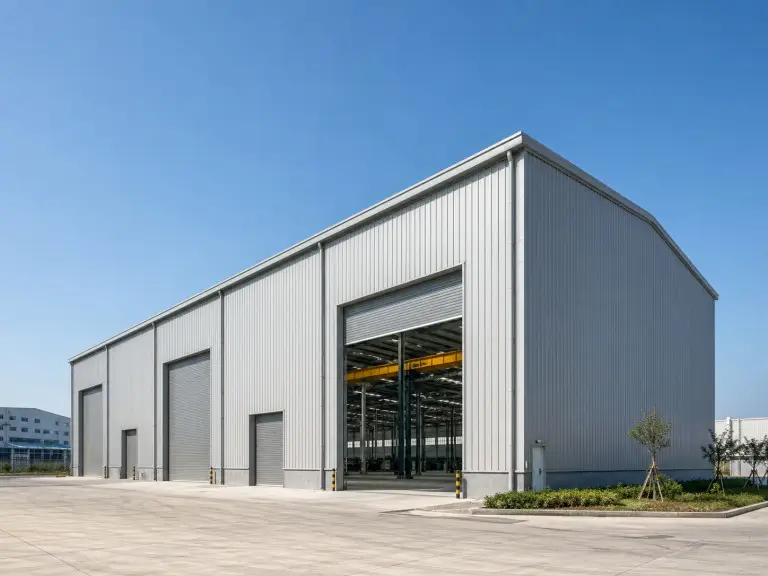
Pre-engineered steel industrial buildings deliver the clear-span column-free interiors, heavy crane beam integration, and configurable eave heights that manufacturing and processing operations require. Concrete-frame alternatives cannot match steel on construction timeline, interior layout flexibility, or cost per square metre for mid-to-large industrial footprints.
Configuration by Use Type
Industrial Steel Construction Configuration Confirmed by Use Type Before Design Begins
Different industrial operations impose fundamentally different structural requirements. The most productive first step is confirming which use type applies — because it determines every structural variable that follows.
Heavy Manufacturing & Fabrication
Column, bracket, and track foundation beam all engineered to the crane spec from the first drawing.
Processing & Assembly Facilities
Preliminary equipment layout or process flow diagram required before column grid is finalised.
Food & Beverage Processing
Hygiene zones, floor drainage lines, and cleaning chemical types declared at requirements intake.
Mining & Resource Processing
Equipment foundation point loads for crusher, conveyor, screen structures before frame engineering.
Energy Sector Auxiliary Buildings
Blast resistance, equipment base loads, and cable trench routing declared at requirements intake.
How We Work
KAFA’s Delivery Process for Steel Industrial Buildings
Five defined stages from requirements intake to installed structure — fabrication, inspection, and export under one ISO-certified process.
Requirements Intake
Floor area, eave height, crane specifications, bay spacing, production layout intent, corrosivity class, site country, and target operational date.
Design & Quotation
Structural drawings including crane beam layout, full component BOM, and detailed price proposal within 3 business days of confirmed parameters.
Fabrication
All structural components manufactured under ISO 9001:2015 at our 20,000 m² facility. Batch inspection, surface treatment, and modular container packing.
Logistics & Export
Container-packed components and export documentation coordinated to your port — corrosivity class and coating spec locked before packing.
Installation
Erection by our team or a locally supervised crew. Weather-tight completion in approximately 45 days for standard single-span facilities under 5,000 m².
Timelines confirmed in writing at scoping based on project scale, production queue, and site conditions.
Structural Specification Errors
Three Errors That Compromise Prefab Industrial Building Performance — All Preventable at Intake
The most consistent sources of structural rework in industrial building projects all originate from treating a heavy industrial facility as a larger version of a standard warehouse and applying inadequate structural inputs to the design brief.
Warehouse Load Assumptions in an Industrial Brief
A storage warehouse is designed for uniform floor and roof loads — no equipment foundation point loads, no crane dynamic loads, no suspended loads from piping or cable trays. When a client provides a footprint and crane capacity without equipment weights and foundation loads, the resulting frame carries insufficient safety margin for the actual operating loads.
We request equipment load data at requirements intake — heaviest single piece of equipment, its foundation footprint, and any dynamic or vibration characteristics — before structural calculations begin. Preliminary estimates accepted at first exchange; final confirmation at design sign-off.
Treating Crane Beams as a Retrofit Item
For crane capacities above 20 tonnes, the crane beam, its supporting corbel, the primary column section, and the track foundation beam are one integrated structural system. When clients order a standard industrial frame and later attempt to add a 50-tonne crane, primary columns are typically undersized, bracket positions are wrong, and anchor bolt layouts do not match the revised column base plate.
We flag crane requirements as a non-negotiable gate at the first exchange. If a crane is anticipated within the building’s operational life, it must be declared before structural engineering begins — even if the exact crane specification is not yet finalised.
Treating Corrosion Protection as an Optional Upgrade
For facilities in chemical processing, food and beverage, mining, or coastal environments, the corrosivity classification determines the coating system. A C2 standard coating applied to a C4 or C5 environment fails within three to five years — recoating must happen under production conditions, operationally disruptive and more expensive than the correct spec at fabrication.
We confirm the corrosivity classification of every project site before selecting surface treatment — no generic industrial default. See the ISO 9223 corrosivity classification reference below for planning.
ISO 9223 corrosivity classification — by environment and coating approach
| Class | Environment | Typical Industrial Applications | Coating Approach |
|---|---|---|---|
| C1 | Dry indoor — minimal humidity, no chemical exposure | Inland dry-climate warehouses, office annexes, finished goods storage | Standard primer system |
| C2 | Low corrosivity — occasional condensation, low pollution | Light assembly, general manufacturing in temperate inland climates | Primer + single topcoat |
| C3 | Medium corrosivity — moderate humidity, urban/industrial atmosphere | Processing plants, automotive assembly, inland industrial parks | Zinc-rich primer + topcoat |
| C4 | High corrosivity — high humidity, consistent chemical exposure | Food & beverage, coastal manufacturing, fertiliser handling | Heavy zinc + 2-coat topcoat system |
| C5 | Very high corrosivity — aggressive chemical or salt-laden atmosphere | Chemical processing, offshore-adjacent, mining with process water | Hot-dip galvanising or multi-layer system |
Corrosivity classification per ISO 9223. Final classification confirmed at requirements intake based on climate zone, process media, and site-specific conditions. Table is a planning reference only.
Our Delivery Process
Steel Building Design
Structural drawings and load calculations delivered within 3 business days from confirmed site dimensions, location, and intended use.
Metal Building Plans
Standard and custom floor plan configurations for warehouses, workshops, hangars, and industrial facilities across common clear-span ranges.
Metal Building Colors
Colour coating options for wall panels and roof sheets — including Colorbond-equivalent finishes and custom RAL matching for commercial projects.
Metal Building Components
Primary frames, secondary members, roof and wall cladding, gutters, doors, and windows — all fabricated in-house to ISO 9001:2015 standards.
Metal Building Insulation
PU, PIR, rock wool, and glass wool systems specified by climate zone — from tropical ambient buildings to cold storage facilities at −25 °C.
Metal Building Construction
45-day on-site erection programme from foundation handover to structural completion, covering anchor bolt setting, frame erection, and cladding.
Metal Building Foundation
Anchor bolt layout drawings, concrete grade and dimension requirements, and ±3 mm placement tolerances provided with every structural package.
Site Preparation
Ground levelling, drainage gradient, access road, and temporary power requirements confirmed before steel components leave the fabrication facility.
Metal Building Erection
6-stage installation sequence: foundation verification, column erection, rafter setting, bracing installation, cladding, and final handover inspection.
Project References
Steel Industrial Building Projects Delivered by KAFA
Representative examples across heavy fabrication, food and beverage processing, and multi-bay industrial park development — spanning Southeast Asia, the Middle East, and Sub-Saharan Africa.
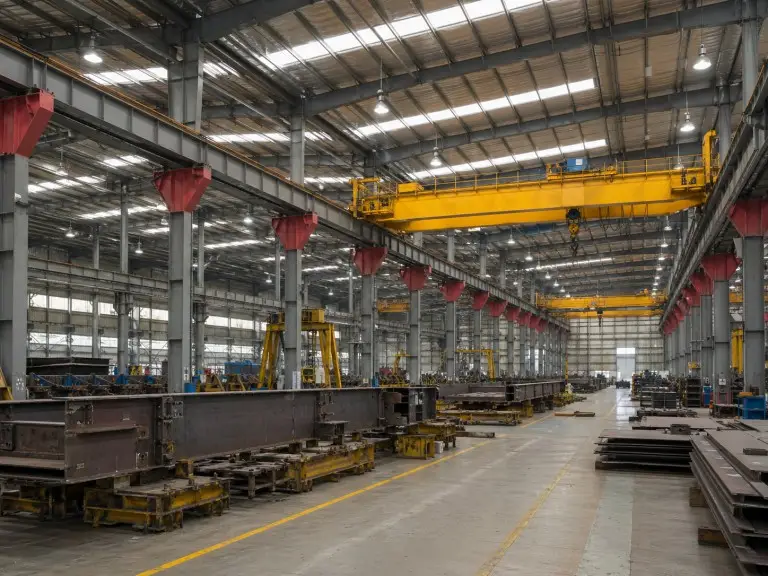
Steel Fabrication Plant — 50 T Crane Provisions
Two-span heavy fabrication plant for a steel structure manufacturer. Double-girder 50 T bridge crane provisions engineered into both primary spans from initial design. Column cross-sections and haunch brackets sized to carry combined static and dynamic crane loads. Bay spacing confirmed against production line layout before column grid was finalised.
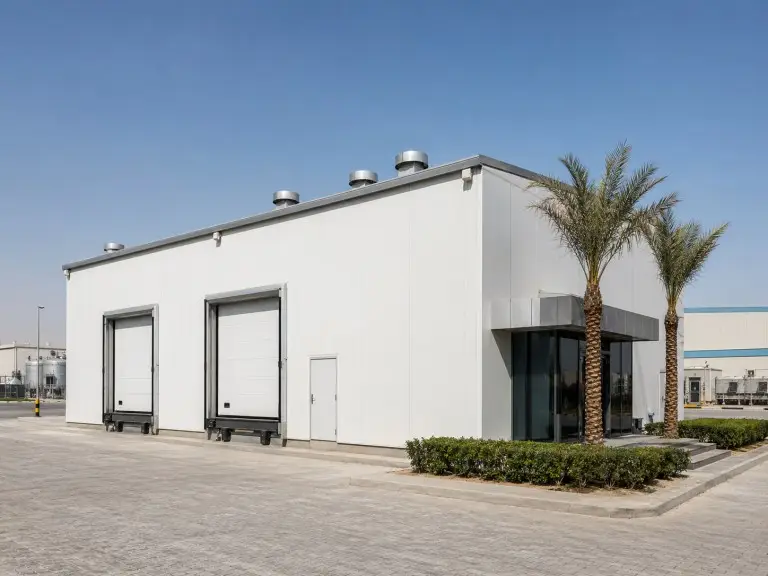
Food Processing & Packaging Facility
Single-span food processing building with hygiene-specific structural provisions: smooth closed-section members in production zones to prevent condensate accumulation, drainage channel provisions coordinated with slab design, and C4 chemical-resistant coating confirmed for cleaning agent exposure. Column grid aligned to the processing line layout before structural drawings were issued.
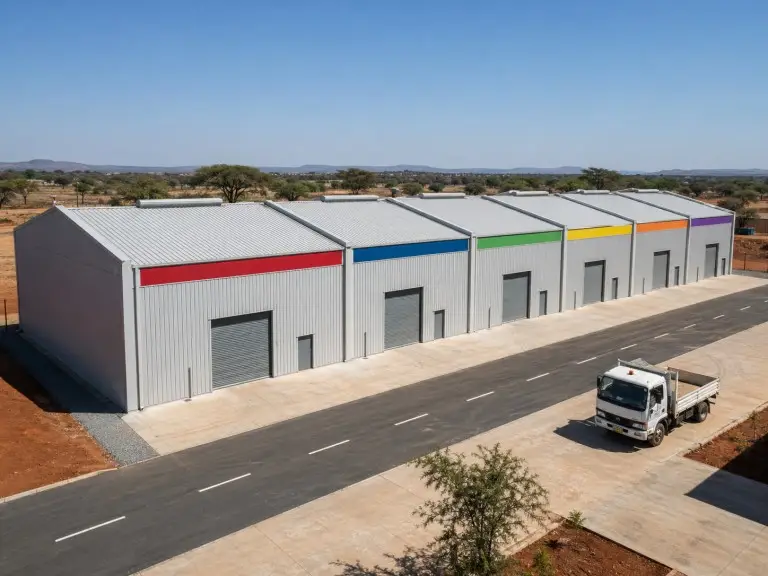
Multi-Bay Industrial Park — Phase 1 Complex
Six standardised heavy industrial units across a shared column grid for an industrial park developer. Replication confirmed before the first unit was fabricated: identical bay width, eave height, 10 T single-girder crane provision, and end-wall expansion provisions across all units. Subsequent phases fabricated against the same drawing set with site-specific load zone amendments only.
Project Fit
Who This Service Is Designed For — and Where It Is Not the Right Fit
- Mid-to-large heavy manufacturing plants and fabrication facilities — 1,000 m² single-span to multi-bay complexes exceeding 15,000 m²
- Processing and assembly facilities where column grid must be aligned to a preliminary process layout or equipment arrangement
- Food and beverage processing plants with hygiene-specific structural provisions and C3–C4 coating requirements
- Mining and resource processing auxiliary buildings in high-corrosivity environments requiring C4–C5 coating specification
- Energy sector auxiliary buildings — transformer halls, pump houses, switchgear buildings — with heavy equipment base provisions
- Industrial park developers building standardised multi-tenant production units for phased replication across a shared column grid
- Operators requiring a combined production and maintenance footprint — industrial buildings paired with an adjacent steel structure workshop under a single project scope
- Nuclear facilities, specialised chemical reactor containment structures, or facilities subject to government defence or strategic infrastructure procurement regimes imposing national sourcing requirements
- High-rise industrial towers requiring multi-storey reinforced concrete cores with integrated steel superstructure — hybrid engineering coordination outside our standard industrial delivery scope
- Projects requiring ASME, PED, or other pressure vessel or piping code compliance in structural interfaces — confirm documentation requirements before finalising scope, as these are distinct from our building system certifications
- Process equipment supply, mechanical and electrical systems installation, and interior fit-out — these follow structural installation and are outside our standard scope unless otherwise agreed in writing
Verified Project Outcomes
What Industrial Clients Say — and What the Projects Delivered
Engineering challenge, structural outcome, and client response are presented together so you can assess the result, not just the sentiment.
Manufacturing complex requiring two-span configuration with integrated overhead crane provisions in both bays. Production line layout was confirmed before structural design was finalised — bay spacing and crane beam positioning confirmed to eliminate column interference with the agreed equipment arrangement.
The relationship between production line layout and bay spacing is the most common source of structural rework in manufacturing facility projects. Bay spacing — the centre-to-centre column distance along the building length — directly determines where columns appear in the floor plan. If the production line layout is designed around a 9 m bay module and the structural design uses 6 m bays, the result is a column grid that conflicts with the equipment arrangement. We asked for the production line layout before finalising the bay spacing, confirmed that the 9 m module was required, and locked the structural grid accordingly. The production line was installed without a single structural conflict.
“Our production layout was fixed before KAFA designed the frame. They incorporated every equipment position and crane beam requirement without a single revision cycle.”
Industrial processing facility on a C3 corrosivity site near a chemical production zone. Surface treatment confirmed at scoping — C3 coating applied to all structural members before container packing, eliminating site-level corrosion remediation after delivery.
The corrosivity classification of an industrial site adjacent to a chemical production zone is determined not only by atmospheric chloride deposition but also by the specific chemicals produced and their airborne concentration profiles. For this site, the adjacent facility produced chlorine-based compounds at concentrations that elevated the site classification above standard C3. We requested the MSDS documentation for the adjacent facility’s primary process chemicals, confirmed the atmospheric concentration at the prevailing downwind boundary, and specified a primer system rated for the confirmed chemical environment — not the generic C3 classification. The structural coating was delivered to a defined chemical resistance specification, not a corrosivity grade alone.
“KAFA confirmed the C3 corrosivity requirement in the first technical exchange. The coating specification was locked into the design — we received a structure ready for this environment.”
Manufacturing Credentials
Certifications, Accreditations, and Production Capacity
KAFA’s production credentials are verified by independent third-party accreditation bodies against defined benchmarks for metal building system manufacturers — not self-declared.
ISO 9001:2015 Certified
Our quality management system covers the full production sequence — structural fabrication, surface treatment, and component inspection — against the ISO 9001:2015 standard. Each production batch is inspected before leaving the facility. Certification documentation provided on request for permit and client approval submissions.
IAS AC472 Accredited
Independent accreditation from the International Accreditation Service verifies our engineering documentation, production processes, and quality controls against defined benchmarks for metal building system manufacturers. Independently audited against IAS requirements — not self-certified.
20,000 m² Production Facility
Dedicated fabrication facility with over 500 production and engineering staff and a certified 2,000 MT monthly output. Industrial clients in manufacturing, processing, energy, and mining sectors across Africa, Southeast Asia, and the Middle East have engaged us where crane beam engineering, corrosion protection specification, and delivery programmes tied to production commissioning dates were prerequisites.
Frequently Asked Questions
Technical and Commercial Questions, Answered Directly
For single-storey and low-rise industrial buildings up to approximately 30 m clear span, pre-engineered steel frame construction offers faster erection, lower structural cost, and greater flexibility for future modification than concrete frame alternatives. Concrete construction requires sequential on-site pours and cure periods for each structural level, extending the programme significantly. Steel components arrive pre-fabricated and bolt together directly, reducing on-site construction risk and compressing the erection phase. Both systems can accommodate heavy crane loads and equipment foundation reactions — the programme and cost advantages of steel over concrete are most pronounced for single-storey heavy-span industrial buildings, which is where pre-engineered steel is the dominant choice globally.
For light crane systems up to approximately 10–15 tonnes, retrofitting crane provisions to an existing frame is sometimes feasible, depending on the original column section sizes and foundation design. For crane systems above 20 tonnes — and particularly for 30-tonne, 50-tonne, or heavier double-girder bridge cranes — the primary column section, bracket geometry, and foundation anchor bolt layout must be designed from the outset to carry the combined static and dynamic crane loads. Attempting to retrofit a heavy crane system to a frame not originally designed for it typically results in structural inadequacy requiring column replacement or reinforcement — both operationally disruptive and significantly more expensive than the original crane-integrated design. We treat crane capacity as a gating design input and will not issue structural drawings for an industrial building without confirming whether a crane is required.
Corrosion protection is specified based on the ISO 9223 corrosivity classification of the operating environment, determined by factors including ambient humidity, temperature cycling, exposure to chemical process media, proximity to coastal areas, and airborne contaminants such as ore dust, fertiliser, or cleaning agents. C1–C2 environments are dry indoor conditions with minimal chemical exposure. C3 covers industrial settings with moderate humidity and occasional chemical contact. C4 applies to high-humidity industrial environments with consistent chemical exposure, including food processing and coastal manufacturing. C5 applies to chemical, mining, and coastal facilities with aggressive chemical or salt-laden atmospheres. We confirm the corrosivity classification at requirements intake and specify the coating system accordingly. For C4 and C5 environments, the correct coating system at fabrication is substantially less expensive than remedial recoating under production conditions.
Bay spacing — the centre-to-centre column distance along the building’s length — determines where columns appear in the floor plan, which directly affects how process equipment, conveyors, material handling routes, and personnel pathways can be arranged. In a multi-bay industrial complex, the column grid must be planned concurrently with the preliminary process layout, not independently. We ask clients to share a preliminary equipment arrangement drawing or process flow diagram at requirements intake so that the column grid can be positioned to avoid interference with production line transfers, overhead crane coverage zones, and material handling corridors. A column grid that does not account for the process layout creates production constraints that persist for the operational life of the facility.
To produce an initial structural drawing and detailed price proposal within 3 business days, we need: industrial use type, building footprint dimensions and required bay configuration, overhead crane specification (rated load, crane span, duty class) or confirmation that no crane is required, heaviest single equipment weight and approximate foundation footprint if known, description of the corrosive environment, site country and city, and target operational start date. Equipment load data does not need to be finalised at this stage — preliminary estimates are sufficient for an initial structural concept and cost range, with final confirmation at the design sign-off stage.
Yes, provided the standardised unit design is confirmed before the first bay is fabricated. Industrial park developers who need a repeatable building module — a standard bay width, eave height, crane provision, and end-wall configuration that can be replicated across multiple tenants — benefit from declaring the replication requirement at the outset. The first unit’s structural drawings can be issued with end-wall provisions designed for expansion bay attachment, and subsequent bays can be fabricated against the same drawing set with only site-specific load zone amendments. This approach reduces both engineering cost per unit and fabrication variation across the park.
KAFA does not sell off-the-shelf industrial buildings at fixed prices from a catalogue. Every steel industrial building is custom-engineered to confirmed crane load, clear span, eave height, corrosivity classification, and use type. This ensures the structural frame, crane beam sizing, and surface treatment are correct for the specific operation from the outset — not a standard building adapted after manufacture. A detailed price proposal is delivered within 3 business days of confirmed use type, floor area, crane requirements, and site location.
Industrial steel construction refers to the engineering and fabrication of steel-framed structures designed for active industrial operations — manufacturing, processing, heavy equipment storage, and energy sector facilities — rather than passive storage. The key differences from standard warehouse construction are: overhead crane beam integration (requiring heavier columns and dedicated crane runway beam design), higher floor live load specifications (industrial process loads versus pallet racking loads), corrosivity coating selection driven by process media (chemicals, moisture, industrial gases) rather than ambient environment alone, and higher eave clearances to accommodate process equipment and crane lift heights. A warehouse and an industrial production facility may look similar from the outside; their structural engineering is fundamentally different.
Start Your Project
Drawings & Proposal in 3 Business Days
Share your industrial use type, building footprint and bay configuration, crane specification, any known equipment load data, site country and city, and your target commissioning date. Our engineering team responds with initial structural drawings and a detailed price proposal within 3 business days.
Submit Requirements Directly
Ready to Send Your Industrial Brief?
Submit your industrial building specifications — use type, footprint, bay configuration, crane rated load and duty class, corrosivity environment, and target commissioning date — and our team will prepare a detailed structural proposal without a preliminary call.