





Pre-Engineered Metal Airplane Hangars & Aircraft Hangar Buildings
KAFA designs, fabricates, and delivers prefab steel aircraft hangars for private operators, general aviation facilities, MRO maintenance centres, and agricultural aviation across Africa, Southeast Asia, the Middle East, and Oceania. The aircraft defines the building — wingspan, tail height, and body length are confirmed before a single structural member is sized.

Why Steel for Aircraft Hangars
Why Pre-Engineered Steel Dominates Aircraft Hangar Construction
Pre-engineered steel aircraft hangars deliver the clear-span column-free interiors, high eave clearances, and wide-opening door systems that aircraft maintenance and storage operations require. Concrete alternatives cannot achieve equivalent clear spans at comparable cost, and masonry structures cannot deliver the dimensional accuracy that aviation door systems and aircraft clearance envelopes demand. The structural requirements differ fundamentally from a standard steel structure workshop or industrial shed — aviation hangar engineering is a distinct discipline.
Because all structural members are fabricated to the confirmed span, height, and door system specification before leaving our facility, the on-site programme is compressed to erection and envelope installation. Aviation MRO operators with aircraft AOG considerations or lease commitments benefit from a weather-tight hangar within 45–60 days of steel delivery on-site.

Key Structural Advantages
- Clear spans from 18 m to 50 m+ — no interior columns obstructing aircraft movement or maintenance
- Eave heights engineered to aircraft tail clearance — not estimated from a default warehouse specification
- Hangar door system integrated into the primary frame — not a post-erection fit-out item
- Open-front end-wall wind loading engineered into the structural design — not a warehouse calculation
- Surface treatment matched to corrosivity class of the airport environment before fabrication
Start with the Aircraft
Aircraft Dimensions Determine Metal Hangar Building Structure — Not the Other Way Around
Three aircraft dimensions are structural design inputs that must be confirmed before any frame engineering begins. Each maps directly to a structural variable that cannot be adjusted after fabrication without re-engineering the primary frame.
Wingspan → Clear Span
Required interior clear span equals aircraft wingspan plus a safe working clearance margin — typically 1.5 m to 3 m per side depending on aircraft type and ground handling method. Wingspan alone is not the building width. A Cessna 172 (11 m wingspan) requires a minimum clear span of 14–17 m. A Beechcraft King Air C90 (16.6 m wingspan) requires 20–23 m minimum.
We calculate required clear span from confirmed aircraft dimensions. Do not use wingspan as the building width at any stage of the specification process.
Body Length → Building Depth
Overall aircraft length, multiplied by the number of aircraft to be stored simultaneously, determines minimum building depth. The layout of aircraft inside the hangar — nose-in or tail-in, single row or double row — affects how this calculation resolves. We confirm the intended parking layout at requirements intake before finalising building depth.
Multi-aircraft facilities with two rows of parking require a minimum building depth of approximately twice the aircraft length plus a central taxiway clearance.
Tail Height → Eave Clearance
Maximum tail height determines minimum eave clearance — the structural variable that is most consistently underspecified and most difficult to correct after construction. Raising eave height after the primary frame is fabricated requires new columns, modified rafters, and revised foundation anchor positions. Confirmed tail height clearance is a non-negotiable gate before any structural drawing is produced.
We treat unconfirmed tail height the same as an unconfirmed crane rated load: the structural drawing cannot proceed until the value is confirmed in writing.
| Aircraft Type | Wingspan | Min. Clear Span | Tail Height | Min. Eave Clearance |
|---|---|---|---|---|
| Cessna 172 | 11.0 m | 14 – 17 m | 2.7 m | 4.5 – 5.0 m |
| Beechcraft King Air C90 | 16.6 m | 20 – 23 m | 4.3 m | 6.0 – 6.5 m |
| Pilatus PC-12 | 16.2 m | 20 – 22 m | 4.3 m | 6.0 – 6.5 m |
| Cessna Citation CJ3 | 16.3 m | 20 – 23 m | 4.8 m | 6.5 – 7.0 m |
| Agricultural (Ag-Cat class) | 10 – 13 m | 14 – 18 m | 2.5 – 3.5 m | 4.5 – 5.5 m |
All figures are indicative references for planning purposes only. Confirmed aircraft dimensions must be provided at requirements intake — KAFA engineers clear span and eave clearance from the specific aircraft data, not from this table.
Door System Selection
Hangar Door Systems — Selection Criteria and Structural Integration
The hangar door system is the defining structural decision in an aircraft hangar project and must be selected before primary frame engineering begins. Hangar doors are not fit-out items — they are integrated into the primary frame design, with the door header beam, side columns, door track foundations, and end-wall all engineered around the specific door system and its load characteristics.
Hydraulic Bifold Doors
Fold upward in two leaves, with the outer leaf rising to near-horizontal and the inner leaf remaining partially vertical. Open quickly, require minimal apron clearance in front of the building, and are the preferred system for operational facilities where aircraft are moved frequently. Carry the highest structural load on the header beam.
Recommended for: MRO facilities, active GA hangars, private jet storage. Hydraulic drive system sourced and installed by the client unless otherwise confirmed.
Sliding Hangar Doors
Move laterally along bottom tracks and overhead guides to one or both sides of the opening. Impose lower structural loads on the header than bifold systems. Require apron clearance alongside the building equal to the door panel width — this must be confirmed against the available site footprint before door type is finalised.
Recommended for: Agricultural aviation hangars and single-aircraft private storage where sufficient apron run-out space is available and rapid access is not the primary requirement.
Mechanical Bifold Doors
Use a manual folding system without hydraulic actuation — suitable for smaller hangar openings, typically up to 20–25 m wide. Lower capital cost than hydraulic systems. Appropriate for smaller general aviation aircraft and agricultural aviation hangars in markets where hydraulic system maintenance availability is a practical concern.
Recommended for: Smaller GA and agricultural aviation hangars where lower capital cost is a priority and operational frequency is moderate.
Bottom-Rolling Doors
Run on floor-level tracks and are suited for wide, low-height openings where vertical clearance is constrained but horizontal span is large. Require level, well-maintained track foundations. Appropriate for configurations where tail height clearance is the primary design constraint rather than door opening width.
Recommended for: Wide-span hangars with restricted eave height where the tail height constraint is the primary structural driver and floor-track maintenance is manageable on-site.
Structural Specification Errors
Where Aircraft Hangar Projects Go Wrong — Three Errors to Eliminate at Intake
All three errors stem from the same root cause: treating a hangar as a large warehouse and applying general steel industrial buildings assumptions to a specialised aviation structure.
Error 1: Using Wingspan as Building Width
Required clear span exceeds aircraft wingspan by at least 3–6 m for single-aircraft hangars and more for multi-aircraft facilities with parallel parking. When buildings are ordered at wingspan dimension, the structure arrives on-site without sufficient clearance for safe aircraft movement.
Correcting insufficient clear span after fabrication is not a minor modification — it requires re-engineering of the primary frame, new columns, and revised foundation anchor positions. We calculate required clear span from confirmed aircraft dimensions and wingtip clearance standards before any structural drawing is issued.
Error 2: Omitting Tail Height at Design Stage
Door opening height — which must clear the aircraft’s tail — is the harder constraint to correct post-construction. Width can sometimes be increased with additional door panels; height requires raising the entire eave line. In engagements where clients provide wingspan and length but do not confirm tail height before design begins, the resulting building consistently cannot accommodate the aircraft’s tail without modification.
We request all three aircraft dimensions — wingspan, body length, and maximum tail height — at the first exchange, and flag any that are missing before producing structural drawings.
Error 3: Open-Front Wind Loading Not Accounted For
The end wall of a hangar — the wall containing the large door opening — is subject to significantly higher wind loading than a solid wall because the large opening changes the internal pressure dynamics under wind load. This affects column sizing, bracing layout, and foundation anchor design in ways that a standard warehouse structural calculation does not account for.
A hangar structural design that has not accounted for open-front wind loading carries a structural deficiency that is not visible until a wind event exposes it. Our hangar engineering process treats the open-front end wall as a separate loading condition from the outset.
How We Work
KAFA’s Delivery Process for Pre-Engineered Steel Hangars
Five defined stages from span and door specification through to weather-tight structure on-site.
Requirements Intake
Aircraft type and tail height, required clear span and eave height, door system type, crane provisions, site country, and target operational date.
Design & Quotation
Structural drawings including door system interface and crane beam layout, full BOM, and detailed price proposal within 3 business days.
Fabrication
All primary and secondary structural members fabricated and inspected under ISO 9001:2015. Surface treatment and modular container packing before export.
Logistics & Export
Container-packed structural components and export documentation coordinated to your port — aviation site logistics confirmed at scoping.
Installation
Erection by our team or a locally supervised crew. Weather-tight completion in approximately 45–60 days depending on span and door system complexity.
Timelines confirmed in writing at scoping based on project scale, production queue, and site conditions.
Our Delivery Process
Steel Building Design
Structural drawings and load calculations delivered within 3 business days from confirmed site dimensions, location, and intended use.
Metal Building Plans
Standard and custom floor plan configurations for warehouses, workshops, hangars, and industrial facilities across common clear-span ranges.
Metal Building Colors
Colour coating options for wall panels and roof sheets — including Colorbond-equivalent finishes and custom RAL matching for commercial projects.
Metal Building Components
Primary frames, secondary members, roof and wall cladding, gutters, doors, and windows — all fabricated in-house to ISO 9001:2015 standards.
Metal Building Insulation
PU, PIR, rock wool, and glass wool systems specified by climate zone — from tropical ambient buildings to cold storage facilities at −25 °C.
Metal Building Construction
45-day on-site erection programme from foundation handover to structural completion, covering anchor bolt setting, frame erection, and cladding.
Metal Building Foundation
Anchor bolt layout drawings, concrete grade and dimension requirements, and ±3 mm placement tolerances provided with every structural package.
Site Preparation
Ground levelling, drainage gradient, access road, and temporary power requirements confirmed before steel components leave the fabrication facility.
Metal Building Erection
6-stage installation sequence: foundation verification, column erection, rafter setting, bracing installation, cladding, and final handover inspection.
Project References
Aircraft Hangar Projects Delivered by KAFA
Representative examples across general aviation, agricultural aviation, and MRO facilities — spanning Sub-Saharan Africa, Southeast Asia, and the Middle East.

Private GA Hangar — Turboprop Storage
Single-bay hangar designed for a Beechcraft King Air C90 primary aircraft plus one light single-engine aircraft in parallel. Hydraulic bifold door specified for operational frequency. Eave height confirmed against tail height plus 2.2 m operating clearance. Door header and frame engineered to full hydraulic door load.
Agricultural Aviation Hangar — Crop-Dusting Fleet
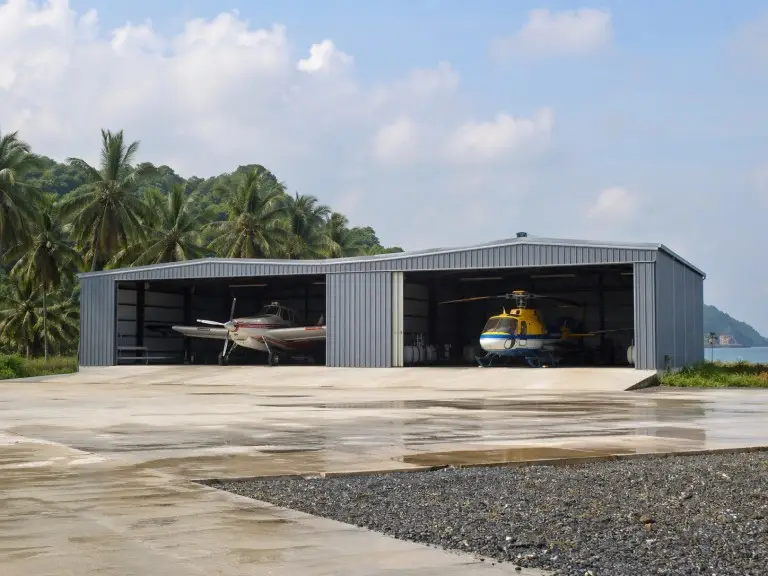
Two-bay agricultural hangar for a fleet of four Ag-Cat-class crop-dusting aircraft at a tropical coastal site. Sliding doors selected against site apron layout. C4 zinc-aluminium coating confirmed for coastal high-humidity corrosivity classification. Chemical storage room structural provision included in the primary frame.
MRO Maintenance Hangar — Light Business Jets
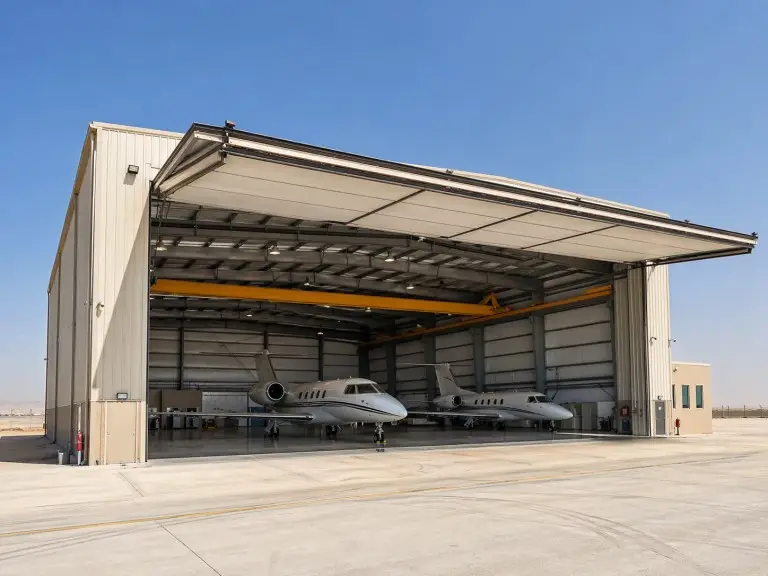
Single-bay MRO hangar with overhead crane beam rails integrated into the primary frame for engine and component maintenance hoists. Maintenance pit reservation coordinated with the structural foundation design. Hydraulic bifold door. Structural drawings submitted to local civil aviation authority with full load calculations and connection details.
Project Fit
Who This Service Is Designed For — and Where It Is Not the Right Fit
- Private aircraft owners and small airfield operators requiring single-bay hangars for single-engine to turboprop aircraft
- General aviation facilities housing light-to-medium aircraft — clear spans typically 18 m to 50 m
- MRO maintenance hangars for light-to-medium aircraft requiring overhead crane provisions and maintenance pit reservations
- Agricultural aviation operators in Africa and Southeast Asia storing crop-dusting aircraft and agricultural helicopters
- Government and institutional airfield developments requiring documented structural drawings suitable for civil aviation authority submission
- Projects in Africa, Southeast Asia, the Middle East, and Oceania where container shipping to a major port is viable and local erection capability is available on-site
- Large commercial airliner maintenance hangars requiring 80 m+ clear spans with integrated ground support systems, fire suppression infrastructure, and civil airside construction coordination
- Runway and taxiway construction, airfield lighting systems, and air traffic control infrastructure — confirm what KAFA can specifically supply before proceeding with a broader airfield project brief
- Military aviation facilities with classified or restricted specification requirements outside our standard documentation scope
- Projects where local civil aviation authority documentation requirements exceed ISO 9001:2015 and IAS AC472 — confirm documentation requirements before finalising scope, as local permitting compliance is the client’s responsibility
Verified Project Outcomes
What Aviation Clients Say — and What the Projects Delivered
Engineering challenge, structural outcome, and client response are presented together so you can assess the result, not just the sentiment.
MRO facility requiring 60 m clear span for aircraft tail clearance and 16 m structural clear height for maintenance platform access. Sliding hangar door system coordinated with structural frame before fabrication — door track and structural interface confirmed in design drawings submitted for CAA authority review.
Hangar door systems carry loads that affect the primary frame directly — the door track support structure must be engineered as part of the primary frame, not added as a post-erection bracket. For sliding doors of this size, the track is typically suspended from the eave beam or a dedicated door header beam that transfers load to the primary columns. We confirmed the door manufacturer’s track loading and interface geometry in the structural proposal and incorporated the door header into the primary frame fabrication. When the door contractor arrived on-site, the interface was ready — no drilling, no site fabrication, no delay.
“The span and height specifications were critical — any deviation would have failed our CAA approval. KAFA delivered both to the millimetre and coordinated the door system without any re-engineering.”
Aircraft maintenance base in a high-temperature arid environment requiring C3 surface treatment for long-term structural durability. HVAC provisions and electrical conduit routes were designed into the primary frame before fabrication — eliminating the need for post-erection penetrations through primary structural members.
Post-erection penetrations through primary structural members — columns, rafters, and eave beams — are a structural integrity risk that is almost entirely avoidable with pre-fabrication MEP coordination. The rule is simple: if a service needs to pass through a primary structural member, that penetration must be designed, reinforced, and fabricated at the factory stage. Field-drilled penetrations require structural assessment after the fact, often reveal that the member needs local reinforcement, and add cost and delay. We confirmed the HVAC duct routes and electrical conduit sizes from the project’s M&E drawings before finalising the structural fabrication drawings. Every required penetration was a designed feature, not a site modification.
“Every provision we asked for was designed into the frame before a single bolt was shipped. That level of pre-fabrication coordination is rare — and it shows in the finished structure.”
Manufacturing Credentials
Certifications, Accreditations, and Production Capacity
KAFA’s production credentials are verified by independent third-party accreditation bodies against defined benchmarks for metal building system manufacturers — not self-declared.
ISO 9001:2015 Certified
Our quality management system covers the full production sequence — structural fabrication, surface treatment, and component inspection — against the ISO 9001:2015 standard. Each production batch is inspected before leaving the facility. Certification documentation provided on request for permit submissions.
IAS AC472 Accredited
Independent accreditation from the International Accreditation Service verifies our engineering documentation, production processes, and quality controls against defined benchmarks for metal building system manufacturers. Independently audited — not self-declared.
20,000 m² Production Facility
Dedicated fabrication facility with over 500 production and engineering staff and a certified 2,000 MT monthly output. Our engineering team’s experience across coastal tropical, high-wind savanna, and seismically active environments means environmental loading parameters are designed for before fabrication — not discovered on-site.
Frequently Asked Questions
Technical and Commercial Questions, Answered Directly
The required interior clear span for a single-aircraft hangar is the aircraft wingspan plus a safe working clearance margin on each side — typically 1.5 m to 3 m per side, depending on aircraft type and ground handling method. For a Cessna 172 with an 11 m wingspan, a minimum clear span of 14–17 m is appropriate. For a turboprop such as a Beechcraft King Air C90 with a 16.6 m wingspan, a minimum clear span of 20–23 m is appropriate. For multi-aircraft storage, the required clear span depends on whether aircraft are parked wingtip to wingtip or with separation bays, and this layout must be confirmed at requirements intake. We calculate the required clear span from confirmed aircraft dimensions — do not use wingspan alone as the building width.
The choice between hydraulic bifold, sliding, mechanical bifold, and bottom-rolling door systems depends on four factors: door opening width and height required by the aircraft, available apron clearance alongside and in front of the building, required operational speed and frequency, and local availability of hydraulic system maintenance. Hydraulic bifold doors are recommended for high-frequency operational facilities and MRO hangars where speed of access matters and the structural and mechanical investment is justified. Sliding doors are the practical choice where apron run-out space is available and operational frequency is moderate. Mechanical bifold and bottom-rolling systems suit smaller openings and lower-frequency access patterns. Door type must be confirmed before structural engineering begins — it cannot be changed after the primary frame is fabricated.
An MRO maintenance hangar requires several structural provisions beyond standard aircraft storage: overhead crane beam rails integrated into the primary frame to support maintenance cranes or hoists; maintenance pit reservations in the concrete floor slab coordinated with the structural foundation design; aircraft jacking pad provisions; and in some cases, blast-resistant or fire-rated panel specifications for certain maintenance procedures. All of these must be declared at requirements intake, as they affect primary frame design, foundation layout, and fabrication scope.
For single-storey and low-rise aircraft hangars up to approximately 50 m clear span, pre-engineered steel frame construction is faster to erect and generally lower in total structural cost than reinforced concrete frame alternatives. Concrete construction requires sequential pours and cure periods for columns, beams, and roof structures, extending the construction programme significantly. Steel portal frame components arrive on site pre-fabricated and bolt together directly, compressing the erection phase to weeks. The critical structural difference is the open-front end wall: steel portal frame construction handles the elevated wind loads on an open-front hangar end wall through engineered frame sizing and bracing. Concrete construction can also accommodate this load, but the formwork complexity and programme length for a concrete hangar with a large open end wall make the cost premium substantial.
We produce structural drawings to internationally recognised engineering standards — including load calculations, connection details, anchor bolt plans, and erection drawings — that have been used as the basis for permit submissions in multiple African and Southeast Asian markets. Whether these drawings satisfy the specific documentation requirements of your national civil aviation authority, local building authority, or airfield operator depends on the regulations and standards applicable in your jurisdiction. Requirements vary significantly between countries and between civil and military aviation facilities. We recommend confirming your local documentation requirements before finalising scope, and we are available to discuss documentation needs during the initial inquiry stage.
All structural components are modularly packed and loaded into standard shipping containers for delivery to the client’s nominated destination port. We coordinate export documentation, container loading, and port-of-origin logistics. In-country customs clearance, import duty arrangements, port-to-site haulage, and any inland transport from port to airfield site are the client’s responsibility unless an alternative scope is confirmed in writing before production begins.
KAFA supplies fully engineered aircraft hangar kits — pre-fabricated structural components packed for container shipping, accompanied by structural drawings, connection details, anchor bolt plans, and erection documentation. Every kit is engineered to the confirmed aircraft dimensions, door system, and structural parameters of the specific project. We do not supply generic off-the-shelf hangar kits. The aircraft hangar kits we ship are project-specific: span, eave height, door type, and surface treatment are all confirmed before fabrication begins.
Start Your Project
Drawings & Proposal in 3 Business Days
Share your aircraft type and dimensions, number of aircraft to be stored, whether MRO provisions are required, your door type preference, site location, and target completion date. Our engineering team responds with initial structural drawings and a detailed price proposal within 3 business days.
Submit Requirements Directly
Ready to Send Your Hangar Brief?
Submit your hangar specifications — aircraft type, wingspan, tail height, body length, door type, site location, and target programme — and our team will prepare a detailed structural proposal without a preliminary call.