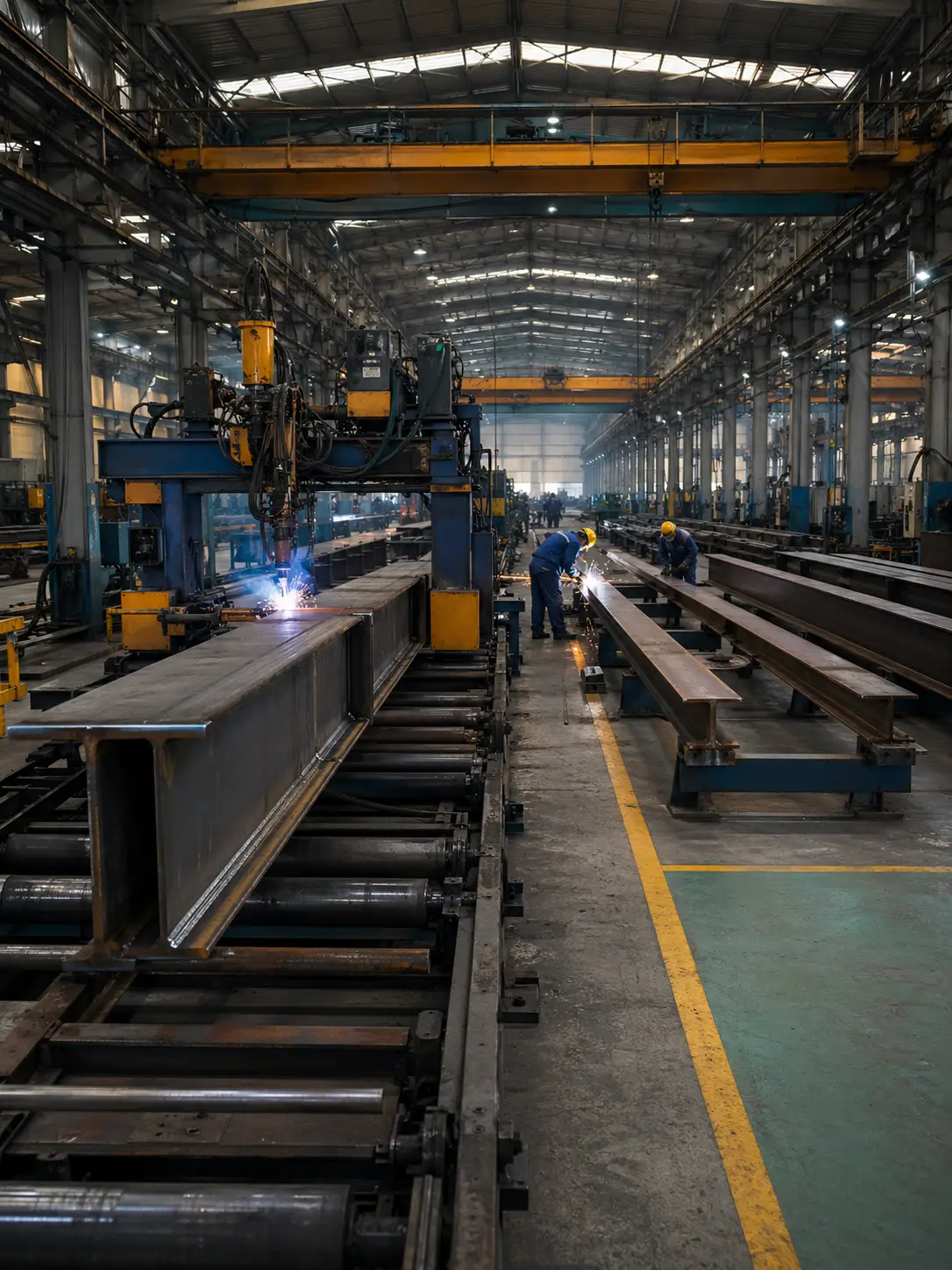





Pre-Engineered Commercial Metal Buildings for Retail, Office & Mixed-Use Development
KAFA engineers, fabricates, and ships prefab steel commercial buildings direct from our ISO 9001:2015-certified facility to your destination port — serving developers and operators across Africa, Southeast Asia, and the Middle East with initial structural drawings and a detailed price proposal in 3 business days.
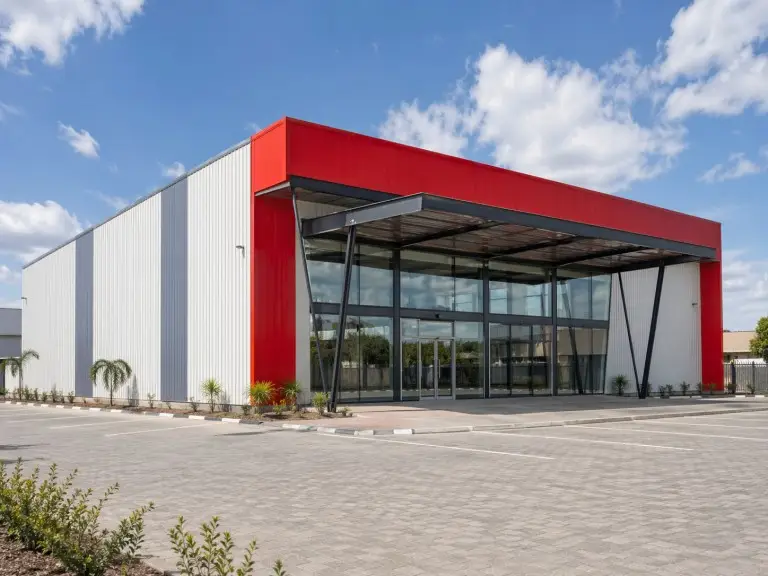
Why Steel for Commercial Buildings
Why Pre-Engineered Steel Outperforms Concrete Frame for Commercial Building Projects
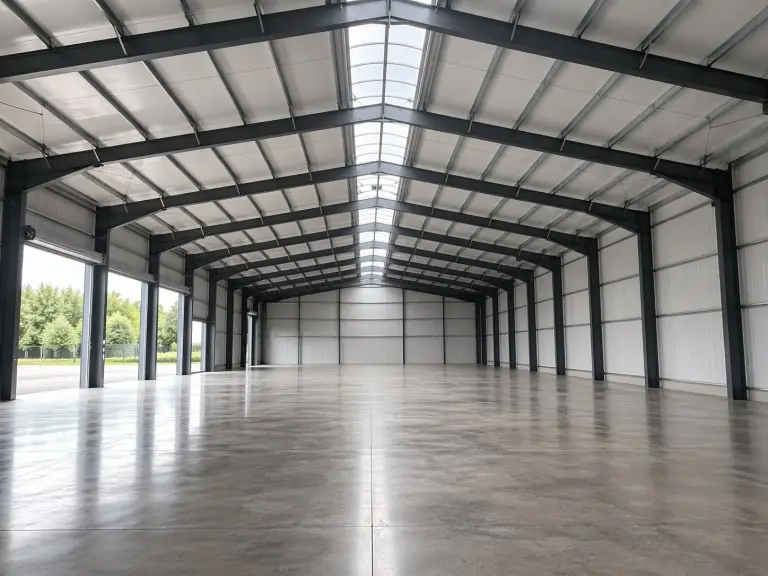
Pre-engineered steel commercial buildings deliver faster construction programmes, lower structural cost per square metre, and greater interior layout flexibility than reinforced concrete alternatives of equivalent footprint. For retail distribution, logistics, and commercial storage applications, clear-span column-free interiors from 20 m to 60 m+ eliminate the structural constraints that limit racking configuration, forklift routing, and future floor plan changes. The same structural system underpins metal office buildings, showrooms, and service centre developments across the same project footprint.
Because all structural components are fabricated off-site and shipped in modular containers, the on-site programme is reduced to foundation work, erection, and envelope installation. For commercial operators with lease commitments or tenant occupancy deadlines, a 45-day erection window versus a 6-to-9-month concrete pour has direct financial implications.
Key Structural Advantages
- Faster erection — structural steel components bolt together on-site without formwork or pour cycles
- Clear-span column-free interiors — unrestricted retail floor layout and future tenant reconfiguration
- Mezzanine floors, partitioning changes, and bay additions without structural constraint
- Factory-fabricated precision under ISO 9001:2015 — consistent quality across all structural members
- Container-shipped direct from manufacturer — no intermediary markup or supplier handoff
Design & Configuration
Facade, Interior Configuration, and Design Options
A well-specified prefab commercial building is structurally and aesthetically indistinguishable from a conventionally constructed retail or office facility. The distinction lies in how the structure is produced — not in what the finished building looks like.
Exterior Facade Options
Coloured steel wall panels in a range of profiles and finishes, glass curtain wall entrance sections, architectural canopies, and composite cladding combinations. Facade specification must be confirmed at requirements intake — it interacts directly with the structural frame design and panel attachment systems.
Roof Profile Selection
Single slope, double slope, or multi-span roof profiles selected based on site drainage requirements, interior height needs, and the visual character of the development. Translucent skylight strips provide natural daylighting for retail floor areas without compromising envelope weatherproofing.
Interior Column Grid & Bay Spacing
Column grid spacing — bay width and length — determines how retail units, office suites, or service bays can be arranged and partitioned. This must be confirmed at the design stage because it is locked into the structural frame. Bay spacing also determines whether future expansion bays can be added without modifying the original structure.
Mezzanine Floor Provisions
Mezzanine floors for offices above retail, storage above service areas, or split-level showrooms are available as configured structural options. Mezzanine provisions must be declared at the design stage — they require dedicated structural provisions in the primary frame and cannot be safely added as post-erection modifications.
Door Type & Positioning
Sliding doors, roller shutters, or glazed commercial entrance systems each affect the structural header above the opening and must be sized before the frame is engineered. Commercial entrance systems also interact with canopy and curtain wall design, which in turn affects the structural attachment points on the primary frame.
Phased Expansion Provisions
End-wall structural provisions, foundation sizing at expansion joints, and bay spacing along the building’s length must be designed to accommodate future bays from the outset. When expansion provisions are declared at the design stage, they add minimal cost to the original build. Retrofitting expansion connections after the original foundation slab is completed adds both cost and schedule impact.
How We Work
KAFA’s Delivery Process for Commercial Steel Buildings
Five defined stages from structural brief to installed structure — engineering, fabrication, and export under one certified process.
Requirements Intake
Floor area, eave height, clear-span requirement, racking configuration, door sizes, future expansion intent, site country, and target occupancy date.
Design & Quotation
Structural drawings, full component BOM, and detailed price proposal within 3 business days of confirmed site data and structural parameters.
Fabrication
All structural components manufactured under ISO 9001:2015 at our 20,000 m² facility. Batch inspection before surface treatment and modular packing.
Logistics & Export
Container-packed components and export documentation coordinated to your port of destination — confirmed timeline agreed at scoping.
Installation
Weather-tight erection in approximately 45 days for a standard single-span commercial building under 5,000 m². Scope confirmed at scoping.
Timelines confirmed in writing at scoping based on project scale, production queue, and site conditions.
Programme Reality
Where Commercial Steel Building Timelines and Budgets Go Wrong
Two consistent sources of project difficulty in commercial steel engagements — both preventable if addressed at requirements intake rather than discovered during the project.
The 45-Day Timeline Misread
The 45-day installation figure refers specifically to the on-site erection phase — from steel arriving on site to weather-tight structure completion for a standard single-storey building under 3,000 m². It does not include structural design (2–4 weeks), local authority permit approval (duration varies significantly across African and Southeast Asian markets), foundation construction, or interior fit-out.
We provide a full programme breakdown covering design, permit, foundation, erection, and fit-out phases as part of every initial proposal — so the commercial opening date is planned against the complete sequence, not a single-phase estimate.
Facade & Interior Specification Added Late
Buyers who specify a building on structural cost alone — without confirming facade finish, door type, and interior configuration upfront — frequently encounter scope additions during the design phase that affect both cost and fabrication lead time. Coloured wall panel selection, glass entrance sections, skylight positioning, and mezzanine provisions each interact with the primary structural design.
We request these parameters at requirements intake, not as post-engineering additions. The specification confirmed at inquiry is the specification that arrives on your site.
Local Permit Documentation Gaps
Structural drawing requirements for local authority permit submission vary significantly across different countries and municipalities in Africa and Southeast Asia. We produce structural drawings to internationally recognised engineering standards — but whether these satisfy your local permit office depends on your specific jurisdiction.
We recommend confirming local permit documentation requirements before finalising scope. Our engineering team is available to discuss documentation needs during the initial inquiry stage.
Our Delivery Process
Steel Building Design
Structural drawings and load calculations delivered within 3 business days from confirmed site dimensions, location, and intended use.
Metal Building Plans
Standard and custom floor plan configurations for warehouses, workshops, hangars, and industrial facilities across common clear-span ranges.
Metal Building Colors
Colour coating options for wall panels and roof sheets — including Colorbond-equivalent finishes and custom RAL matching for commercial projects.
Metal Building Components
Primary frames, secondary members, roof and wall cladding, gutters, doors, and windows — all fabricated in-house to ISO 9001:2015 standards.
Metal Building Insulation
PU, PIR, rock wool, and glass wool systems specified by climate zone — from tropical ambient buildings to cold storage facilities at −25 °C.
Metal Building Construction
45-day on-site erection programme from foundation handover to structural completion, covering anchor bolt setting, frame erection, and cladding.
Metal Building Foundation
Anchor bolt layout drawings, concrete grade and dimension requirements, and ±3 mm placement tolerances provided with every structural package.
Site Preparation
Ground levelling, drainage gradient, access road, and temporary power requirements confirmed before steel components leave the fabrication facility.
Metal Building Erection
6-stage installation sequence: foundation verification, column erection, rafter setting, bracing installation, cladding, and final handover inspection.
Project References
Commercial Building Projects Delivered by KAFA
Representative examples across retail, mixed-use, and modular commercial park development — spanning Sub-Saharan Africa, Southeast Asia, and the Middle East.
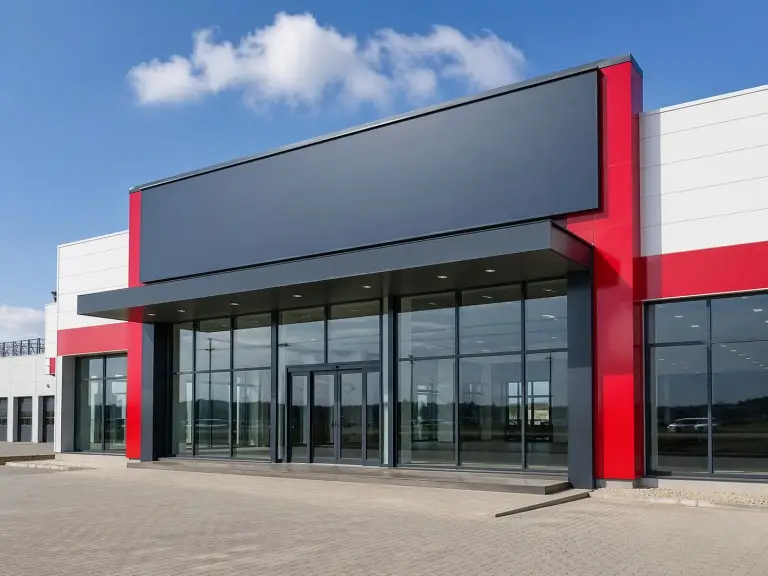
Auto Dealership & Service Centre
Single-storey showroom with mezzanine office level and attached service workshop. Glazed curtain wall entrance confirmed at design stage alongside roller shutter service access doors. Facade specified in brand colours using pre-painted steel panels in matching RAL reference.
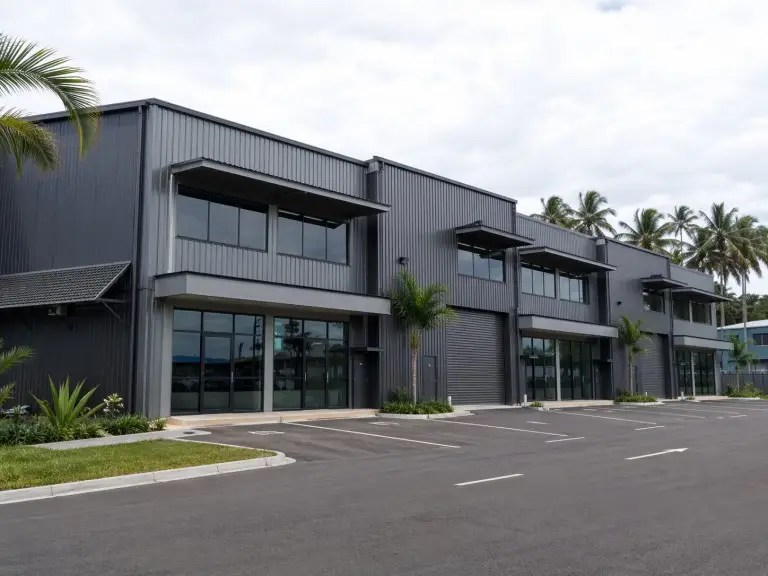
Modular Business Park — Phase 1
Twelve commercial units in a shared structural grid for a phased business park development. Uniform bay spacing across all units with end-wall expansion provisions designed into Phase 1 to accommodate Phase 2 additions without structural re-engineering or slab modification.
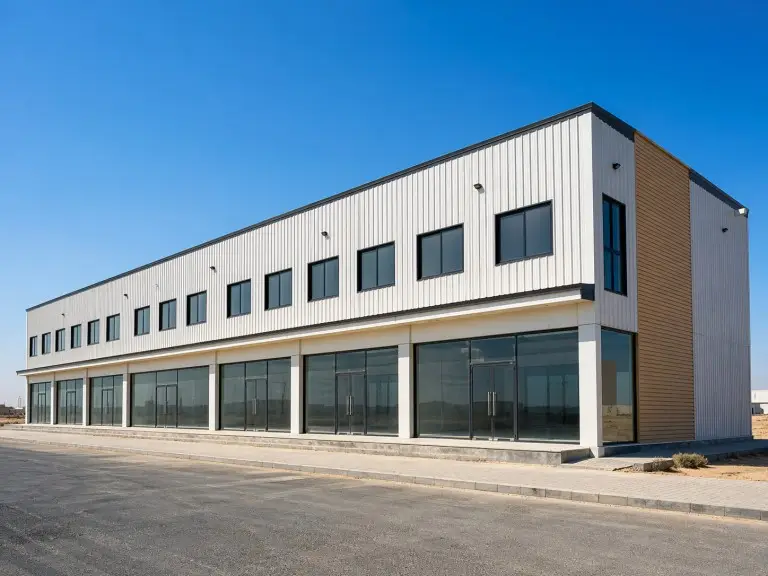
Ground-Floor Retail with Mezzanine Office
Mixed-use two-level commercial building for a property developer. Ground floor retail strip with full-width glazed shopfront; mezzanine office level above rear half of the footprint. Structural drawings submitted to local authority at design stage with load calculations and connection details.
Project Fit
Who This Service Is Designed For — and Where It Is Not the Right Fit
- Single-storey and low-rise retail stores, showrooms, and commercial service centres up to three storeys
- Auto dealerships and auto service facilities with combined showroom and workshop footprints
- Mixed-use ground-floor retail with mezzanine office — 300 m² to 5,000 m² total floor area
- Modular commercial buildings for business park and industrial park developments with phased expansion provisions
- Community and civic facilities including steel church buildings, prefab shop buildings, and commercial strip market complexes
- Developers combining commercial units with adjacent steel structure warehouses for combined retail and storage operations
- Projects in Africa, Southeast Asia, and the Middle East where container shipping to a major port is available and local erection crews can be engaged on-site
- High-rise commercial buildings above four storeys requiring a reinforced concrete core structurally integrated with a steel superstructure — hybrid engineering coordination is outside our standard commercial delivery scope
- Residential apartment buildings — outside our standard scope regardless of structural system
- Projects requiring mandatory fire-rated compartmentation using non-combustible panel systems beyond our standard envelope specification — confirm local code requirements before finalising scope
- Jurisdictions where structural certification requirements exceed ISO 9001:2015 and IAS AC472 — local permitting compliance is the client’s responsibility and should be confirmed before design begins
Verified Project Outcomes
What Commercial Building Clients Say — and What the Projects Delivered
Engineering challenge, structural outcome, and client response are presented together so you can assess the result, not just the sentiment.
Distribution centre requiring high-bay racking configuration to 9 m and a clear-span interior for full-width forklift movement. A late-stage drainage routing change was identified after erection began — resolved on-site by the KAFA installation team without programme extension.
High-bay racking installations are one of the most common sources of post-erection structural conflict in distribution centre projects. The racking uprights carry point loads to the floor slab that must be confirmed at the structural design stage — if the slab thickness and reinforcement are designed around a different load distribution, the racking layout is constrained. We confirmed the racking supplier’s upright grid and maximum point load before finalising the floor slab specification in our structural proposal. The result is a slab designed for the actual racking — not a generic warehouse assumption.
“We engaged KAFA to construct our new regional distribution centre and were thoroughly impressed. The project completed on time and the team resolved a late-stage drainage change without schedule impact.”
Two-span warehouse development for a free trade zone developer with multiple tenant configuration requirements. C3 corrosivity environment driven by proximity to an industrial port — surface treatment confirmed at scoping and applied at fabrication, eliminating the need for site-level upgrade.
Two-span structures reduce structural steel volume by 15–20% compared to two independent single-span buildings of equivalent total area, because the shared centre column eliminates two end-frame column-rafter assemblies. The saving is real but comes with a constraint: the centre column is a permanent interior element. If tenants require clear-span access across both bays in future, the only structural option is a full re-engineering exercise. We confirmed the tenant requirement — and the permanent column position — with the developer before locking the structural layout. The developer chose two-span with eyes open to the constraint.
“KAFA delivered exactly what was agreed. The two-span configuration gives our tenants the floor flexibility they need. C3 coating was specified from the outset — no surprises on delivery.”
Manufacturing Credentials
Certifications, Accreditations, and Production Capacity
KAFA’s production credentials are verified by independent third-party accreditation bodies against defined benchmarks for metal building system manufacturers — not self-declared.
ISO 9001:2015 Certified
Our quality management system covers the full production sequence — structural fabrication, surface treatment, and component inspection — against the ISO 9001:2015 standard. Each production batch is inspected before leaving the facility.
IAS AC472 Accredited
Independent accreditation from the International Accreditation Service verifies our engineering documentation, production processes, and quality controls against defined benchmarks for metal building system manufacturers. Independently audited.
20,000 m² Production Facility
Dedicated fabrication facility with over 500 production and engineering staff and a certified 2,000 MT monthly output. Commercial clients across retail, industrial park development, and institutional sectors in Southeast Asia, Africa, and the Middle East have engaged us for projects with opening-date programme commitments.
Frequently Asked Questions
Technical and Commercial Questions, Answered Directly
For single-storey and low-rise commercial buildings up to three storeys, pre-engineered steel frame construction is generally faster to erect and lower in structural cost per square metre than reinforced concrete frame alternatives. Concrete construction requires sequential on-site pours, cure periods, and formwork cycles that add weeks to the structural programme. Steel components arrive on site pre-fabricated and bolt together directly, compressing the erection phase. The cost difference depends on building size, specification, local labour costs, and steel and concrete material prices in the project country — a direct comparison should be confirmed during scoping with local cost data for your specific market.
Yes. Facade finish is independent of the structural system. KAFA commercial buildings can be clad with coloured steel wall panels, glass curtain wall entrance sections, composite cladding, and architectural canopies — producing a finished exterior that reflects the commercial identity of the development rather than the industrial appearance sometimes associated with basic metal sheds. Facade specification must be confirmed at the requirements intake stage because it interacts with the structural frame design and panel attachment systems.
The 45-day figure refers to the on-site erection and installation phase only — from steel components arriving on site to weather-tight structure completion for a standard single-storey building under 3,000 m². It does not include structural design and drawing production, local authority permit approval, foundation construction, or interior fit-out. A complete commercial project programme — covering all phases from design sign-off to occupancy — should be planned before a commercial opening date is committed. We provide a full programme breakdown as part of every initial proposal.
To produce an initial structural drawing and detailed price proposal within 3 business days, we need: building use type, site footprint dimensions, number of storeys, required interior clear height, facade and door type preferences, mezzanine floor requirements if any, expansion provisions if phased development is planned, target country and city (for wind, snow, and seismic load zone confirmation), and target completion date. The more complete this information is at the first exchange, the more accurate the initial proposal will be.
We produce structural drawings to internationally recognised engineering standards that include load calculations, connection details, anchor bolt plans, and erection drawings. Whether these drawings meet the specific documentation requirements of your local building authority depends on the regulations of your jurisdiction — requirements vary significantly across different countries and municipalities in Africa and Southeast Asia. We recommend confirming your local permit documentation requirements before finalising scope, and we are available to discuss documentation needs during the initial inquiry stage.
Yes, provided expansion provisions are declared at the design stage. End-wall structural provisions, foundation sizing at expansion joints, and bay spacing along the building’s length must be designed to accommodate future bays from the outset. Retrofitting expansion connections after the original foundation slab is completed adds both cost and schedule impact to the expansion phase. We ask clients to declare phased expansion intent at requirements intake so structural provisions can be incorporated into the original design at minimal additional cost.
The 45-day figure refers to the on-site erection and installation phase only — from steel components arriving on site to weather-tight structure completion for a standard single-storey building under 3,000 m². It does not include structural design and drawing production, local authority permit approval, foundation construction, or interior fit-out. A complete commercial project programme covering all phases should be planned before a commercial opening date is committed.
KAFA supplies fully detailed commercial steel building kits — pre-fabricated structural components packed for container shipping, accompanied by structural drawings, connection details, anchor bolt plans, and erection documentation. The kit is designed for assembly by a qualified local erection crew under our technical supervision. We do not supply flat-pack or generic frame kits; every kit is engineered to the confirmed structural parameters of your specific project.
Start Your Project
Drawings & Proposal in 3 Business Days
Share your building use, site footprint, number of storeys, target country and city, facade requirements, and preferred completion date. Our engineering team responds with initial structural drawings and a detailed price proposal within 3 business days.
Submit Requirements Directly
Ready to Send Your Project Brief?
Submit your commercial building specifications — use type, footprint, storeys, facade preferences, mezzanine requirements, expansion provisions, and target programme — and our team will prepare a detailed structural proposal without a preliminary call.