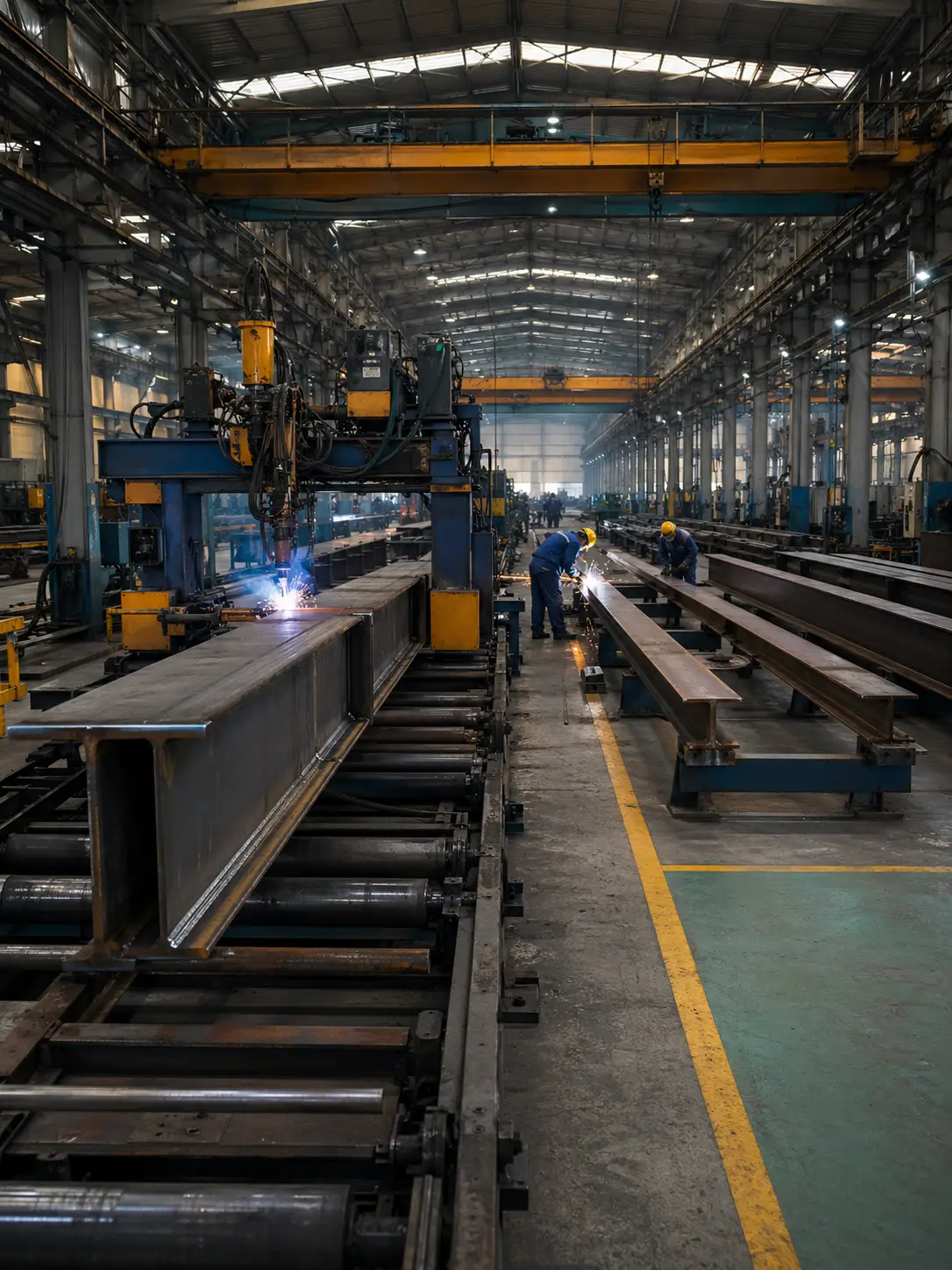





Pre-Engineered Steel Church Buildings & Prefab Worship Structures
KAFA engineers, fabricates, and ships prefab steel church buildings direct to destination port for growing congregations across Africa and Southeast Asia. Gabled and arch profiles, column-free sanctuary interiors, tropical insulation specification, and weather-tight structure in approximately 45 days from steel on-site.
Steel vs Brick & Concrete
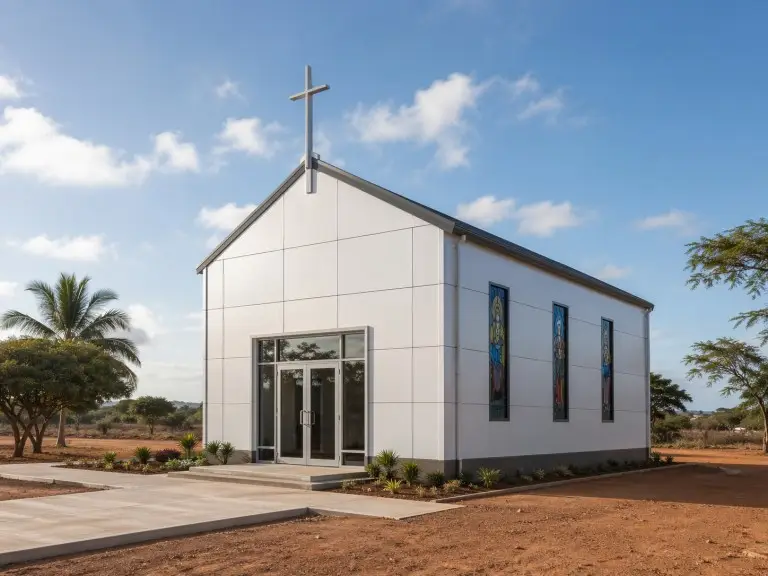
Why Steel Church Construction Outperforms Brick and Concrete for Growing Congregations
A pre-engineered steel church building typically costs 30–50% less per square metre than an equivalent brick or concrete structure of the same floor area and interior height. For congregations building in Sub-Saharan Africa and Southeast Asia — where construction timelines are constrained by seasonal rainfall or limited local contractor capacity — the cost and programme difference between steel and masonry is a practical decision, not a preference.
Design for Worship
Appearance, Acoustics, and Thermal Comfort for Metal Church Buildings — Confirmed at Design Stage
The three variables that determine whether a steel church building serves its congregation well from the day it opens must all be confirmed before fabrication begins. Treating any of them as interior finishing decisions made after the structure is erected consistently leads to costly remediation.
Exterior Appearance
Gable profiles read as traditional church forms; Gothic arch configurations deliver the ecclesiastical silhouette; white or warm-toned wall panels project dignity rather than industrial character. Stained-glass openings, entrance glazing, and gable-apex cross mounting are standard provisions when declared.
Roof geometry and panel system are fabricated to the confirmed profile — it cannot be re-specified on site.
- Exterior style: contemporary · traditional gable · arch profile
- Facade panel type, colour, and finish
- Entrance glazing and stained-glass openings
- Cross mounting points at gable apex
Acoustic Design Factors
Interior clear height, roof pitch angle, and interior wall surface finish all affect speech intelligibility and musical resonance during worship. A ceiling too low produces flat, uninspiring acoustics; one too high without treatment produces echo that reduces spoken-word clarity.
Clear height and roof pitch are structural variables — acoustic treatment is a fit-out follow-on that depends on them.
- Interior clear height at eaves and ridge
- Roof pitch angle
- Surface provisions for wall/ceiling panelling
- Platform-end height allowance for AV equipment
Thermal Comfort — Tropical Climates
An uninsulated steel roof in a tropical climate absorbs solar radiation and radiates heat into the interior during daylight hours. An uninsulated steel church in West Africa, East Africa, the Philippines, or Indonesia will be uncomfortably hot during services — a material barrier to congregational growth, not a minor inconvenience.
Insulation cost at fabrication is a fraction of post-construction retrofit — and defines the sandwich-panel build itself.
- Roof insulation: rock wool or glass wool, thickness specified
- Wall insulation specification for sanctuary envelope
- Inner liner panel system between structure and interior
- Ventilation and ridge-vent provisions
How We Work
KAFA’s Delivery Process for Steel Church Buildings
Five defined stages from structural brief to installed building — one team from design through export and erection.
Requirements Intake
Floor area, eave height, clear-span intent, insulation requirements, skylight coverage, door sizes, site country, and target dedication date.
Design & Quotation
Structural drawings, insulation schedule, skylight layout, and detailed price proposal within 3 business days of confirmed parameters.
Fabrication
All structural components manufactured and ISO 9001:2015 inspected at our 20,000 m² facility. Surface treatment and container packing before shipment.
Logistics & Export
Modular container packing and export documentation coordinated to your destination port in Africa, Southeast Asia, or the Pacific.
Installation
Erection by our team or a locally supervised crew. Weather-tight completion in approximately 35–45 days for standard single-span worship buildings.
Timelines confirmed in writing at scoping based on project scale, production queue, and site conditions.
Specification Errors to Avoid
Where Prefab Church Building Projects Encounter Avoidable Problems
The errors that cause steel church buildings to underperform their design intent follow consistent patterns — all avoidable if the relevant design parameters are confirmed before fabrication.
Building for Current Congregation, Not Future Growth
Ordering a building primarily on available budget without confirming congregation capacity — producing a structure too small for the congregation within two to three years of completion. The required floor area is a function of seating and arrangement, and must be calculated before the structural footprint is set.
We size the frame to the 5-to-7-year projection, not current attendance. Planning reference: 0.75–0.9 m² per person for fixed pews, ~1.0 m² for moveable chairs. See the capacity reference table below for standard span and floor-area combinations.
Ordering in a Tropical Climate Without Insulation
Thermal discomfort typically surfaces during the first hot season after the building opens — not during procurement. Building committees in Nigeria, the Philippines, and other high-temperature markets often assumed insulation was an interior finishing item and ordered without it.
Thermal comfort is a required design discussion for all tropical-climate projects before structural drawings are issued. Insulation specified at fabrication is substantially cheaper than post-construction retrofit — and the impact on congregational growth is material.
Underspecifying the Platform and Stage Area
Worship bands, audio-visual equipment, and stage lighting are now standard in many evangelical and Pentecostal settings across Africa and Southeast Asia. Structural height at the platform end, cable management provisions, and mezzanine or choir loft requirements must be declared at the design stage — they cannot be cost-effectively modified after fabrication.
We confirm platform dimensions, stage height, choir loft provisions, and cable routing at requirements intake — before any structural drawing is produced. Frame geometry is fixed to these inputs rather than to a generic template.
Sanctuary capacity planning — floor area and clear-span by congregation size
| Congregation Size | Fixed Pew Seating (0.85 m²/person) | Moveable Chairs (1.0 m²/person) | Typical Clear Span |
|---|---|---|---|
| 100 people | ~85 m² sanctuary | ~100 m² sanctuary | 12 – 15 m |
| 200 people | ~170 m² sanctuary | ~200 m² sanctuary | 15 – 20 m |
| 300 people | ~255 m² sanctuary | ~300 m² sanctuary | 18 – 24 m |
| 500 people | ~425 m² sanctuary | ~500 m² sanctuary | 24 – 30 m |
| 1,000 people | ~850 m² sanctuary | ~1,000 m² sanctuary | 30 – 40 m |
Sanctuary floor area figures exclude platform, entry vestibule, fellowship hall, offices, and classrooms. All figures are planning references — confirmed congregation capacity and layout must be provided at requirements intake before structural drawings are produced.
Our Delivery Process
Steel Building Design
Structural drawings and load calculations delivered within 3 business days from confirmed site dimensions, location, and intended use.
Metal Building Plans
Standard and custom floor plan configurations for warehouses, workshops, hangars, and industrial facilities across common clear-span ranges.
Metal Building Colors
Colour coating options for wall panels and roof sheets — including Colorbond-equivalent finishes and custom RAL matching for commercial projects.
Metal Building Components
Primary frames, secondary members, roof and wall cladding, gutters, doors, and windows — all fabricated in-house to ISO 9001:2015 standards.
Metal Building Insulation
PU, PIR, rock wool, and glass wool systems specified by climate zone — from tropical ambient buildings to cold storage facilities at −25 °C.
Metal Building Construction
45-day on-site erection programme from foundation handover to structural completion, covering anchor bolt setting, frame erection, and cladding.
Metal Building Foundation
Anchor bolt layout drawings, concrete grade and dimension requirements, and ±3 mm placement tolerances provided with every structural package.
Site Preparation
Ground levelling, drainage gradient, access road, and temporary power requirements confirmed before steel components leave the fabrication facility.
Metal Building Erection
6-stage installation sequence: foundation verification, column erection, rafter setting, bracing installation, cladding, and final handover inspection.
Project References
Steel Church Building Projects Delivered by KAFA
Representative examples across single-span sanctuaries, multipurpose worship halls, and campus expansion buildings — spanning West Africa, East Africa, and Southeast Asia.
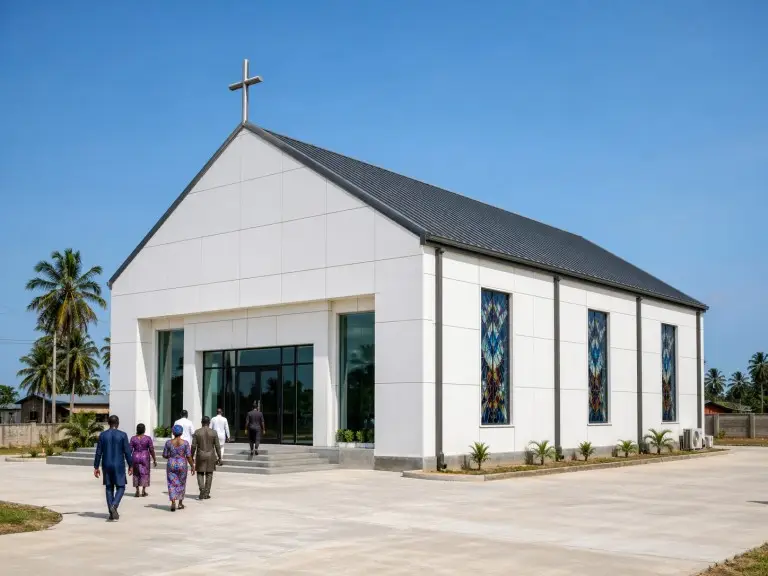
Evangelical Worship Sanctuary — 500-Seat Capacity
Single-span sanctuary designed for a 500-seat congregation with moveable chairs, raised platform with choir loft provision, and side-wall window openings framed for decorative panels. Gable roof profile with steeper 20° pitch. Rock wool insulation specified as a required design provision for tropical climate. Cross mounting point at gable apex.
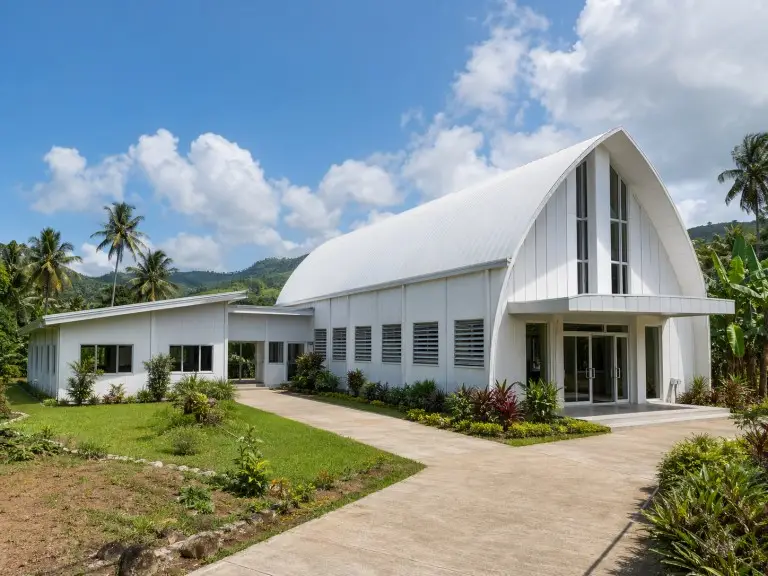
Multipurpose Worship & Community Hall
Two-span structure combining a 300-seat sanctuary and a separate fellowship hall under a single connected roof. Gothic arch roof profile on the sanctuary span. Glass wool insulation throughout for tropical climate thermal management. Side-wall louvres for natural ventilation confirmed as structural provisions. Expandable end-wall framing for a future classroom block.
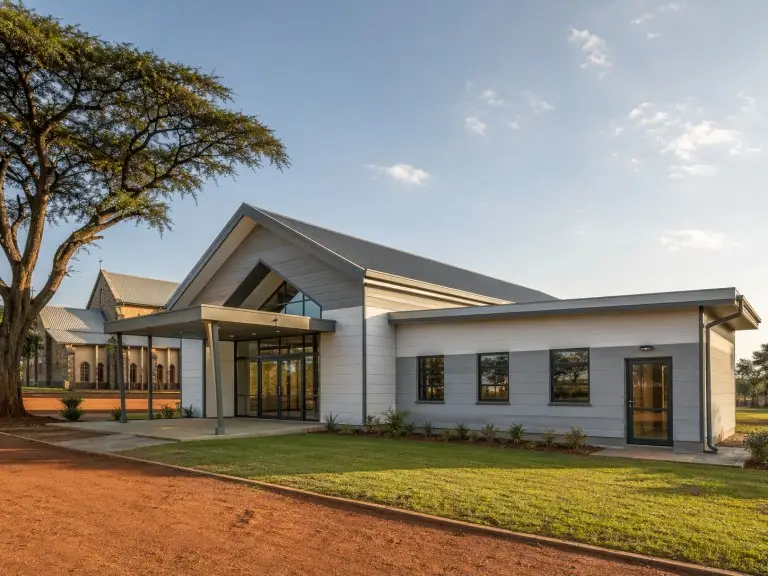
Church Campus Expansion — Chapel & Pastoral Offices
Campus expansion building alongside an existing main sanctuary. Single-span structure combining a 150-seat satellite chapel with pastoral offices and a Sunday school classroom block. Contemporary roof profile matching the existing building eave height. Glazed entrance section on the street-facing facade. Insulation specified as a required provision for the highland tropical climate zone.
Project Fit
Who This Service Is Designed For — and Where It Is Not the Right Fit
- Growing congregations in Nigeria, Kenya, Ghana, Uganda, the Philippines, Indonesia, Papua New Guinea, and other African and Southeast Asian markets requiring a permanent dignified worship facility
- Single-span sanctuaries for congregations of 100 to 1,000 — sanctuary floor areas from 300 m² to 2,000 m²
- Multipurpose buildings combining a worship hall and fellowship hall under one roof
- Satellite church buildings and chapels for secondary congregations
- Church campus expansions adding classrooms, pastoral offices, or covered gathering space alongside an existing main building
- Mission organisations and community development bodies establishing multipurpose worship and community centres
- Projects requiring reinforced concrete domes, bell towers structurally integrated with a masonry campanile, or multi-storey religious complexes combining a sanctuary with residential quarters in a load-bearing concrete frame
- Interior acoustic design — we confirm the structural variables that affect acoustics, but acoustic engineering for wall panelling, ceiling treatment, and sound system specification is the client’s responsibility
- Interior fit-out scope including seating, audio-visual systems, floor finishing, electrical, and plumbing — unless otherwise confirmed in writing during scoping
- Projects with specific local regulatory requirements for fire safety compartmentation, occupancy load ratings, or structural certification standards — local permit compliance is the client’s responsibility and varies across jurisdictions
Verified Project Outcomes
What Community Building Clients Say — and What the Projects Delivered
Engineering challenge, structural outcome, and client response are presented together so you can assess the result, not just the sentiment.
Worship centre requiring a clear-span interior for unobstructed congregation seating and an unobstructed platform area. Acoustic insulation specified as a configured add-on — rock wool system selected for thermal and sound attenuation. Construction window constrained by the start of the wet season.
Clear-span portal frames for worship spaces require the same structural engineering as any other column-free building — what changes is the load case. A congregation floor under dynamic loading from a large seated assembly has a different vibration frequency response than a static warehouse floor. We apply a dynamic load factor to the primary frame design for any assembly occupancy application, which affects rafter depth and connection sizing marginally but is the difference between a structure that meets occupancy loading requirements and one that passes static loading only. For a worship centre expecting regular full-capacity occupancy, the distinction is not academic.
“KAFA understood what a worship space needs structurally. The clear span and insulation specification were both confirmed in the first meeting — and delivered exactly as agreed.”
Multi-purpose complex combining a main hall with ancillary community rooms under one structural roof. Future expansion bay declared at design stage and incorporated into the anchor bolt layout at no additional cost. Skylight system covering 12% of roof area specified to reduce artificial lighting during daytime services.
The 12% skylight coverage figure is not arbitrary — it is calculated from the building’s floor area, the glazing transmittance of the skylight panel, and the target maintained illuminance level for the occupancy type. A worship space requires higher maintained illuminance than a warehouse but lower than an office or classroom. The skylight calculation confirmed that 12% coverage with a standard double-skin polycarbonate panel achieves the target illuminance on a clear tropical day without supplementary artificial lighting. Below 10%, the illuminance falls short on overcast days. Above 15%, solar heat gain becomes a thermal comfort issue in a non-air-conditioned space.
“The expansion bay KAFA designed into the original structure saved us a significant re-engineering cost when we added the community hall two years later. That foresight was invaluable.”
Manufacturing Credentials
Certifications, Accreditations, and Production Capacity
KAFA’s production credentials are verified by independent third-party accreditation bodies against defined benchmarks for metal building system manufacturers — not self-declared.
ISO 9001:2015 Certified
Our quality management system covers the full production sequence — structural fabrication, surface treatment, and component inspection — against the ISO 9001:2015 standard. Each production batch is inspected before leaving the facility.
IAS AC472 Accredited
Independent accreditation from the International Accreditation Service verifies our engineering documentation, production processes, and quality controls against defined benchmarks for metal building system manufacturers. Independently audited.
20,000 m² Production Facility
Dedicated fabrication facility with over 500 production and engineering staff and a certified 2,000 MT monthly output. Our engineering team’s experience across tropical, high-humidity, and high-wind environments means climate-specific requirements are confirmed during design — not discovered after the building is occupied.
Frequently Asked Questions
Technical and Commercial Questions, Answered Directly
Yes. The exterior appearance of a steel church building is determined by facade specification choices made at the design stage, not by the structural system. Gable roof profiles with steeper pitches, gothic arch roof configurations, white or warm-toned coloured wall panels, glazed entrance sections, decorative window openings sized for stained-glass inserts, and cross mounting provisions at the gable peak all contribute to an exterior that reads as a place of worship. The structural system is steel portal frame; the appearance is defined by the envelope. We recommend discussing exterior style preference — contemporary, traditional gable, or arch profile — at the requirements intake stage.
A general planning reference for sanctuary seating area is 0.75–0.9 m² per person for fixed pew seating, or approximately 1.0 m² per person for moveable chair arrangements including circulation space. For a congregation of 200, this suggests a sanctuary floor area of approximately 150–200 m², not including the platform, entry vestibule, and any secondary spaces such as a fellowship hall, offices, or classrooms. We recommend planning for the congregation size anticipated within five to seven years of building completion, not only the current active attendance, and confirming the layout with the building committee before structural drawings are finalised.
For projects in tropical and subtropical climates — including most of West Africa, East Africa, the Philippines, and Indonesia — insulation is not optional if congregational thermal comfort is a requirement. An uninsulated steel roof in a tropical climate radiates significant heat into the building interior during morning and evening service hours. Rock wool or glass wool insulation fitted between the outer roof panel and an inner liner panel substantially reduces this heat gain. We include insulation specification as a required design discussion for all tropical-climate church projects. The cost of insulation specified at fabrication is substantially lower than retrofitting it after construction, and the impact on congregational comfort and growth is material.
The overall programme from initial inquiry to first worship service has several phases. Our engineering team returns initial structural drawings and a price proposal within 3 business days of receiving confirmed design parameters. Fabrication runs 20–30 days from design sign-off. Shipping transit to destination port varies by origin and destination — typically 20–35 days to major African or Southeast Asian ports. Installation from steel on-site to weather-tight structure runs approximately 45 days for a standard building under 1,500 m². Interior fit-out — seating, audio, electrical, and floor finishing — follows and varies significantly by scope and local contractor capacity. A realistic total programme from confirmed order to first service for a mid-size congregation building is typically four to six months, depending on foundation readiness, port clearance, and interior fit-out scope.
Cost depends on floor area, clear span width and interior eave height, roof profile type, insulation specification, facade treatment and window openings, platform and mezzanine provisions, door type and quantity, and site location relative to the nearest container port. Fabrication cost, shipping cost, and local installation cost each vary by these parameters and cannot be accurately estimated without confirmed design requirements. We provide a detailed price proposal within 3 business days of receiving confirmed congregation capacity, floor area, location, and key configuration preferences.
Yes, provided expansion provisions are declared at the design stage. Steel portal frame buildings can be extended along the length axis by adding bays to either end wall. The original end-wall framing must be designed as an expandable wall — with structural provisions for future bay attachment — rather than a standard braced end wall. Declaring expansion intent at the outset adds minimal cost to the original structure and avoids the significantly higher cost of modifying a non-expandable end wall later. We ask building committees to confirm whether phased expansion is anticipated before structural drawings are finalised.
KAFA supplies fully engineered steel church building kits — pre-fabricated structural components, roof and wall panel systems, insulation, door and window frames, and all connection hardware — packed for container shipping with full structural drawings, erection documentation, and anchor bolt plans. Every steel church building kit is engineered to the confirmed congregation capacity, roof profile, insulation specification, and facade system of the specific project. We do not supply generic off-the-shelf church building kits; every kit is project-specific.
KAFA does not sell fixed-price prefab church buildings from a catalogue. Every prefab steel church is custom-engineered to confirmed congregation size, site location, climate zone, and configuration. This means the structure is correct for the specific congregation from the outset — not a standard building adapted after manufacture. A detailed price proposal is delivered within 3 business days of confirmed congregation capacity, floor area, site country, and key configuration preferences.
Start Your Project
Drawings & Proposal in 3 Business Days
Share your congregation’s current and anticipated size, the spaces you need, your site country and city, preferred exterior style, and your target worship date. A budget indication is also helpful for matching the initial proposal to your financial parameters. Our team responds within 3 business days.
Submit Requirements Directly
Ready to Send Your Church Building Brief?
Submit your sanctuary requirements — congregation capacity, floor area, secondary spaces, site location, climate zone, exterior style preference, and target first service date — and our team will prepare a detailed structural proposal without a preliminary call.