



Pre-Engineered Metal Office Buildings for Corporate, Industrial & Government Projects
KAFA engineers, fabricates, and ships prefab steel office buildings direct to destination port for businesses, industrial park developers, and government facility managers across Africa and Southeast Asia. Professional facade options, mandatory tropical insulation, and weather-tight structure in approximately 45 days from steel on-site.
Steel vs Concrete
Why Steel Outperforms Concrete for Office Building Construction in Africa and Southeast Asia
Concrete construction for a single-storey or two-storey office building requires sequential formwork, poured slab, curing periods, and masonry infill before interior fit-out can begin. A pre-engineered steel frame reaches a weather-tight envelope significantly faster — compressing the critical path between ground break and tenant occupancy, with lower structural cost per square metre for buildings up to four storeys.
Design Prerequisites
Three Design Prerequisites for Prefabricated Office Buildings in Tropical and Subtropical Climates
A steel office building that serves its occupants well over its operational life requires three design variables to be specified before the structure is fabricated. For organisations in tropical and subtropical climates, two of these three are non-negotiable structural requirements, not optional upgrades.
Thermal Performance
An uninsulated steel roof and wall system in a tropical climate transmits solar heat into the building interior during working hours, producing indoor temperatures that make sustained productive work impossible. Rock wool or glass wool insulation fitted within the roof and wall panel assembly — combined with a continuous inner liner panel — reduces solar heat transmission to levels compatible with standard office air conditioning.
For all KAFA office projects in tropical climates — including West Africa, East Africa, the Philippines, and Indonesia — insulation is a mandatory design input. The cost of insulation at fabrication is a fraction of the oversized air conditioning plant required to compensate for an uninsulated envelope — and an even smaller fraction of the productivity cost of an office that is too hot to work in.
Acoustic Performance
Steel roof panels transmit rainfall noise into the building interior at levels that disrupt spoken communication and concentration in open-plan office settings — a real operational issue in high-rainfall markets including coastal West Africa, the Philippines, and much of Southeast Asia. Rock wool insulation in the roof panel assembly, combined with a continuous inner liner panel, substantially reduces transmitted rain noise to levels consistent with normal office working.
The acoustic benefit is a direct consequence of the insulation system — not a separate add-on. We confirm the acoustic requirements of every project alongside the thermal specification during design. Both are specified in the same fabrication instruction.
Interior Layout & Space Programme
The column grid position, interior clear height, and floor load capacity for a two-storey building all depend on the confirmed space programme. We ask clients to confirm the number of enclosed offices, open-plan areas, meeting rooms, reception, and bathroom facilities required — and whether a second storey is needed — before structural drawings are issued.
For two-storey buildings: composite metal deck floor (profiled steel deck with structural topping) supported on steel secondary beams. Floor live load capacity designed to 2.0–3.0 kN/m² for standard office use. Staircase position and width, and any elevator shaft provision, must be declared at the design stage — they affect the primary frame layout and cannot be repositioned after fabrication.
Space programme reference figures for planning purposes only. Confirmed occupant count, functional space list, and number of storeys must be provided at requirements intake before structural drawings are produced.
Professional Appearance
Addressing the “Temporary Building” Perception
The most persistent barrier to steel office building adoption among corporate buyers and government procurement teams is the assumption that a prefabricated steel building will look like a temporary site office, a container facility, or an industrial shed. This concern is legitimate as a general principle — but incorrect as applied to a well-specified metal office building.
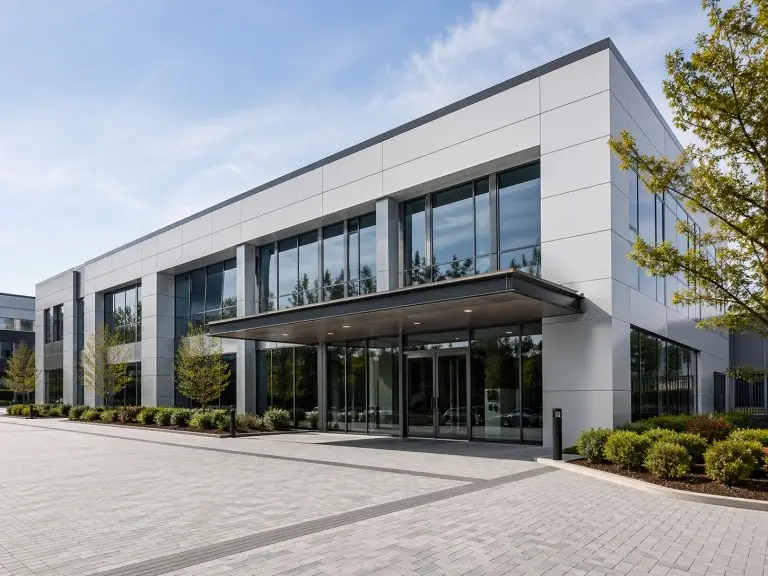
The external appearance of a KAFA steel office building is determined entirely by facade specification choices made at the design stage. The structural system is steel frame; the professional appearance is defined by the facade.
Flat Roof with Deep Parapet
Produces a modern office silhouette at the roofline — not a pitched industrial gable. Defines the building’s perceived category from first glance.
Aluminium Composite Panel (ACP)
Visual finish directly comparable to conventionally built corporate and government office facilities. The most common premium facade selection.
Glass Curtain Wall Sections
Creates a professional reception presence at the building frontage — read as headquarters-grade by visitors, tenants, and assessors.
Architectural Canopies & Shading
Entrance canopies and sun-shading elements deliver the campus-standard exterior detailing expected on institutional and HQ projects.
Coloured Steel Panels
White, light grey, or earth-tone steel panels deliver a clean professional appearance at a lower facade cost — suited to back-office and industrial-park admin buildings.
Mixed Panel Combinations
Glass at entrance and lower facade, metal panels above — matched to campus aesthetic or corporate identity across a multi-building estate.
We present facade options with every initial proposal so procurement teams can confirm external appearance before structural fabrication begins — not after.
How We Work
KAFA’s Delivery Process for Steel Office Buildings
Five defined stages from structural brief to weather-tight structure — engineering, fabrication, and export managed in-house.
Requirements Intake
Floor area, number of storeys, eave height, MEP provisions, facade system interface, insulation requirements, site country, and target occupancy date.
Design & Quotation
Structural drawings including MEP provision layout, full component BOM, and detailed price proposal within 3 business days of confirmed parameters.
Fabrication
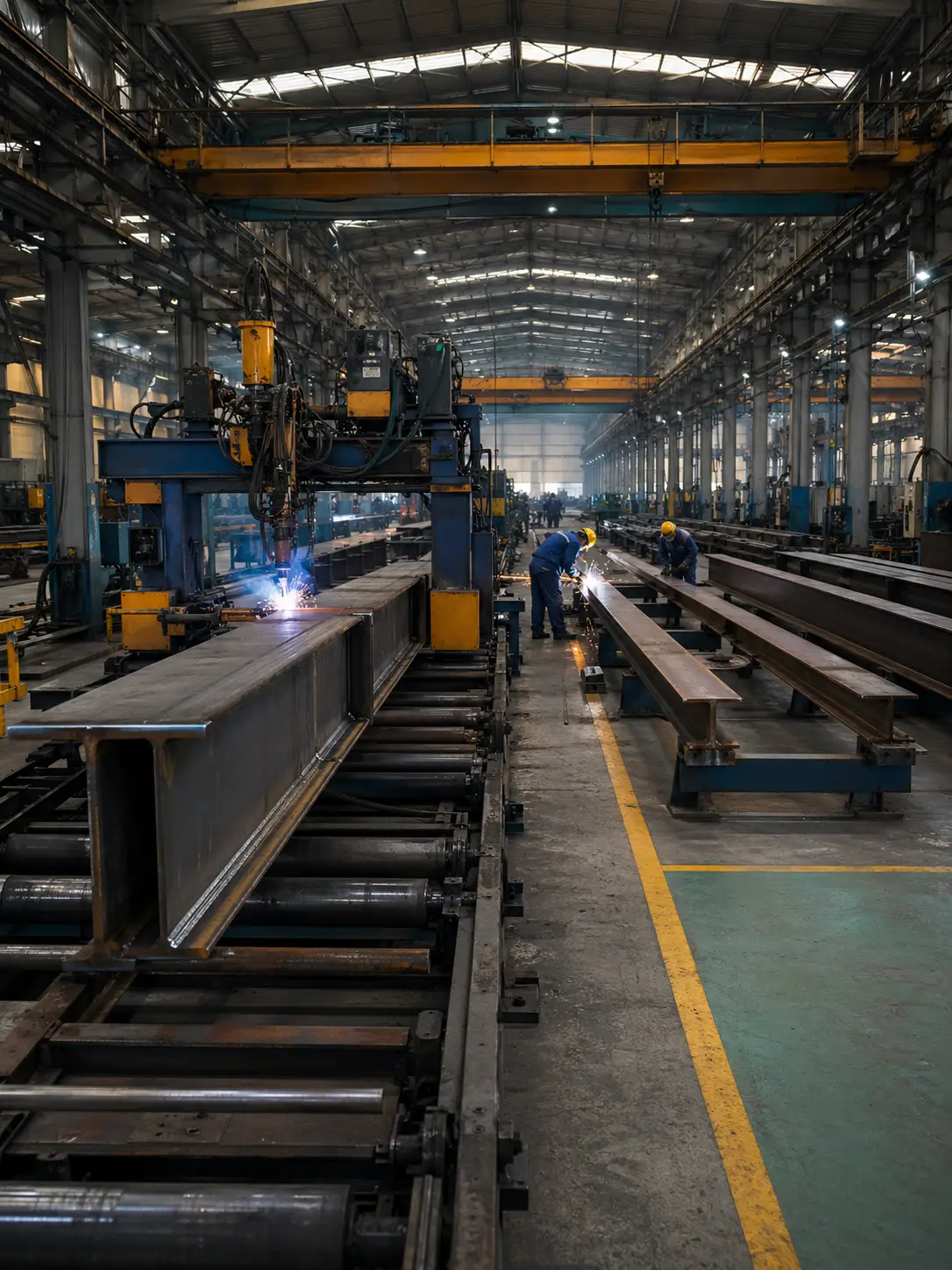
All primary and secondary structural members fabricated and ISO 9001:2015 inspected. Surface treatment applied at factory — no site-level coating required.
Logistics & Export
Container-packed structural components and export documentation coordinated to your port of destination. Timeline confirmed at scoping.
Installation
Erection by our team or a locally supervised crew. Weather-tight completion in approximately 40–50 days for standard two-storey office structures.
Timelines confirmed in writing at scoping based on project scale, production queue, and site conditions.
Our Delivery Process
Steel Building Design
Structural drawings and load calculations delivered within 3 business days from confirmed site dimensions, location, and intended use.
Metal Building Plans
Standard and custom floor plan configurations for warehouses, workshops, hangars, and industrial facilities across common clear-span ranges.
Metal Building Colors
Colour coating options for wall panels and roof sheets — including Colorbond-equivalent finishes and custom RAL matching for commercial projects.
Metal Building Components
Primary frames, secondary members, roof and wall cladding, gutters, doors, and windows — all fabricated in-house to ISO 9001:2015 standards.
Metal Building Insulation
PU, PIR, rock wool, and glass wool systems specified by climate zone — from tropical ambient buildings to cold storage facilities at −25 °C.
Metal Building Construction
45-day on-site erection programme from foundation handover to structural completion, covering anchor bolt setting, frame erection, and cladding.
Metal Building Foundation
Anchor bolt layout drawings, concrete grade and dimension requirements, and ±3 mm placement tolerances provided with every structural package.
Site Preparation
Ground levelling, drainage gradient, access road, and temporary power requirements confirmed before steel components leave the fabrication facility.
Metal Building Erection
6-stage installation sequence: foundation verification, column erection, rafter setting, bracing installation, cladding, and final handover inspection.
Project References
Steel Office Building Projects Delivered by KAFA
Representative examples across corporate headquarters, industrial park administration, and government institutional facilities — spanning West Africa, Southeast Asia, and East Africa.
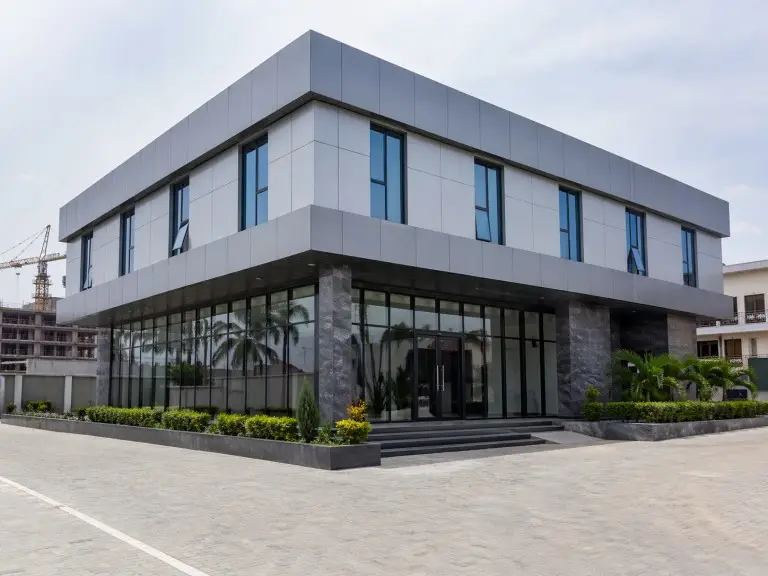
Two-Storey Corporate Headquarters
Two-storey corporate office building for an engineering services company. Flat roof profile with deep parapet. Aluminium composite panel cladding with glass curtain wall at the ground-floor reception frontage. Rock wool insulation mandatory for tropical climate. Composite metal deck floor on the first floor — floor live load 3.0 kN/m² confirmed for open-plan office and meeting room use.
Industrial Park Administration Block
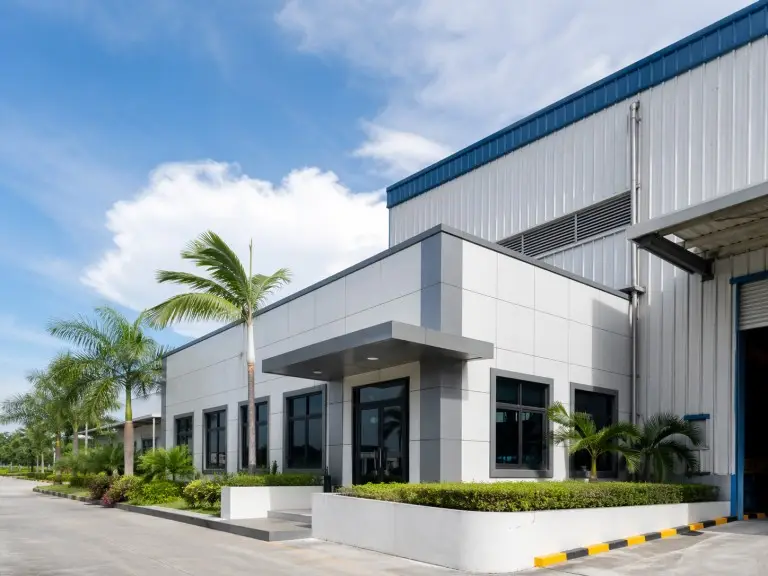
Single-storey administration building attached to an existing warehouse structure at an industrial park. Shared column grid confirmed against the existing building’s expansion wall provisions. Internal layout: reception, six enclosed offices, one large meeting room, and bathroom facilities. Coloured steel panels with entrance canopy. Rock wool roof insulation for tropical climate compliance.
Government Institutional Office Facility
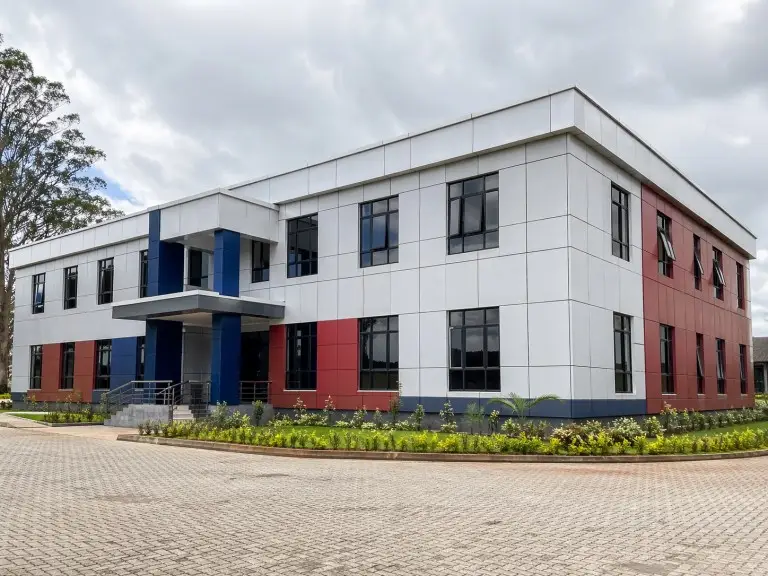
Standalone two-storey office facility for a government agency on a defined budget and programme timeline. Flat roof with parapet. Mixed facade: ACP cladding panels on the primary street-facing elevation, coloured steel panels on secondary elevations. Structural drawings submitted to local building authority with load calculations and anchor bolt plan. Rock wool insulation for highland tropical climate zone.
Project Fit
Who This Service Is Designed For — and Where It Is Not the Right Fit
- Small and medium enterprises establishing permanent business premises — 200 m² single-storey standalone to 1,500 m² two-storey administration complexes
- Industrial park developers building administration and management facilities alongside production or warehouse buildings
- Government and institutional bodies requiring functional office facilities on defined budgets and timelines in Nigeria, Kenya, Ghana, the Philippines, Vietnam, and Indonesia
- Manufacturing and logistics operators adding attached or standalone office wings to existing facilities
- Field operations and project sites requiring permanent offices with a professional standard of fit-out
- Faith-based and institutional organisations — including administrative wings attached to steel church buildings — requiring professional office facilities on defined programme timelines
- Projects in markets where container shipping to a major port is available and local foundation contractors and interior fit-out crews can be engaged on-site
- Office buildings above two storeys requiring multi-level reinforced concrete cores for lateral stability, lift shaft structural integration, or centralised building management systems beyond our standard structural scope
- Cleanroom or laboratory office facilities requiring specialist environmental control systems integrated into the structural frame
- Interior fit-out scope — partitioning, floor finishes, electrical and plumbing, furniture, and HVAC — unless otherwise confirmed in writing during scoping
- Office buildings subject to national procurement frameworks mandating local construction content — confirm scope and documentation requirements before proceeding
Verified Project Outcomes
What Office Building Clients Say — and What the Projects Delivered
Engineering challenge, structural outcome, and client response are presented together so you can assess the result, not just the sentiment.
Corporate headquarters building requiring MEP provisions — electrical conduit routes, HVAC penetrations, and data infrastructure sleeves — designed into the structural frame before fabrication. Rock wool insulation system specified for acoustic and thermal performance in an urban site context.
MEP coordination at the fabrication stage requires the structural engineer and the M&E engineer to work from the same drawing set before the fabrication drawings are issued. The standard project sequence — structure first, services second — produces a structure that was never designed around the service routes, forcing the M&E contractor to work around structural members with field-cut penetrations and improvised brackets. We require M&E coordination drawings as a condition of structural design sign-off. For this project, the electrical conduit routes, HVAC duct penetrations, and data tray positions were all resolved in the structural drawing set before a single member was cut. The fit-out contractor found a structure they could work with on day one.
“Every MEP provision we needed was incorporated into KAFA’s structural design. No drilling, no remediation, no delays to our fit-out contractor. That level of pre-fabrication coordination made a measurable difference to our programme.”
Mixed-use office complex with curtain wall facade interface requiring precise structural tolerances at column and floor beam connections. C3 corrosivity classification driven by coastal proximity — surface treatment confirmed and applied at fabrication, not as a post-delivery upgrade.
Curtain wall systems are installed against a structural envelope that must be within tight dimensional tolerances — typically ±5 mm on column face position and ±3 mm on floor beam elevation across the full facade height. These tolerances are not achievable by site adjustment of the structural frame after erection; they are a function of fabrication accuracy and erection procedure. We fabricate all multi-storey office structures to a tighter dimensional standard than single-storey industrial buildings, apply survey controls at each erection stage, and provide as-built dimensional records to the curtain wall contractor before their installation commences. The contractor can design their bracket system to the actual column positions, not a nominal drawing position.
“The structural tolerances for our curtain wall system were tight. KAFA met every interface dimension exactly — our facade contractor had no adjustments to make. That precision is what we needed.”
Manufacturing Credentials
Certifications, Accreditations, and Production Capacity
KAFA’s production credentials are verified by independent third-party accreditation bodies against defined benchmarks for metal building system manufacturers — not self-declared.
ISO 9001:2015 Certified
Our quality management system covers the full production sequence — structural fabrication, surface treatment, insulation installation, and component inspection — against the ISO 9001:2015 standard. Each production batch is inspected before leaving the facility.
IAS AC472 Accredited
Independent accreditation from the International Accreditation Service verifies our engineering documentation, production processes, and quality controls against defined benchmarks for metal building system manufacturers. Independently audited — not self-certified.
20,000 m² Production Facility
Dedicated fabrication facility with over 500 production and engineering staff and a certified 2,000 MT monthly output. Corporate clients, industrial park developers, and government facility operators across Africa, Southeast Asia, and the Middle East have engaged us for office building projects where professional facade specification and reliable delivery programmes tied to business occupancy dates were required.
Frequently Asked Questions
Technical and Commercial Questions, Answered Directly
Yes — and the facade specification is entirely within the client’s control at the design stage. Aluminium composite panel cladding, glass curtain wall entrance sections, flat roof profiles with deep parapets, and architectural canopies all produce an external appearance that is visually comparable to conventionally built office facilities. The structural system is steel frame; the professional appearance is defined by the facade specification. We present facade options with every initial proposal so organisations can confirm the external appearance before making a procurement decision. The assumption that a steel building will look like a temporary site office is based on familiarity with poorly-specified industrial buildings, not with purpose-designed commercial steel office structures.
For projects in tropical and subtropical climates — including most of West Africa, East Africa, the Philippines, and Indonesia — thermal insulation is a design prerequisite, not an optional upgrade. An uninsulated steel building envelope in a tropical climate transmits solar heat into the interior at levels that make sustained productive work impractical and require significantly oversized air conditioning plant to compensate. Rock wool or glass wool insulation fitted within the roof and wall panel assembly, combined with a continuous inner liner panel, reduces solar heat transmission to levels compatible with standard office air conditioning. We treat insulation specification as mandatory for all tropical-climate office projects and include it in every design proposal for these markets.
Yes. Two-storey steel office buildings use a composite metal deck floor system — a profiled steel deck panel with a structural concrete or lightweight composite topping — supported on steel secondary beams spanning between primary steel columns. This system provides a durable, safe floor structure for standard office floor live loads of 2.0–3.0 kN/m² and does not require a reinforced concrete column-and-beam frame. The steel floor system is lighter than a concrete slab, which reduces foundation loads and allows construction on sites with lower ground bearing capacity. Staircase position, floor plate dimensions, and any elevator provision must be declared at the requirements intake stage, as these affect the primary frame layout and cannot be repositioned after fabrication.
Interior partitioning in a steel office building is typically constructed using lightweight steel stud framing with gypsum board or equivalent finish panels — a system that can be repositioned, extended, or removed without structural modification to the primary frame. This is the key layout flexibility advantage over concrete block wall construction, where partition walls are structural elements that cannot be removed without assessment. Open-plan areas can be subdivided into enclosed offices or meeting rooms using steel stud partitioning; these partitions can be reconfigured later if the organisation’s space needs change. The main constraint is column position — the primary steel columns are fixed elements — and these are positioned at the design stage to minimise interference with the intended space programme.
Cost depends on floor area, number of storeys, facade specification (steel panels versus aluminium composite versus glass curtain wall), insulation system, interior partition scope if included, door and window quantity and type, site country and city relative to the nearest container port, and local installation resource costs. Fabrication, shipping, and installation costs each vary by these parameters and cannot be accurately estimated without confirmed design requirements. We provide a detailed price proposal within 3 business days of receiving confirmed occupant numbers, floor area, storeys, functional space requirements, and site location.
The overall programme has four phases. Our engineering team returns initial drawings and a price proposal within 3 business days of confirmed requirements. Fabrication runs 20–30 days from design sign-off. Shipping transit to destination port is typically 20–35 days to major African or Southeast Asian ports. Installation from steel on-site to weather-tight structure runs approximately 45 days for a standard building under 1,500 m². Interior fit-out — partitioning, electrical and plumbing, floor finishes, and furniture — follows and varies by scope and local contractor capacity. A realistic total programme from confirmed order to first occupancy is typically four to six months, depending on foundation readiness, port clearance speed, and fit-out scope.
KAFA supplies fully engineered metal office building kits — pre-fabricated structural components, insulated roof and wall panel systems, facade components, and all connection hardware — packed for container shipping with full structural drawings, erection documentation, and anchor bolt plans. Every kit is engineered to the confirmed floor area, storey count, insulation specification, and facade system of the specific project. Span, eave height, insulation, and facade are all confirmed before fabrication begins.
Start Your Project
Drawings & Proposal in 3 Business Days
Share your anticipated occupant number, number of storeys, key functional spaces, whether standalone or attached, your preferred exterior appearance style, site country and city, and target occupancy date. Our team responds with structural drawings, facade options, and a detailed price proposal within 3 business days.
Submit Requirements Directly
Ready to Send Your Office Building Brief?
Submit your office building specifications — occupant count, storeys, functional space list, standalone or attached, site location, facade style preference, and target occupancy date — and our team will prepare a detailed structural proposal without a preliminary call.