
Pre-Engineered Metal Workshop Buildings & Prefab Steel Workshop Structures
KAFA designs, fabricates, and installs prefabricated steel workshop buildings for mid-to-large production, fabrication, and assembly operations. Clear-span portal frames from 500 m² to 8,000 m²+, with crane beam integration and configurable eave heights from 6 m to 14 m.
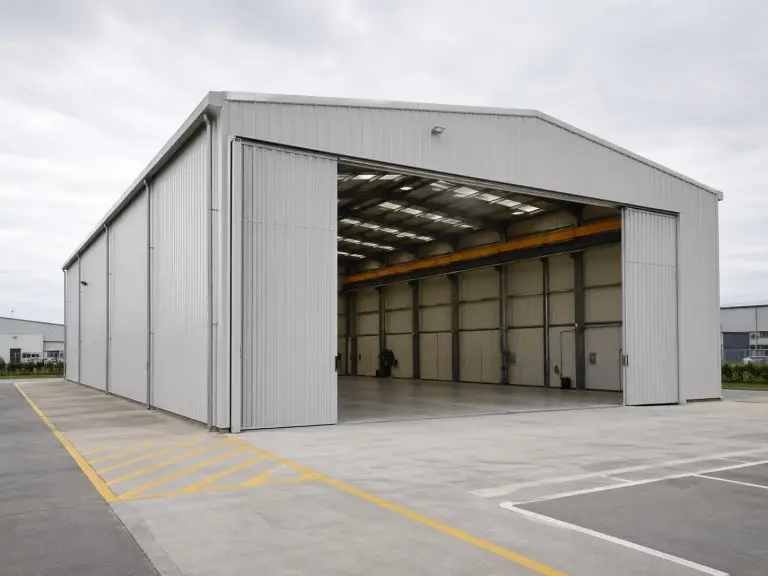
Steel Portal Frame vs Concrete
Why Pre-Engineered Steel Portal Frames Are the Standard for Metal Workshop Buildings
Clear-span column-free interiors across spans of 18 m to 60 m give production line designers full flexibility in equipment placement, aisle routing, and future process reconfiguration without structural constraints. Concrete-frame alternatives of equivalent footprint cannot match this configuration at comparable cost or construction speed.
Engineering Capability
Six Quantified Capabilities of a KAFA Steel Workshop Building
Every metric below is fabricated to specification under ISO 9001:2015 — confirmed at design stage, locked at requirements intake, and delivered to your site without re-engineering.
Portal frame construction eliminates internal load-bearing columns up to 60 m — unrestricted equipment placement and aisle routing.
Single or double-girder overhead crane provisions engineered into primary columns from initial design — never retrofitted.
On-site erection completes in approximately 45 days for standard single-span structures under 5,000 m². Production start dates committable.
Centre-to-centre column spacing accommodates light fabrication through heavy equipment operations — locked into the column grid before fabrication.
Every batch inspected under our certified QMS before surface treatment, coating, and modular container packing. Each delivery traceable to its inspection record.
Mezzanine floors for office, QC stations, or parts storage — declared and engineered at design stage rather than added as post-erection modification.
How We Work
KAFA’s Delivery Process for Steel Workshop Buildings
Five defined stages from structural brief to installed structure — all managed in-house by a single engineering and production team.
Requirements Intake
Site dimensions, production layout intent, eave height, crane specifications, bay spacing, door opening sizes, and target completion date.
Design & Quotation
Structural drawings, full component bill of materials, and detailed price proposal delivered within 3 business days of confirmed parameters.
Fabrication
All structural components manufactured at our 20,000 m² facility. ISO 9001:2015 inspection before surface treatment and modular container packing.
Logistics & Export
Components modularly packed for container shipment. Export documentation and port-of-destination logistics coordinated by KAFA’s team.
Installation
Our installation team or locally supervised crew erects the structure on-site. Approximately 45 days to weather-tight completion for structures under 5,000 m².
Timelines confirmed in writing at scoping based on project scale, production queue, and site conditions.
Structural Decision Gates
Three Variables Confirmed Before Metal Frame Workshop Fabrication Begins
Crane specifications, eave height, and bay spacing must all be resolved at requirements intake. Leaving any one undefined at the design stage causes structural revisions that delay fabrication.
Crane Specifications
Rated load capacity, crane span, lifting height, and crane type — single-girder or double-girder bridge crane — must be confirmed before structural engineering begins. These directly determine column sizing, rafter depth, crane beam bracket positioning, and primary frame weight.
Eave Height
A calculated output, not a default dimension. The correct figure depends on the tallest equipment or load handled, the required crane hook elevation above that load, and the structural depth of the crane beam and primary rafter.
Bay Spacing
Centre-to-centre column distance along the building length determines how equipment, production lines, and storage areas can be arranged without structural interference. 6 m suits most light-to-medium fabrication; heavy equipment typically requires 9 m or wider bays.
Configuration Add-Ons — declared at design stage, fabricated in the same package
- Mezzanine floors for office, QC stations, or parts storage — engineered at design stage
- Roller shutter, sliding, and oversized equipment access doors
- Roof and wall cladding — single-skin, insulated, or PU-panel options
- Ridge ventilation and translucent skylights for production environment control
- Anti-corrosion surface treatment to specified corrosivity classification
- Anchor bolt layout drawings issued for client foundation contractor
Our Delivery Process
Steel Building Design
Structural drawings and load calculations delivered within 3 business days from confirmed site dimensions, location, and intended use.
Metal Building Plans
Standard and custom floor plan configurations for warehouses, workshops, hangars, and industrial facilities across common clear-span ranges.
Metal Building Colors
Colour coating options for wall panels and roof sheets — including Colorbond-equivalent finishes and custom RAL matching for commercial projects.
Metal Building Components
Primary frames, secondary members, roof and wall cladding, gutters, doors, and windows — all fabricated in-house to ISO 9001:2015 standards.
Metal Building Insulation
PU, PIR, rock wool, and glass wool systems specified by climate zone — from tropical ambient buildings to cold storage facilities at −25 °C.
Metal Building Construction
45-day on-site erection programme from foundation handover to structural completion, covering anchor bolt setting, frame erection, and cladding.
Metal Building Foundation
Anchor bolt layout drawings, concrete grade and dimension requirements, and ±3 mm placement tolerances provided with every structural package.
Site Preparation
Ground levelling, drainage gradient, access road, and temporary power requirements confirmed before steel components leave the fabrication facility.
Metal Building Erection
6-stage installation sequence: foundation verification, column erection, rafter setting, bracing installation, cladding, and final handover inspection.
Project References
Metal Workshop Building Projects Delivered by KAFA
Representative examples across automotive fabrication, metal processing, and industrial park development — spanning Southeast Asia, the Middle East, and Sub-Saharan Africa.
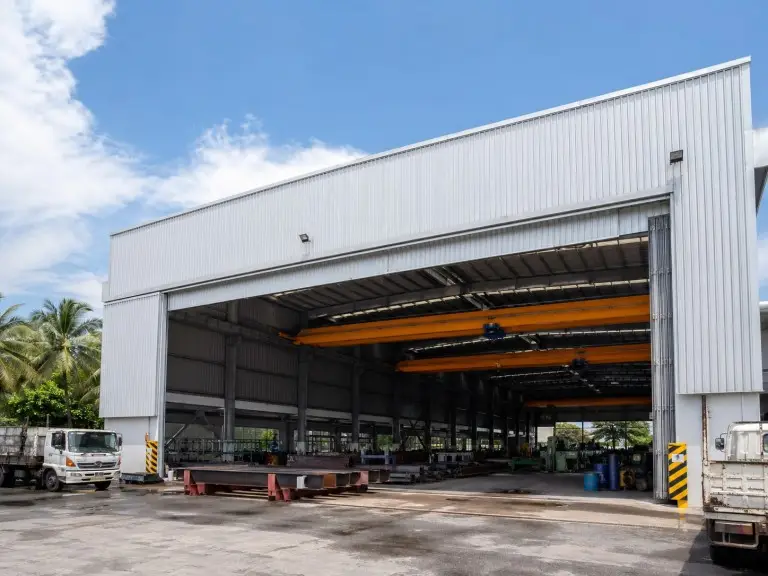
Automotive Parts Fabrication & Assembly Shop
Two-span crane-ready workshop for precision parts fabrication and sub-assembly. Dual overhead bridge crane provisions at 10 T rated load per runway, 9 m bay spacing for long-bed machinery clearance.
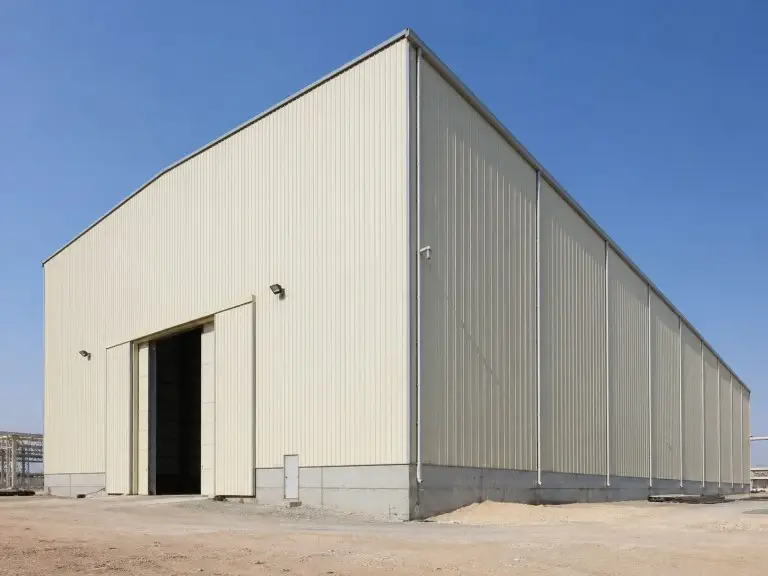
Heavy Fabrication & Metal Processing Workshop
Single-span heavy fabrication workshop with 14 m eave clearance for overhead crane hook height. High-corrosivity coastal site — C4 surface treatment specification applied to all primary and secondary structural members.
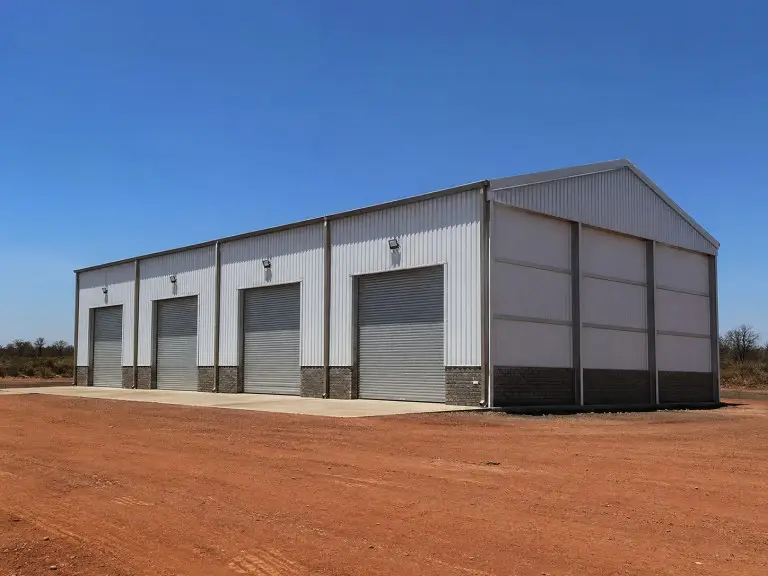
Modular Multi-Tenant Production Units
Eight modular workshop units with a shared structural grid for an industrial park developer. Standard 6 m bay spacing across all units for a consistent anchor bolt layout and phased construction sequencing.
Project Fit
Who This Service Is Designed For — and Where It Is Not the Right Fit
- Automotive parts fabrication and assembly shops requiring overhead crane provisions and controlled aisle widths
- Metal processing and heavy fabrication workshops where crane hook height and structural load ratings are primary design drivers
- Machinery manufacturing and maintenance facilities needing high eave clearance and rolling door openings for oversized equipment
- Industrial park developers building multi-tenant production units with a shared structural system
- Processing, packaging, and light-to-medium manufacturing from 1,000 m² to 8,000 m²+ across Southeast Asia, the Middle East, and Africa
- Projects in markets where container shipping is a viable supply route and local erection capability is available on-site
- Operators requiring a combined workshop and storage footprint — workshop buildings paired with an adjacent steel structure warehouse under a single project scope
- Multi-storey industrial buildings where floor-slab loading, seismic requirements, or local building authority standards require a hybrid concrete-steel engineering approach
- Structures requiring a reinforced concrete core structurally integrated with a steel superstructure beyond our standard delivery scope
- Jurisdictions mandating state-stamped PE drawings for local permits — confirm documentation requirements with our team before finalising scope
- Projects under 500 m² — our delivery model is optimised for mid-to-large production facilities
Verified Project Outcomes
What Workshop Clients Say — and What the Projects Delivered
Engineering challenge, structural outcome, and client response are presented together so you can assess the result, not just the sentiment.
Double-girder overhead crane provisions required structural frame engineering before any column or rafter was sized. Client’s crane supplier confirmed rated load and span late in the scoping process — KAFA held the fabrication slot and incorporated the final crane parameters without schedule impact.
The crane beam bracket positioning and column sizing cannot be finalised without knowing the rated load, span, and duty classification of the overhead crane system. When the client’s crane supplier confirmation arrived three weeks after initial scoping, we had held the design at the foundation level — anchor bolt layout confirmed, primary frame geometry frozen — and incorporated the crane parameters in the following revision. No additional fabrication time was needed because the hold point was planned, not reactive.
“KAFA’s team confirmed crane beam positioning in the first technical exchange. Every parameter we gave them was incorporated cleanly — no revision cycles, no change orders after fabrication started.”
High-corrosivity coastal site required C4 surface treatment across all primary and secondary structural members. 14 m eave clearance for crane hook height was the primary dimensional driver — confirmed in the first scoping call before drawings were initiated.
The distinction between C3 and C4 is not a grade preference — it reflects a specific chloride deposition rate range driven by coastal proximity and prevailing wind direction. A site within 200 m of open water in a humid tropical environment will accumulate chloride deposits at a rate that compromises a C3 epoxy primer within four to six years of erection. We specified C4 because the site data — not the client’s request — required it. Applying C3 would have been cheaper at delivery and significantly more expensive within a decade.
“The quality of their steel structures is outstanding. We would not hesitate to engage them for future projects. Every structural parameter was delivered exactly as specified.”
Manufacturing Credentials
Certifications, Accreditations, and Production Capacity
KAFA’s production credentials are verified by independent third-party accreditation bodies against defined benchmarks for metal building system manufacturers — not self-declared.
ISO 9001:2015 Certified
Our quality management system covers the full production sequence — structural fabrication, surface treatment, and component inspection — against the ISO 9001:2015 standard. Each production batch is inspected before leaving the facility.
IAS AC472 Accredited
Independent accreditation from the International Accreditation Service verifies our engineering documentation, production processes, and quality controls against defined benchmarks for metal building system manufacturers.
20,000 m² Production Facility
Dedicated fabrication facility with over 500 production and engineering staff, certified 2,000 MT monthly output, and more than 24 years of accumulated delivery experience across manufacturing and heavy industry internationally.
Frequently Asked Questions
Technical and Commercial Questions, Answered Directly
A pre-engineered workshop building is a structural system where all primary and secondary steel members — columns, rafters, purlins, crane beams, and cladding — are engineered, sized, and fabricated to a confirmed structural brief before leaving the factory. This differs from a standard metal shed in that the structural design is specific to the building’s intended use, including crane load ratings, eave height, bay spacing, wind and snow load zone, and foundation interface — rather than a generic kit assembled from stock components. For industrial and manufacturing clients, the distinction matters because crane beam integration and production-specific eave clearances cannot be safely retrofitted to a shed-grade structural system.
Yes. Overhead crane beam integration requires that rated load capacity, crane span, lifting height, and crane type — single-girder or double-girder bridge crane — are confirmed before structural engineering begins. These parameters directly determine column sizing, rafter depth, crane beam bracket positioning, and primary frame weight. Leaving crane specifications undefined at the design stage typically results in a structure that cannot accommodate the intended crane system without structural modification after erection.
Bay spacing — the centre-to-centre column distance along the building’s length — directly determines how equipment, production lines, and storage areas can be arranged without structural interference. A 6 m bay spacing suits most light-to-medium fabrication operations; heavy equipment or long-bed processing lines typically require 9 m or wider bays. Bay spacing must be confirmed at the requirements intake stage because it is locked into the structural column grid and cannot be adjusted after fabrication without full re-engineering of the primary frame.
Eave height is a calculated output, not a default dimension. The correct figure depends on the tallest piece of equipment or load to be handled inside the building, the required crane hook elevation above that load, and the structural depth of the crane beam and primary rafter. We work through this calculation with clients during requirements intake. Typical eave heights in our workshop projects range from 6 m to 14 m, but the right figure for a specific project should be confirmed before design is finalised — not estimated from a warehouse specification.
KAFA supplies fabricated structural steel components, roof and wall cladding systems, doors, specified accessories, structural drawings, and installation documentation. Foundation construction, site preparation, local permitting and regulatory approvals, in-country customs clearance, and crane or lifting equipment for erection are the client’s responsibility unless an alternative scope is confirmed in writing before production begins. Overhead crane equipment is procured separately by the client; KAFA designs and fabricates the crane beam and runway support structure to the client’s confirmed crane specification.
KAFA holds ISO 9001:2015 certification and IAS AC472 accreditation. Whether these satisfy the documentation requirements of your local building authority depends on the specific regulations of your jurisdiction and your local permit office. We provide certification documentation on request and recommend confirming permit documentation requirements with your local authority before finalising scope with us.
KAFA supplies fully engineered workshop building kits — pre-fabricated primary and secondary structural members, roof and wall cladding systems, crane runway beams where specified, all connection hardware, and erection documentation — packed for container shipping. Every workshop building kit is project-specific: span, eave height, crane load, door configuration, and surface treatment are all confirmed before fabrication begins. We do not supply generic off-the-shelf kits. The kit is designed for assembly by a qualified local erection crew under our technical supervision or a KAFA installation team.
A metal frame workshop and a standard metal warehouse share the same steel portal frame structural system, but differ in the structural provisions that serve active industrial operations versus passive storage. A workshop structure typically incorporates: overhead crane runway beams engineered into the primary frame (requiring heavier columns and dedicated beam brackets), higher eave clearances to accommodate crane hook height plus lifted load, heavier floor slab specifications for production equipment and point loads, corrosivity coating driven by process media as well as ambient conditions, and more complex door configurations for equipment access. A warehouse primarily optimises for clear floor area, loading dock configuration, and racking load distribution. Both are available from KAFA — scope is confirmed at requirements intake.
Start Your Project
Drawings & Proposal in 3 Business Days
Share your workshop footprint, intended production use, eave height, crane specifications, bay spacing preference, and target completion date. Our engineering team responds with initial structural drawings and a detailed proposal within 3 business days.
Submit Requirements Directly
Ready to Send Your Project Brief?
Submit your workshop specifications — span, eave height, crane load and type, bay spacing, and target programme — and our team will prepare a detailed structural proposal without a preliminary call.