




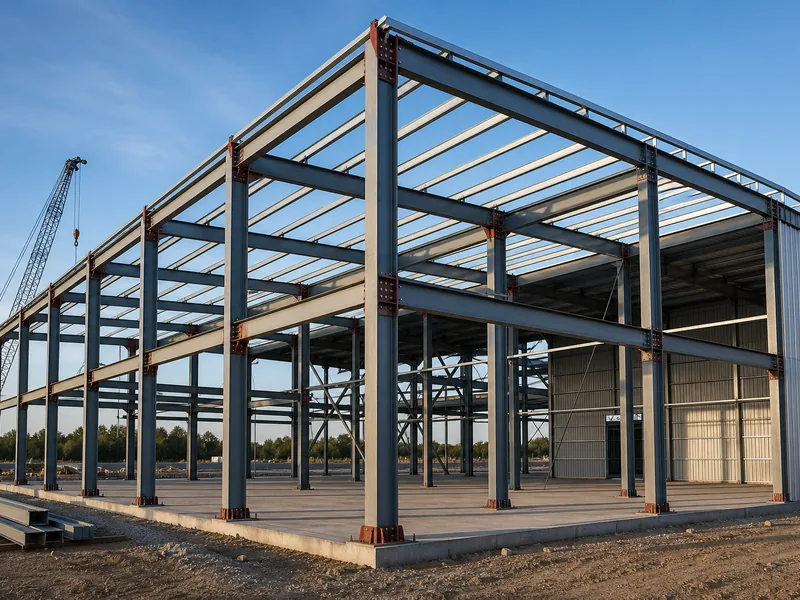
Steel frame construction builds a load path from steel columns and beams, so the frame, not the walls, carries the weight of the floors and roof. That single structural idea separates it from masonry or wood bearing-wall construction and explains most of its strengths and trade-offs.
The frame method is only one part of metal building construction, which also includes foundations, secondary members, enclosure, and erection sequencing.
This article covers how steel framing works, the three assembly methods, the common frame systems and where each fits, and the limits useful to check before you commit. It does not cover foundation design, connection calculations, or fireproofing detailing, all of which belong with a structural engineer working to your local code.
What Steel Frame Construction Is and Its Core Members
A steel frame is a skeleton of vertical columns and horizontal beams joined into a rigid grid that supports the building and carries loads down to the foundation. Walls in this system are usually non-structural cladding, or a curtain wall, hung on the frame rather than holding it up.
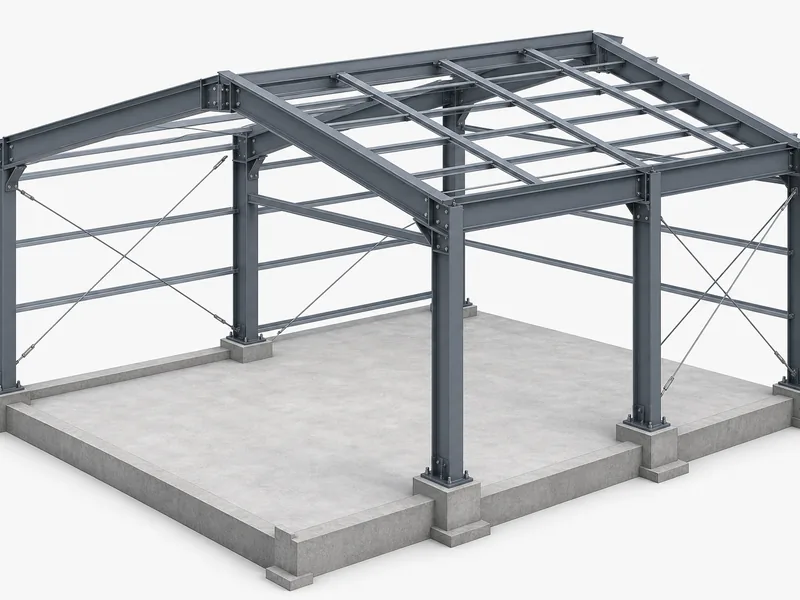
The core members are few but specialized. Columns take vertical load, beams (often I-beams or girders) span between columns to carry floors and roof, and secondary members such as purlins and girts support the cladding. Bracing or rigid moment connections resist the lateral loads from wind and seismic action.
Because the frame carries the structure on its own, interior walls become partitions rather than supports, so layouts can change later without structural rework. That independence is the practical reason open-plan offices, warehouses, and column-free spans are easier to achieve in steel than in load-bearing masonry.
The Three Steel Framing Methods: Welded, Bolted, and Light Gauge
Steel framing is assembled in one of three ways, and the method shapes cost, speed, and where the work happens. Welded and bolted framing use heavy hot-rolled sections for primary structure, while light gauge uses thin cold-formed sections for lighter walls and floors.
| Method | Sections used | Where assembled | Best suited to |
|---|---|---|---|
| Welded | Hot-rolled heavy sections | Mostly shop, some field | Rigid frames where continuous connections are detailed for the demand |
| Bolted | Hot-rolled heavy sections | Site erection | Fast schedules, future expansion, easy inspection |
| Light gauge | Thin cold-formed sections | Site or panelized | Walls, floors, residential and light commercial |
Welded steel framing
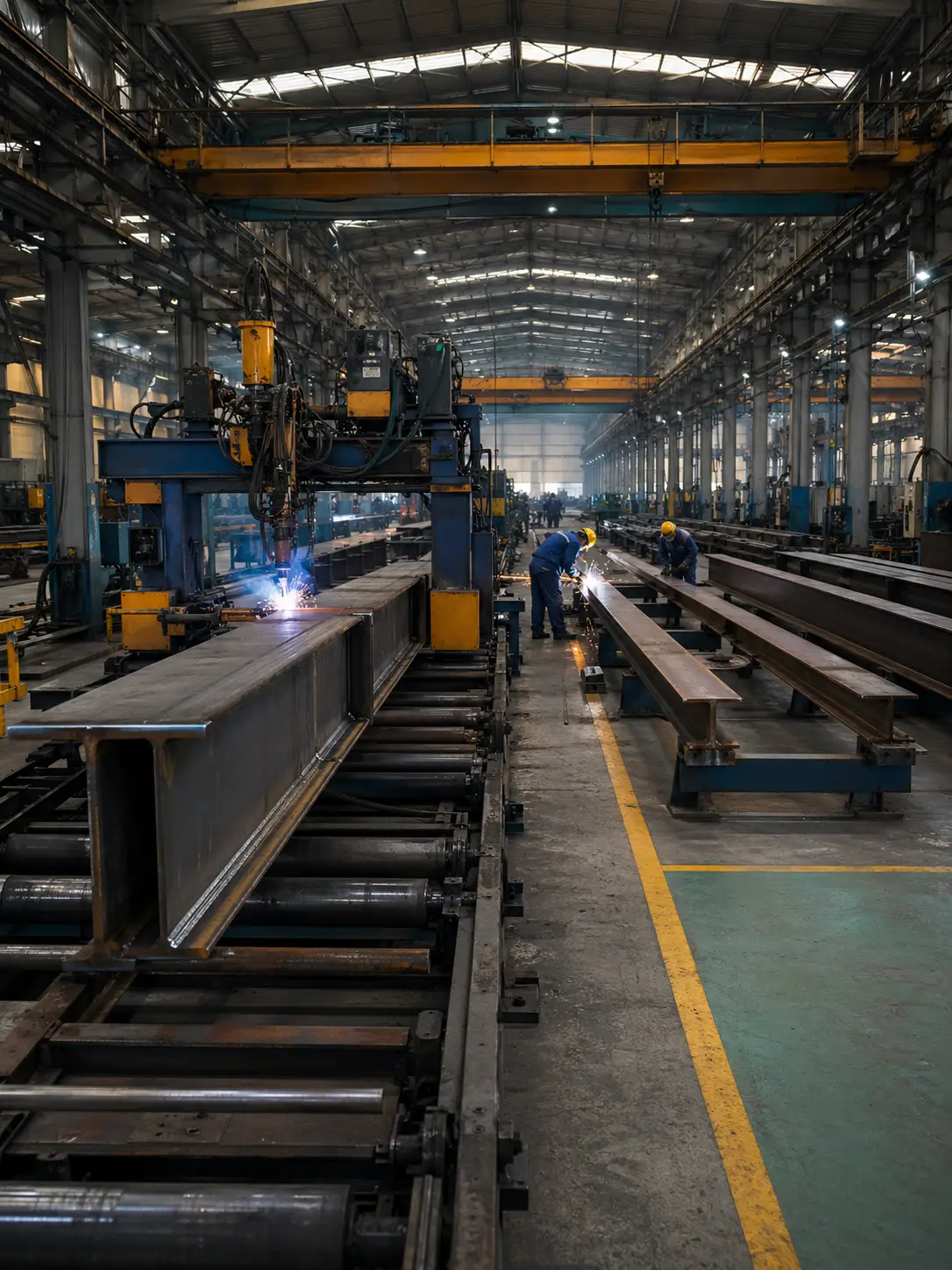
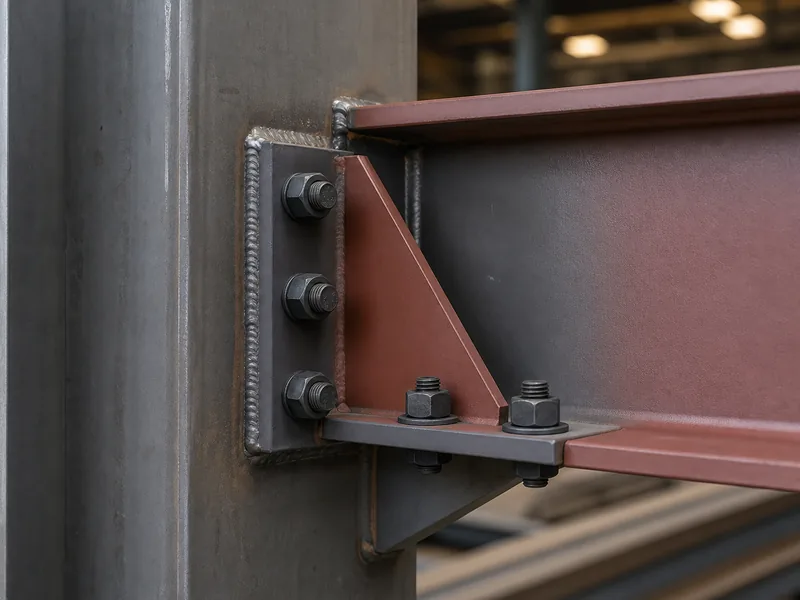
Welded framing joins members by fusing them, producing continuous, rigid connections that, when properly designed, detailed, welded, and inspected for that demand, perform well under dynamic and seismic loads. Shop welding under controlled conditions is generally more consistent than field welding, where weather, position, and access affect quality, so fabricators often weld assemblies in the plant and bolt them together on site. Welding quality is governed by AWS D1.1, the Structural Welding Code for steel, which is the document an inspector references rather than any single rule of thumb. Heavy welded portal and rigid frames are the backbone of red iron buildings, the hot-rolled structural systems used for most industrial spans.
Bolted steel framing
Bolted framing connects pre-drilled members with high-strength bolts, which speeds site erection and keeps inspection straightforward. Bolted joints are easier to verify and to disassemble than welds, a real advantage for projects with tight schedules or future expansion in mind. The trade-off is detailing, because bolt holes, plates, and tolerances have to be resolved in fabrication, where field adjustment is limited once members arrive.
Light gauge steel framing
Light gauge framing uses thin, cold-formed steel sections in a pattern similar to wood studs, and it suits walls, floors, and roofs in residential and light commercial work rather than long industrial spans. Its design follows AISI S100, the North American Specification for cold-formed steel members, which is a different standard from the one covering heavy hot-rolled frames. For the member profiles and gauges used in walls and studs, cold-rolled steel framing goes into more depth.
Common Steel Frame Systems and Their Span Characteristics
The frame system, not just the connection method, decides how far you can span and how much column-free space you get. Most buildings use one of a handful of systems, and the right one follows from the clear span and the loads it has to carry.
| Frame system | How it resists load | Span character | Where it fits |
|---|---|---|---|
| Rigid / portal frame | Rigid moment joints | Short to medium clear-span bays; multi-bay layouts may add interior columns | Workshops, warehouses, retail |
| Braced frame | Diagonal bracing takes lateral load | Economical, internal columns present | Multi-story, industrial |
| Moment-resisting frame | Stiff beam-column joints, no bracing walls | Open floor plans | Offices, seismic zones |
| Skeleton frame | Columns and beams, walls non-load-bearing | Scalable, multi-story | High-rise, commercial |
| Truss / space frame | Triangulated members | Long to very long span | Arenas, hangars, large roofs |
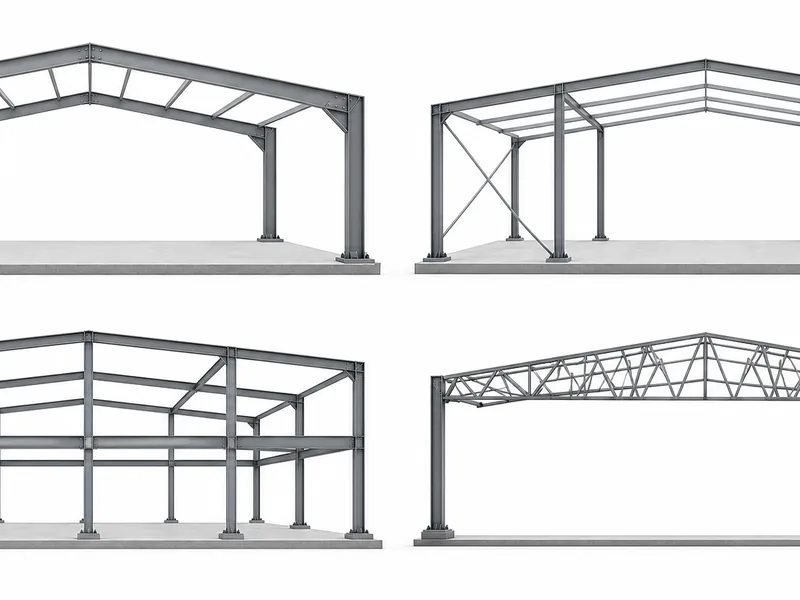
For the common workshop and warehouse decision between a clear-span portal frame and a trussed roof, portal frame vs truss compares the two on span, headroom, and cost. Published span figures vary widely with load, member spacing, and steel grade, so treat any range as a starting point and confirm it against an engineered design rather than a catalog number.
Advantages That Drive Steel Frame Selection
Steel’s main advantage is a high strength-to-weight ratio, which lets a lighter frame carry larger loads and longer spans than wood or concrete of similar bulk. That efficiency cascades, since lighter frames can mean smaller foundations, faster erection, and column-free interiors.
Prefabrication is the second driver. Because members are cut, drilled, and often welded in the shop, site work becomes assembly, which shortens schedules and reduces weather exposure compared with cast-in-place concrete. Steel is also ductile, and a properly detailed frame can yield rather than crack under overload, which supports predictable behavior under seismic or high-wind design demands.
As a non-combustible material steel does not feed a fire, and it is highly recyclable at the end of a building’s life. Together these frame-level gains are why steel prefab buildings have become a common choice for many commercial, industrial, and agricultural owners.
Limitations and Considerations Before Committing to Steel
Steel’s limits are manageable but specific, and overlooking them is where projects run into trouble. The recurring issues are thermal bridging, corrosion, fire protection, and how cost compares with wood.
Thermal bridging is the first to plan for, because steel conducts heat far more readily than wood, so an uninsulated steel member becomes a path for heat loss and condensation. The fix is a deliberate thermal break and continuous insulation, not just batt placed between members, and it works best designed in from the start. Corrosion is the second issue. In coastal or high-humidity settings, the fasteners, connections, and any breached coating are the first places to inspect, which is why galvanizing or a maintained paint system usually becomes more important there than on a dry inland site.
Fire is the most misunderstood. Steel does not burn, but it loses strength at sustained high temperature, so structural members in many occupancies still need applied fireproofing to meet code even though the material itself is non-combustible. Cost is the last consideration, and it is genuinely variable. Steel framing often carries a premium over wood on small, simple buildings, but the gap narrows or reverses on long spans and tall structures where wood becomes less practical or needs a different structural strategy. The honest answer depends on span, height, and local labor, not a fixed percentage.
Choosing the Right Steel Frame Approach
Choosing a steel frame is a sequence, not a single pick, and getting the order right is what prevents expensive rework. Start with the clear span and column-free area you need, because that constraint alone eliminates most systems before cost ever enters.
Once the span is fixed, layer in function and loads. A workshop with an overhead crane, an office that needs open floors, and a warehouse carrying heavy snow each push toward different systems and connection types. Then weigh the site environment, since coastal corrosion, seismic activity, and snow or wind load change both the coating spec and the lateral system. Only after those are set does the assembly method, welded, bolted, or light gauge, follow naturally from the structure and the schedule.
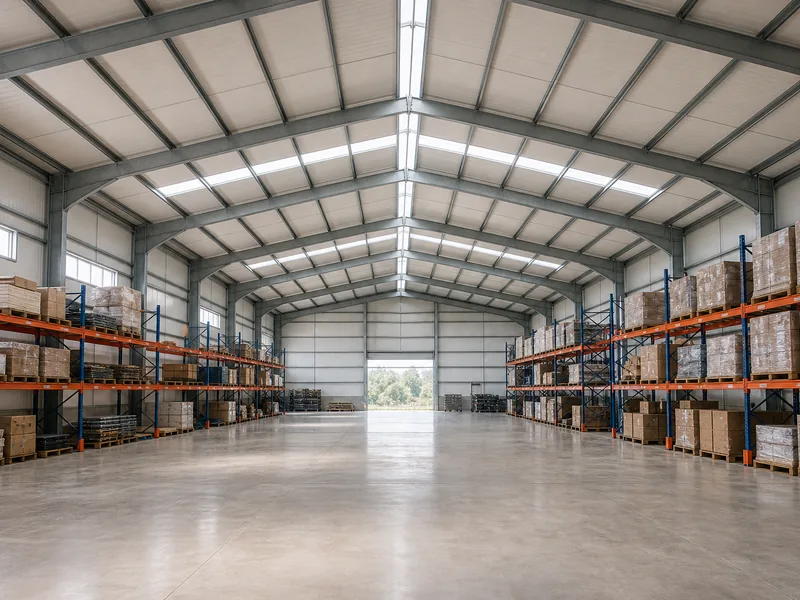
A few common cases show how that order plays out. A maintenance workshop with an overhead crane points toward a rigid or braced frame sized for the crane’s moving load, not just the roof. A clear-span warehouse or an aircraft hangar pushes toward portal frames or trusses that keep the floor free of columns, while an open-plan office in a seismic zone leans on a moment-resisting frame. An agricultural building on a humid coastal site makes the coating spec a bigger driver than the span itself. In each case the span and the governing load set the system, and the site environment sets the protection.
Verification is the final step, and it is where standards do the work. On projects using U.S. or North American references, loads may be checked against ASCE 7, hot-rolled structural design against AISC 360, welding quality against AWS D1.1, and cold-formed members against AISI S100, each applied where the local building code adopts it and confirmed by a licensed engineer.
On the supply side, a fabricator such as Qingdao KAFA Fabrication Co., Ltd. holds qualifications for light and heavy steel structure design, fabrication, and installation, and runs dedicated H-beam, box-section, and C/Z purlin lines under documented quality procedures. That fabrication capability is the point where a frame system on paper becomes a buildable package.
Conclusion
A practical route to a sound steel frame is to let constraints eliminate options in order: lock the clear span first, then the loads and site conditions, and let the frame system and assembly method fall out of those rather than starting from a preferred look or a target price. Span and lateral demand decide more than any single feature, so a portal frame that is wrong for a long-span arena is not a cheaper option, it is a different building.
Before fabrication, confirm the three things that drive the most rework: the corrosion environment and its coating spec, the fireproofing your occupancy requires, and the engineered load path signed off against code. Settle those, and the choice between welded, bolted, and light gauge becomes a logistics decision rather than a structural risk.
Frequently Asked Questions
What is steel frame construction in simple terms?
In simple terms, steel frame construction supports a building with a connected grid of steel columns and beams, so the frame carries the loads while the walls mostly enclose space. This arrangement is what lets steel buildings have open interiors and long clear spans.
What are the main types of steel frames?
The main steel frame systems are rigid or portal frames, braced frames, moment-resisting frames, skeleton frames, and truss or space frames. Each one is defined by how it resists lateral load and how far it can span, which is what matches it to a building type.
Is steel framing more expensive than wood?
Steel framing often costs more than wood on small, simple buildings, but the gap narrows or reverses on long spans and multi-story structures. Because the comparison depends on span, height, and local labor, a per-project estimate is more reliable than any fixed percentage.
How long does a steel frame building last?
A steel frame building can last for many decades when the coating system is specified for its environment and then maintained. Service life depends on corrosion exposure and upkeep rather than on the steel itself, which is why coastal sites call for a more robust coating spec.
What are the disadvantages of steel frame construction?
Three disadvantages come up often: thermal bridging, corrosion risk in humid or coastal settings, and the need for applied fireproofing even though steel does not burn. Each is solvable in design, so they are considerations to plan for rather than reasons to rule out steel.