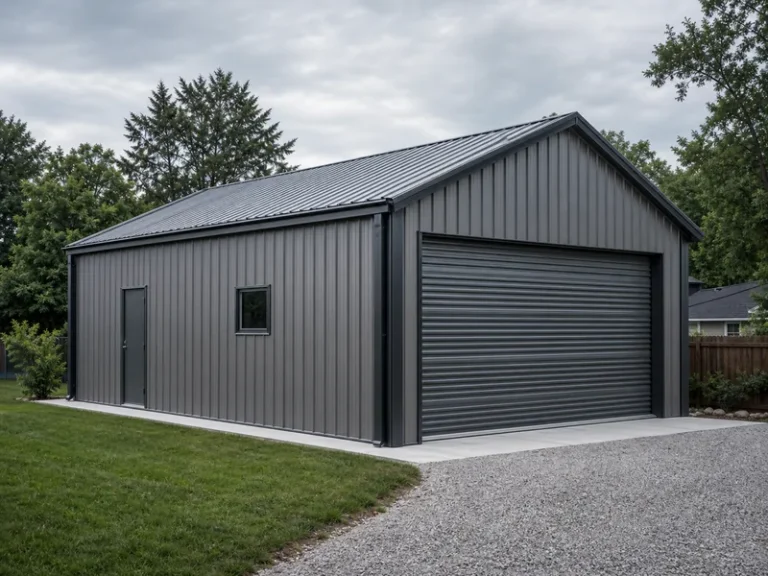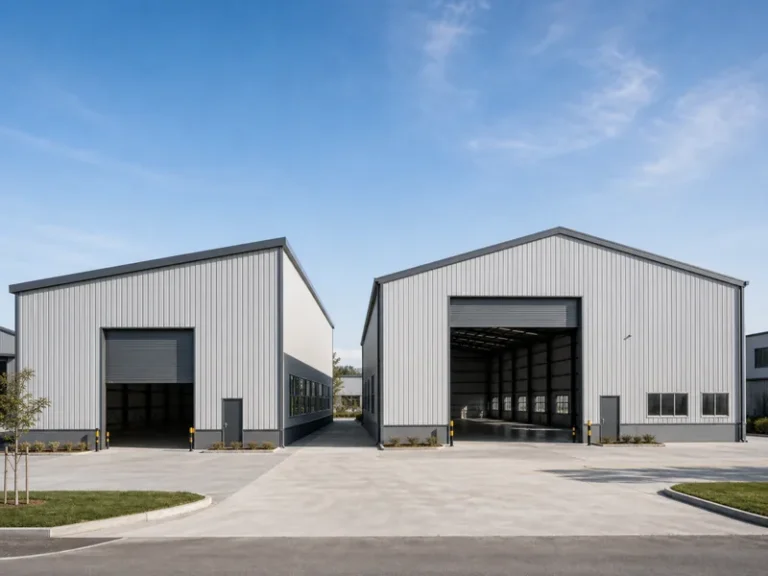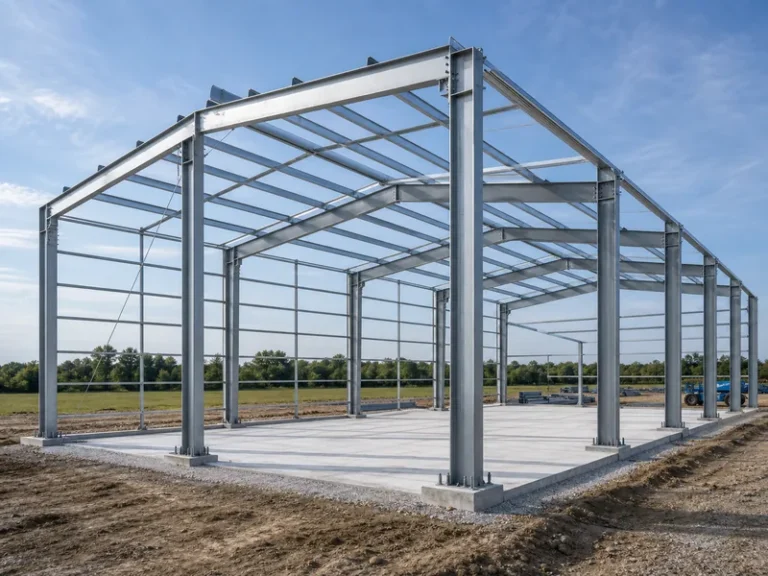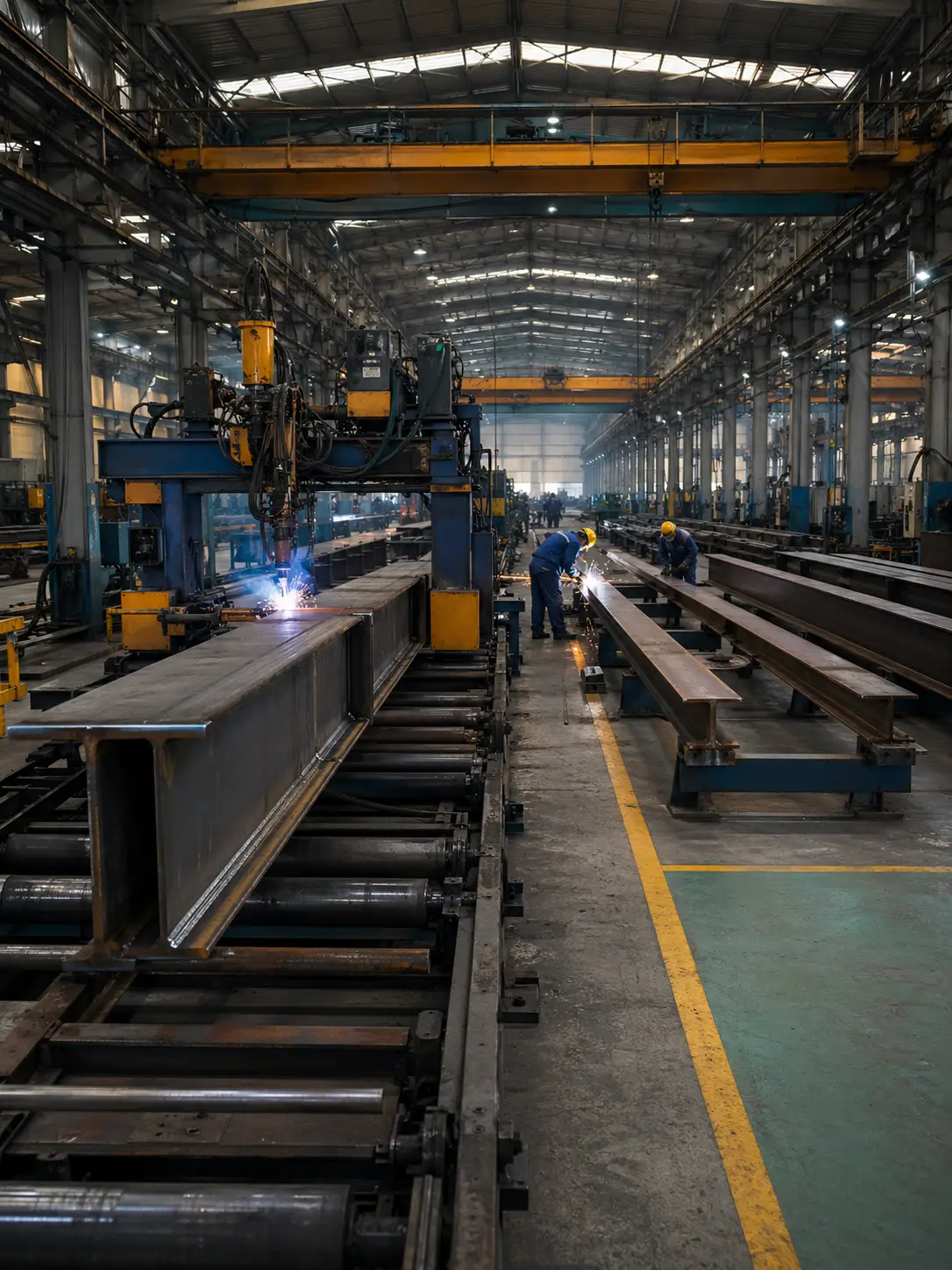





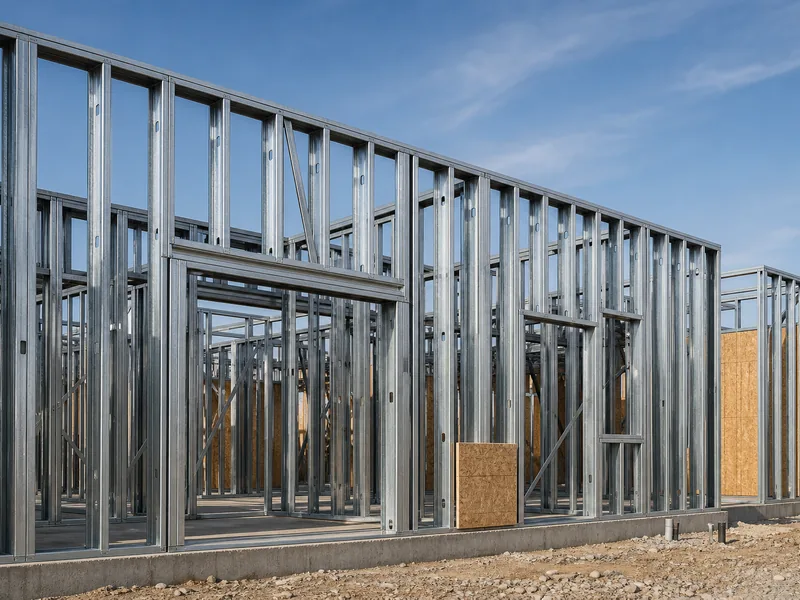
Cold rolled steel framing is the family of light, repetitive studs, tracks, joists, headers, girts, and purlins formed from cold-rolled sheet steel. Depending on the design, it can serve as primary structure, wind-bearing wall framing, interior partitions, or infill alongside a hot-rolled main frame. In buyer language it overlaps with cold-formed steel (CFS) and light-gauge steel framing, so the first job is to separate parent material, formed section, and structural role.
Cold-formed framing is usually specified alongside other metal building components such as purlins, girts, clips, and wall panels.
Cold-Rolled Sheet vs. Cold-Formed Members
Cold rolled steel framing is sheet steel that has been roll-formed at room temperature into light structural members, which is a forming method not a separate grade of steel. The label is best read in two layers before anyone specifies it.
“Cold-rolled” describes the parent sheet: steel reduced to its final thickness at room temperature, which gives tighter tolerances and a smoother surface than hot-rolled coil. “Cold-formed” describes the sections that sheet becomes once it passes through forming rollers, the C-sections, Z-sections, U-channels, and hat channels that act as studs, track, joists, girts, and purlins. “Light-gauge” describes the system those members build. In buyer and search language the three run together, but formal specifications and code references should land on cold-formed steel framing, or CFS, because that is the term the standards use.
The distinction that matters for selection is cold-formed versus hot-rolled. Hot-rolled steel, the heavy I-beams and columns often called red iron buildings, is shaped at high temperature for primary frames and long spans. Cold-formed members are thin, galvanized, and repetitive, carrying load through many closely spaced pieces instead of a few large ones. Confusing the two produces the two common buyer errors: assuming cold-formed steel cannot carry real load, or expecting it to replace primary structural steel on long clear spans. It does neither by default, and light-gauge steel has long dominated interior non-load-bearing partition walls because it is light and dimensionally stable.
How Cold-Formed Steel Sections Are Made
Cold-formed sections are produced by feeding coiled sheet steel through a sequence of forming rollers that bend it into a profile without applied heat. The coil usually arrives already galvanized, zinc-coated for corrosion resistance, and slit to a chosen thickness.
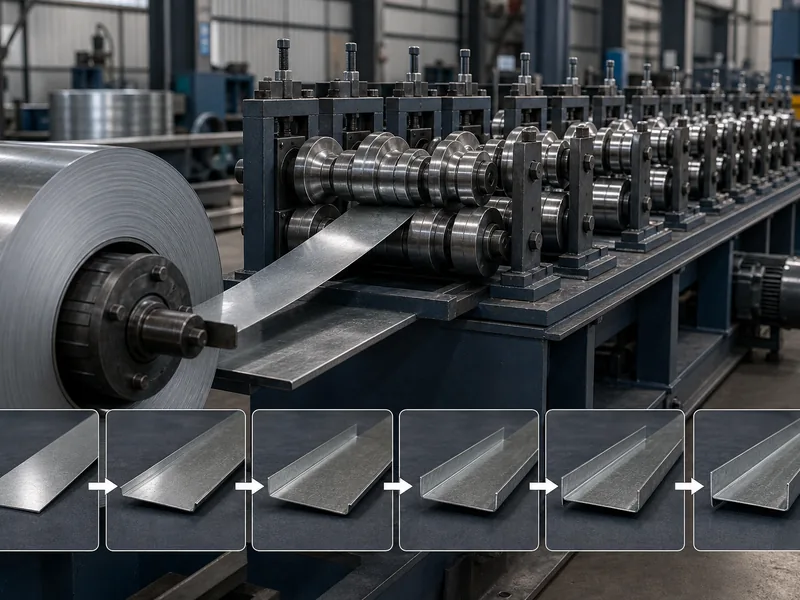
As the strip moves through each roller station, the flat sheet gains its web, flanges, and return lips in stages until a finished C or Z profile emerges. The profile is then punched for service holes and cut to length. Roll-forming supports repeatable profile geometry without welding each member in the field, so when coil, gauge, tooling, and quality control are held steady, sections stay consistent within specified tolerances. That consistency is the practical payoff: frames assemble with mechanical fasteners and predictable spacing instead of field fitting. Punched service holes in the web also let electrical and plumbing runs pass straight through the studs, which removes a step that wood framing often forces on the trades.
The finished section is only as good as what goes into it. At its Qingdao plant, KAFA runs dedicated C/Z-section purlin lines alongside H-beam, box-section, and profile steel plate processing under documented quality procedures. The same cold-forming variables that govern those purlins, profile geometry, gauge, and coil quality, are what decide whether any roll-formed section meets its specified capacity.
Framing Members, Gauges, and Material Specs
The first specification check is not the gauge but whether the member is structural or non-structural, because that decides which standard and which capacities apply. After that, three variables set what a member can do: section shape, steel thickness, and yield strength.
Thickness is called out in mils or gauge, and the working range is narrower than most people expect: typical cold-formed framing runs from about 0.0147 in. (0.373 mm) up to roughly 1/8 in. (3.175 mm). Yield strength is usually 33 ksi or 50 ksi, and availability tracks thickness, with thinner material around 43 mil and below commonly at 33 ksi while heavier members come in both grades. Members are typically spaced at 16 or 24 inches on center, the same module used for wood, with each stud anchored top and bottom into matching track.
| Member | Typical role | Selection note |
|---|---|---|
| C-section stud | Vertical wall framing, structural or non-structural | Gauge and yield set by wall height and load |
| Track | Top and bottom plates that anchor studs | Matched to the stud gauge |
| C-joist | Floor and roof framing | Sized by span, load, and deflection limit |
| Z-purlin or girt | Secondary roof and wall framing | Spans between primary frames; lapped at supports |
| Hat channel / furring | Furring, attachment, finish support | Light gauge; not a primary load member |
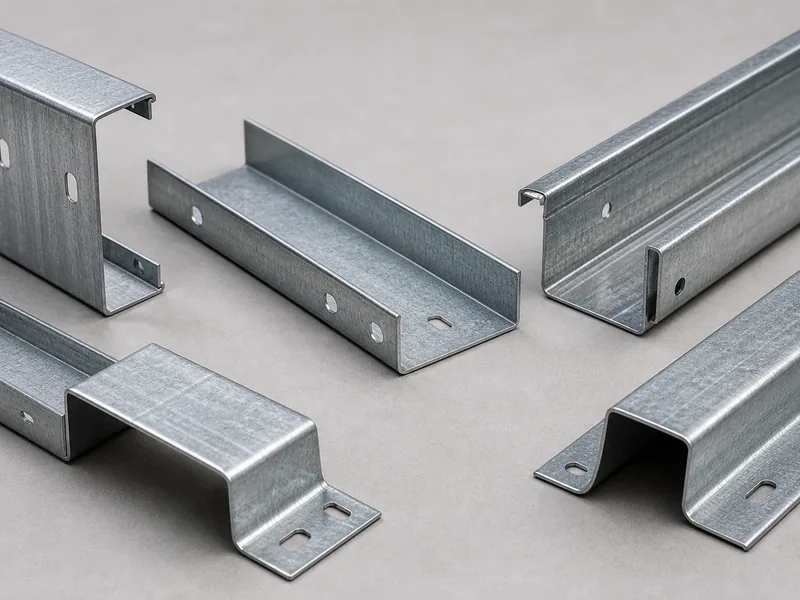
Reading those numbers as independent boxes is the trap. A 24-inch spacing in a thin gauge behaves nothing like the same spacing in a heavier joist, and the right combination depends on the load above it. In practice a member schedule sets four things together: the section and gauge, the steel grade, the on-center spacing, and the connection at each end. Structural members are then checked against span, load, and deflection limits, while non-structural partitions are governed more by height and serviceability than by load. Treat gauge, grade, spacing, and connection as one decision verified against that schedule as a linked set.
Cold-Formed vs Wood and Hot-Rolled Steel Framing
Cold-formed steel, wood, and hot-rolled steel each win on a different axis, so the comparison turns on load, height, exposure, and service life not on one material being better outright. Each belongs in a different part of the same building.
Against wood, cold-formed steel does not shrink, split, warp, or feed termites and mold, and the steel itself is non-combustible. Non-combustible is not the same as fireproof. A fire rating still depends on the assembly, protective layers, and connections, and steel loses strength at high temperature, so rated wall and floor assemblies are designed to the project’s requirements. Against hot-rolled steel, cold-formed framing is lighter and faster to stand up, but it does not replace primary beams and columns on long clear spans or heavy point loads. The cost question is conditional. Cold-formed steel is not automatically cheaper than wood on material price, and where it pulls ahead is usually erection speed, waste reduction, and lower long-term maintenance not the sticker figure.
Seismic and wind behave differently here and should not be lumped together. Lower building mass can reduce seismic demand, since there is less weight to accelerate in an earthquake. High-wind performance is a separate problem, governed by uplift and lateral pressure and resolved through sheathing, bracing, fasteners, anchors, and an engineered load path, not by light weight alone.
| Factor | Cold-formed steel | Wood | Hot-rolled steel |
|---|---|---|---|
| Member weight | Light | Light | Heavy |
| Combustibility / fire rating | Non-combustible; rated assemblies still required | Combustible | Non-combustible; rated assemblies still required |
| Moisture, pest, rot | Resists all three | Vulnerable | Resists all three |
| Span and load role | Repetitive light framing | Light framing, shorter spans | Primary frame, long spans, heavy loads |
| Dimensional movement | Low | Moves with moisture | Low |
| Field labor | Mechanical fasteners, light tools | Familiar trades, fast | Crane and welding |
| Design verification | AISI S240, engineered | Prescriptive or engineered | AISC, engineered |
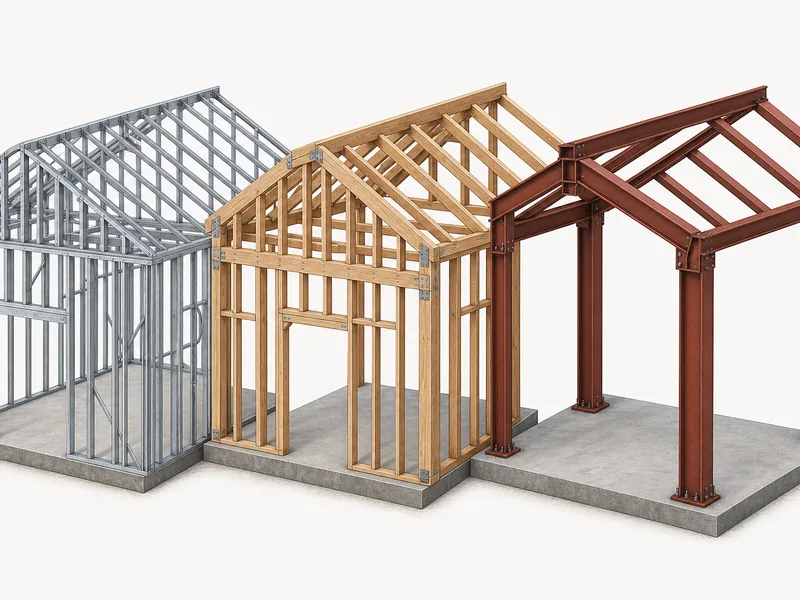
On many buildings the two steels are partners not rivals: a hot-rolled primary frame carries the spans while cold-formed sections frame the walls and infill. That is the same staged decision as choosing a portal frame vs truss for the main structure first, then framing the rest in light-gauge steel.
Standards, Corrosion Protection, and Code Acceptance
Cold-formed steel framing connects to the building code through published design standards, and naming the right one matters more than reciting clauses. The standard is what tells a designer the capacities came from a defined method.
In North American code work, structural members follow AISI S240, the standard for cold-formed steel structural framing, and non-structural members follow AISI S220, both referenced through the International Building Code. To a designer that reference means the system is engineered to recognized procedures instead of rules of thumb. Local code adoption and project jurisdiction still control, so a project outside the United States confirms which standards its authority having jurisdiction actually enforces before design begins.
Corrosion resistance comes from the galvanized zinc coating on the sheet, which protects the steel over a long service life. The coating is not a blank check. In coastal or high-humidity exposure, fasteners and cut or lapped edges are common vulnerable points and the first places to inspect, because that is where bare steel or dissimilar metals can react. How the coating is specified and maintained is its own decision, and the trade-offs between coating approaches are weighed in galvanizing vs painting steel.
Where Cold Rolled Steel Framing Fits Best
Cold rolled steel framing has a clear role where loads are repetitive, spans are moderate, and a light, non-combustible, dimensionally stable frame is an advantage. The first split that governs application is structural versus non-structural.
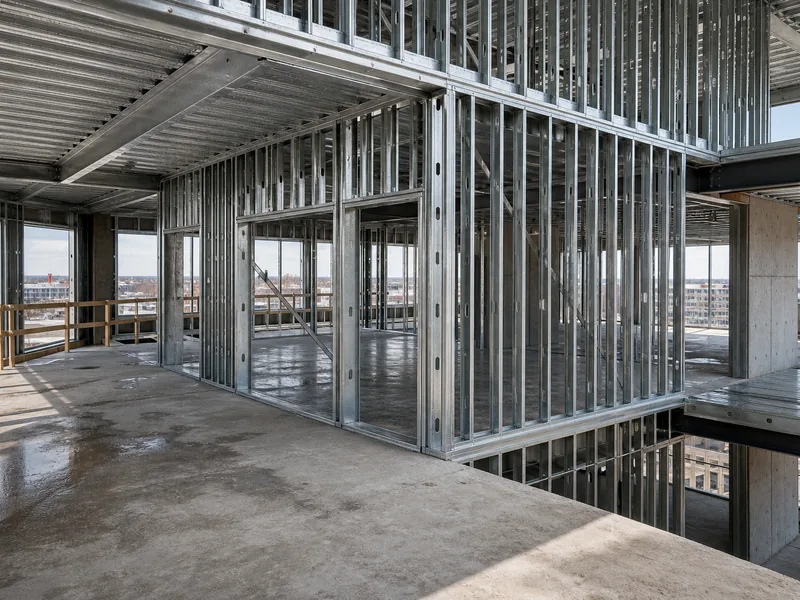
Non-structural cold-formed framing handles interior partitions and similar assemblies that carry no building load, limited mainly by height and serviceability. Structural cold-formed framing can carry real load when it is engineered for that duty, exterior wind-bearing walls, load-bearing walls, floors, and roofs, and the system has been used in buildings taller than ten stories. Low- and mid-rise commercial, multifamily, and mixed-use buildings are its core territory, while very long clear spans and heavy industrial point loads are where it hands off to hot-rolled steel.
Prefabrication is where the repeatability pays off most. Because the members are light and consistent, walls and floor cassettes can be panelized off-site and stood up quickly, which is why cold-formed sections appear so often in pre fabricated metal buildings and panelized systems. Before committing to a structural approach, it helps to weigh this framing against the broader range of types of metal buildings so the frame matches the use.
Project Fit Checks Before Specification
Specifying cold-formed steel framing works best in a fixed order, because each decision constrains the next. The order is what keeps a member schedule honest.
Settle whether each assembly is structural or non-structural first, since that one call decides which standard and capacities apply. Then fix the load and let it drive section, gauge, and yield strength together through a member schedule, instead of reaching for a familiar 16- or 24-inch spacing and hoping it holds. Last, match the galvanized coating to the exposure, confirm the connection details, and check the design path against AISI S240 so the frame ties cleanly into code.
Work in this order: use class first, member schedule and gauge second, coating and connections third. After that, the comparison against wood or red iron is much easier to defend. Where a project needs C/Z purlins and profile steel processed to a verified spec, that is the part KAFA supports on its roll-forming and profile lines. A full light-gauge stud and track package is confirmed against project drawings instead of assumed.
Frequently Asked Questions
Is cold rolled steel framing the same as cold-formed steel framing?
Cold rolled steel framing and cold-formed steel framing point to the same light-gauge system in everyday search and buying language. The difference is one of layer: cold-rolled describes the parent sheet, cold-formed describes the roll-formed sections, and light-gauge describes the system. For formal specifications and code references, cold-formed steel framing, or CFS, is the term to use.
What gauge or thickness is cold rolled steel framing?
Cold-formed framing typically runs from about 0.0147 in. (0.373 mm) to roughly 1/8 in. (3.175 mm), called out in mils or gauge. The right value depends on whether the member is structural or non-structural and on the load, span, and deflection limit it has to meet. Gauge is set on a member schedule, not by a single default.
Is cold-formed steel framing load-bearing?
Cold-formed steel framing can be load-bearing when it is engineered as structural framing. In that role it carries walls, floors, and roofs and has been used above ten stories, with capacities set by structural design, connections, and bracing. In its non-structural role it frames partitions that carry no building load.
Is cold-formed steel framing cheaper than wood?
Cold-formed steel is not automatically cheaper than wood on material price alone. Any advantage tends to come from faster erection, less jobsite waste, dimensional consistency, and lower long-term maintenance, so the comparison depends on the building type, labor market, and design instead of a fixed number.
Does cold rolled steel framing meet building code?
Cold rolled steel framing meets code when it is designed to the AISI standards referenced by the building code, S240 for structural framing and S220 for non-structural in North American work. Local code adoption and the authority having jurisdiction still control, so projects confirm which edition and which standards apply before fabrication.