



Galvanizing and painting are the two most common ways to protect structural steel from corrosion, and the choice between them shapes maintenance budgets for decades, not just the first invoice. Both methods work, but they fail in different ways and on different timelines. A coating decision that looks identical on day one can diverge sharply by year ten, especially outdoors.
This comparison weighs the two on the variables that drive the decision: how each protects steel, what they cost over a project’s life, how long they last, and where each fits. It does not cover paint color selection or step-by-step coating procedures; the focus is choosing a corrosion-protection strategy for steel structures and components. Where useful, it also looks at a third option many buyers overlook, using both together.
How Galvanizing and Painting Protect Steel Differently
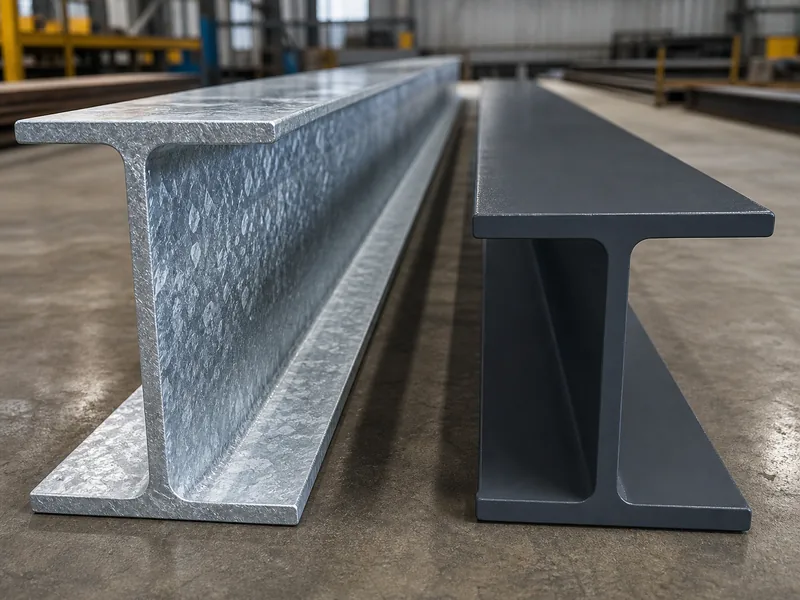
The core difference is that galvanizing protects steel both as a barrier and sacrificially, while paint protects only as a barrier. Hot-dip galvanizing forms a metallurgical zinc-iron coating bonded into the steel surface. Because zinc is more reactive than steel, it also corrodes first to shield any exposed steel through what the industry calls cathodic protection (American Galvanizers Association). Paint, by contrast, is a film sitting on top of the steel and relies on that film staying intact.
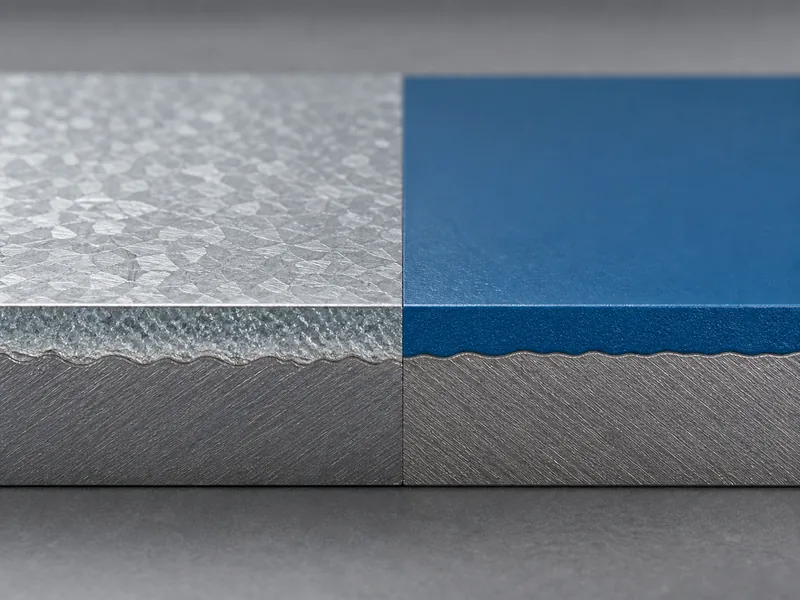
The mechanism difference decides what happens after damage. When a galvanized surface is scratched, the surrounding zinc keeps protecting the small area of bare steel, so a scrape rarely turns into a rust site. When paint is scratched or cracked, the barrier is broken and corrosion of the underlying steel can start right at that point. The same gap shows up during handling. Galvanized members better tolerate the knocks of shipping and erection, while painted assemblies need careful packing and still tend to arrive with chips that have to be touched up.
Why Painted Steel Often Costs More Over Time
Basic paint systems can look cheaper at purchase, but repeated recoating can reverse that advantage on long-life outdoor projects. Up-front application of paint is often cheaper than galvanizing; by some accounts galvanizing can run on the order of twice as much per pound initially, depending on the paint specification (Piping Technology & Products). That gap narrows, and sometimes reverses, once repainting cycles enter the math.
Life-cycle cost is where the comparison gets settled. One widely cited analysis published by the American Galvanizers Association, drawing on KTA-Tator (2020), modeled a 250-ton project over 30 years in an eastern-U.S. industrial exposure, with paint costs based on SP6 surface preparation and life-cycle figures assuming a 4% interest rate and 3% inflation. Under those published assumptions, galvanizing’s initial cost was also its 30-year cost, while multi-coat paint systems carried life-cycle costs several times their initial price once maintenance was counted. Those figures are tied to that specific project size, region, and financial model, so treat them as direction rather than a quote. The direction is consistent across sources: the longer the service life and the harsher the exposure, the more repainting erodes paint’s early savings.
The practical variable to pin down is the service life you are designing for. For a temporary or short-life structure, paint’s lower entry cost may genuinely be the better call. For steel meant to stand for decades, the maintenance line usually decides the question.
Service Life and Maintenance Compared
Service-life estimates for the two coatings sit in very different ranges, and the spread within paint is the part worth reading closely. Hot-dip galvanizing commonly delivers maintenance-free atmospheric protection measured in decades; the American Galvanizers Association cites 75 years or more in many atmospheric environments, and galvanizers’ associations note it can exceed 100 years in low-corrosion conditions. Published figures for paint vary much more widely, from a recoat every three to five years in exposed or coastal service to roughly 12 to 25 years for a well-applied system in milder conditions, depending on the paint type and the environment.
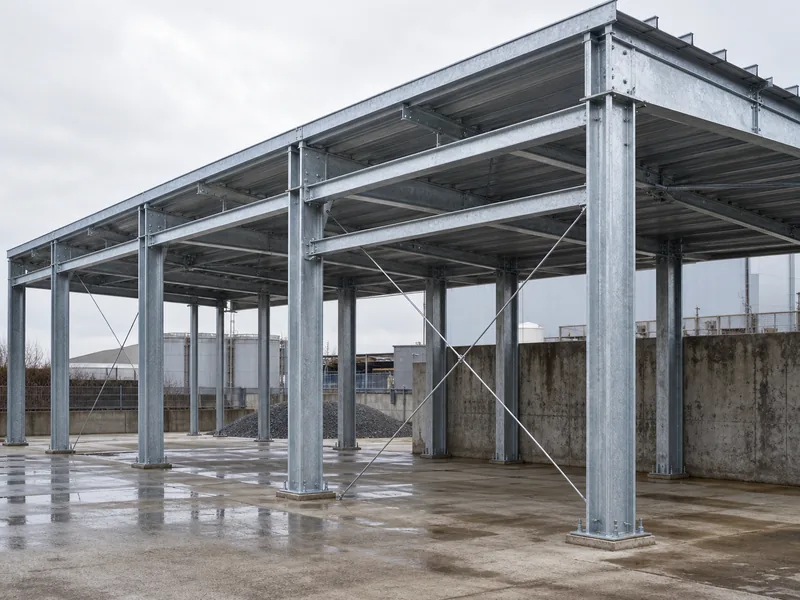
That variability is the real maintenance signal. Galvanizing’s timeline is relatively predictable because the zinc weathers slowly and evenly. Paint’s depends heavily on application quality, film thickness at edges, and exposure. In coastal or high-humidity service, the first places to check on a painted structure are fasteners, seams, and cut edges, because thin paint film at corners and edges is where breakdown usually starts. The verification step before committing to either coating is simple: match the expected recoat interval against the environment the steel will actually see, not a general spec-sheet number.
Galvanizing vs Painting: Side-by-Side Decision Factors
Beyond cost and lifespan, several physical factors separate the two coatings on a real project. The table below summarizes the dimensions that most often tip a decision; the galvanizing values reflect hot-dip figures published by the American Galvanizers Association, while paint values vary by system and applicator.
| Decision factor | Hot-dip galvanizing | Paint |
|---|---|---|
| Protection type | Barrier plus cathodic (sacrificial zinc) | Barrier only |
| Behavior when scratched | Surrounding zinc still protects bare steel | Underlying steel can start corroding at the break |
| Coating thickness / uniformity | Uniform; defined by standards such as ASTM A123/A123M or ISO 1461 | Variable; thin at edges and corners |
| Application | Factory-controlled, weather-independent | Factory or field; sensitive to temperature, humidity, wind |
| Edges and hard-to-reach areas | Fully coated in the dip | Often under-coated, where corrosion starts |
| Appearance and color | Metallic gray finish | Wide color and finish range |
| Field touch-up | Less frequent; still needed for cut, welded, or damaged areas | More frequent, especially after handling or field damage |
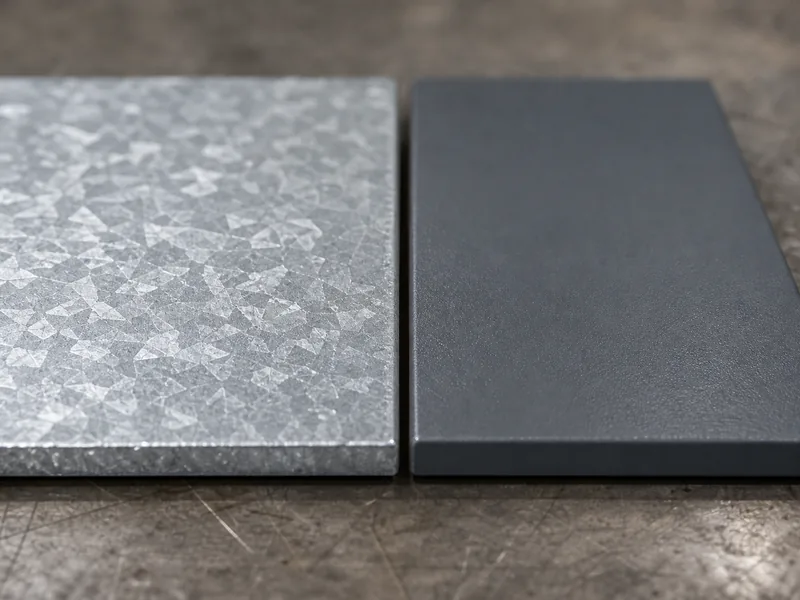
Read the table as a filter, not a scoreboard. Galvanizing leads on durability, coverage, and weather-independent application, which is why it is often preferred for exposed structural steel. Paint leads decisively on one factor that matters for many projects: appearance and color choice. For fabricated hot-dip galvanized articles, standards such as ASTM A123/A123M or ISO 1461 define coating requirements; the applicable version and product scope are details to confirm with the fabricator rather than assume.
When Painting Steel Still Makes Sense
Paint is the better choice when appearance, color flexibility, or low up-front cost outranks maximum service life. Most comparisons, this one included, lean toward galvanizing for durability, but that lean hides real cases where paint is the right answer. The honest test is whether the project’s priority is decades of maintenance-free life or something else.
A few situations favor paint:
- Color and aesthetics drive the spec — architectural steel, branded structures, or anything needing a specific finish.
- Indoor or low-corrosion service — interior framing and components that rarely meet moisture gain little from cathodic protection.
- Short-life or temporary structures — where a multi-decade coating outlasts the structure’s purpose.
- A tight initial budget — when up-front cost governs and the owner accepts the repaint schedule.
The variable that should make you reconsider paint is exposure. Once steel faces coastal salt, persistent humidity, or industrial atmospheres, paint’s maintenance burden climbs quickly, and the appearance advantage rarely justifies the recoating cycle. The same logic applies to coated roofing and cladding panels, where finish options matter but exposure is constant, a trade-off worth weighing alongside the panel choices covered in types of metal roofs.
Using Galvanizing and Paint Together: Duplex Systems
Galvanizing and paint are not mutually exclusive; painting over galvanized steel creates a duplex system that combines both protections. The zinc supplies barrier and cathodic protection underneath, while the topcoat adds color and slows the zinc’s consumption, so the two together usually outlast either one alone. This is the option that disappears when the question is framed as a strict either/or.
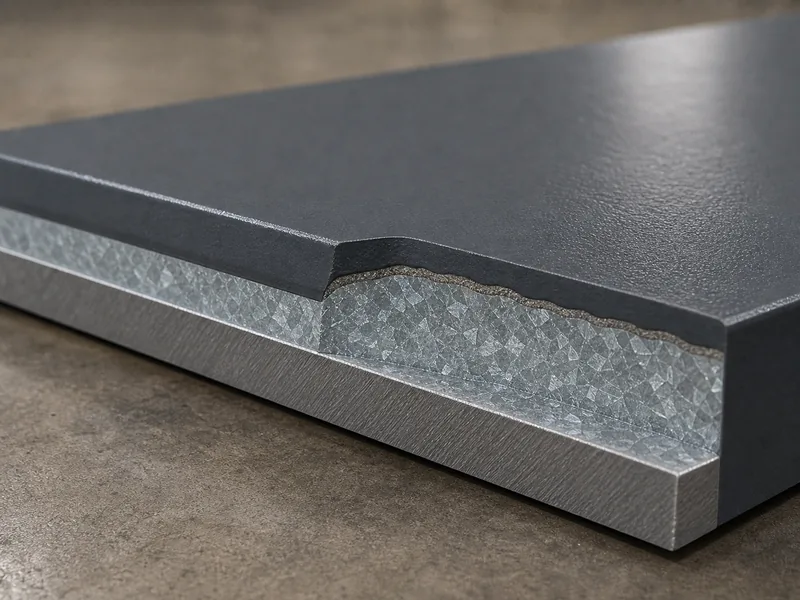
Duplex makes sense when a project needs both long maintenance-free life and a specific appearance, or when steel sits in a severe environment where extending the zinc’s life pays off. A duplex system depends on proper surface preparation so the paint bonds to the galvanized layer, and that prep is a common failure point if it is rushed. For owners weighing whether the added cost is worth it, the deciding variables are again exposure and appearance: when both are non-negotiable, duplex often beats picking one coating and compromising on the other.
Choosing the Right Protection for Your Steel
The decision comes down to matching the coating to exposure, intended service life, and appearance needs, in that order. Start with the environment the steel will face: coastal, industrial, and high-humidity exposures push hard toward galvanizing or a duplex system, while sheltered indoor service widens the field to include paint. Then set the service life you are actually designing for, because the longer it is, the more galvanizing’s flat maintenance cost outweighs paint’s lower entry price. Only after those two should appearance decide among galvanizing, paint, or duplex.
Before committing, confirm three things: the corrosion category of the site, the coating thickness or specification (for galvanizing, against ASTM A123/A123M or ISO 1461), and who controls application quality. Corrosion protection is also only one layer of a steel building’s overall protection plan. Fire performance and other requirements run in parallel and should be coordinated early rather than traded against it, which is why it helps to plan corrosion choices alongside steel building fire protection.
Getting the coating specification right is as much a fabrication question as a design one, because the coating choice has to suit how the steel is detailed, fabricated, and assembled. As steel building manufacturers, we apply factory-controlled fabrication and ISO 9001:2015 quality management across H-beam, box-section, and purlin production, and can coordinate coating specifications at the design and project-documentation stage. The final galvanizing or paint application, thickness acceptance, and coating-applicator qualifications should be confirmed against the project specification and supplier documentation.
Frequently Asked Questions
Which lasts longer, galvanizing or paint?
Galvanizing typically lasts far longer than paint in outdoor exposure. Hot-dip galvanizing commonly provides maintenance-free protection for several decades, with the American Galvanizers Association citing 75 years or more in many environments. Paint systems generally need recoating somewhere between every few years and a couple of decades, depending on paint type and exposure.
Is galvanized steel cheaper than painted steel?
Galvanized steel is usually more expensive up front but often cheaper over a long service life. Paint’s lower initial cost can be offset or exceeded by repeated repainting, so the answer depends on how long the steel must last and how harsh its environment is.
Can you paint over galvanized steel?
Painting over galvanized steel is a recognized approach called a duplex system. It combines the zinc’s cathodic protection with a paint topcoat for color and added life, but it requires proper surface preparation so the paint adheres to the zinc.
Which is better for coastal or marine steel?
Galvanizing, or a duplex system, is generally the stronger choice for coastal and marine steel. Salt and constant humidity accelerate paint breakdown at edges and seams, whereas zinc’s cathodic protection holds up better; where appearance also matters, a duplex system adds a topcoat over the zinc.
Does galvanized steel come in different colors?
Standard hot-dip galvanizing produces a metallic gray finish rather than a color range. To get specific colors with galvanizing’s durability, the steel is painted over the zinc as a duplex system, which is the usual route when both color and long life are required.