



Steel building fire protection is the set of measures that keep a steel frame standing long enough for people to get out and for crews to respond, even though the steel itself does not burn. For an owner, developer, or contractor planning a steel or metal building, the practical questions are narrow: does this frame need protection at all, how many hours does the code require, which method fits the project, and how do you confirm the installed work meets the rating.
This article works through those decisions in order. It does not interpret specific code sections line by line, design sprinkler or detection systems, or get into coating chemistry, all of which belong to the relevant specialist and your local authority. The goal here is to help you specify fire protection without overspending on steel that never needed it or under-protecting steel that did.
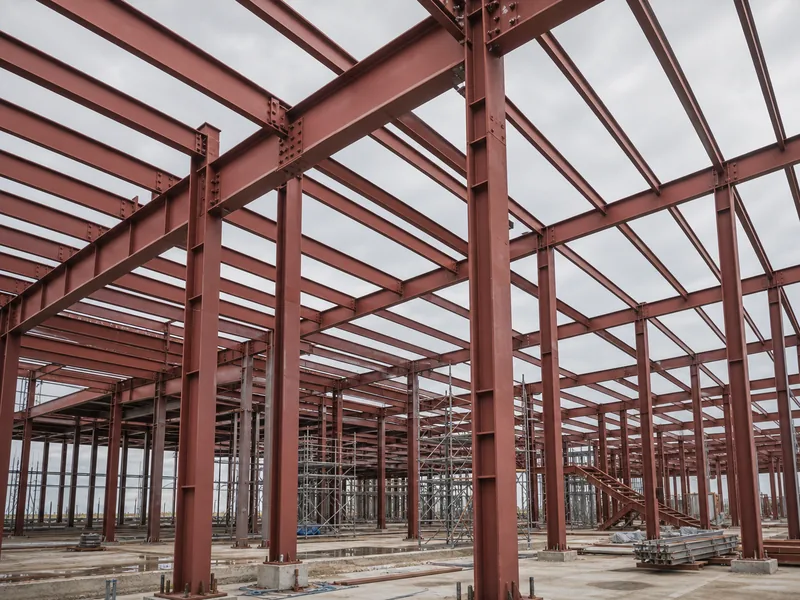
Why Steel Buildings Need Fire Protection (Even Though Steel Doesn’t Burn)
Steel is noncombustible, yet it still loses load-bearing strength as it heats, and that strength loss, not flammability, is the reason a steel building can need fire protection. Building codes generally treat structural steel as a noncombustible material, meaning it will not ignite or feed a fire. Heat is the problem. As a member’s temperature climbs, its yield strength falls.
Most structural steels begin to lose meaningful strength somewhere past roughly 300 to 400°C (about 570 to 750°F). By the time a member reaches the 550 to 650°C band (very roughly 1,000 to 1,200°F), it has typically shed on the order of half its room-temperature strength. The exact point depends on the steel grade, how heavily the member is loaded, and how it is restrained, so a single “failure temperature” is misleading. For context, ordinary building fires can reach around 2,000°F, well into the range where unprotected steel softens. Steel melts at a much higher temperature, near 2,500°F, but it becomes structurally unsafe long before it ever melts.
That gap matters because unprotected steel can lose enough strength to fail in as little as 10 to 30 minutes under a standard fire, depending on the section size and how heavily it is loaded. Fire protection buys rated time; it does not make steel “fireproof,” which is a misnomer because no structural material is truly fireproof. On a real frame, slender, heavily loaded members heat and weaken faster than stocky members carrying light loads. That is why two beams in the same fire can behave very differently, and why protection is specified member by member instead of as one blanket number.
What Fire-Resistance Ratings Mean: From 1-Hour to 4-Hour
A fire-resistance rating is a length of time, not a material property: it states how long a protected assembly held its structural role under a standardized furnace test, expressed as 1, 2, 3, or 4 hours. The test follows a standardized time-temperature curve defined by ASTM E119 and its companion standard UL 263, which climbs past 1,000°F within the first minutes and approaches 2,000°F by the four-hour mark.
A “2-hour” beam is therefore not “twice as safe” as a 1-hour beam in everyday terms; it kept performing for two hours under that defined curve. Ratings belong to tested assemblies, which is why a compliant specification points to a specific tested design rather than to a coating alone. The rating you must reach is the single number that drives everything downstream, from the method you can use to the thickness that gets applied, so it is worth pinning down before any product is selected. When in doubt, confirm the rating against the tested assembly or listed design that the project intends to use.
Does Your Steel Frame Actually Need a Rating?
Building codes, not the steel itself, decide whether your frame needs a fire-resistance rating, and the trigger is the construction type assigned to your project. Under the IBC, the required rating for the structural frame is set by construction type and ranges from no rating up to about 3 hours, with the exact figure depending on the adopted code edition, the occupancy, and applicable footnotes. Treat any specific hour value as something to verify with your local authority having jurisdiction (AHJ), not as a fixed rule.
Many low-rise, open, or fully sprinklered steel structures require little or no passive protection on the frame. Open-deck parking structures and some low-rise industrial or open buildings often fall into construction types that need only active protection or none on the steel. Large open structures such as clear span buildings frequently sit in that category, which is why a warehouse frame and a mid-rise office frame can have completely different requirements. Even when the frame is exempt, specific walls may still need a rating for exit corridors, occupancy separations, or closeness to a property line. In other words, “the frame is fine” does not always mean “nothing is rated.” Pre-engineered metal buildings can meet 1- and 2-hour requirements where they apply, using tested wall, roof, and column assemblies.
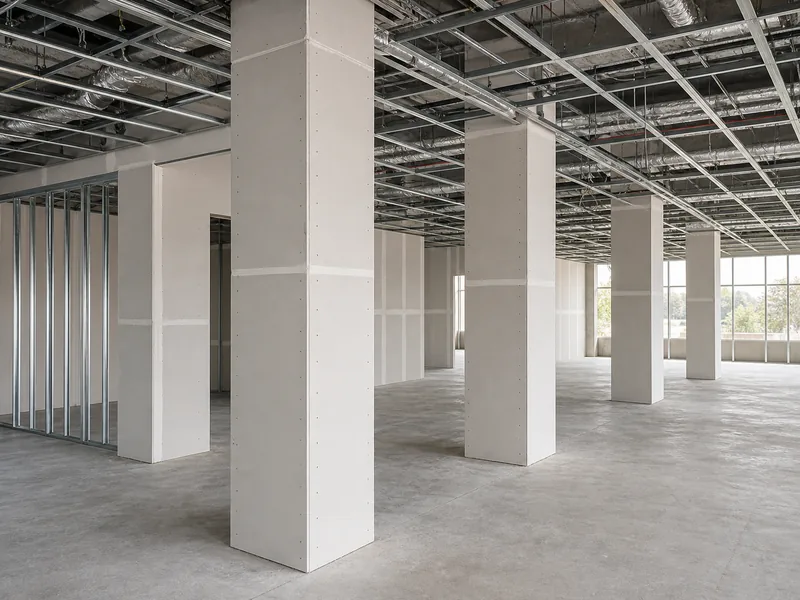
Active fire protection feeds directly into this decision. Sprinklers, fire walls, and compartmentation can change what passive protection the frame needs, and in some buildings active systems carry much of the load that protection of the steel would otherwise carry. Whether a sprinkler trade-off is permitted is a code and AHJ decision, not a default. The reliable path is to pull the construction type and required ratings from the project’s code analysis, confirm any active-system allowances, and only then specify protection for the steel.
Passive Fire Protection Methods for Structural Steel
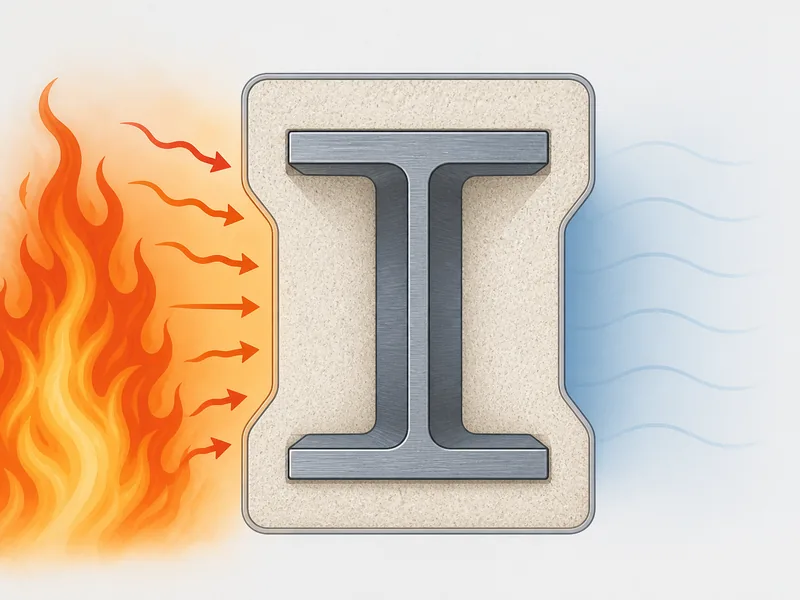
Passive fire protection works by insulating the steel so it heats slowly, and the practical choices come down to coatings, sprays, boards, or encasement. Each protects the same way, by delaying heat reaching the steel, but they differ in finish, cost behavior, and where they fit.
| Method | How it protects the steel | Where it typically fits | Main trade-off |
|---|---|---|---|
| Intumescent coating | Thin film that swells into an insulating char when heated | Exposed or architectural steel that must look finished | Cost rises with required hours; needs compatible primer and controlled application |
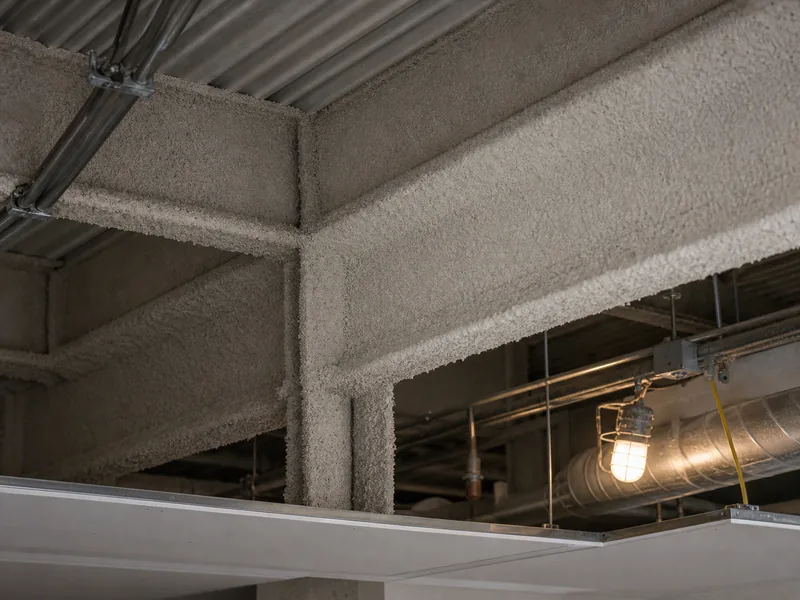
| Spray-applied fire-resistive material (SFRM) | Thick sprayed layer of cementitious or mineral-fiber material | Concealed commercial and industrial steel above ceilings | Rough finish; overspray and masking; can be knocked off and need patching |
| Rigid board / gypsum | Boxed-in boards that insulate and double as a finished surface | Columns and beams where a clean dry finish is wanted | Labor to box members and detail connections |
| Concrete encasement | Concrete shell around the member | Heavy-duty or impact-prone locations | Heavy, space-consuming, less common today |
| Flexible blanket | Wrapped insulating blanket around the member | Retrofit and awkward geometry | Fewer suppliers; detailing at junctions |
Intumescent Coatings
Intumescent coatings look like paint when applied and expand to many times their original thickness when heated, forming an insulating char over the steel. Products vary in how far they expand, commonly cited in the range of roughly 50 to 100 times. They suit steel that stays visible, but the cost per protected member climbs as the required rating goes up, and they depend on a compatible primer and controlled film thickness to perform.
Spray-Applied Fire-Resistive Materials (SFRM)
SFRM is the economical workhorse for concealed steel, sprayed on as a cementitious or mineral-fiber layer. Its required thickness is not a single number; it is set by the member’s section factor and the target rating according to a tested design, so heavier ratings and slender sections call for more material. The finish is rough, which is fine above a ceiling but rarely acceptable on display, and it can be damaged by later trades and need patching.
Rigid Boards and Gypsum
Board encasement, including fire-rated gypsum board, protects the steel while giving a clean, dry finish that can serve as the interior surface. The work is predictable and avoids overspray, but boxing in columns and beams takes labor and careful detailing at connections.
Concrete Encasement and Flexible Blankets
Concrete encasement is durable and robust but heavy and space-consuming, so it is far less common now than sprays and coatings. Flexible blankets wrap individual members and are useful for retrofits or awkward geometry where spraying or boxing is impractical, though fewer suppliers offer them and junction detailing needs attention.
How to Choose the Right Method for Your Building
The right method follows from the rating you must reach, the section sizes you are protecting, and where the steel sits in the finished building. The same beam can call for a different solution in an exposed lobby than it does above a warehouse ceiling. Weigh these variables together rather than picking a product first:
- Required rating (hours): Higher durations push toward sprays, boards, or thicker intumescent, and they raise cost.
- Section factor (W/D or Hp/A): Slender members with more surface per unit mass heat faster and need more protection than stocky members, which often sets thickness more than the headline rating does.
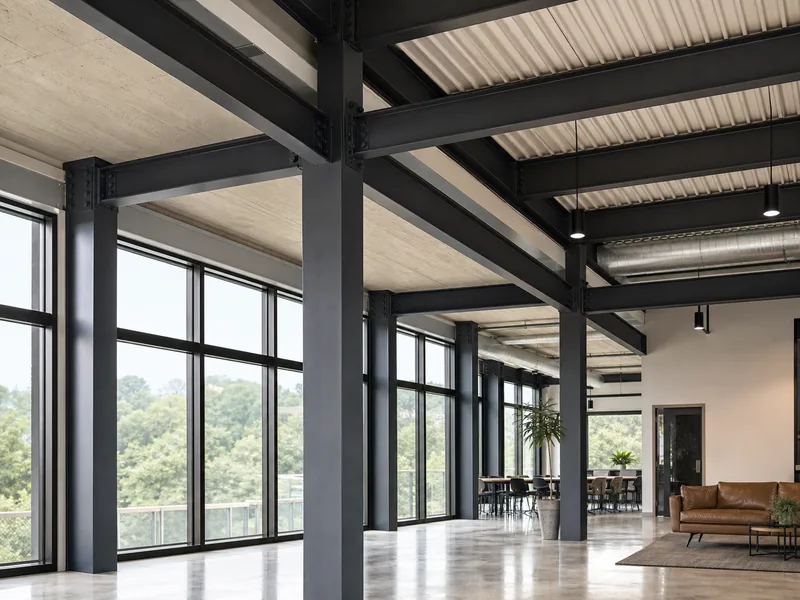
- Exposure and aesthetics: Exposed or architectural steel favors paint-like intumescent; concealed steel favors economical SFRM or board.
- Application environment: Humidity, freeze-thaw, temperature limits, and drying time govern what can be applied and when.
- Substrate and compatibility: The shop primer must be compatible with the chosen topcoat or intumescent, because mismatched systems cause adhesion failures that surface later.
- Schedule and access: On-site spraying needs masked, blocked-off areas and cure time, while shop-applied options can reduce site delays.
Cost behaves the same way: it is driven by the method, the required hours, the section factor, accessibility, and the risk of rework, not by a single price per square foot. A common and avoidable mistake is to specify intumescent on hidden steel, which pays for an appearance nobody sees, or to spray SFRM on feature steel, which then forces an expensive enclosure. Matching the method to where the steel lives usually saves more than chasing the cheapest unit rate.
Verifying Fire Protection and Keeping It Effective
Fire protection only counts if the installed assembly matches a tested design and stays intact over the building’s life. The specification should reference a tested assembly or UL design number for the exact rating and member type, and the applied thickness should be checked against that design. Restraint conditions (restrained versus unrestrained) should also be documented by the design professional, since they affect the rating. Rated construction is not only about columns and beams; roof and wall assemblies carry ratings too, so the types of metal roofs and wall systems you choose feed into the same fire analysis rather than sitting outside it.
Keeping protection effective is mostly about sequencing and upkeep. SFRM is easily knocked off by trades running ducts and conduit, so it should be inspected and patched after those crews finish, and damaged intumescent needs recoating to its specified thickness. Coordinate early with the steel building companies fabricating your frame, so the shop primer is compatible with the specified intumescent or spray system and connection details leave room for the protection. A primer mismatch or a tight detail discovered on site is far more expensive to fix than to prevent.
Specifying Steel Building Fire Protection With Confidence
Specifying steel building fire protection is an ordering problem: settle the required rating first, then the method, then the verification. Start by confirming the construction type and the hours it demands with your code analysis and AHJ, including whether sprinklers or other active systems change what the frame needs. Match the method to the section factor, the exposure, and the application environment, and reserve intumescent for steel that will be seen. Then tie the specification to a tested assembly, check thickness in place, and protect the work through the rest of construction.
As a steel structure fabricator working in light and heavy steel under ISO 9001:2015 quality management, KAFA builds frames to a project’s specified construction-type and rating requirements and can coordinate shop priming so it is compatible with the fire-protection scope. The rated assembly itself is verified through the tested design and the applicator’s listed system. Lock the required rating and the tested assembly before steel is primed, and fire protection stops being a late-stage surprise on the schedule.
Frequently Asked Questions
Is steel fireproof?
No structural material is truly fireproof, including steel. Steel is noncombustible and will not burn, but it loses strength as it heats, so the aim of fire protection is a rated duration of resistance rather than immunity to fire.
Do all metal buildings need fireproofing?
Many metal buildings need little or no passive fire protection on the frame, but the requirement depends on construction type, occupancy, and local code. Even when the frame is exempt, specific walls or separations may still need a rating, so confirm the requirement with your AHJ before assuming either way.
How many hours of fire resistance does structural steel need?
Required ratings for the structural frame typically range from 0 to about 3 hours, set by the building’s construction type under the adopted code. Verify the exact figure with your AHJ, since the edition in force, the occupancy, and code footnotes all affect it.
How thick is fireproofing on steel?
Coating or SFRM thickness is not a fixed value; it is determined by the member’s section factor and the target rating according to a tested design. Heavier ratings and more slender sections call for more material, which is why thickness is specified per member, not as one project-wide figure.
Does steel building fire protection lower insurance costs?
Steel’s noncombustibility often earns more favorable insurance rates, but the amount varies by carrier and region. Confirm any benefit with your insurer instead of assuming a fixed discount, and treat fire protection mainly as a code and life-safety measure.
Further reading
- MBMA Fire Protection resource (Metal Building Manufacturers Association): industry-body reference showing that metal buildings can meet 1- and 2-hour ratings through tested assemblies. Most useful to pre-engineered metal building owners confirming what their wall, roof, and column assemblies can achieve. Available from mbma.com.
- International Building Code (IBC) (International Code Council): the code that assigns required structural-frame ratings by construction type and governs fire walls and barriers. Check the edition your jurisdiction has adopted, since requirements change between editions. Available from the ICC.
- ASTM E119, Standard Test Methods for Fire Tests of Building Construction and Materials (ASTM International): the test standard behind hourly ratings, useful for understanding what a “1-hour” or “2-hour” rating actually measures. It defines the test, not the rating any given building needs.