




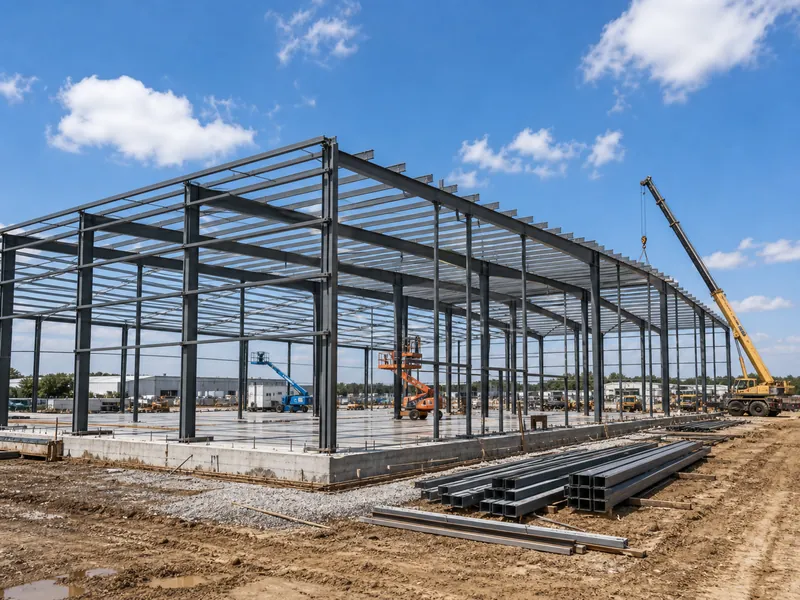
Building an industrial building is less one project than a stack of decisions that lean on each other, from the first soil boring to the day the inspector signs off. Get the early constraints right — footprint, clear height, floor loads, and how the structure will go up — and the schedule and budget that follow tend to hold. Steel framing, including pre-engineered metal building (PEMB) systems, has become the default skeleton for most manufacturing, storage, and distribution work because it clear-spans wide, erects fast, and adapts when operations change. What follows walks the build roughly in the order it happens: planning, permits and foundation, frame erection, the method choice, envelope and commissioning, and what the whole thing costs.
What Counts as an Industrial Building — and Why Steel Leads
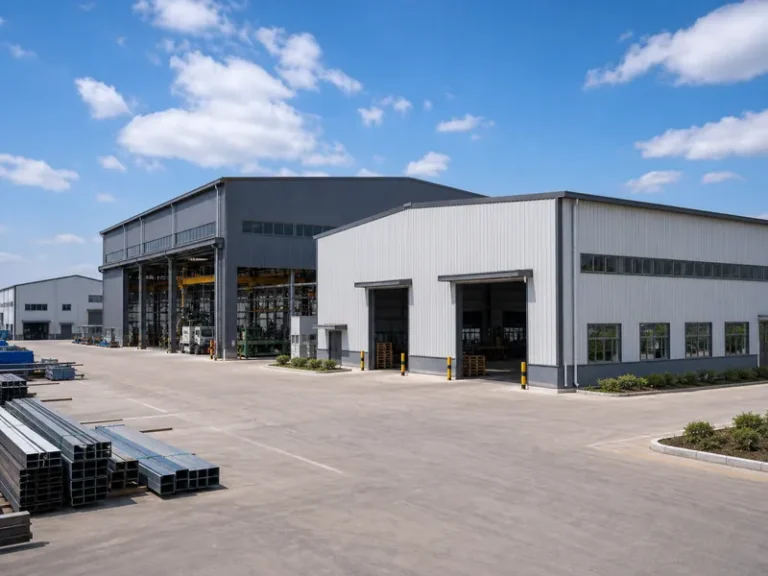
An industrial building is organized around a process — making things, storing them, or moving them — rather than around people at desks, so open floor area and vertical clearance drive the design more than partition count does. The categories range from manufacturing plants to warehouses, distribution centers, and flex space; the main types of industrial buildings differ mostly in how much clear height, floor load, and dock access each one needs, and that is a separate question from how any of them gets built.
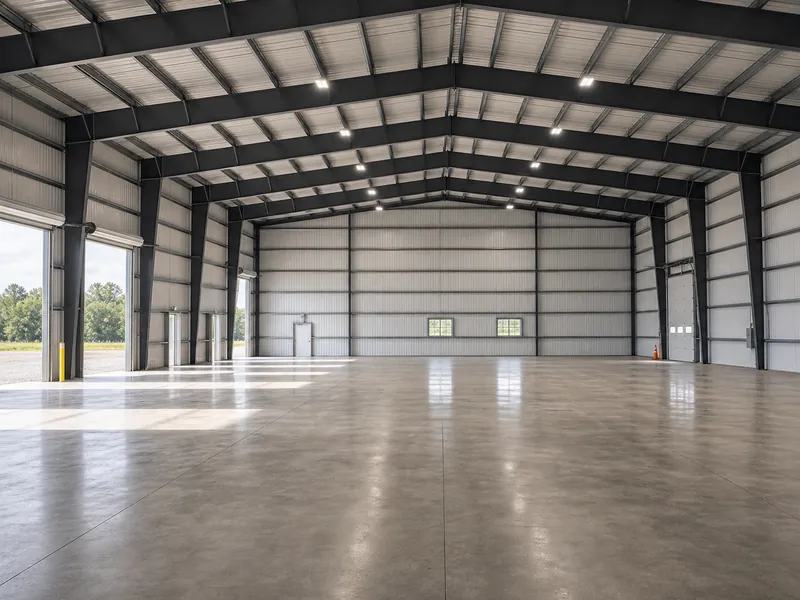
Steel dominates the structure for a practical reason: a rigid steel frame can clear-span wide bays with no interior columns, leaving a column-free floor that a plant can re-tool or a warehouse can re-rack without designing around posts. It also goes up quickly and carries heavy roof and crane loads predictably. Concrete still does the rest of the structural work — in the slab, the foundations, and sometimes tilt-up wall panels — but the roof and the long-span framing are almost always steel.
Planning and Design: Locking In Size, Loads, and Clear Height
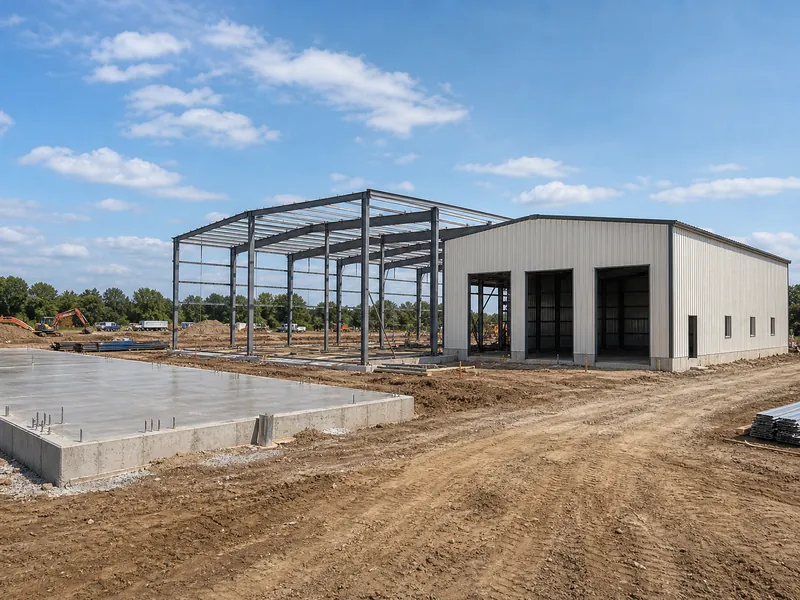
The figures that fix your structure, and most of your budget, are settled during steel building design, well before anyone orders steel. Four of them carry the most weight. Footprint follows from the operation — production line length, racking layout, truck circulation. Clear height is set by what stacks or hangs inside, not by the roof. Floor load depends on axle weights, forklift traffic, and equipment pads. Bay spacing, the distance between columns, trades column count against aisle and rack flexibility.
A frequent early miss is sizing clear height to today’s racking instead of the next reconfiguration. Two extra feet of eave height costs little on paper and a great deal once the columns are standing, so it pays to size for the building’s second use, not just its first. This is also the stage to bring mechanical, electrical, and plumbing (MEP) thinking in at a concept level, because where the heavy power, drainage, and ventilation runs land will shape the frame and the slab penetrations later.
Permits, Site Prep, and the Foundation
Permits and ground conditions stall more early schedules than steel lead times do. Zoning clearance, the building permit, and any environmental approvals have to be in hand before crews break ground, and a geotechnical survey has to come first because the soil decides the foundation. Weak or expansive soils can turn a routine spread footing into piers or deep foundations, which is a cost and schedule risk to settle before the design is locked.
Site preparation then clears, grades, and compacts the pad and runs underground utilities. Foundation work comes next. A steel building foundation carries anchor bolts cast precisely into the footings and piers, and their placement has to match the frame drawings to the bolt, or erection stalls on day one. The floor slab is its own decision: a standard distribution slab usually runs about 6 to 7 inches, while bays carrying heavy machinery or steady forklift traffic are commonly thickened to 8 to 12 inches and specified at higher strength, often in the 4,000 to 5,000-plus psi range. Thickness here is driven by the loads above it, not by a default.
Erecting the Steel Frame
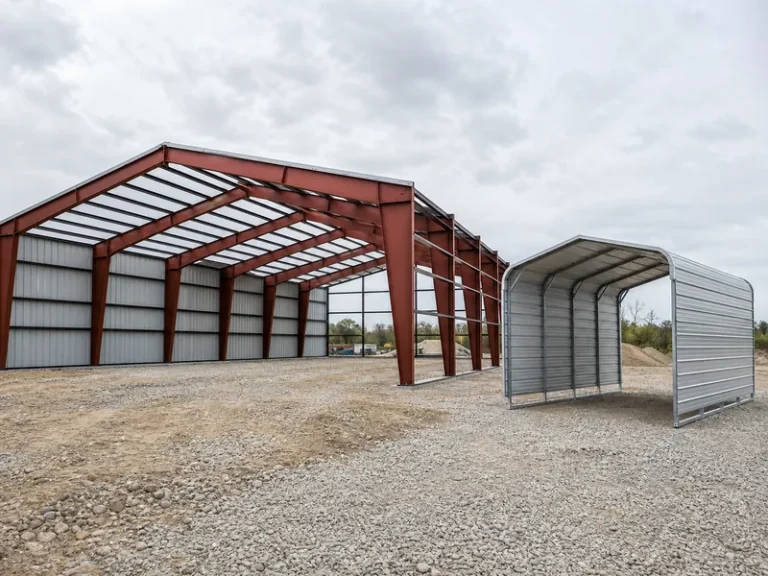
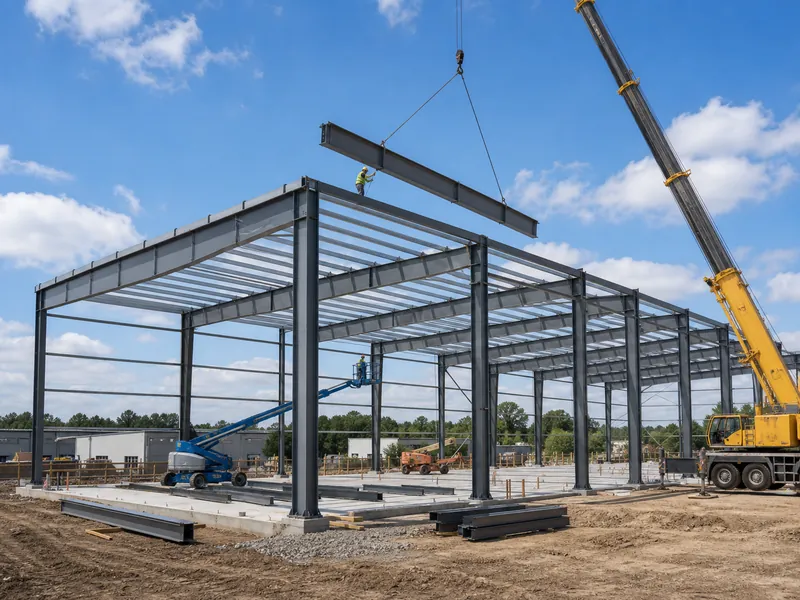
Frame erection follows a fixed order that every steel job repeats, because each step braces the one after it. Crews set columns onto the cast-in anchor bolts, connect the rafters or rigid frames across the top, then run purlins along the roof and girts along the walls as secondary framing before any sheeting goes on. Bracing and bolt-up hold it square and plumb at each stage. The general sequence is the same whether the job is a small shop or a long-span plant; for the broader mechanics, our guides on steel frame construction and how to build steel building go deeper than this overview can.
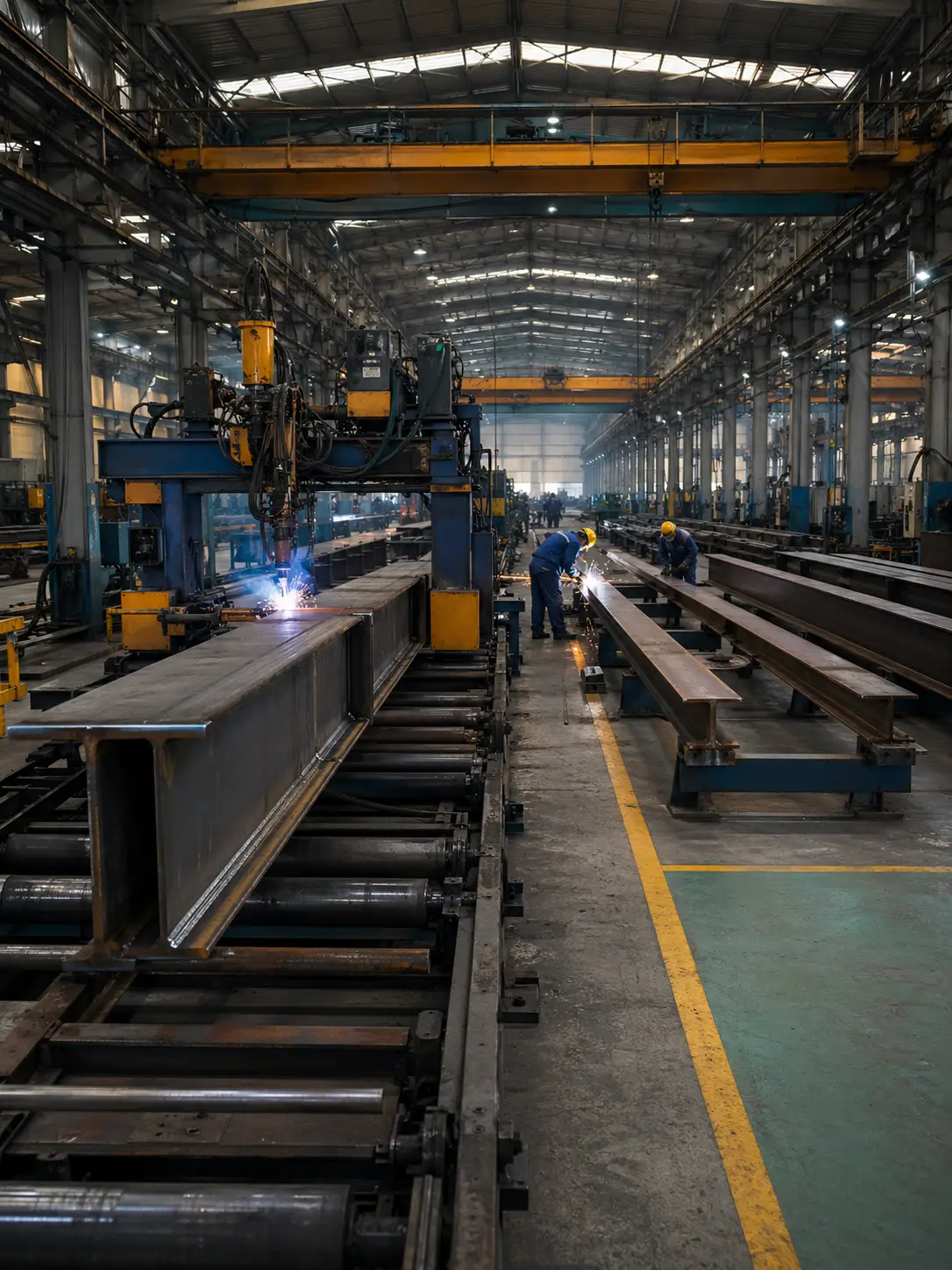
The frame is only ever as good as the shop behind it. KAFA, for instance, runs dedicated H-beam, box-section, and C/Z-section purlin lines at its 20,000-square-meter Qingdao plant under ISO 9001:2015 quality management, with light- and heavy-gauge design, fabrication, and installation handled in house, so primary frames and secondary members arrive cut, drilled, and marked to the erection drawings rather than fettled in the field. On coastal or high-humidity sites, the fasteners and panel laps are the first things to watch on the way up — that is where corrosion and leaks begin, not in the heavy frame — so connection torque, plumb, and weather-side detailing are the checks to sign off before the building is closed in.
Choosing a Construction Method: PEMB, Tilt-Up, or Hybrid
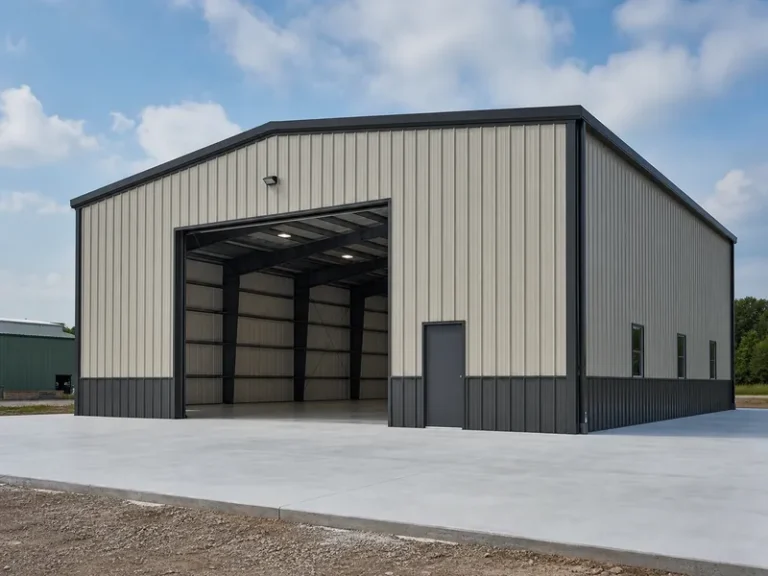
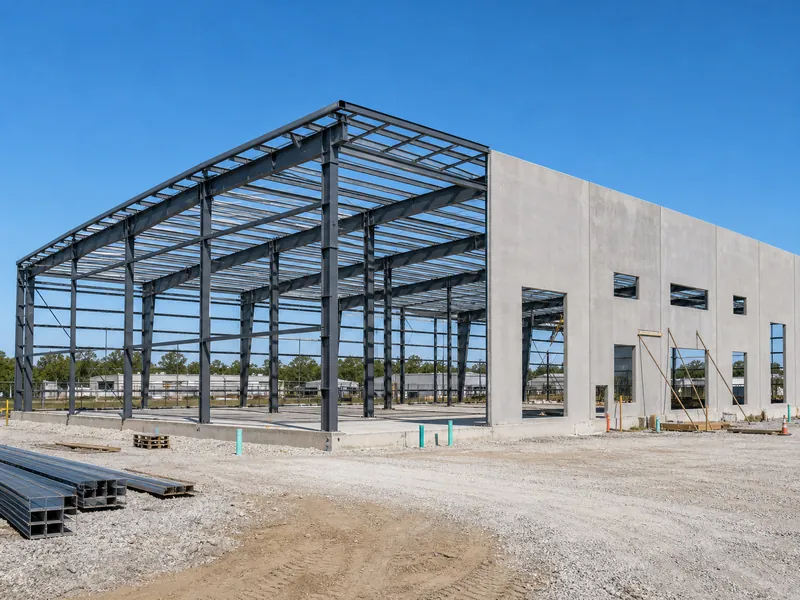
Three structural approaches cover most industrial builds, and the right one tracks span, footprint, and how finished the walls need to be. A PEMB is a steel frame engineered as a kit to the exact span and loads, fast to erect and economical across a wide range of single-story buildings. Tilt-up forms concrete wall panels on the slab and lifts them into place, so the walls double as the envelope. A hybrid pairs a steel clear-span roof with tilt-up or masonry walls.
For most wide-span, single-story plants and warehouses where speed and a column-free interior matter, a PEMB is the default choice. Tilt-up pulls ahead on very large footprints — roughly 50,000 square feet and up — where its concrete walls provide a durable, fire-resistant envelope and the panel count is high enough to be efficient. A hybrid suits a facility that wants both a long clear-span roof and a hard, low-maintenance wall, such as a plant with wash-down or impact exposure along the perimeter.
| Method | Structure | Footprint sweet spot | Walls | Best for |
|---|---|---|---|---|
| PEMB | Engineered steel frame | Small to large, single-story | Steel cladding | Fast, column-free plants and warehouses |
| Tilt-up | Concrete panels + steel roof | Very large (≈50,000+ sq ft) | Concrete (load-bearing) | Durable, fire-resistant big-box facilities |
| Hybrid | Steel frame + concrete/masonry walls | Mid to large | Mixed | Clear-span roof with a hard wall |
Building Envelope, MEP, and Commissioning
Once the frame is decked, the building is closed in and fitted out in a sequence where MEP coordination sets the pace. Roofing and wall cladding — standing seam or insulated metal panels, with insulation to the target R-value — make the building weathertight. Inside, electrical, HVAC, fire protection, and plumbing trades run in an order that has to be sequenced against each other and against the slab penetrations, since rework here is slow and expensive. The MEP design itself — load calculations, duct sizing, sprinkler density — sits with licensed engineers and is beyond this overview.
Commissioning closes the job. Systems are tested and balanced, the contractor inspects columns, connections, bolts, and roof-to-wall seals, and a punch list catches the gaps before the authority having jurisdiction grants occupancy. The seams at ventilation openings and panel joints are a common last-minute leak source, so a close walk of those joints before sign-off saves a callback after the first storm.
What It Costs and How Long It Takes
Industrial build costs split into two numbers that get confused constantly: the shell and the turnkey facility. A shell — a PEMB frame with roof and wall cladding — commonly lands around $20 to $40 per square foot. A turnkey building — site work, foundation, slab, MEP, and interior finishes folded in — runs far higher and scales inversely with size. Recent industry cost surveys put large projects near $77 per square foot, mid-size work around $85, and smaller buildings up toward $130 to $140, because fixed costs spread over less floor area. The same scaling shows up across industrial buildings of most uses.
A worked example keeps the two straight. A 50,000-square-foot distribution building might run roughly $1.5 million as a bare shell at about $30 a square foot, and on the order of $4 million turnkey at about $80 — the gap is everything between a weathertight envelope and a finished, working facility. For costs tied to specific dimensions, a sizing reference like 40×80 metal building cost is more precise than any per-foot average.
> What a square-foot number includes: A shell or PEMB price typically covers the steel frame, roof, and wall cladding — not the slab, site work, permits, MEP, or interior fit-out. A turnkey figure folds all of those in. Poor soil, heavy floor loads, tall clear heights, and dense MEP push any estimate toward the top of its range or past it, so treat a single number as a starting band, not a quote.
Schedules track the same complexity. Most facilities take 8 to 24 months from groundbreaking to occupancy, with three to six of those months often spent in planning and design before any dirt moves. A straightforward warehouse on a clean site can land in the 8-to-12-month range; a manufacturing plant with specialized foundations, process pads, and heavy MEP sits at the long end.
Conclusion
The order you lock decisions in matters as much as the decisions themselves. Settle the design constraints first — footprint, clear height, and floor load — because those three set the structure and rule out the methods that cannot meet them. Choose the method second: PEMB for fast, column-free span; tilt-up where a very large concrete-walled box is the cheaper, harder envelope. Price it last, and only against a clear shell-versus-turnkey line, so a bare frame and a finished plant never get compared as if they were the same number. Anchor placement, slab thickness to load, and weather-side detailing are the items that cause real rework when they are rushed, so they are the ones to confirm before fabrication starts. As a steel structure manufacturer that designs, fabricates, and installs light and heavy frames, KAFA’s role is usually earliest here — turning those locked constraints into a frame and member package that erects to the drawings.
FAQ
How much does it cost to build an industrial building?
A bare steel shell commonly runs about $20 to $40 per square foot, while a turnkey facility ranges from roughly $77 per square foot on large projects up toward $130 to $140 on small ones, because fixed costs spread over less floor area. A useful habit is to ask which number a quote represents — a shell price and a finished-building price can differ by more than half, and most disagreements about “the cost” are really two different scopes being compared.
How long does it take to build an industrial building?
Most industrial buildings take 8 to 24 months from groundbreaking to occupancy, not counting the three to six months of planning, design, and permitting that usually come first. A simple distribution warehouse on a clean, well-drained site sits at the short end, often 8 to 12 months, while a manufacturing plant with deep foundations, process pads, and heavy MEP coordination runs toward two years.
Is a PEMB or tilt-up better for an industrial building?
Choose a PEMB when you want a fast, column-free, single-story building with room to expand or re-skin later; choose tilt-up once the footprint is large enough — roughly 50,000 square feet and up — for its concrete panels to be cost-efficient and to give a hard, fire-resistant wall. Below that size, the forming and crane time behind tilt-up rarely pays off, which is why most mid-size plants and warehouses default to steel.
How thick should an industrial floor slab be?
A standard distribution slab is usually about 6 to 7 inches thick, while bays carrying heavy machinery or constant forklift traffic are commonly thickened to 8 to 12 inches and poured at higher strength. The thickness is set by the loads above it — axle weights, equipment pads, and rack post loads — so the right answer comes from the load schedule, not from a default number, and it is best confirmed before the foundation is designed.
Is steel or concrete better for the structure?
Steel is the usual choice for the frame and roof because it clear-spans wide bays without interior columns and erects quickly, which keeps the floor flexible for future layouts. Concrete does the work it is best at — the slab, the foundations, and tilt-up walls where a hard envelope is wanted — so most industrial buildings are not one or the other but a steel frame on a concrete base, each material where its strengths line up.
Further Reading
- OSHA Steel Erection Standard (Subpart R) — U.S. Occupational Safety and Health Administration. Federal safety requirements for assembling structural steel on site; supports the frame-erection sequence described above.
- International Building Code — International Code Council. The model code behind most building permits and the structural, fire, and occupancy requirements raised in the permitting and design stages.
- Construction Spending — U.S. Census Bureau. Official monthly data on nonresidential and manufacturing construction put in place, background for the cost ranges discussed here.