




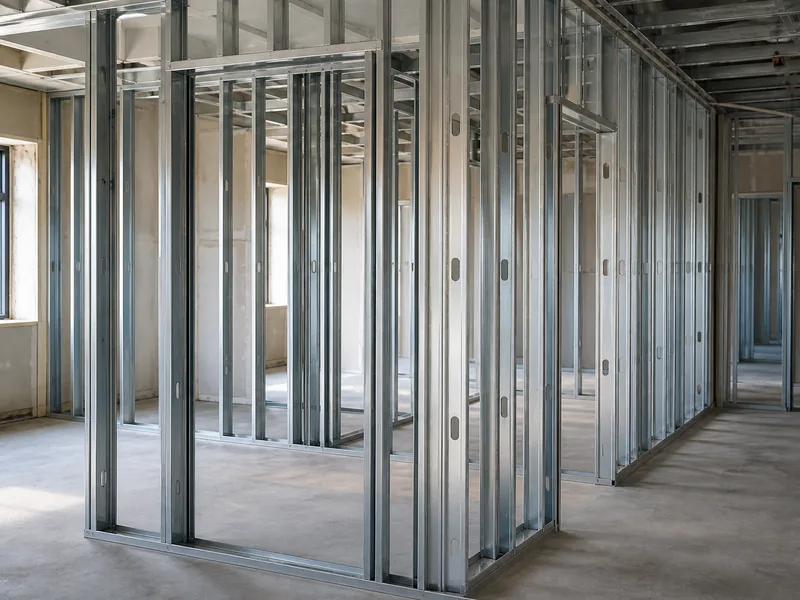
Most interior projects that frame with steel studs land between $3.50 and $7.50 per square foot installed for non-load-bearing partitions, yet the same search returns numbers as high as $40 per square foot. That gap is not random. What you actually pay per square foot depends on which job “metal stud framing” refers to: light-gauge steel studs for interior partition walls, priced per square foot of wall by a framing or drywall crew, or structural steel framing that carries load, which is engineered and quoted on a different basis. Before any per-square-foot figure means anything, a project has to be placed in the right bucket. The sections below break down what moves the price — gauge, labor, wall height, finish, and region — so a budget rests on the version of framing that matches the actual work.
Metal studs should be priced together with related metal building components because clips, tracks, bracing, sheathing, and openings affect the installed number.
Cost scope note: Treat the ranges below as scope-specific planning numbers. Kit or shell figures exclude the slab, site work, delivery, permits, insulation, utilities, and interior finish unless the line item says otherwise. Heavy loads, poor soil, tight access, and custom openings can move a quote above the base band.
What “Metal Stud Framing Cost” Really Measures
Metal stud framing cost almost always refers to interior, non-load-bearing partition walls built from light-gauge steel studs and track, not to a building’s structural frame. That distinction sets the price class before any other variable enters. Interior partition framing is repetitive, light-gauge work a crew installs quickly, which is why it sits in the single-digit-per-square-foot range. Load-bearing or exterior steel framing uses heavier-gauge studs, more bracing, and often a structural engineer, so it moves into a higher band. A complete structural steel building frame — columns, rafters, and primary members — is a separate product priced per building, not per square foot of partition.
This article covers interior light-gauge metal stud framing priced per square foot. It does not quote the engineered cost of a full structural steel building or a pre-engineered metal building, which are estimated on span, load, and foundation rather than wall area. Reading an online price without knowing which of these it describes is a common budgeting mistake on this topic.
Metal Stud Framing Cost Per Square Foot
Interior metal stud framing typically runs about $3.50 to $7.50 per square foot installed for a straightforward non-load-bearing partition. Reported ranges use different scopes, so they should not be added together. Installed partition work is often quoted around $3.50 to $7.50 per square foot. Separate material-only references commonly appear near $2 to $4 per square foot, and labor-only references near $5 to $10 per square foot. These figures come from different sources and measurement bases, so treat each as its own reference rather than parts that sum to a single number — unless a quote uses the same wall-area basis and scope. The table below shows how the rate shifts as walls take on more demanding roles.
| Scope | Typical gauge | Reported range / cost effect | What it includes |
|---|---|---|---|
| Interior, non-load-bearing partition | 25 / 20 ga | ~$3.50–$7.50 / sq ft | Studs, track, and labor on the framed wall area |
| Interior load-bearing or taller walls | 20 / 18 ga | Higher; rises with gauge and bracing | Heavier studs, frequently engineering |
| Exterior or structural light-gauge | 18 / 16 ga | Higher again | Structural studs; usually engineered |
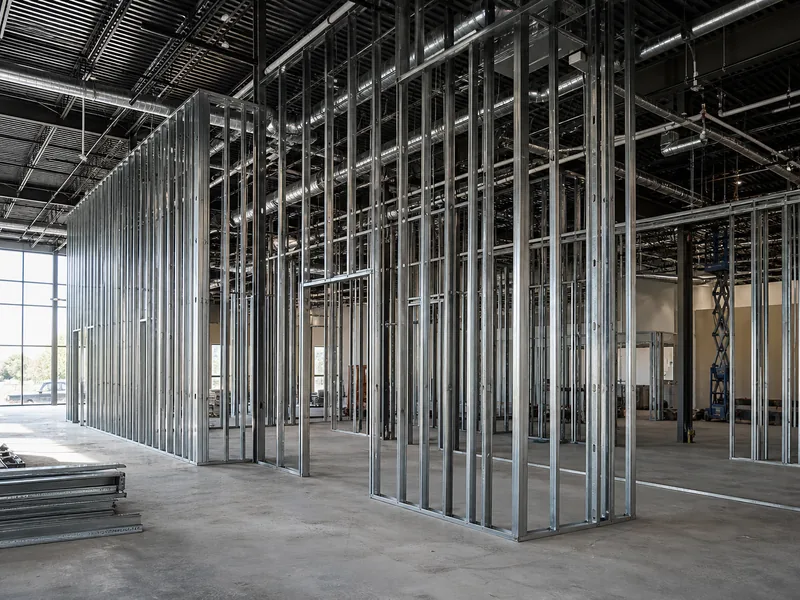
| Commercial buildout | Mixed | ~$12–$40 / sq ft | Often a stud-and-drywall / buildout package, not bare framing |
To turn a per-square-foot range into a rough budget, multiply the wall area by the installed rate for the matching scope: a 400-square-foot interior partition at $3.50 to $7.50 per square foot lands near $1,400 to $3,000 installed. If you price materials separately, add a 5 to 10 percent waste allowance for offcuts. That is an estimating method, not a quote — the real figure still depends on gauge, height, and finish. Commercial work sits in its own band because packages bundle framing with drywall, insulation, and taller walls, which is why commercial stud-and-drywall figures commonly reach $12 to $40 per square foot.
How Steel Gauge and Stud Size Drive the Material Price
Gauge — the thickness of the steel — is the largest single lever on what a metal stud costs, because a thicker stud uses more steel per foot and carries more load. Steel studs are sold by gauge, and the convention runs backward from intuition: a higher gauge number means thinner steel. Interior non-load-bearing partitions typically use 25- or 20-gauge studs, while 18- and 16-gauge studs (and heavier 14- to 10-gauge) are reserved for load-bearing, exterior, or structural framing.
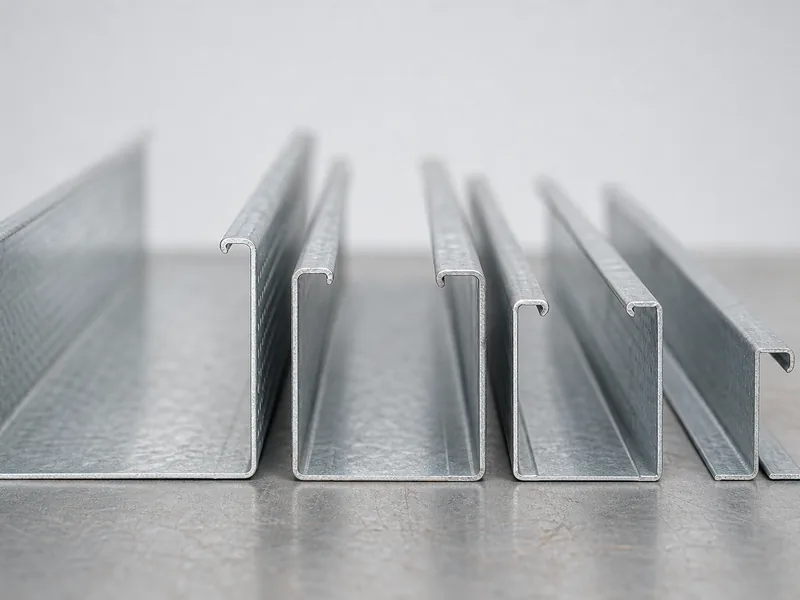
Width matters alongside gauge — common stud widths run from 1-5/8 inch up to 6 inch, and wider studs cost more per linear foot. Inside the trade, gauge is shorthand for the steel’s actual rolled thickness, expressed in mils, and the specific gauge-to-mil designation is best confirmed against supplier submittals rather than assumed. A drywall-grade stud and a structural stud of the same width can look almost identical on a shelf yet differ in steel weight, which is why one frames a closet wall and the other helps carry a floor above.
As a rough gradient, light 20-gauge drywall studs can start well under a dollar per linear foot, while heavy structural studs run several dollars per linear foot. One US supplier’s published list, dated 2025, spanned roughly $0.33 to nearly $9 per linear foot across that gauge and width range. Those numbers illustrate the spread rather than serve as a quote — coil steel pricing moves, and your supplier and volume set the real figure.
The studs themselves are roll-formed from steel coil, the same cold-forming family used for cold-rolled steel framing members. Understanding how that forming and gauge selection work explains why two studs at the same width are not interchangeable on price or on load.
What Moves the Price Beyond the Studs
Four variables move a metal stud framing quote more than the studs themselves: whether a wall carries load, how tall it is, what finish goes on it, and where the job sits. Load is the first fork — a non-load-bearing partition is the cheapest case, but the moment a wall carries structure it needs heavier gauge and usually an engineer’s sign-off, raising both material and design cost. Confirm with the designer whether each wall is structural before pricing it.
Height drives the rest. Walls above standard ceiling height need heavier studs to control deflection and often a lift to install, adding equipment time and labor hours; the wall heights on the plan, not the floor area, are what to price against. Finish is a separate line item — some estimates list drywall over metal framing around $1 to $2 per square foot on its own, but a framing quote may or may not include it, so confirm the scope. Region and complexity close the list: local labor rates, layouts with many corners and openings, and code requirements all shift the rate, which is why a national average rarely matches a real bid.
Labor Cost for Metal Stud Framing
Labor usually accounts for the larger half of an interior framing bill, commonly $5 to $10 per square foot, and more on tall or intricate walls where some crews quote $7 to $15. Metal framing is skilled work — studs are cut and screwed rather than nailed, and a plumb, square steel wall depends on accurate track layout at the floor and ceiling. Hourly rates for experienced framers vary by market; commercial estimating sources cite roughly $25 to $40 an hour for seasoned installers and less for apprentices, but most quotes are written per square foot.
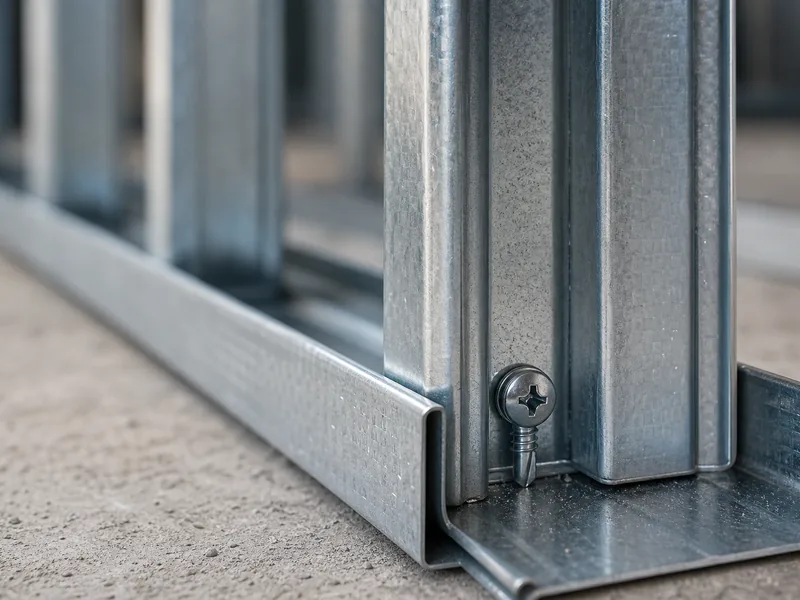
Height and complexity drive labor more than raw wall area. A tall wall with deflection track and many penetrations takes far longer per square foot than a simple office partition, even though both cover the same floor plan. The same dynamics show up across steel projects: the labor cost to erect a metal building tracks height, access, and complexity rather than footprint alone, and interior framing follows the same logic at a smaller scale.
Metal Stud vs Wood Framing Cost
Steel and wood framing now sit closer on price than they once did, and which one costs less depends mostly on current lumber markets and how long the wall has to last. On materials, steel studs run about $2 to $4 per square foot against roughly $1 to $5 per square foot for wood — close enough that lumber price swings can flip the order. Wood was clearly cheaper when lumber sat at long-run lows; after the sharp lumber spikes of recent years, steel’s material premium narrowed and at times disappeared. Labor runs in a similar band for both, though metal needs different tools and crews comfortable working with it.
Where steel separates is over time rather than on day one. Steel studs do not rot, warp, or feed insects, so for partitions meant to last decades the lifetime case favors steel even when the upfront number is a wash. The practical decision rule: if the project is short-horizon and lumber is cheap locally, wood may win on first cost; if it is a long-lived interior, a damp or pest-prone space, or a setting where noncombustible framing and rated wall assemblies are being specified, steel’s durability usually justifies a small premium. Price both against current local material costs instead of assuming a fixed gap.
Hidden and Add-On Costs to Budget Before You Quote
Several costs sit outside the per-square-foot framing rate and routinely surprise first-time budgets:
- Permits — usually a few hundred to a couple thousand dollars, depending on jurisdiction and scope.
- Structural engineering — load-bearing or tall walls often need an engineer’s design and stamp, billed separately.
- Finish — drywall, insulation, and corner bead are separate from the steel frame and add to the all-in wall cost.
- Equipment — tall walls may need a scissor lift or similar, charged by the day.
- Waste — estimators typically add a 5 to 10 percent material allowance for offcuts and damage.
- Accessories — deflection track, bridging, and clips are small per piece but add up across a large takeoff.
None of these are optional extras in a marketing sense; they are real line items. Leaving them out is how a framing budget comes in low and the project finishes over.
Interior Stud Framing vs a Structural Steel Building Frame
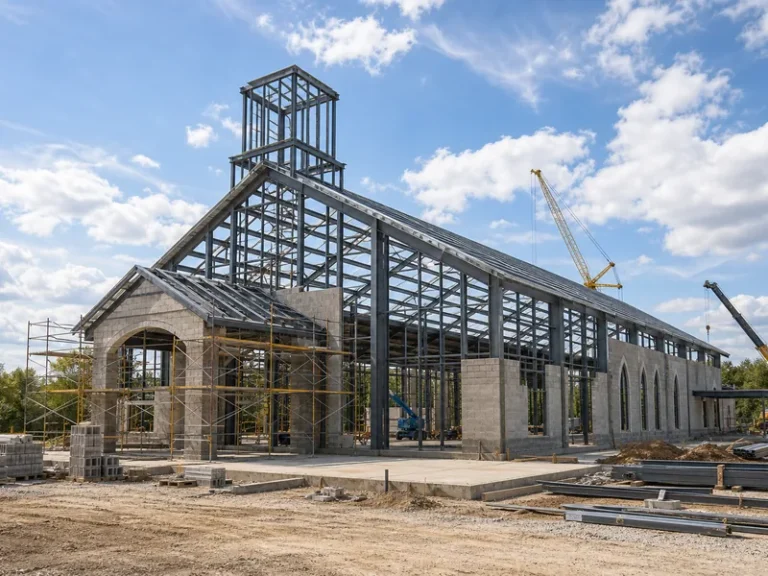
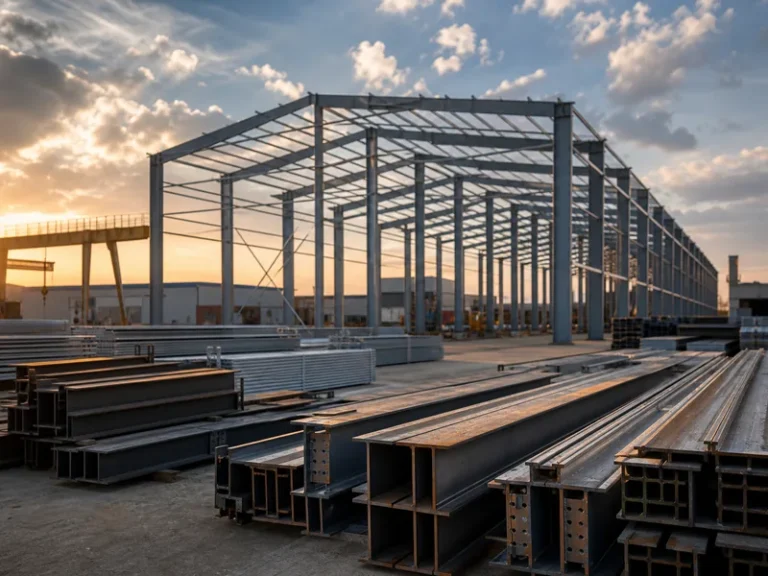
Interior metal stud framing and a structural steel building frame are priced on entirely different bases, and mixing them up is the fastest route to a wrong budget. Partition stud framing is sold per square foot of wall and assumes the building’s structure already exists. A structural steel frame — the columns, rafters, and bracing that hold a building up — is engineered for span, load, and code, then quoted as part of the building rather than as a wall rate. That is why some cost summaries report whole-structure framing ranges as high as $17 to $32 per square foot (against $11 to $25 for wood); those reported whole-structure figures describe framing an entire structure and should never be set beside a $4-per-square-foot interior partition number.
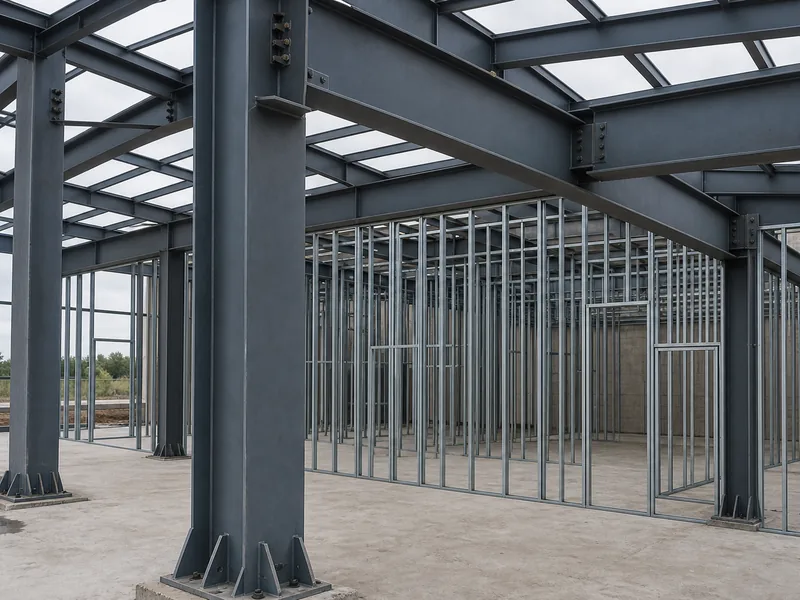
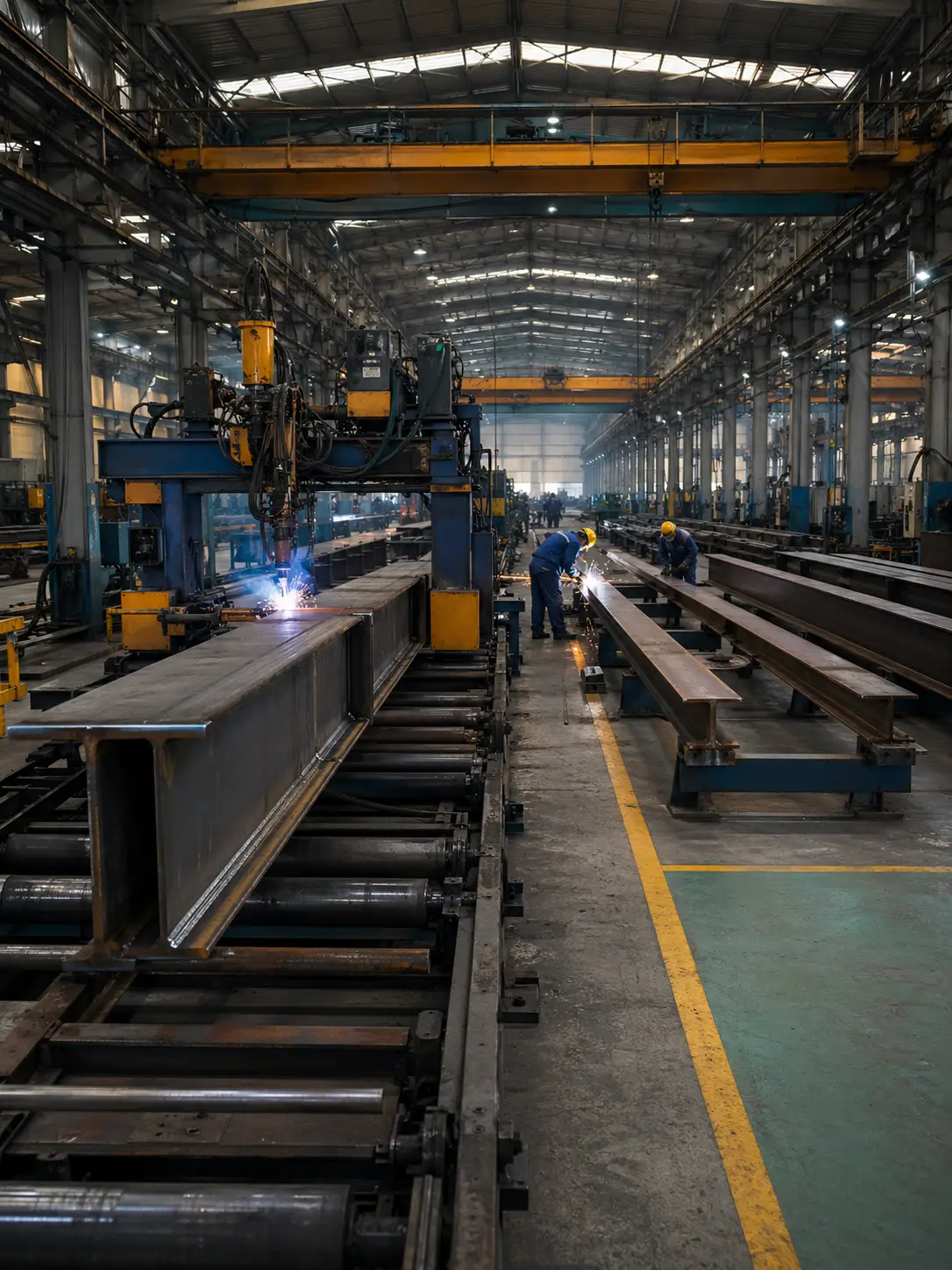
For projects that need the structure itself, the cost question shifts to spans, foundations, and engineered members rather than stud gauge. A steel frame construction approach, or a packaged structure such as a 30×50 metal building, is estimated on those terms. Manufacturers that fabricate the structure — for example, custom built steel buildings assembled from H-beams, box sections, and C/Z-section purlins — price the engineered frame, not the interior studs a finishing crew installs. Qingdao KAFA Fabrication works on that structural side, running dedicated H-beam, box-section, and C/Z-section purlin lines for metal building packages under an ISO 9001:2015 quality system at its 20,000-square-meter facility. That is a different scope from interior drywall-stud framing, which a finishing contractor prices and installs.
Conclusion
The widest swing in any metal stud framing budget comes from three things: whether the walls carry load, what gauge they require, and whether the quoted rate includes finish. Lock those before comparing prices, and decide first which scope you are pricing — bare interior partitions, load-bearing framing, or a full structural frame — because each sits in a different cost band and a number from one is meaningless in another. To keep bids comparable, require every quote to state:
- the wall-area basis it uses (per square foot of wall, not floor area)
- the stud gauge, and the mil designation where it matters
- whether the walls are load-bearing or non-load-bearing
- whether finish such as drywall and insulation is included or separate
- whether engineering and equipment or lift access are in or out
With those five points fixed, a single-digit per-square-foot rate is a fair starting point for interior partitions; anything load-bearing or structural shifts the question from stud price to engineered design, where a steel fabricator rather than a framing crew sets the cost. Get the scope and gauge right, and the per-square-foot number stops being a guess.
Frequently Asked Questions
How much does metal stud framing cost per square foot?
Interior, non-load-bearing metal stud framing is commonly reported around $3.50 to $7.50 per square foot installed. Material-only and labor-only figures are quoted on different bases and should not simply be summed against that installed range. Load-bearing, taller, or commercial work runs higher — commercial stud-and-drywall packages often reach $12 to $40 per square foot — and the rate always depends on gauge, wall height, and whether finish is included.
Are metal studs cheaper than wood?
Metal and wood framing are close enough on price that the cheaper option depends on current lumber costs and the project’s lifespan. Steel material runs about $2 to $4 per square foot versus roughly $1 to $5 for wood, and recent lumber volatility has at times erased wood’s edge. Over a long-lived interior, steel’s resistance to rot, warp, and insects often justifies any small premium.
What gauge of metal stud do interior walls use?
Interior non-load-bearing partition walls typically use 25- or 20-gauge steel studs, where the higher gauge number means thinner, lighter steel. Load-bearing, exterior, or taller walls step up to 18- or 16-gauge, with heavier 14- to 10-gauge reserved for structural framing. In North American specifications, nonstructural drywall studs are commonly referenced under ASTM C645, while structural cold-formed framing is addressed by AISI S240.
Is metal stud framing the same price as a steel building frame?
No — interior metal stud framing and a structural steel building frame are priced on different bases and should not be compared per square foot. Stud framing is a wall rate that assumes the structure already exists; a steel building frame is engineered for load and span and quoted as part of the building. A whole-structure framing figure can be several times an interior partition rate without either being wrong.
Do metal stud walls need a structural engineer?
Non-load-bearing interior partitions usually do not need a structural engineer, but load-bearing or tall steel-framed walls generally do. The trigger is whether the wall carries structural load or exceeds the heights covered by prescriptive methods. When in doubt, confirm the wall’s role with the project designer before pricing, since engineering is billed separately and changes the budget.