





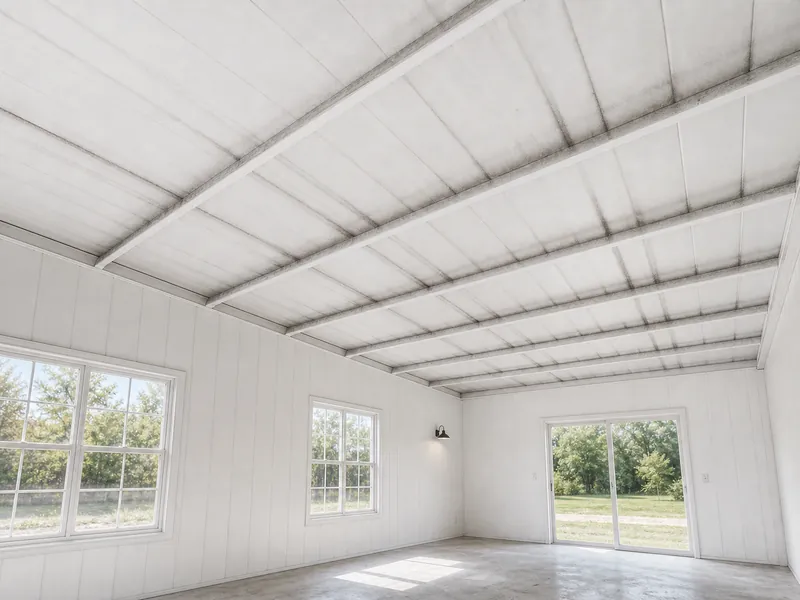
Those gray-to-black streaks running in straight lines across a ceiling are almost always ghosting, not mold. Clearing them takes two stages: clean or seal-and-repaint the marked surface, then break the three conditions that put it there — a cold framing line behind the drywall, humid indoor air, and a steady source of soot or dust. Handle only the surface and the pattern returns within a heating season or two, because the cause never left. Below is how to confirm it really is ghosting (and not mold or a leak), how to remove it, and how to keep it gone.
What Ghosting on a Ceiling Actually Is
Ghosting is a gradual deposit of airborne dust, soot, and cooking or candle residue that settles on the coldest strips of a ceiling and traces the framing hidden above the drywall. The discoloration is not growing or alive; it is fine particle buildup held to the surface by a thin film of condensation. Because the framing members (joists, rafters, or steel studs) sit at regular spacing, the marks read as evenly spaced lines, often about 16 or 24 inches apart. Occasional dots appear where drywall screws or nails pierce the board.
The reason the lines land there and nowhere else is straightforward. Insulation fills the cavities between framing, but the framing itself is a break in that blanket. Each joist or stud is a colder strip on the interior surface, and colder strips collect condensation and particles faster than the warmer, insulated areas around them. Ghosting therefore shows up most on exterior ceilings and along outside walls, where the temperature gap is largest. It also tends to surface in winter, when the indoor-to-outdoor temperature difference, and the condensation that comes with it, reaches its peak.
Ghosting vs. Mold vs. Water Stains: Read the Pattern First
Reading the pattern is the fastest way to separate ghosting from the two problems people confuse it with, and it decides how you treat the ceiling. Ghosting follows the straight, repeating geometry of the framing and stays dry to the touch. Mold ignores framing lines, spreads in irregular blotches, favors genuinely damp spots like a bathroom corner or a roof leak, and often carries a musty smell. A water stain reads differently again: a brown or yellow ring with a defined edge, usually around a single source such as a pipe or roof penetration.
| Clue | Ghosting | Mold | Water stain |
|---|---|---|---|
| Pattern | Straight lines or dots on framing | Irregular patches | Ring with a hard edge |
| Texture | Dry, sooty film | Fuzzy or slimy | Dry, discolored halo |
| Where | Cold framing lines, exterior ceilings | Persistently damp spots | Below a leak source |
| Health risk | Cosmetic, low | Can affect health | Cosmetic, but signals a leak |
If the marks are instead fuzzy, damp, spreading, musty, or clustered around a leak or a chronically wet spot, stop and treat the problem as mold or water intrusion, not ghosting. Those are moisture and air-quality issues, and a large, growing, or recurring patch calls for a professional assessment rather than a DIY wipe-down. The rest of this guide assumes you have confirmed clean, dry, framing-aligned ghosting.
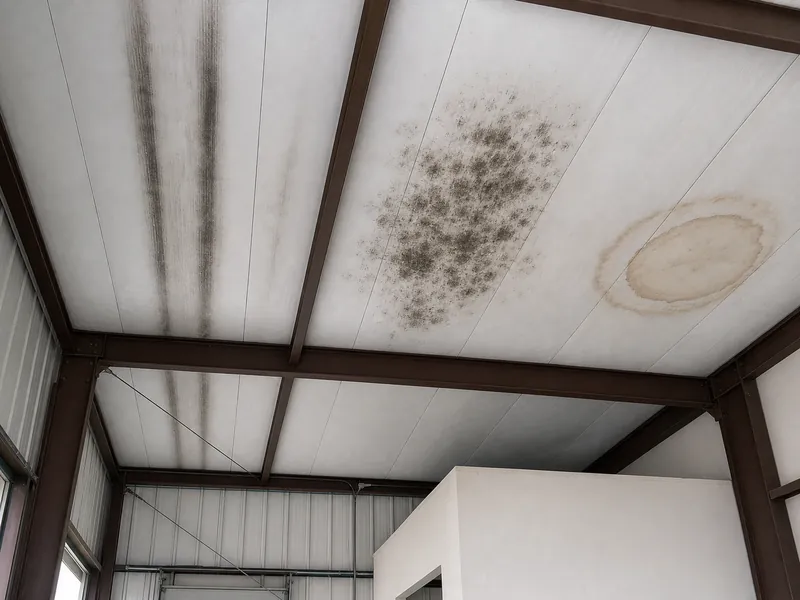
Why Ceiling Ghosting Forms (and Why Steel Framing Makes It Sharper)
Ghosting needs three things at once, and clearing it for good means taking away at least one of them. First is a thermal bridge: a framing member that carries outdoor cold through the insulation layer and leaves a cooler strip on the interior surface. Second is humidity, the warm and moist indoor air that condenses into an invisible film exactly where the surface is coldest. Third is a particle supply: soot from candles, cooking, a fireplace, or tobacco, plus ordinary household dust, which sticks to that damp film and darkens over months. Cold surfaces also draw particles toward them through electrostatic attraction and thermophoresis, so the coldest lines load up first.
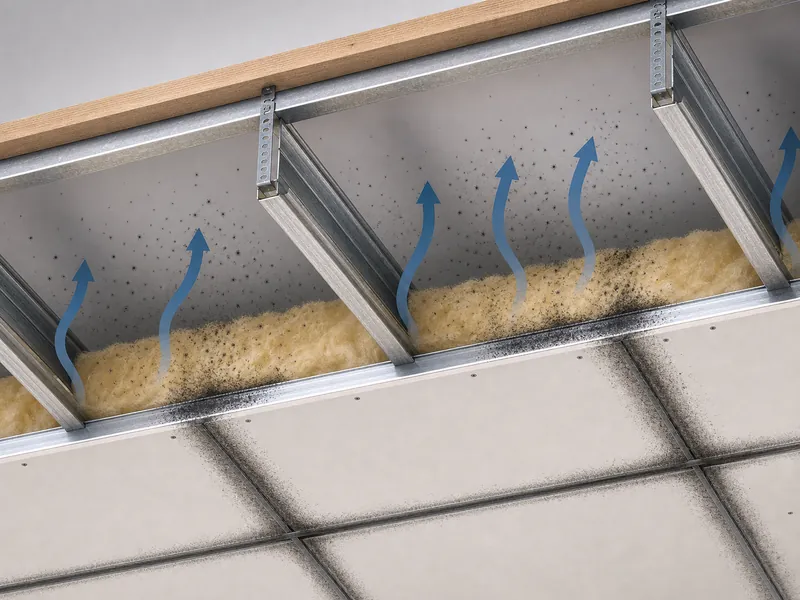
Framing material changes how sharp the result looks. Steel conducts heat hundreds of times faster than wood, so a steel stud or purlin forms a stronger, colder thermal bridge than a wood joist in the same assembly. Light-gauge steel framing and metal fasteners also hold a static charge that pulls fine particles in. That combination is why ghosting in steel-framed and commercial buildings often appears as crisp, high-contrast lines along purlins, girts, and screw rows, rather than the softer smudging seen in older wood-framed homes.
The fix that addresses the cause instead of the symptom is almost always insulation. Closing the gaps so the framing line is no longer a cold strip removes the condensation that anchors the particles. In pre-engineered metal structures this is handled at the design stage: fewer framing penetrations, thicker metal building insulation, a thermal break over the steel, and a vapor barrier to limit condensation. As a steel fabricator, we treat those framing lines as a building-envelope decision long before they could ever shadow a finished ceiling.
How to Remove Ghosting on the Ceiling, Step by Step
Removing ghosting works from the gentlest method up, escalating only if the marks resist. Start with cleaning, and move to sealing and repainting only when cleaning leaves a shadow behind.
Clean the surface first
Cleaning lifts most light to moderate ghosting with no repainting at all. Work in this order:
- Mix warm water with a few drops of mild dish detergent and wipe the streaks with a soft sponge or microfiber cloth, working in small sections.
- For stubborn marks, add white vinegar to the solution, or lift them with a paste of baking soda on a damp sponge.
- If soot still holds, step up to a dilute bleach solution, roughly one part household bleach to three parts water, left on for about five to ten minutes, then wiped down with clean water.
- Let the ceiling dry fully and inspect it in good light before deciding whether a repaint is needed.
A few cautions matter here. Wear gloves, eye protection, and a mask, and ventilate the room whenever you use bleach; switch to an oxygen-based, color-safe bleach on tinted or delicate finishes so you do not leave a bleached halo. Cleaning takes off the color but not the cause, so treat it as the first half of the job rather than the whole repair.
Seal and repaint when cleaning isn’t enough
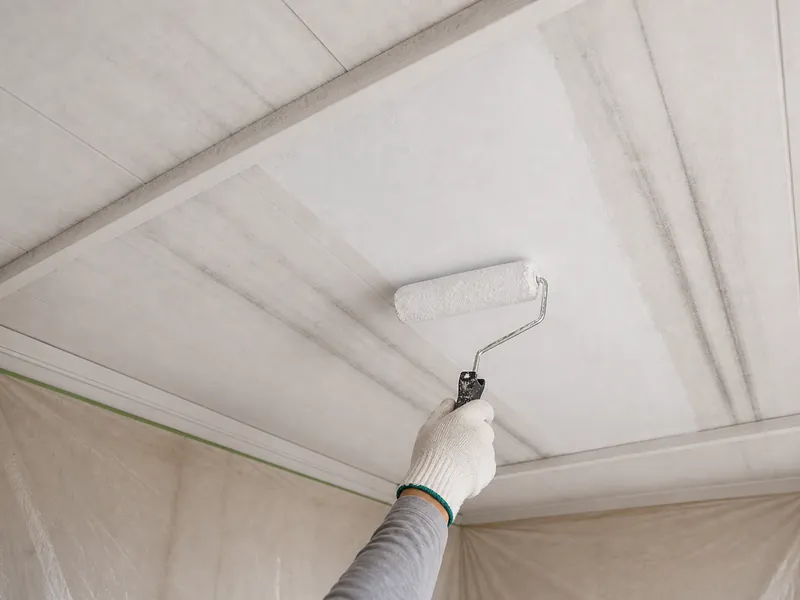
Repainting is the reliable fix once cleaning stalls, but only over a stain-blocking primer. Painting straight onto soot is the mistake that brings ghosting back fastest: the residue bleeds through ordinary latex within weeks and the streaks reappear. Clean and dry the area first, roll or brush on a stain-blocking primer (shellac- or oil-based primers hold back soot most reliably), let it cure, then finish with a topcoat matched to the existing ceiling color. On a ceiling being refreshed anyway, folding this into a wider repaint or metal building renovation is more efficient than spot-treating the same lines twice.
Stop Ghosting From Coming Back
Keeping ghosting gone means weakening the three conditions behind it, in roughly this priority: temperature difference, then humidity, then particles.
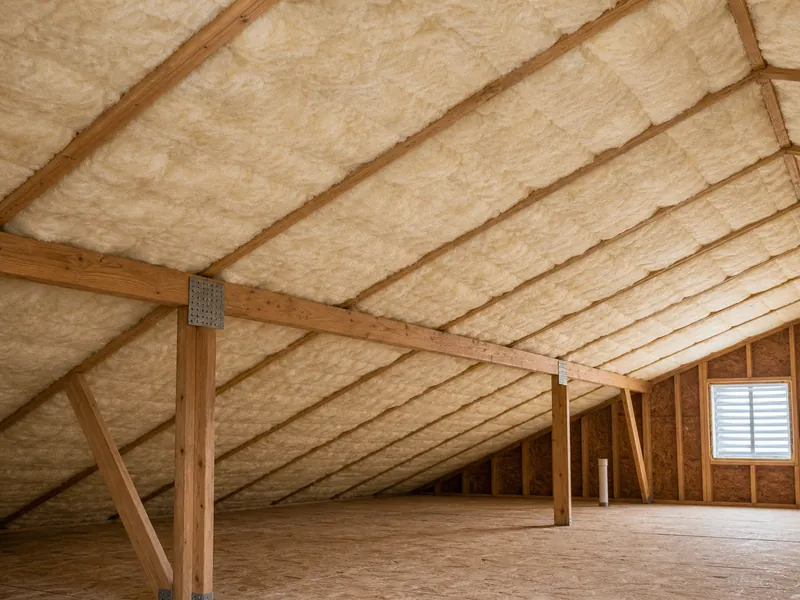
Insulation does the heavy lifting, because it removes the cold strip the particles need. Make sure attic insulation is continuous and covers the tops of the ceiling joists rather than stopping between them. Fill any gaps or compressed spots, and seal air leaks around fixtures and at the attic floor so cold air cannot wash across the back of the drywall. In a steel building the same goal is met by design, through continuous insulation over the framing and a working vapor barrier, and confirming that coverage is a routine part of steel building maintenance. On a cold day an infrared thermometer, or even a bare hand, will find these cold lines before you open the ceiling, pointing to where insulation is missing or thin.
Humidity control is the second lever. Keep indoor relative humidity below roughly 50 to 55 percent, run bathroom and kitchen exhaust fans during and for about 20 minutes after showers or cooking, and add a dehumidifier in rooms that stay damp. Drier indoor air gives condensation little to form from, even where a minor cold spot remains.
Cutting the particle supply is the third lever and the easiest to act on today. Paraffin candles and an open fireplace put far more soot into the air than soy or beeswax candles with trimmed wicks; a range hood that vents outside captures cooking grease before it reaches the ceiling; and keeping combustion sources away from supply registers stops them from spraying soot onto cold surfaces. None of this counts as much as insulation, but together the three levers are what keep the lines from redrawing themselves.
A ceiling marked in straight lines points to a colder strip behind the drywall, so work in sequence: confirm the framing-aligned pattern to rule out mold, clean or prime-and-repaint to clear what you can see, then close the thermal bridge, drop the humidity, and cut the soot at its source. Do the surface work without those last three steps and the same lines return on the same framing within a season. The permanent answer lives in the insulation and the building envelope, not the cleaning bucket.
FAQ
Is ceiling ghosting dangerous or toxic?
Ghosting itself is cosmetic, not a health hazard, because it is settled dust and soot rather than living mold. The soot that feeds it, mostly from candles and cooking, is something to reduce for indoor air quality, but the stain on the ceiling does not release anything on its own. The exception is a misdiagnosis: fuzzy, damp, musty patches are mold and should be handled as an air-quality problem.
Will painting over ghosting get rid of it?
Painting only works when you first clean the surface and apply a stain-blocking primer. Soot bleeds through standard latex within weeks, so an unprimed topcoat brings the streaks straight back. Even a proper prime-and-paint is cosmetic, though. Without fixing the cold framing line and the humidity, ghosting redevelops over the new paint.
How do I know it’s ghosting and not mold?
Look at the geometry and the texture. Ghosting forms dry, straight lines and dots that match the framing spacing, while mold grows in irregular, often fuzzy patches in genuinely damp areas and may smell musty. Marks in a clean, ruler-straight pattern on a dry ceiling point to ghosting; marks that recur in a damp corner should be treated as mold.
Why does ghosting appear in straight lines on my ceiling?
The lines trace the framing because insulation fills the cavities but not the joists or studs themselves. Each framing member is a colder strip on the interior surface, and those cold strips collect condensation and particles faster than the insulated areas, often in a regular 16- or 24-inch rhythm.
Is ghosting worse in metal or steel-framed buildings?
Steel framing tends to show sharper ghosting than wood because steel conducts heat far faster, making a colder and more defined thermal bridge, and metal fasteners add a static pull on airborne particles. The offsetting advantage is that steel buildings control it well at the design stage, through continuous insulation over the framing and a vapor barrier, so the framing lines never get cold enough to stain.
Further Reading
- EPA — Indoor Particulate Matter — U.S. EPA. Identifies candles, cooking, fireplaces, and tobacco as indoor sources of the fine particles that feed ghosting, and how to reduce them.
- ENERGY STAR — Seal and Insulate — U.S. EPA/DOE program. Guidance on sealing air leaks and adding insulation to remove the cold framing lines and drafts behind ghosting.
- InspectAPedia — Thermal Tracking & Ghosting Diagnosis — building diagnostics reference. Explains the thermal-bridge, condensation, and particle-deposition mechanism and how to tell ghosting from mold.