




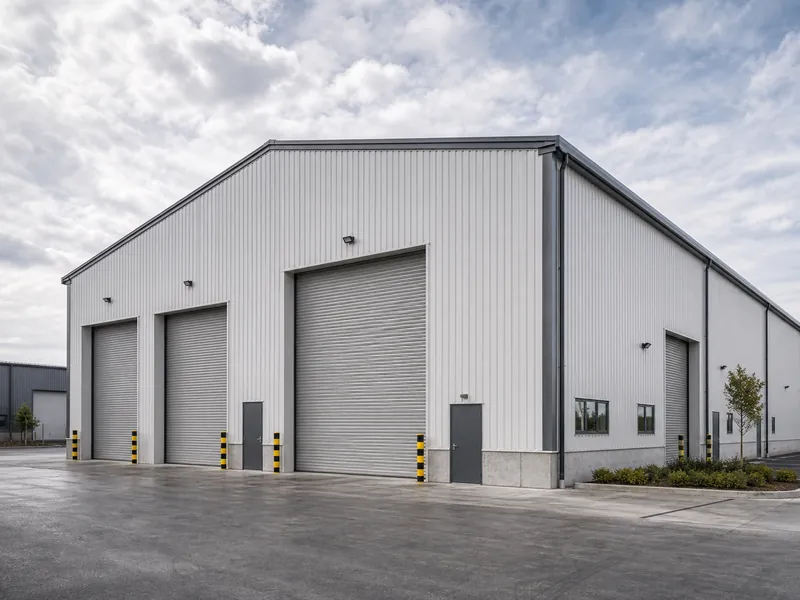
Customizing a steel warehouse works best from the frame out. A short list of structural choices — clear height, clear-span width, column bay spacing, and loading-dock positions — gets engineered into the rigid frame before fabrication and is effectively permanent. Almost everything else buyers picture when they hear “custom” — overhead doors, insulation, a mezzanine, wall colors, windows, roof panels — can be added or changed far more freely. Some of it goes in well after the shell is standing. Get the permanent layer right for how you store and move goods, and the flexible layer becomes a question of preference and budget rather than a costly regret.
This guide walks the permanent structural shell first, then the operational and finish options you layer on top, what each does to the cost, and how the design gets finalized with a fabricator. Every dimension below is a planning range, not a final spec — the numbers come from racking plans, forklift and trailer fleets, site geometry, and local code, so treat them as starting points to confirm with your engineer. The guide covers the customization choices themselves, not site selection or local permitting, which vary too much by location to generalize.
Start With the Structural Shell You Can’t Change Later
The frame dimensions you set at order time decide what the building can ever do, because a steel warehouse’s clear height, span, and column grid are fixed once the primary members are engineered and fabricated. A 30-foot clear height does not become 40 feet after the columns are up, and a line of interior columns cannot be pulled out later without re-engineering the roof. These are the choices to resolve against your operation before anything else, and they carry the largest share of the structural cost.
Clear height and how high you stack
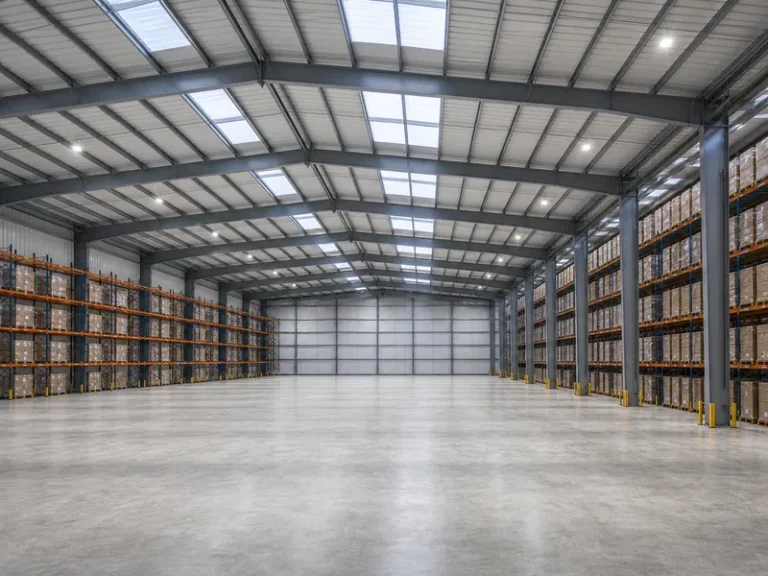
Clear height should be driven by your racking plan, not by a round number, because the gap between the floor and the lowest roof framing sets how many pallet levels you can use. As a rough planning guide, about 24–26 feet of clear height suits three to four rack levels with common forklifts. Roughly 30–33 feet opens up five to six levels, and around 36–40 feet supports six to eight, with taller still reserved for automated stacker systems. Standard catalog heights run up to about 40 feet, and going past that is a custom engineering exercise. Height is not free: each additional metre of clear height (about 3 feet) adds a few percent to primary-frame steel, so price the height your racking actually needs, then confirm the frame tonnage that height implies before you commit.
Clear span and column bay spacing
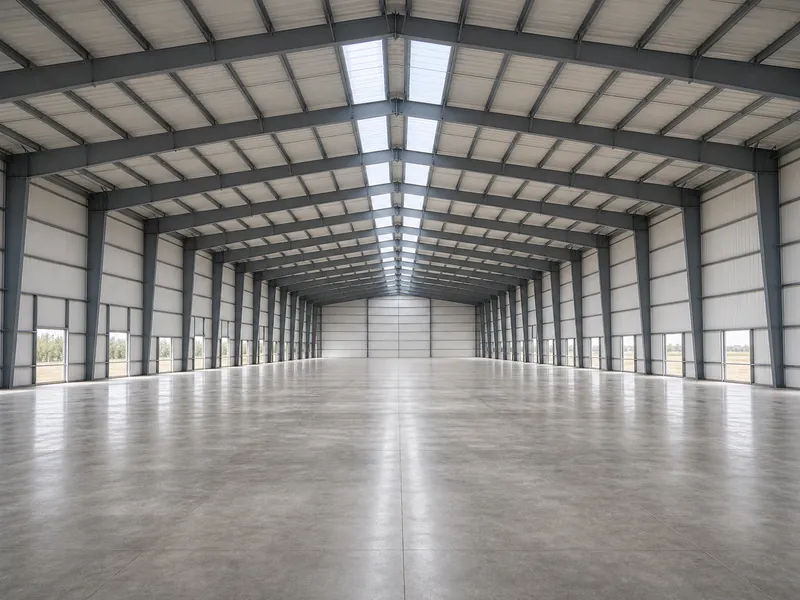
A clear-span frame gives you column-free floor, and how wide you can go without interior columns is one of the defining customizations of a steel warehouse. Standard rigid frames reach roughly 150 feet of clear-span width with no interior supports; custom-engineered frames push to 200–300 feet column-free, and a single interior column line lets the building go wider still for very large footprints. Where interior columns are unavoidable, bay spacing — the distance between columns down the building’s length — controls how much floor is lost to them. Stepping from tight bays of about 20 feet to wider bays near 40 feet can cut column-blocked floor from a rough 8–15% down to under 2% and fit two racking rows back-to-back, depending on your rack layout. Aisle width ties equipment to that spacing — counterbalance forklifts want roughly 11–13 feet of aisle, reach trucks about 9–10 feet, and very-narrow-aisle turret trucks as little as 5–6 feet — so the trucks you run shape both the bay grid and how much floor the racking gives back.
| Clear height (approx.) | Typical rack levels | Common use |
|---|---|---|
| 24–26 ft | 3–4 | General storage, light distribution |
| 30–33 ft | 5–6 | Higher-density pallet storage |
| 36–40 ft | 6–8 | High-density or future racking |
| 40 ft+ | Automated stacker systems | Custom-engineered |
*Clear-span widths run up to about 150 ft as standard and 200–300 ft custom. Rack levels depend on rack type and forklift reach.*
Match Loading Docks and Doors to Your Trucks
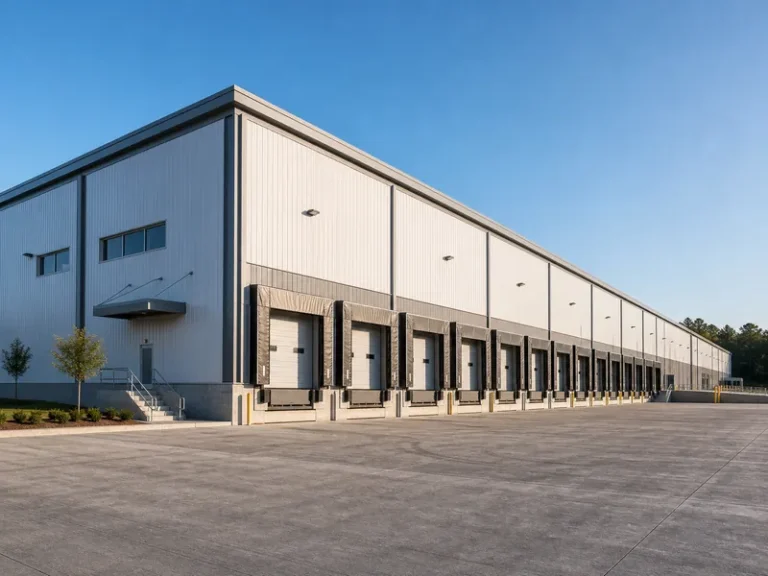
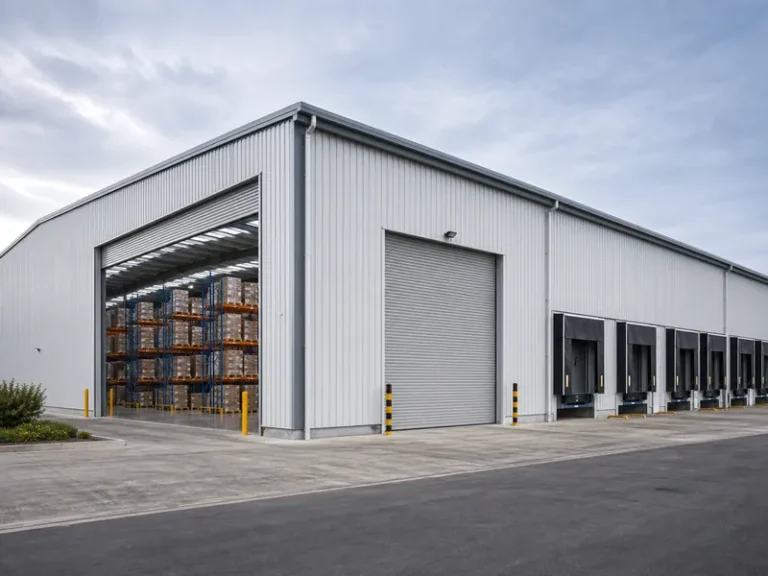
Dock and door layout has to match the vehicles and flow you run, and dock positions in particular belong to the permanent structural layer rather than the finish stage. Where docks sit, how high the dock floor is, and how much paved apron a truck needs are all resolved while the frame and foundation are designed — the same stage that drives any custom distribution center where throughput sets the layout. The standard U.S. dock height is about 48 inches (roughly 1.2 m) above the apron, with some docks up to about 55 inches for taller trailers. A truck apron generally wants at least about 40 feet of depth for rigid trucks, and more — on the order of 60–70 feet — for articulated semi-trailers to maneuver. As a planning rule of thumb, standard distribution runs roughly one dock per 1,000–1,500 m² of floor and high-throughput operations closer to one per 500–700 m², with your trailer fleet and peak volume setting the real count.
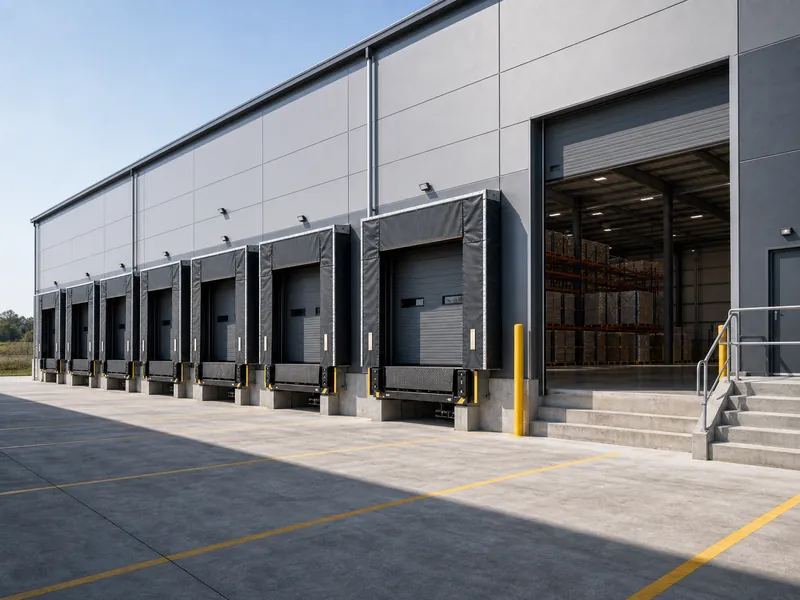
Doors themselves are more flexible. Overhead roll-up and sectional doors commonly come in sizes like 12×12 feet and can be specified larger — up to about 18×18 feet — for oversized loads, alongside walk doors, glazed entries, and dock levelers. Framed openings are straightforward to add wherever the structure allows, but the dock pits and approach grades are not, so fix dock locations early and treat door types as the adjustable part.
Insulation and Climate Control Options
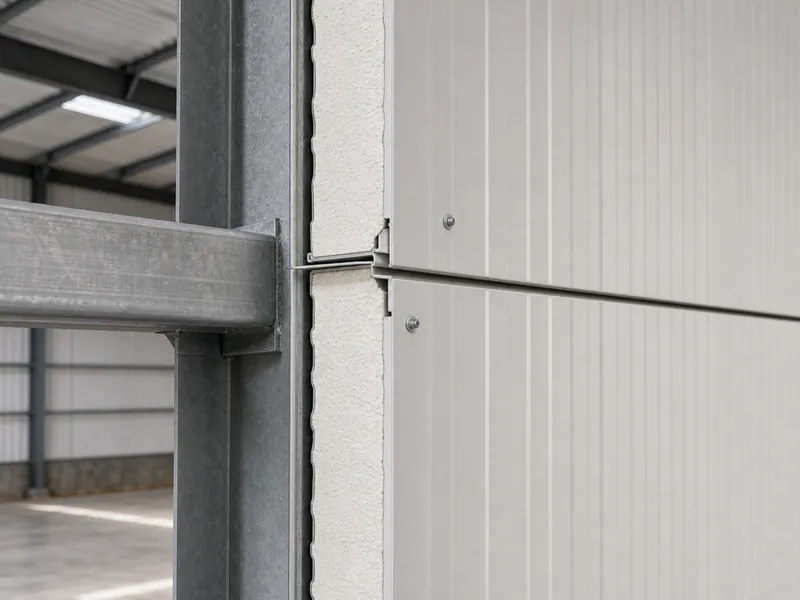
Insulation is the customization that matches a steel warehouse to its climate and contents, and the system you choose depends on whether you are holding temperature, fighting condensation, or just cutting summer heat. Choices range from fiberglass batt or blanket systems and rigid board to spray foam and insulated metal panels, and the right insulation for metal buildings is matched to the use case, not a catalog default. For ambient storage, the priority is usually condensation control and a basic thermal break; for conditioned space, the assembly steps up. Temperature-controlled and cold-storage warehouses are a different specification entirely — rooms held at chilled temperatures often use thicker insulated panels, on the order of 100 mm, and deep-freeze rooms more still, roughly 150–200 mm, though the real figure depends on the target temperature, product, vapor control, and the panel and refrigeration design. If cold storage is even a possibility, flag it before the frame is sized, because the added panel weight and tighter envelope feed back into the structure.
Interior Build-Out: Mezzanines, Offices, and Cranes
Interior features turn a bare shell into a working building, and they divide cleanly into things you can add later and things the frame has to anticipate. A mezzanine for offices, parts storage, or a pick floor is typically a free-standing steel structure that can go in after the warehouse is up, which makes it one of the more flexible ways to add floor area without enlarging the footprint. Partitions, lighting layouts, and office build-outs are similarly add-on work. An overhead crane is the opposite case: crane loads have to be designed into the columns and frame from the start — supporting a crane can add roughly 15–25% to the structural steel, depending on capacity and span — so a crane-ready frame is a permanent-layer decision even though the crane itself arrives later. List any heavy or overhead equipment now and ask whether it loads the frame; if it does, it belongs in the structural conversation, not the fit-out.
Exterior Finishes and Accessories
Exterior choices are the most forgiving customizations, since most of them ride on the secondary structure and cladding rather than the primary frame. You pick a roof profile — a gabled, double-slope roof for balanced drainage or a single-slope roof for simpler runoff and a cleaner street face — and a roof panel system, typically standing seam for long-term weather performance or through-fastened panels for a lower upfront cost. Low roof pitches such as 1:12 are common, with steeper pitches available where snow load or appearance calls for it. Wall color, wainscot, windows, skylights, canopies, and gutters round out the look, and a Galvalume-coated or painted envelope sets the maintenance profile. If solar is on the horizon, ask for a solar-ready frame: carrying panels means reserving roughly 15–25 kg/m² of extra dead load, which is cheap to design in now and costly to retrofit.
What Customization Does to the Cost
Customization moves cost mainly through how far you take the build past a bare kit, so it helps to price a steel warehouse in tiers rather than as one number. The choices above land in one of three quote scopes:
- Building kit (shell only): about $15–25 per sq ft — the pre-engineered rigid frame, purlins and girts, and roof and wall panels. Excludes foundation, freight, permits, and labor.
- Erected shell: about $30–60 per sq ft — the kit plus freight, a concrete slab, and the labor to stand the building.
- Turnkey, move-in ready: about $50–120+ per sq ft — adds site work, insulation, doors and windows, interior finishes, and utilities such as electrical, plumbing, and HVAC.
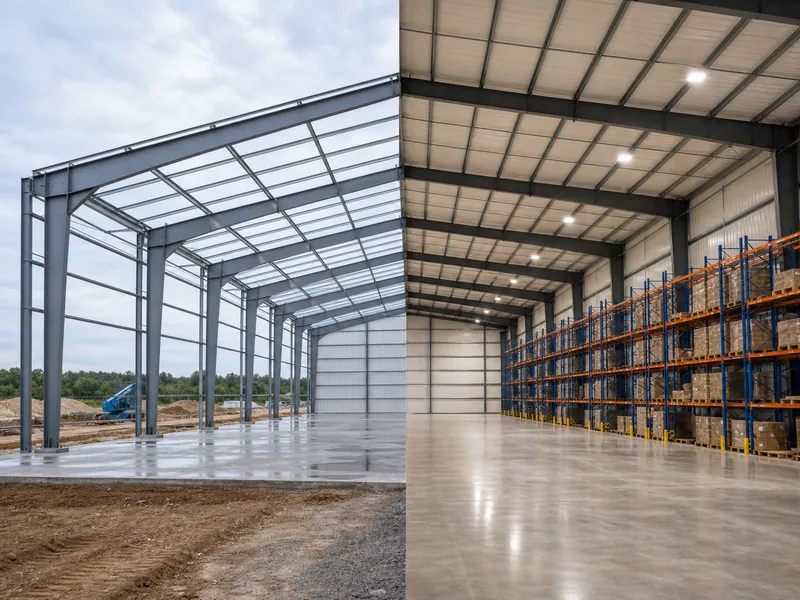
The slab on its own runs roughly $4–8 per sq ft, moving with rebar, loading, and soil conditions. A note on scope: these are planning ranges, not live quotes, and each tier is a different deliverable — a shell-only kit price and a turnkey budget describe different scopes and should not be compared directly or added together. Actual pricing tracks steel markets, region, and finish level. Within the tiers, the items that push you toward the top are structural — extra clear height, wide clear spans, crane-ready framing, heavy snow or wind loads — plus a conditioned or cold-storage envelope; doors, colors, and trim move the number far less. For a full estimate by configuration, a broader cost to build a warehouse breakdown covers how these scopes scale with size and finish.
Working With the Manufacturer to Finalize the Design
The cleanest custom builds settle the structure before the layout, which is why the design conversation should open with how you operate, not which color you want. Bring your storage plan, the equipment and trucks you run, your site dimensions, and any growth you foresee, and the engineering follows from there: clear height from racking, span and bay grid from aisles and flow, dock layout from your vehicles. Structural loads are engineered to local wind and snow per ASCE 7, and permits, occupancy, and fire requirements follow the IBC for your jurisdiction. Because the slab ties directly to column loads and anchor bolts, the metal building foundation is designed alongside the frame, not bolted on afterward.
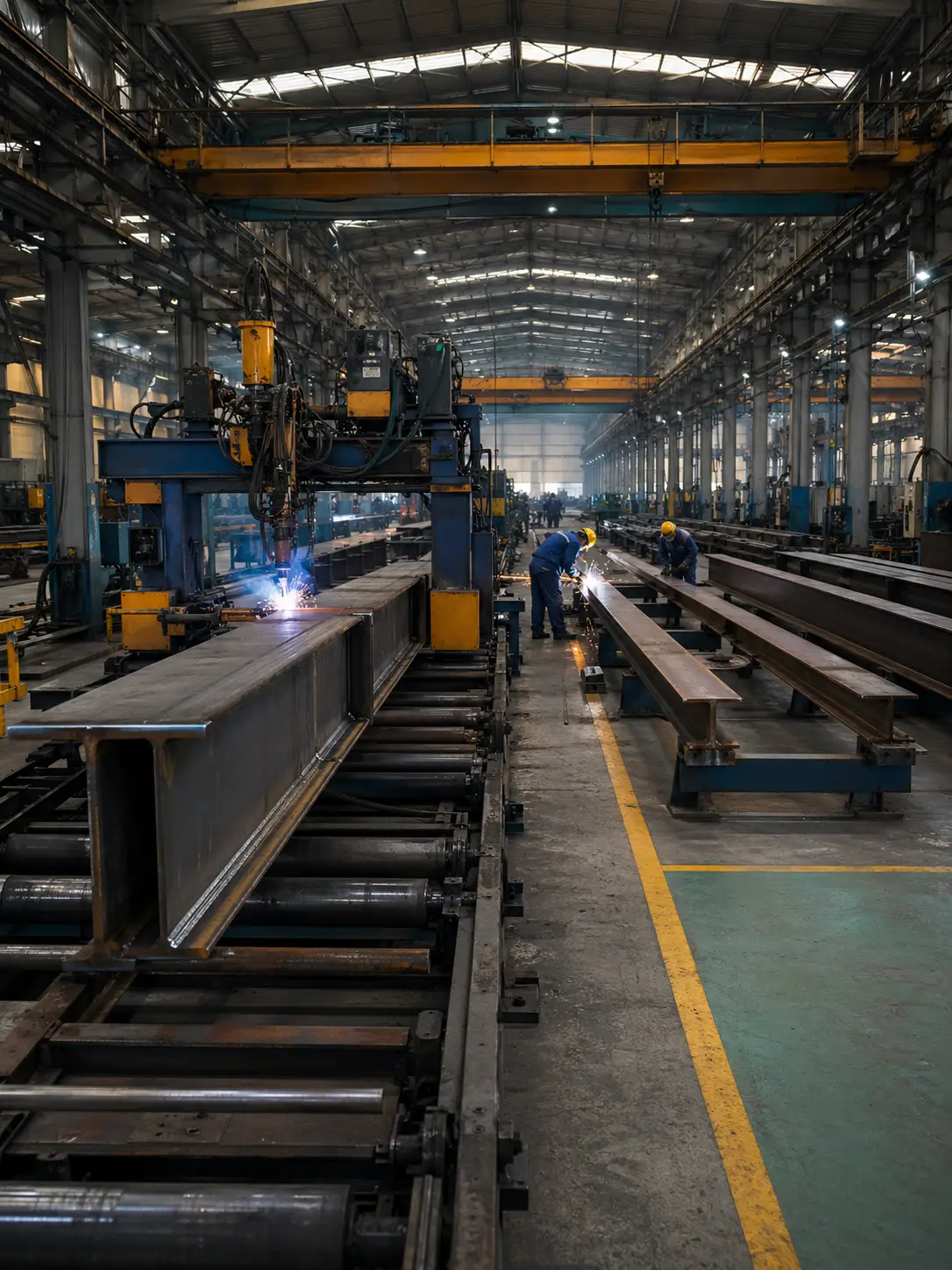
Who fabricates the frame matters for a heavily customized building. A custom primary frame, non-standard bay spacing, or a crane runway needs a fabricator that can engineer and produce the members, not just supply a stock kit. As a steel structure manufacturer, Qingdao KAFA Fabrication runs dedicated H-beam, box-section, and C/Z purlin lines at its Qingdao facility — the in-house fabrication a non-standard steel building warehouse frame depends on when the members are anything but stock. If you are still shaping the layout, working through warehouse building design alongside your fabricator keeps the structural and operational sides aligned.
Decide the Frame Before the Finishes
Customizing a steel warehouse goes well when you sequence the decisions by how hard each one is to undo. Fix the permanent layer first — clear height to your racking, clear span and bay spacing to your aisles, dock positions to your trucks, and a frame that anticipates any crane or future bay — because those set the ceiling on what the building can ever do. Insulation, mezzanines, doors, and finishes can then be matched to budget and even adjusted over time without touching the frame. When you are ready to put numbers to a specific configuration, request a quote with your clear height, span, and dock requirements in hand, and the estimate will reflect the building you actually need rather than a generic shell.
FAQ
What can you customize on a steel warehouse?
Nearly every dimension and feature can be specified, from the structural shell to the finishes. The permanent structural choices are clear height, clear-span width, column bay spacing, and loading-dock positions; the flexible options include overhead doors, insulation, mezzanines, offices, roof style, wall color, windows, and accessories such as skylights or solar-ready framing.
What is the most important customization decision?
Clear height usually constrains the most, because it sets how many racking levels you can ever use and it cannot be raised after the frame is built. Sizing it to your rack plan, not a round number, is the decision most worth getting right before the frame is engineered.
How wide can a steel warehouse be with no interior columns?
Standard clear-span rigid frames reach about 150 feet wide with no interior columns. Custom-engineered frames extend to roughly 200–300 feet column-free, and adding a single interior column line lets very large warehouses go wider still, with the wider spans requiring heavier steel.
Can you add a mezzanine or offices to a steel warehouse later?
A mezzanine and interior offices can usually be added after the building is standing, since a mezzanine is typically a free-standing steel platform independent of the main frame. Partitions, lighting, and build-outs are likewise add-on work, which is why they sit on the flexible side of customization.
How does customizing a steel warehouse affect the cost?
Cost rises mainly with structural ambition, not finishes. A shell-only kit runs about $15–25 per sq ft, an erected shell about $30–60, and a turnkey building about $50–120+ per sq ft; extra clear height, wide spans, crane-ready framing, and a conditioned envelope move you up those tiers far more than doors or colors do.
Can a steel warehouse be expanded after it’s built?
A steel warehouse can be expanded, most readily by extending its length when the design plans for it from the start. Leaving an end wall non-load-bearing and reserving land on that side makes a future bay far simpler than cutting into a frame that was never meant to grow.
Further Reading
- Metal Building Manufacturers Association (MBMA) — Industry association for metal building systems; background on how pre-engineered rigid frames and clear-span design work, supporting the structural-shell choices above.
- NAIOP Research and Publications — Commercial real estate research on industrial and warehouse demand and clear-height trends, useful when sizing a warehouse to its operation.
- OSHA — Powered Industrial Trucks (Forklifts) — U.S. safety standard (29 CFR 1910.178) for forklifts and dock operation, relevant to aisle widths, door sizing, and dock layout.