




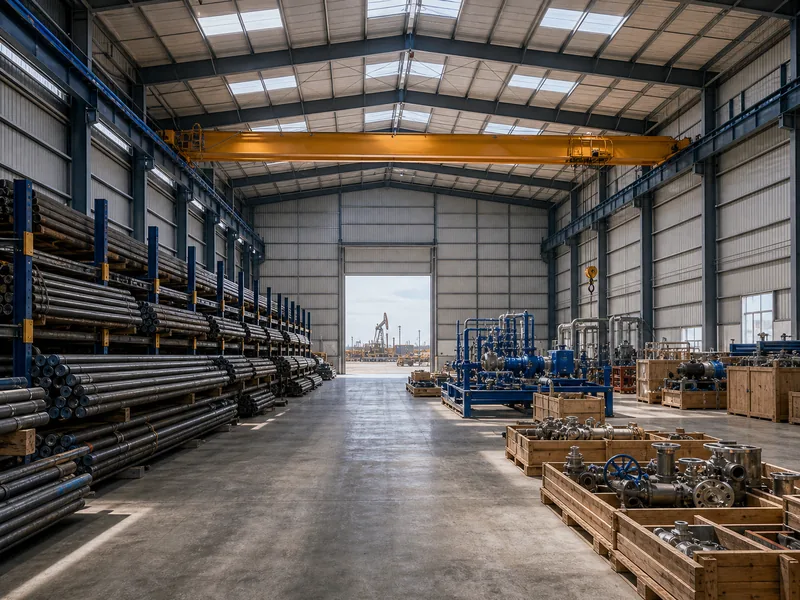
Oil industry warehouse services cover the storage, staging, and inventory control of the tubular goods, drilling and production equipment, MRO spares, and packaged chemicals an operation runs on. The building behind those services has to carry heavier loads, meet stricter hazardous-material rules, and turn equipment around faster than a general warehouse ever does. A standard dry-goods shed can hold pallets and call it done. An oilfield facility has to hold a 40-foot joint of casing, a crate of valves, and a drum of flammable additive in the same footprint, and keep each one compliant and reachable. This article focuses on the warehouse and storage side of that work — the facility and the services that run inside it — not tank-farm engineering, pressure vessels, or freight routing, which sit in their own disciplines.
What Oil Industry Warehouse Services Cover
Oil industry warehouse services combine two jobs that lighter operations often keep apart: physically housing heavy, hazardous, and high-value inventory, and moving that inventory to wellsites, rigs, and plants on short notice. The storage side handles four broad categories — tubular goods and OCTG, drilling and production equipment, maintenance-repair-operations (MRO) spares, and packaged chemicals such as lubricants, drilling fluids, and additives. The service side wraps those goods in inventory control, kitting, and distribution so a crew gets the right parts before downtime starts costing money.
A working scope usually includes:
- Receiving, inspecting, and storing OCTG, line pipe, and heavy equipment
- MRO spare-parts management with real-time inventory visibility
- Kitting and staging for scheduled jobs and turnarounds
- Segregated storage and handling for flammable liquids and hazardous materials
- Outbound staging, cross-docking, and dispatch to field locations
An oil and gas facility is still an industrial warehouse at its core, but the cargo reshapes almost everything about how it is built and operated. The same questions that drive any general warehouse — clear height, floor strength, door size, fire rating — get answered very differently once OCTG and flammable inventory are on the floor.
Why Oilfield Inventory Changes the Building
The contents of an oilfield warehouse, not its square footage, set most of the design decisions. Casing and tubing arrive in long, dense bundles that concentrate weight on small bearing points. Wellheads, valves, and pumps are heavy and oddly shaped. Chemicals come with flash points and containment rules. Each category pushes the building in a specific direction. Sound warehouse building design for oil and gas starts from the load and hazard profile and works outward to span, doors, and zoning, instead of dropping a generic box on site with a hazmat label on the door.
| Material category | What it is | What the building has to provide |
|---|---|---|
| Tubular goods / OCTG | Casing, tubing, line pipe in bundles | High floor load capacity, long clear bays, crane or forklift reach, thread protection |
| Drilling & production equipment | Wellheads, valves, pumps, BOPs | Heavy-point flooring, overhead lifting, wide doors, column-free routing |
| MRO spares & small parts | Fittings, instruments, consumables | Racking, secure rooms, organized pick paths, inventory tracking |
| Lubricants, additives & packaged chemicals | Drums, totes, IBCs | Ventilation, fire separation, secondary containment, climate control |
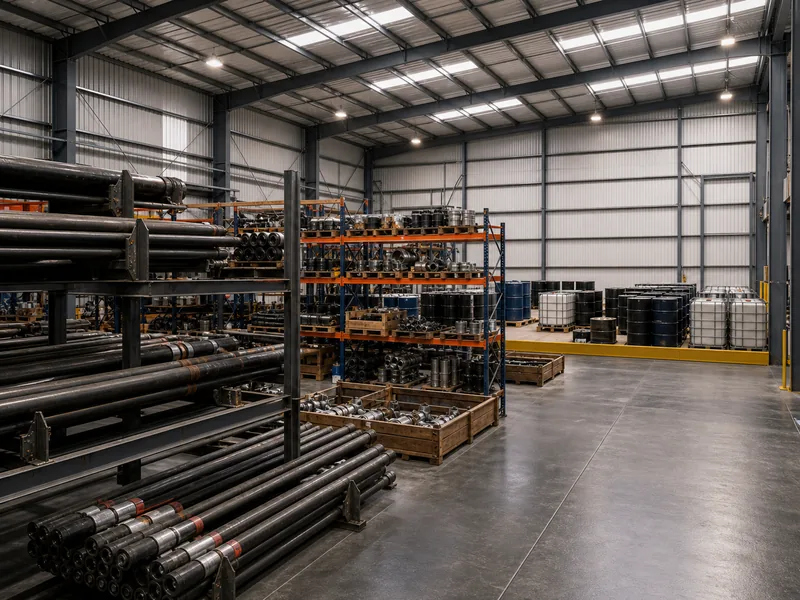
One detail that separates a workable layout from a frustrating one is how OCTG actually sits on the slab. A pipe bundle puts its full weight on a few cradle points, so the floor specification follows the heaviest stack you plan to build, not the average load across the room. Get that number wrong and you are either over-pouring concrete everywhere or restricting where pipe can go later.
Clear-Span Layout and Heavy-Load Handling
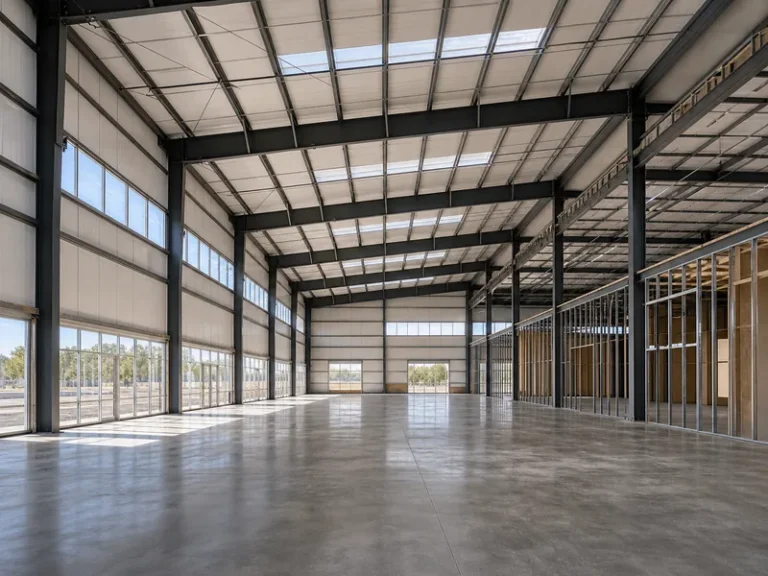
A column-free interior matters in an oil and gas warehouse because the loads moving through it are long, heavy, and awkward to route around posts. Clear-span steel framing removes the internal columns that would otherwise force pipe handlers and forklifts into tight turns, and it lets you re-stripe storage zones as inventory mixes change. For the casing, line pipe, and heavy equipment common to oilfield work, the open floor is the difference between a building you adapt and one you fight.
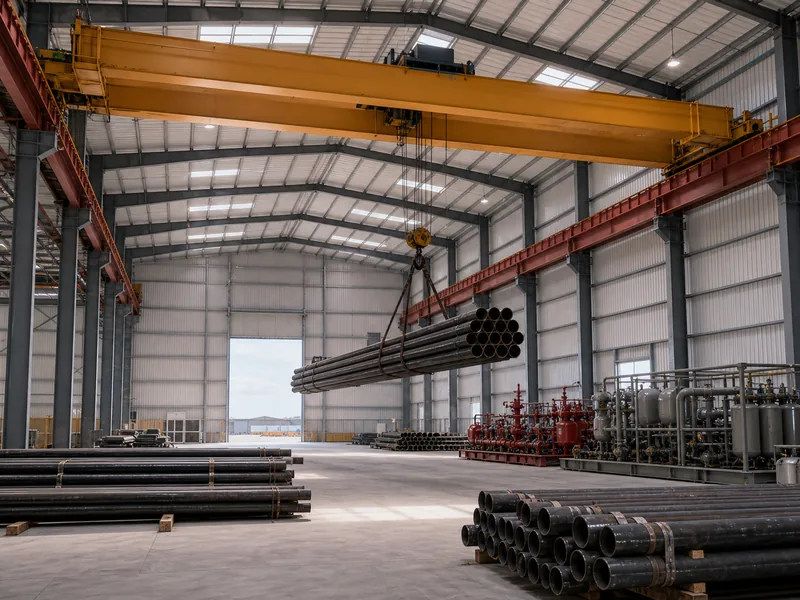
Three structural variables carry most of the weight here. Floor load capacity has to match concentrated point loads from stacked tubulars, not just a uniform per-square-foot rating. Eave height sets how high you can rack and whether an overhead crane fits above the top load. Door and bay sizing decides whether a full joint of pipe or a skid-mounted unit can actually get inside. These are the same fundamentals behind any industrial steel buildings project, sized up for the loads an oilfield handles.
Overhead handling is where many oilfield warehouses justify the heavier frame. A bridge crane riding on engineered crane beams lets one operator place a wellhead or a pipe bundle without a second machine, and it keeps the floor clear for staging. That capability has to be designed into the structure from the start, because retrofitting crane support into a frame that was never sized for it is expensive and often limited. Choosing the right frame and cladding also depends on the inventory, which overlaps with broader warehouse construction materials decisions.
Compliance for Flammable and Hazardous Storage
Storing flammable liquids and hazardous materials puts an oil and gas warehouse under fire and environmental rules that a dry-goods warehouse can ignore. Lubricants, solvents, drilling fluids, and additives carry flash points, and once they are on site the building has to satisfy codes written specifically for ignitible liquids. This is warehouse-side compliance — storage, separation, and containment — not the tank-farm or pressure-vessel engineering that governs bulk fuel.
In the United States, three references frame most of the conversation. OSHA’s flammable liquids standard, 29 CFR 1910.106, governs how containerized flammable liquids are stored indoors, including requirements such as keeping stored material clear of structural beams and sprinkler deflectors and maintaining aisle access to doors and fire equipment. NFPA 30, the Flammable and Combustible Liquids Code, classifies liquids by flash point and sets the storage and handling safeguards that OSHA and many state and local authorities adopt. The EPA’s Spill Prevention, Control, and Countermeasure (SPCC) rule covers secondary containment, requiring a containment capacity at least equal to the largest single container plus freeboard for precipitation.
Three practical rules tend to drive the layout:
- Separate incompatible materials so flammable liquids are not stored alongside oxidizers or water-reactive chemicals
- Provide ventilation that prevents vapors and dust from accumulating in storage areas
- Build secondary containment — curbs, berms, or sloped collection areas — under drums, totes, and IBCs
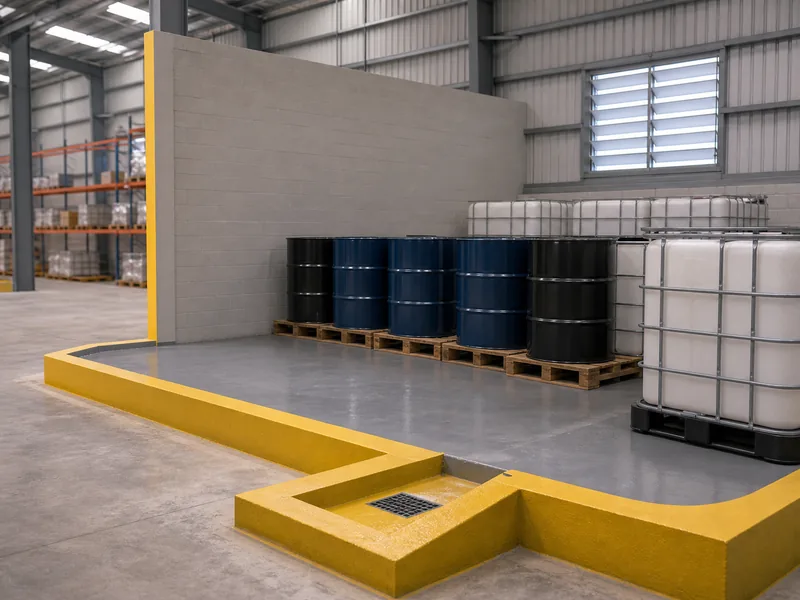
Because these rules touch the structure itself, fire separation and rated assemblies belong in the design phase, not as an afterthought; the principles behind steel building fire protection apply directly to how flammable zones are walled off from the rest of the floor. The exact thresholds depend on liquid classification and local code adoption, so the safe path is to verify the applicable edition with the authority having jurisdiction rather than treat any of this as a substitute for code review.
Corrosion Protection and Climate Control
Corrosion is the slow cost in an oil and gas warehouse, and it shows up at the fasteners and panel seams long before the main frame does. Oilfield sites are often humid, coastal, or chemically loaded, and that environment attacks connections first. Galvanized or properly coated steel, sealed details, and the right fastener spec hold the building together far longer than bare steel in the same air. That is why the protective system is specified to the site instead of copied from a mild inland project.
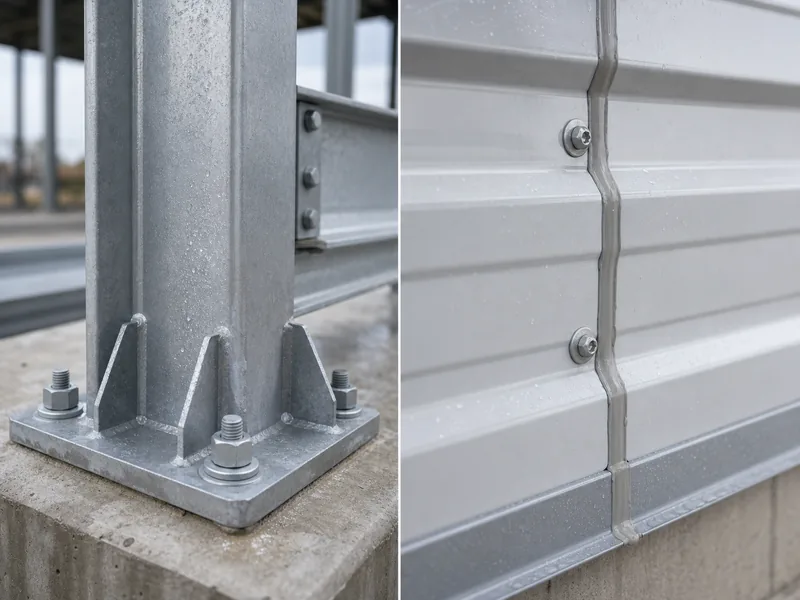
Stored product has its own environmental needs. Many lubricants and additives are sensitive to temperature swings, and condensation on cold steel can damage labels, packaging, and threaded surfaces. A facility holding temperature-sensitive chemicals usually needs controlled ventilation and, in some climates, insulation and heating or cooling to keep conditions stable; matching the building envelope to the product is where metal building insulation choices earn their cost. The level of control follows the product data sheets, not a blanket rule, so the storage spec should come from the materials being held, not a generic comfort target.
Inventory, MRO, and Staging Inside the Facility
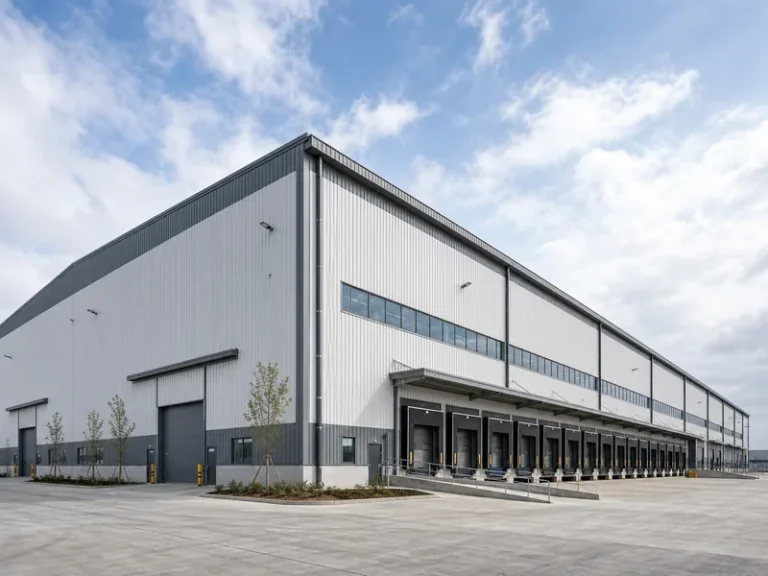
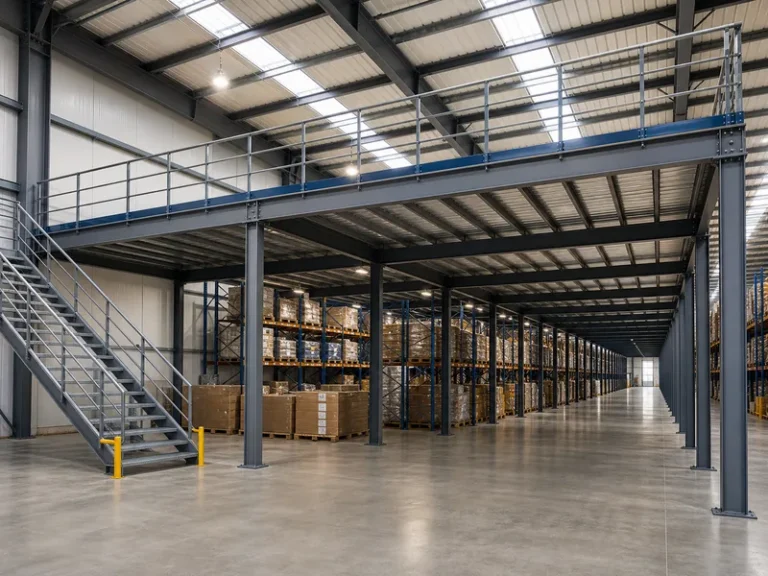
Warehouse services only pay off when the building lets inventory move as fast as the field demands it. MRO spares staged close to the dispatch door cut the hours a rig sits idle waiting for a part, and that downtime is usually the largest cost an oilfield operator is trying to avoid. The service layer — inventory visibility, kitting, cross-docking — runs on top of physical features the structure has to provide: wide aisles for long loads, dock height for the trucks you actually run, and racking that suits both small parts and heavy assemblies.
Layout decisions follow the mix. A facility that handles mostly OCTG leans toward open floor and crane coverage; one that handles MRO and consumables leans toward dense racking, secure rooms, and tight pick paths. Most oilfield warehouses do both, so the building is zoned — heavy and hazardous on one side, racked spares on another, staging and dispatch near the doors. Getting those zones right at the design stage avoids the rework of carving them out of a finished shed later.
Conclusion
Specifying an oil industry warehouse works best as an order of decisions, not a feature list. Start with what you store and how it is classified, because the inventory — concentrated tubular loads, heavy equipment, and flash-point-rated chemicals — sets the hard constraints. From there, size the structure for clear span, floor load, eave height, and crane capacity; layer in fire separation, ventilation, and SPCC-style containment for the hazardous portion; and only then organize the inventory and MRO services on top. Skipping straight to racks and doors before the materials and hazard classes are settled is what forces expensive retrofits.
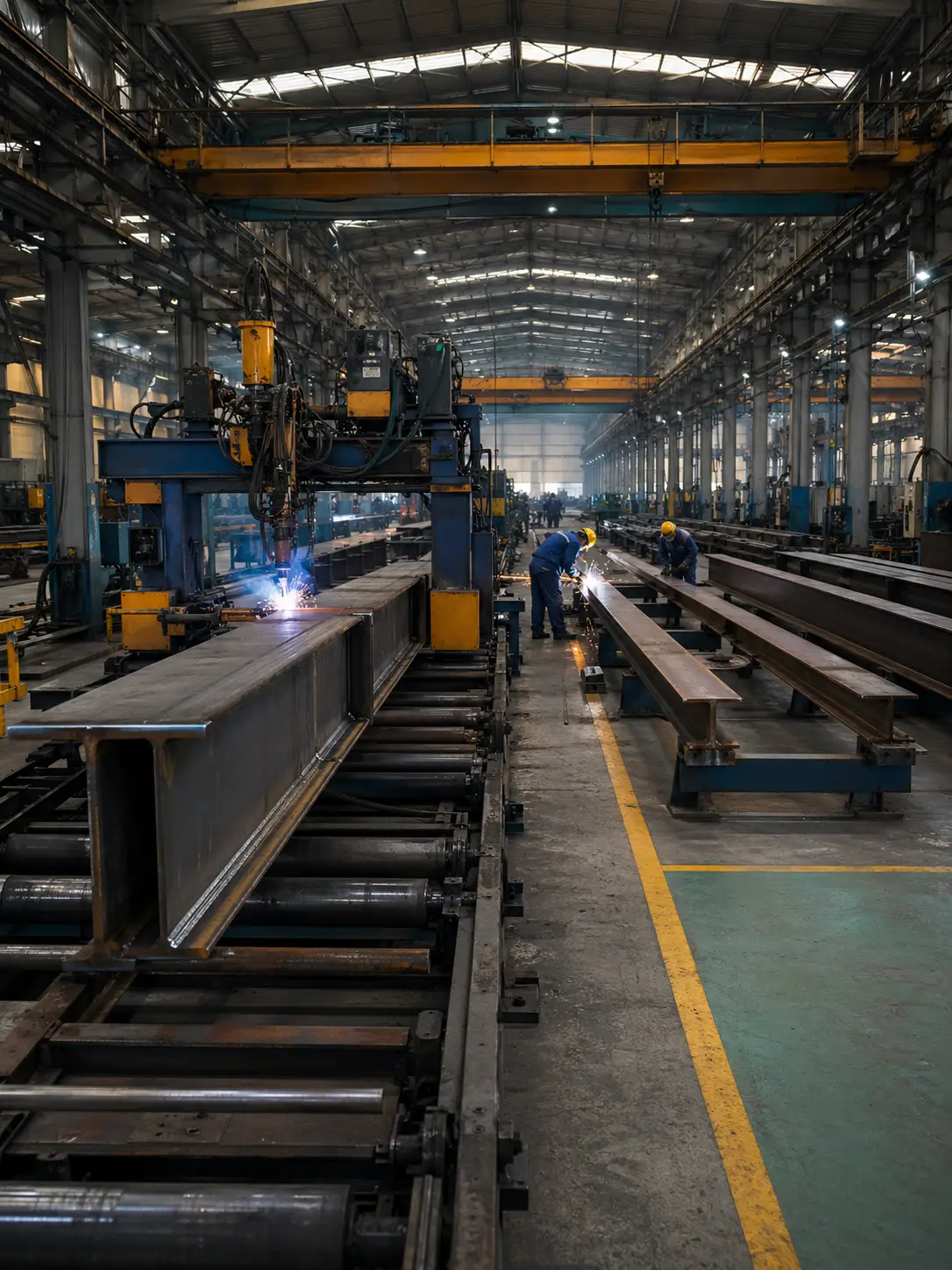
KAFA builds the steel side of that equation. As a steel structure manufacturer with design, fabrication, and installation qualifications, and dedicated H-beam, box-section, and purlin lines, we engineer clear-span frames and crane-rated structures to the loads and site conditions an oilfield warehouse actually faces. If you are scoping a facility, start from the OCTG stack height, the heaviest lift, and the flammable inventory on the manifest, and the building requirements follow from there.
FAQ
What does oil and gas warehousing include?
Oil and gas warehousing includes both storage and inventory services for oilfield goods. The storage side houses OCTG, drilling and production equipment, MRO spares, and packaged chemicals; the service side adds inventory management, kitting, and staging so parts reach wellsites and plants on time. The combination is what distinguishes it from simple pallet storage.
What are the storage requirements for oilfield equipment and tubular goods?
Oilfield equipment and tubular goods require a building sized for concentrated heavy loads, not the uniform pallet weights a standard warehouse plans around. Casing and pipe bundles bear on small cradle points, so floor capacity is set by the heaviest planned stack, and long clear bays plus crane or forklift reach allow safe handling. Thread protection and dry storage keep the goods usable after they are received.
What safety standards apply to flammable and hazardous storage in a warehouse?
Flammable and hazardous storage in a U.S. warehouse is governed mainly by OSHA 29 CFR 1910.106, NFPA 30, and the EPA SPCC rule. OSHA and NFPA 30 cover how ignitible liquids are classified, separated, and stored indoors, while SPCC covers secondary containment for spills. The exact requirements depend on the liquid classification and the edition adopted by the local authority.
How is an oil industry warehouse different from a standard warehouse?
An oil industry warehouse differs from a standard warehouse in load, hazard, and handling. It carries heavier concentrated loads from tubulars and equipment, follows fire and containment codes that dry-goods storage avoids, and is usually built with clear-span framing and overhead cranes for long, awkward items. A general warehouse rarely needs any of those three at once.
Does oilfield warehouse storage need climate control?
Oilfield warehouse storage needs climate control when it holds temperature-sensitive products. Lubricants, additives, and some chemicals degrade or sweat with temperature swings, so facilities storing them add ventilation, insulation, and sometimes heating or cooling. Buildings holding only steel goods and equipment often need corrosion protection more than active climate control.
Further Reading
- OSHA 29 CFR 1910.106 — Flammable liquids — U.S. Occupational Safety and Health Administration. The federal standard for indoor storage and handling of flammable liquids, including the clearance and aisle rules referenced above.
- NFPA 30 — Flammable and Combustible Liquids Code — National Fire Protection Association. Defines how ignitible liquids are classified by flash point and the storage safeguards adopted by OSHA and many local jurisdictions.
- EPA SPCC — Secondary containment requirements — U.S. Environmental Protection Agency. Explains the secondary containment capacity expected for bulk oil and chemical storage, which shapes containment design on the warehouse floor.