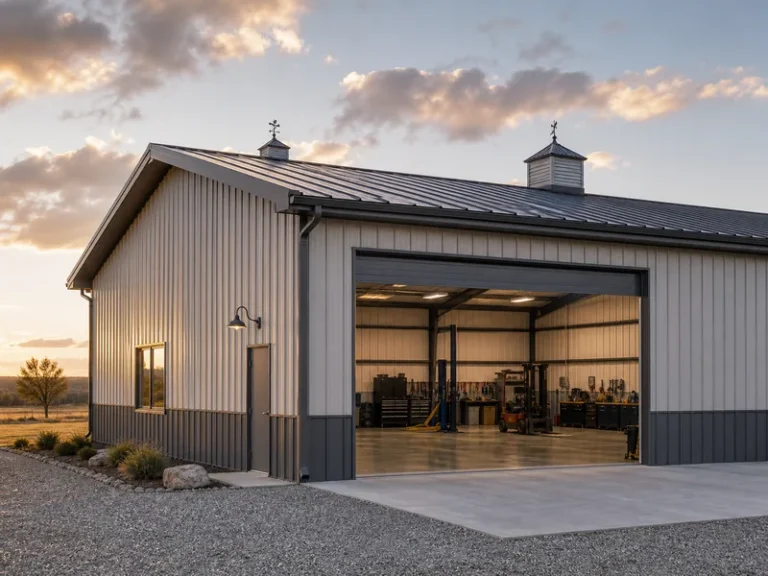





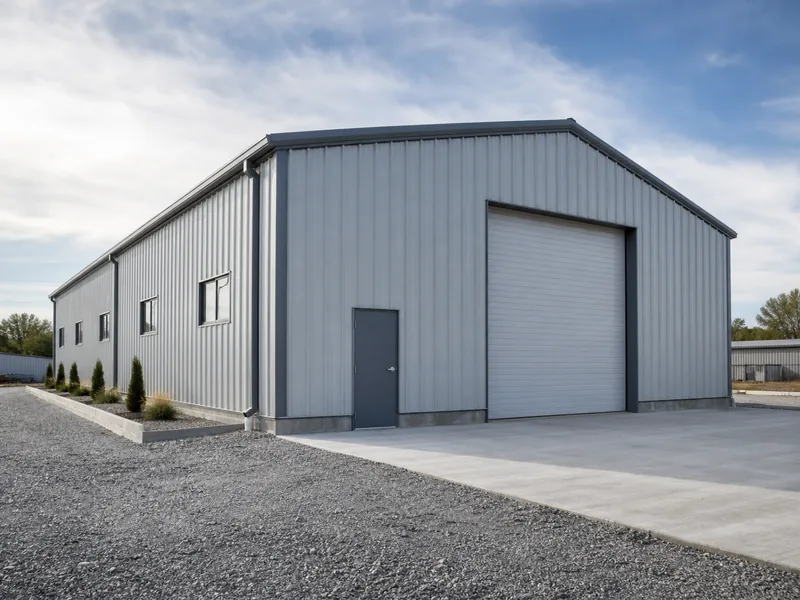
A turnkey metal workshop usually costs $25 to $45 per square foot to build. That puts a 30×40 (1,200 sq ft) shop around $30,000 to $54,000, and a 40×60 closer to $60,000 to $108,000. That installed range covers the steel building, a concrete slab, and erection, but not full insulation or climate control. Two other numbers bracket it. A bare steel building kit runs about $15 to $25 per square foot before you pour a slab or hire a crew, while a fully finished, climate-controlled shop can pass $60. Most of the prices below are for pre-engineered steel workshop buildings, which carry the widest and most predictable cost data; wood and custom builds vary more by local market and are covered near the end.
Workshop Cost by Size
Floor area scales the whole budget, so square footage is the first number to settle. At $25 to $45 per square foot, a turnkey metal shop runs from about $14,000 for a one-bay hobby space to $180,000 for a 4,000 sq ft production shop.
| Workshop size | Floor area | Turnkey cost at $25–$45/sq ft | Typical use |
|---|---|---|---|
| 24 × 24 | 576 sq ft | $14,000 – $26,000 | One-bay hobby or home workshop |
| 30 × 30 | 900 sq ft | $22,000 – $40,000 | Two-bay maker or wood shop |
| 30 × 40 | 1,200 sq ft | $30,000 – $54,000 | Small auto or fabrication shop |
| 40 × 60 | 2,400 sq ft | $60,000 – $108,000 | Light-industrial workshop |
| 50 × 80 | 4,000 sq ft | $100,000 – $180,000 | Multi-bay production shop |
Per-square-foot pricing falls as the footprint grows, because the frame, roof, and crew spread across more floor area. A 40×60 or 50×80 usually lands near the low end of the band, while a 24×24 sits at the high end. Use the upper figure when you expect heavy insulation, tall walls, or a finished interior.
The 30×40 is the typical starting point for a serious workshop: large enough for two work bays plus a storage corner, yet small enough to stay under commercial permitting thresholds in many areas. Sizing up to a 40×60 roughly doubles the budget but adds the clear floor a vehicle lift or larger machine needs.
What the $25–$45 turnkey figure includes, and what it does not. The installed range above is for a working metal shell on a standard slab. It generally includes the engineered steel frame, roof and wall cladding, fasteners and trim, a standard-thickness concrete slab, erection labor, and one basic roll-up or entry door. It generally excludes:
- full insulation and any heating or cooling;
- electrical beyond a basic circuit, and all plumbing;
- permits, engineered drawings, and site grading;
- freight to your site;
- interior fit-out such as walls, lining, and finished floors;
- extra or oversized doors and windows.
Expect the figure to climb past the top of the band with a finished interior, tall eave heights, a wide clear span, a thickened slab for heavy equipment, or high local snow and wind loads. A bare kit with none of the install items runs lower, around $15 to $25 per square foot.
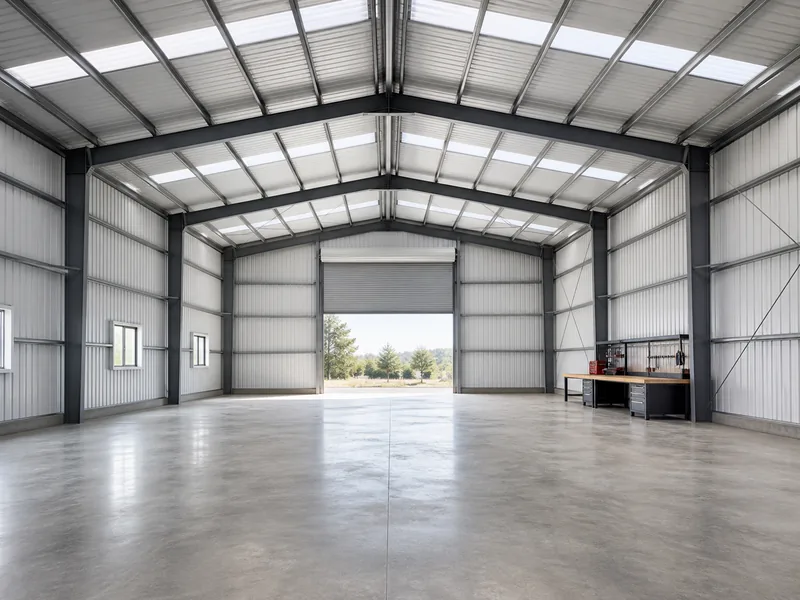
Where the Money Goes in a Workshop Build
A workshop budget breaks into four parts that each move on their own variable: the building, the slab, the erection crew, and the finish. Pricing them separately is what keeps a kit quote from being mistaken for a turnkey one.
| Line item | Typical cost | What moves it |
|---|---|---|
| Steel building package (rigid frame, roof and wall panels, fasteners) | $15 – $25 / sq ft | Drops toward $10–$15 on large clear-span footprints |
| Concrete slab and foundation | $4 – $8 / sq ft | $10–$12 for thickened, reinforced slabs under heavy machinery or vehicles |
| Erection and labor | $6 – $12 / sq ft | Higher for tall eave heights, cranes, or tight sites; labor can be 30–50% of the all-in budget |
| Insulation | $1.50 – $3.00 / sq ft (batt); $3 – $7+ (spray foam) | Closed-cell foam costs more but seals tighter |
| Heating and cooling | $2 – $8 / sq ft | Scales with how tightly you climate-control the space |
| Electrical, lighting, doors, windows | Project-specific | A basic circuit and one roll-up door add a few thousand; 3-phase power for machinery costs more |
| Permits, site prep, utility hookups | $3,000 – $16,000 combined | Permits alone run $200–$5,000 by jurisdiction |
Erection is where bids diverge the most, because site access and building height change crew time. Look at how labor costs for erecting a metal building are quoted before you judge one bid against another. The concrete foundation is the other line that shifts with your site, since soil conditions and slab thickness drive how much concrete and rebar you pour.
Together, these lines explain why a finished shop can cost roughly double a bare shell, and why a single per-square-foot number means little until you know which of them it covers.
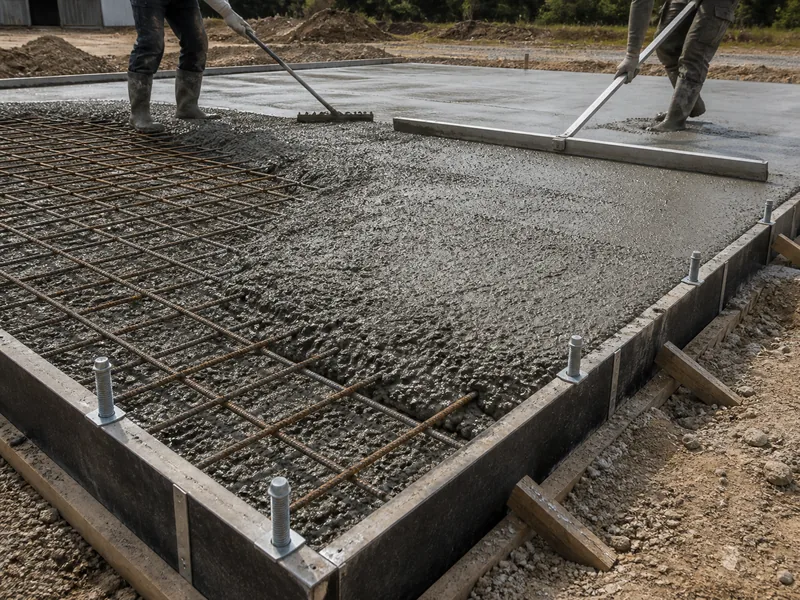
What Drives Workshop Cost the Most
Finish level swings a workshop budget further than the building itself, because the shell is a small share of a fully wired, climate-controlled shop. Adding metal building insulation and an HVAC system can push a bare shell well into the finished tier, so decide early whether the space needs to be heated and sealed or can stay a cold shell.
Clear span and height are the next levers. A column-free, clear-span workshop costs more per square foot than one with interior posts, because the wider rigid frame carries more steel, and every extra foot of eave height adds wall panel and frame weight. Size the eave to your tallest equipment or lift, not higher.
Large openings carry a cost most size charts skip. A workshop’s roll-up or sliding doors interrupt the wall framing, so every wide or tall door adds header steel and trim on top of the door unit itself. A single 10×10 roll-up is a minor line, but a drive-through shop with two oversized doors can add several thousand dollars in framing and hardware, so list every opening before you price the shell.
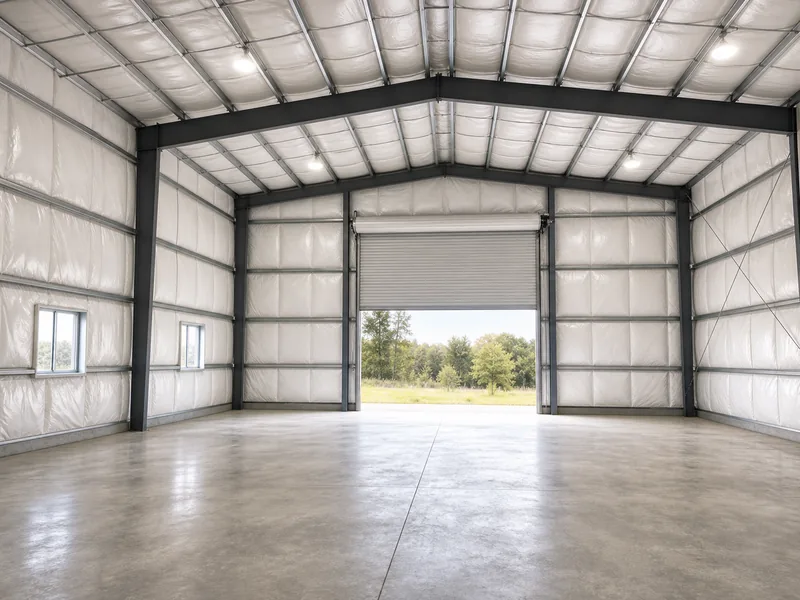
Design loads set the steel tonnage underneath all of it. Local snow and wind loads decide how heavy the frame has to be, so the same 30×40 costs more in a high-snow or coastal-wind region than in a mild one. Confirm your design loads against the local code before you compare quotes, since a light quote often assumes light loads.
Site and sourcing move the install side. Grading, access, and regional labor rates change the erection bill, and buying factory-direct from a fabricator rather than through a reseller can trim the building line on a larger order.
Metal vs. Wood and Prefab vs. Custom Workshops
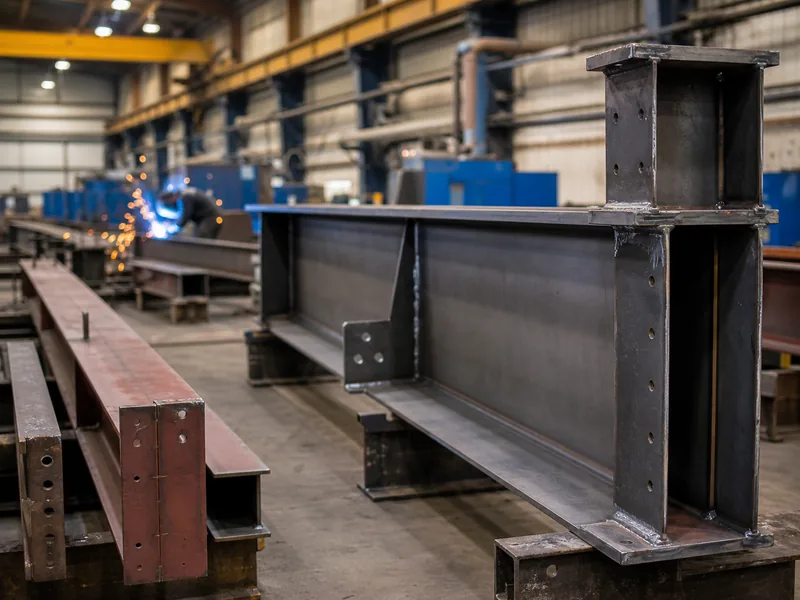
A prefab steel building is the default for a working workshop, though not because it always wins on local price. Its edge is a wide clear span, factory-controlled fabrication, a predictable shell scope, and low upkeep. Steel kits run about $15 to $25 per square foot, erect in days rather than weeks, and span without interior posts, which is why they dominate the working-shop market.
Wood and stick-built shops compete on small footprints and on looks. But they need more framing labor and added posts or engineered trusses to match a steel clear span, so their advantage narrows as the building grows. Local lumber and labor prices decide which one is cheaper in a given market, so price both for your area rather than assuming. Custom builds with architectural finishes, masonry, or living space run $55 to $150 or more per square foot and behave more like small buildings than shops.
Choose steel when span, speed, and a predictable shell budget matter, which covers most working shops. Choose wood or custom when the building doubles as finished living or showroom space, or has to match a home’s exterior. If your project is really a commercial or auto shop rather than a hobby workshop, the cost to build a shop breakdown covers that use case, where higher bays and heavier slabs shift the mix.
How to Build a Workshop for Less
The cheapest workshop is a simple rectangle at a standard size, built as a bare shell now and finished in phases later. A few choices at the planning stage do most of the saving:
- Stick to standard widths and bay spacing (30, 40, or 50 ft); manufacturers price stock sizes best.
- Keep a clean rectangle and skip lean-tos, wings, and complex rooflines in the first build.
- Pour the slab and erect the frame in one mobilization so crews are not paid to show up twice.
- Phase the finish: put up the shell, then insulate, wire, and add climate control as budget allows.
- Right-size the eave height to your tallest equipment instead of overbuilding clearance.
Layout decisions made early are the ones that prevent expensive mid-build changes; a few metal workshop design tips at the drawing stage keep both the steel weight and the rework bill down.
Conclusion
A workshop budget firms up fastest when you settle it in order rather than chase one per-square-foot number. First, define how you will use the shop, since the equipment, vehicle access, and ceiling height you need set both the size and the design loads. Second, lock the shell scope you are actually pricing: a steel kit at $15 to $25 per square foot, a turnkey shell at $25 to $45, or a finished, climate-controlled shop above $55. Third, size the slab and the door openings to your heaviest equipment, because those two lines move more than buyers expect. Fourth, decide what to finish now and what to phase later, which is where most of the flexible budget lives. Hold every bid to the same scope, since a kit quote and a turnkey quote for one 30×40 can read $20,000 apart and both be honest. As a steel structure fabricator, KAFA builds the rigid frame, purlins, and panels that set the shell line of that budget, so a factory-direct quote shows the steel cost on its own. Get a free quote with your size, location, and finish level to turn these ranges into a firm number.
FAQ
How much does a 30×40 metal workshop cost?
A 30×40 metal workshop runs about $30,000 to $54,000 turnkey, or roughly $18,000 to $30,000 for the steel kit alone. The 1,200 sq ft footprint is the most common workshop size because it holds two work bays plus storage without crossing into commercial-scale slab and permit costs.
Is it cheaper to build a metal or wood workshop?
Metal usually wins once a workshop passes roughly 1,000 sq ft, because steel’s clear-span framing avoids the extra posts and labor a wood span needs, though local lumber and labor prices can shift the result. On very small sheds, or where you want a specific wood look, timber can come out even or cheaper up front, but it tends to carry higher maintenance and fire-insurance costs over the building’s life. Price both for your own market before deciding.
What’s the cheapest way to build a workshop?
The cheapest workshop is a standard-size prefab steel shell on a basic slab, finished in phases. Choosing a stock size such as 30×40 or 40×60 and skipping lean-tos, extra openings, and tall eave heights holds down both the steel weight and the erection bill.
Does a concrete slab come with a workshop kit?
No, a steel workshop kit almost never includes the concrete slab, which is quoted separately at $4 to $8 per square foot. On a 1,200 sq ft shop that adds roughly $4,800 to $9,600 on top of the building, and more when the slab is thickened for heavy equipment.
How much does it cost to insulate a workshop?
Insulating a workshop costs about $1.50 to $3.00 per square foot for fiberglass batt and $3 to $7 or more for closed-cell spray foam. On a 1,200 sq ft shop that is roughly $1,800 to $8,400 depending on the system, before any heating or cooling equipment.
Further Reading
- Metal Building Manufacturers Association (MBMA) — industry association. Background on pre-engineered metal building systems and why they erect faster than site-built structures.
- International Code Council (ICC) — publisher of the International Building Code. Where the local permit and structural requirements that affect a workshop’s cost originate.
- ASCE 7, Minimum Design Loads and Associated Criteria — ASCE/SEI standard. Defines the snow, wind, and seismic loads that decide how much steel a workshop frame needs.