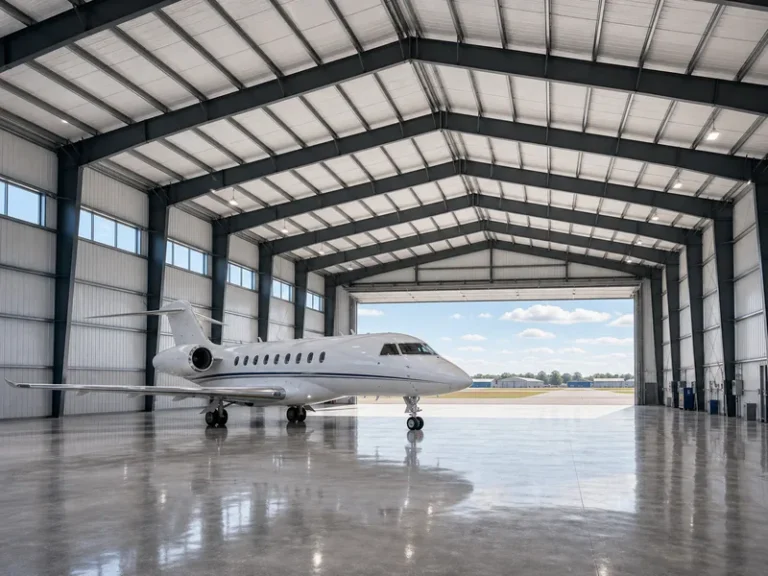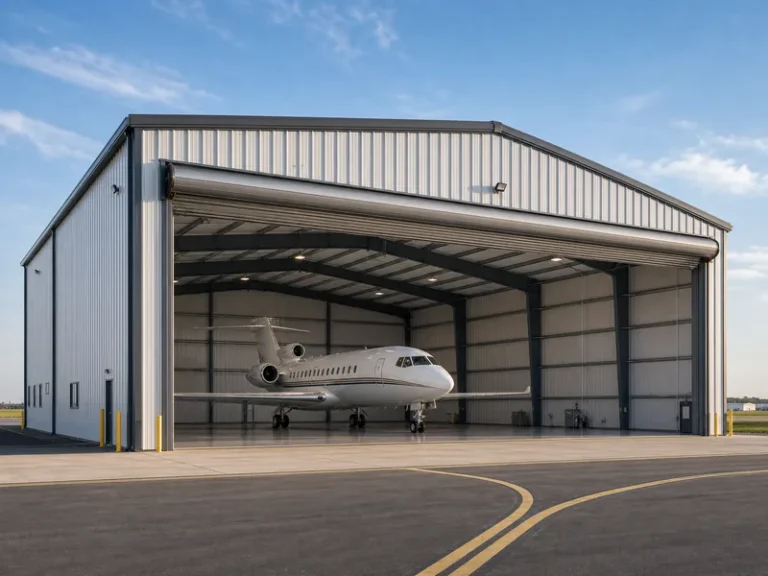





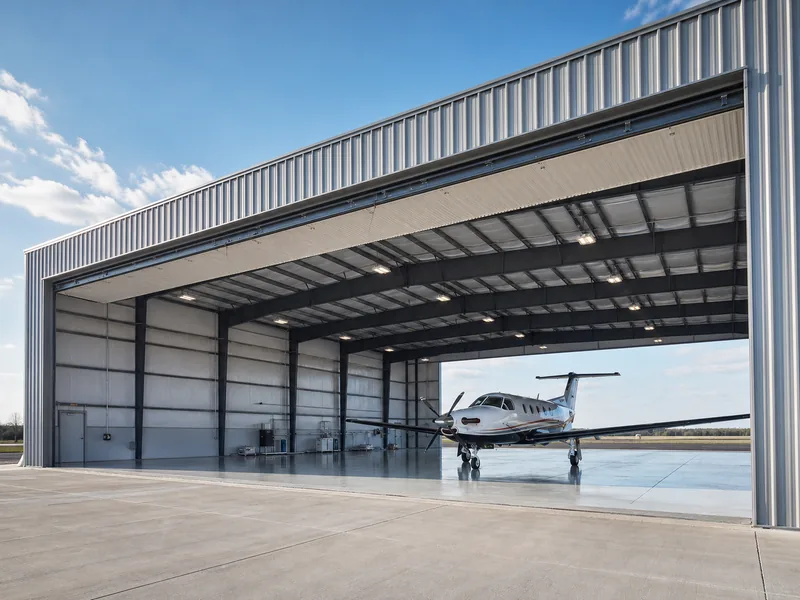
Aircraft hangar sizes run from about 40 by 30 feet for a single light plane to well over 200 feet across for a wide-body jet, and the clear door height is the number that decides which aircraft actually fit. A standard single-aircraft T-hangar covers roughly 1,000 square feet with a door near 12 feet tall. A two-to-four plane box hangar runs 60 by 60 to 80 by 80 feet with 16- to 18-foot doors. Corporate hangars run from roughly 80 to 150 feet deep with 22- to 28-foot doors, and commercial bays for airliners start around 120 to 150 feet wide and climb from there.
Those ranges are starting points, not catalog numbers. The size that fits an aircraft depends on its wingspan, length, and tail height, on how many planes share the floor, and on how much room you need to tow and turn them inside. The sections below give typical dimensions by class, then work through the constraints that move a hangar up or down a tier.
What Determines Aircraft Hangar Size
Three aircraft measurements set the floor and door of any hangar: wingspan drives width, fuselage length drives depth, and tail height drives the door opening. Of the three, tail height is the one owners underestimate, because a plane that clears the floor easily can still be too tall for the door. A turboprop with a 14-foot tail needs more than a 12-foot T-hangar door, even though its wingspan would slide into the bay. The same width-length-height logic sets ordinary metal building sizes, but in a hangar the door height carries far more weight than it does in a warehouse or shop.
Two more factors push the footprint outward. The number of aircraft stored together multiplies width and adds circulation lanes, and the clearance kept around wingtips and tails lets a plane be towed in without catching a column or door track. A hangar sized to the aircraft’s static footprint alone will be too tight in practice, since a plane has to be pushed in and angled rather than slid straight back.
Drivers that set hangar size:
- Wingspan fixes the minimum clear width between columns.
- Fuselage length fixes the depth from door to back wall.
- Tail height fixes the minimum clear door opening, usually the binding number.
- Aircraft count adds width and internal circulation lanes.
- Tow and maneuvering clearance adds a margin on every side of the static footprint.
Typical Hangar Sizes by Aircraft Class
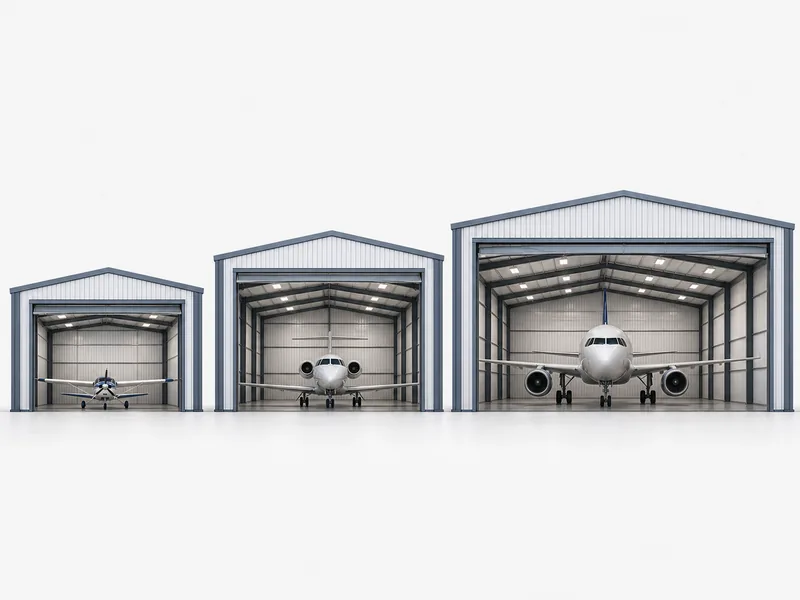
Hangars fall into four broad size tiers, from single-plane T-hangars to wide-body commercial bays. These tiers track the common types of aircraft hangars, but they are defined by dimensions rather than by name, so the same building can suit several aircraft. Each tier follows its own sizing logic: a T-hangar is built around one aircraft’s envelope and door; a box hangar around circulation for several planes; a corporate hangar around a business jet’s tail and door; and a commercial or maintenance (MRO) hangar around full-width door access and overhead working room. One dimension rule does not carry across all of them.
| Hangar class | Typical footprint (W × D) | Approx. area | Clear door height | Example aircraft |
|---|---|---|---|---|
| T-hangar (single) | 40×30 to 42×32 ft | ~960–1,400 sq ft | 12–14 ft | Piston singles, light turboprops |
| Box hangar (2–4 planes) | 60×60 to 80×80 ft | ~3,600–6,400 sq ft | 16–18 ft | Light jets, multiple GA aircraft |
| Corporate / executive | 80×80 to 150×150 ft | ~6,400–22,500 sq ft | 22–28 ft | Midsize to large business jets |
| Commercial / wide-body | 120–200+ ft wide | 15,000–60,000+ sq ft | 28–40 ft | Narrow-body and wide-body airliners |
Read the table as planning guidance, not a spec sheet. Each row still assumes you confirm the specific aircraft’s wingspan, length, and tail height, the clear door opening, and the circulation and support space your operation needs before fixing dimensions. Local fire-code grouping can also move a building into a larger or differently built class at certain size thresholds.
T-Hangars for Single Aircraft
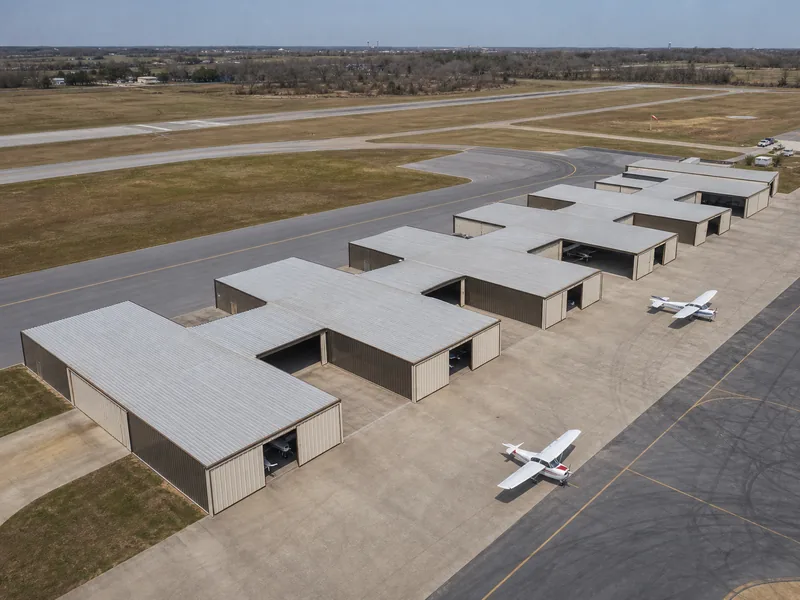
A T-hangar is the standard shelter for one piston single or light turboprop, typically 40 by 30 to 42 by 32 feet with a door opening near 12 feet. The interlocking T-shape lets each unit nest against the next, which is why municipal airports pack rows of them at roughly 1,000 square feet apiece. Published municipal layouts run from about 960 to 1,400 square feet per unit, depending on whether it is a standard bay or a wider corner unit. The limit is almost always the door: many older T-hangars top out near a 40-foot-wide, 12-foot-tall opening, which rules out taller turboprops regardless of floor space.
Box and Corporate Hangars
Box and corporate hangars cover the wide middle of the market, from 60-by-60-foot bays for a couple of light aircraft up to roughly 150-foot-deep corporate hangars for large business jets. A box hangar holding two to four general-aviation planes usually runs 60 by 60 to 80 by 80 feet with 16- to 18-foot doors. Corporate and executive hangars step up to 22- to 28-foot doors, with the clear height raised to match, so a midsize or large jet’s tail clears the opening. These mid-tier hangars are usually ordered as a prefab hangar package sized to one of the tiers above. Because the spans cross the point where interior columns would block aircraft movement, they are built as clear span buildings, with the roof load carried entirely by the perimeter rigid frame.
Commercial and Wide-Body Hangars
Commercial hangars for airliners start near 120 to 150 feet wide and 28 to 40 feet tall, and wide-body bays run past 200 feet in both width and depth. A single narrow-body aircraft needs a clear span and door tall enough for a tail in the 30- to 40-foot range, which puts these buildings in a different structural class from general-aviation shelters. Maintenance, or MRO, hangars add still more height for tail docks and overhead access, and their door openings often span the full width of the building so an aircraft can be towed straight in. At this scale the door and the clear span govern the engineering and the budget more than the floor area does.
Why Door Height Is the Binding Constraint
Door height, not floor area, is the dimension that decides whether a given aircraft fits at all. A hangar with room to spare on the floor is useless if the tail will not clear the opening, so the clear door height has to exceed the aircraft’s tail height with margin for the door structure and seals. Eave height then has to sit above the door, because the frame and door tracks occupy space over the opening.
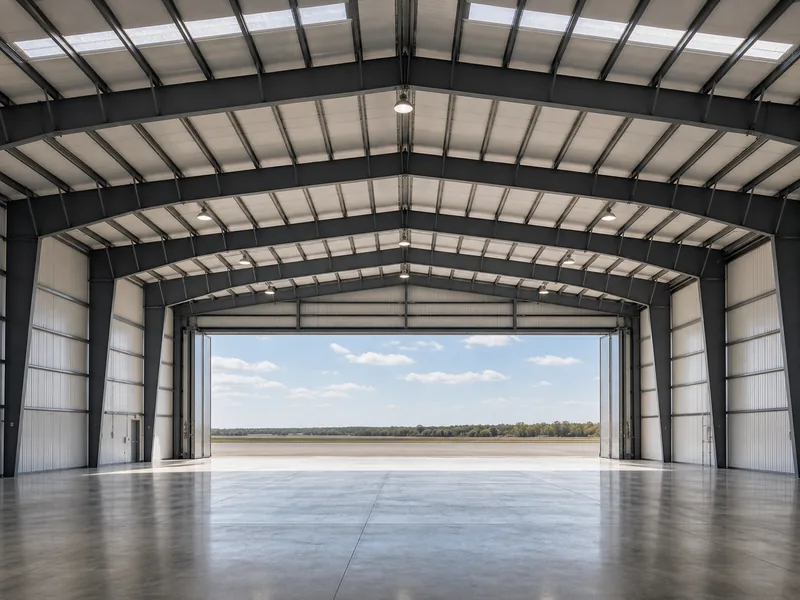
This is where buyers lose money. Stepping a door from 12 to 16 feet, or from 18 to 24, often moves the whole frame up a tier and drives much of the cost to build a hangar. Sizing the door to the actual tail height, rather than to a round number, keeps the structure from growing more than the aircraft requires. Bi-fold and hydraulic one-piece doors also change the usable opening in different ways, which is why a published “door height” should be read as the clear opening, not the frame height.
Clearance, Circulation, and Support Space
Beyond the aircraft’s own footprint, a hangar needs clearance on every side so the plane can be positioned without a wingtip or tail striking a column, wall, or door track. A tug or tow tractor needs room to maneuver and turn the aircraft, so the working aisle in front of the door is part of the size. Aircraft are usually pushed in at a slight angle and straightened, which means the diagonal clearance matters as much as the straight-in width.
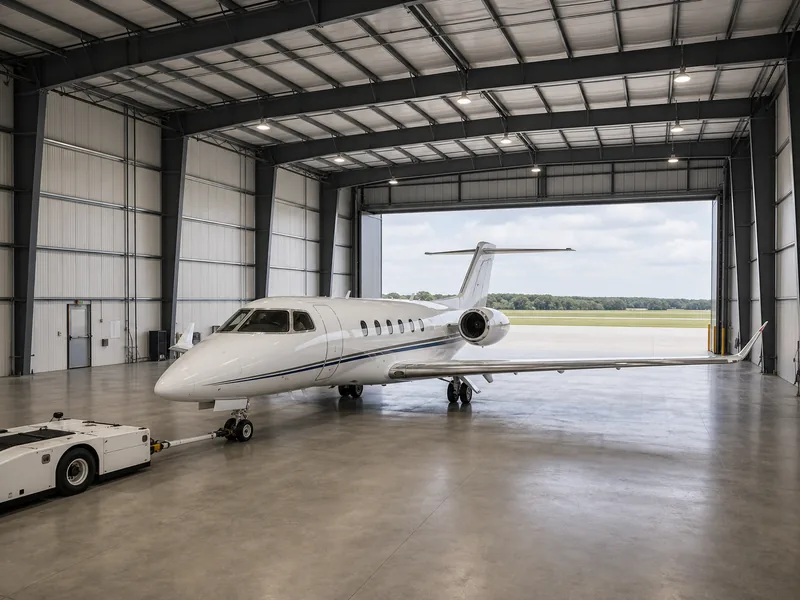
Storing more than one aircraft adds circulation lanes between and around them, so the floor needed runs past the sum of their footprints. Maintenance hangars need still more: room to open cowlings, position stands, and pull components, plus offices, parts storage, and restrooms that cut into the clear floor. A hangar planned only to the static aircraft dimensions will work for parking but cramp any service work.
Right-Sizing a Hangar in the Correct Order
Size a hangar by locking the constraints in order, starting with the tightest: tail height sets the door, wingspan sets the width, length sets the depth, and clearance plus workspace set the final footprint. Begin with the largest or tallest aircraft you expect to store, including the one you may upgrade to later. The door and clear height should carry a growth margin from the start, because those are the hardest dimensions to change once the frame is built. From there the wingspan fixes the column-free width and the length fixes the depth, and only then do you add the maneuvering buffer and any support space.
Getting the frame to those numbers is a structural problem as much as a dimensional one. The clear width and door height drive the steel building design, since a column-free span wide enough for a large wingspan has to carry the full roof load on the perimeter rigid frame. A manufacturer such as Qingdao KAFA Fabrication, which runs dedicated H-beam and box-section production lines, engineers the frame to the span and eave height an aircraft demands rather than to a fixed catalog size. Once the binding aircraft, door height, and clearance are fixed, those four numbers are what a fabricator needs to request a quote and detail the structure.
FAQ
What is the standard size of a single-aircraft hangar?
A standard single-aircraft T-hangar is about 40 by 30 to 42 by 32 feet, roughly 1,000 square feet, with a door near 12 feet tall. That envelope fits most piston singles and light turboprops with room to walk around the aircraft. The door height usually decides the limit before floor space does, so confirm the tail height before assuming a standard T-hangar will work.
How tall does a hangar door need to be?
A hangar door has to clear the aircraft’s tail height plus a margin for the door structure and seals. Light piston singles fit under a 12-foot opening, light turboprops generally need 14 to 16 feet, and business jets call for 18 to 28 feet depending on class. Always read a quoted door height as the clear opening, because the frame above it sits higher still.
How many square feet is a hangar for a business jet?
A business-jet hangar typically runs from about 6,400 to 22,500 square feet, with 80 to 150 feet of depth and a 22- to 28-foot door. Midsize jets sit at the lower end of that band, while large-cabin jets with taller tails and wider spans push toward the top. The tail height usually decides the door tier before floor area becomes the constraint.
What size hangar fits a Cessna 172 or similar small plane?
A standard T-hangar of roughly 40 by 30 feet with a 12-foot door fits a Cessna 172 and most light piston singles. The 172’s wingspan of about 36 feet and low tail sit well inside a typical T-hangar envelope, so floor space rarely governs. Owners of slightly larger singles should still check wingtip clearance against the door opening width.
Does hangar size have to follow a building code?
Hangar size is shaped by fire and design codes as well as by the aircraft. NFPA 409 sorts hangars into groups based on the single fire area and the aircraft-access-door height, and FAA design groups classify aircraft by wingspan and tail height. Crossing a code threshold can force a larger fire area, added fire protection, or a different construction type, so confirm the local requirements before fixing final dimensions.
Further Reading
- NFPA 409, Standard on Aircraft Hangars — National Fire Protection Association. Groups hangars by single fire area and aircraft-access-door height, which shows how code thresholds, not just the airplane, can move a hangar into a larger or differently built size class.
- FAA Advisory Circular 150/5300-13, Airport Design — Federal Aviation Administration. Defines Airplane Design Groups by wingspan and tail height, the same inputs that set a hangar’s clear width and door opening.
- FAA Aircraft Characteristics Database — Federal Aviation Administration. Publishes wingspan, length, and tail-height figures for specific aircraft, the starting numbers for sizing a hangar to a given plane.