






A hangar is sized by the aircraft it protects, not by the floor area you happen to own. Sound aircraft hangar design starts with the tail height, wingspan, and length of your current and future fleet. From there it works outward to the door opening, the clear span, the structural frame, and the fire and slab requirements that follow. Get that order right and the building fits the mission. Reverse it and you end up with a metal hangar building that looks big enough on paper but cannot actually swallow the airplane.
This guide walks the design sequence in the order that constrains a build: aircraft and mission first, then size, clear span, doors, fire and loads, and finally the slab, site, and room to grow. It applies to general aviation through corporate and MRO facilities, and it stays at the design-decision level. Detailed pricing, door product comparisons, and material trade-offs each deserve their own treatment, and final design and approvals always belong to a licensed engineer and the local authorities.
Start With the Aircraft and the Mission
The fleet you intend to shelter, and what you plan to do inside, set every later design number. List the wingspan, tail height, length, and weight of each aircraft you own now and realistically expect to own, then decide whether the building is for storage, for maintenance and overhaul (MRO), or for production. Each mission pulls the design in a different direction: an MRO facility needs more vertical clearance for tail stands, heavier ventilation for fuel and solvent fumes, and a stricter fire approach than a building that only parks aircraft overnight. Maintenance work in particular drives interior height, because tail docks, overhead access platforms, and the occasional engine hoist all need room above the aircraft, not just around it.
Mission also sets the program around the aircraft. An MRO or corporate building usually adds offices, parts storage, and restrooms along a wall or in a mezzanine, plus circulation room for tugs and ground equipment to move without clipping a wing. A pure storage hangar can keep that program minimal. That same mix decides the types of aircraft hangars that make sense, from T-hangars for single aircraft to open-bay layouts for a mixed fleet. Planners who size only for today’s airplane tend to box themselves out of the next category up. A King Air now and a light jet in five years is a common path, and the door that fit the turboprop is suddenly several feet too short for the jet’s tail. Designing to the fleet you expect, not just the one you have, is the cheapest decision in the whole project.
Sizing a Hangar From Wingspan, Tail Height, and Length
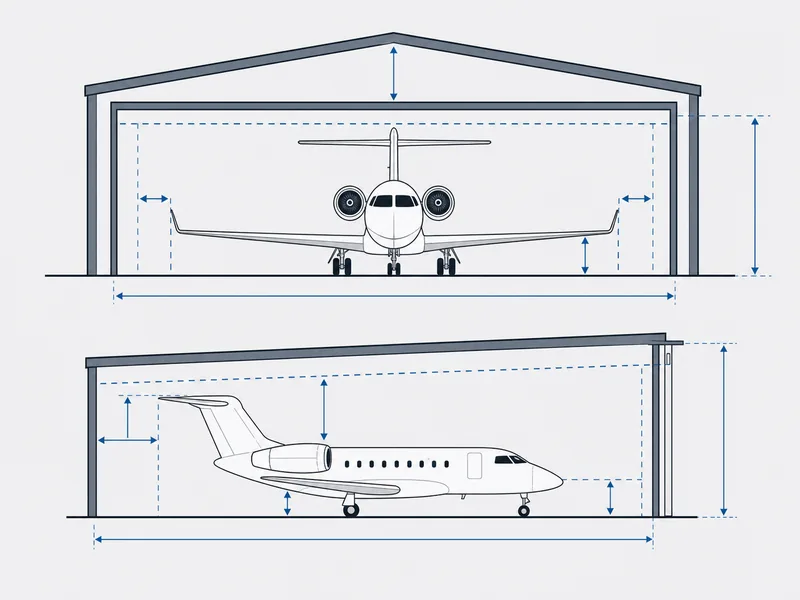
Every hangar dimension traces back to an aircraft measurement plus an operating clearance, never to a catalog of standard sizes. Width comes from wingspan plus wingtip clearance, which many operators plan at roughly 3 feet per side under standard procedures, multiplied out where aircraft park side by side. Depth comes from aircraft length plus nose and tail clearance for towing, often planned near 5 feet at each end. Both are planning figures, not fixed code minimums, so confirm them against your own operating procedures and insurer requirements. Door clear height, meanwhile, has to clear the tallest tail with margin to spare.
The dimension easiest to get wrong is door clear height. Tail height, not wingspan, stops a jet at the threshold, and a door specified for the wing alone will not clear the fin. Clear span ranges follow aircraft class, and the table below is a planning starting point, not a final spec; exhaustive model-by-model dimensions are a separate sizing exercise.
| Aircraft class | Typical clear span (varies by model and mission) | What usually drives it |
|---|---|---|
| Single-engine GA | ~40–60 ft | wingspan plus wingtip clearance |
| Light twin | ~60–80 ft | wider wingspan, side-by-side parking |
| Corporate jet | ~80–120 ft and up | wingspan, with tail height driving the door |
| Wide-body or large MRO | 150 ft and up | full column-free bay for movement |
Read the table as a planning aid and confirm each span against the actual aircraft. A single unusual tail height or winglet can push an aircraft up a band, and the door opening has to follow.
Clear-Span Structure and Column-Free Layouts
A single interior column lands exactly where an aircraft needs to turn, which is why a column-free interior is the structural goal of almost every hangar. A clear-span design removes interior supports so the full width and depth stay usable for maneuvering, parking, and maintenance access. The structural system that delivers it changes with span: rigid steel frames are economical for the small and mid-size bays that cover most general aviation and corporate work, while long-span steel trusses take over as spans grow.

Span also sets the engineering category. Clear spans beyond roughly 250 feet of column-free width move into long-span territory, and hangars have been built well past 500 feet between columns for wide-body and military use. Two heights have to be kept separate here: the door clear height the aircraft passes through, and the interior clear height under the frame, which has to add the structural depth, lighting, and any sprinkler drop sitting above the tail. Wind, snow, and seismic loads under ASCE 7 feed directly into how heavy that frame becomes, so the steel building design has to balance span against load before anyone prices steel. The variable to verify early is the governing load case for your region, because it changes the frame depth and the eave height, and with them the interior clearance you can actually offer.
Why Door Dimensions Drive the Whole Design
Get the door opening wrong and an otherwise correct hangar becomes unusable. Door clear height caps the tail height you can admit, and door clear width caps both how many aircraft park side by side and the largest single opening you can clear in one move. The door system you choose, whether sliding, bifold, or hydraulic, also changes header height, the loads fed back into the frame, and the side room the building has to reserve. That is why the product choice deserves a dedicated look at hangar door types.

Specify the door opening before finalizing the frame, because a wide opening reshapes the structure around it. It drives the endwall framing and the header beam spanning the top of the door, calls for extra bracing to carry wind loads into a wall that is mostly opening, and concentrates jamb and foundation reactions at the door columns. Those reactions feed straight back into the rigid frame and the footings, so a door sized late forces a structural redesign, not a quick tweak. One operational trap shows up after move-in: a door sized to the airplane but not to ground support equipment. Tugs, tow bars, and maintenance stands all need to pass through the same opening, and a door that just clears the airframe can still throttle daily operations.
Fire Groups, Loads, and the Codes Behind the Design
Fire classification shifts the design from being about the aircraft to being about the building’s risk category. In the United States, NFPA 409, the Standard on Aircraft Hangars, sorts hangars into Groups I through IV based on factors such as aircraft access door height, the size of the single fire area, and the type of construction. A door height above 28 feet or a single fire area above 40,000 square feet pushes a building toward Group I, the most demanding class for fire suppression, while staying under those thresholds can place it in a less demanding group.
That makes the fire group a design lever, not a downstream detail. Keeping a door under 28 feet or holding a fire area below the threshold is a deliberate massing decision that belongs in the early layout, not the permit phase, because it changes suppression scope and cost. Higher groups have historically called for foam-based suppression. Recent editions of the standard have eased some of those requirements for mid-size hangars, so the current edition and the local fire marshal’s reading of it should be confirmed before the layout is fixed. Beyond NFPA 409, design also answers to the IBC for permitting and structural safety, ASCE 7 for wind, snow, and seismic loads, the FAA for siting and airspace notification near runways, and OSHA for the working environment inside. None of this replaces formal review: a licensed architect or engineer, the airport authority, and the local building and fire officials sign off on the final design, fire strategy, and permits. What the design phase controls is the early geometry, and the fire group is the one rule that most visibly reshapes the building.
Floor Slab, Site, and Room to Grow
Owners defer the slab, the site, and the expansion plan more than any other design decision, and pay the most to fix them later. A hangar floor is typically 6 to 8 inches of reinforced concrete, thickened and reinforced further wherever landing gear and maintenance jacks concentrate point loads. It is then finished with a fuel-resistant sealer and graded so fuel and wash water drain to a controlled point instead of pooling under the aircraft. The controlling number is the heaviest wheel or jack load, not the overall floor area, so the metal building foundation should be engineered to the aircraft, not to a generic slab schedule.

Site and climate close out the design. Runway and apron access, prevailing wind, and FAA notification where a structure affects airspace all shape where and how the hangar sits. Interior climate control matters for avionics and MRO work, though the insulation approach is a decision in its own right. Expansion is the cheapest thing to plan and the most expensive to retrofit. A hangar that leaves door and bay headroom for the next aircraft class up ages gracefully, while one sized only to today’s fleet often ends up needing a repour. These choices, more than square footage alone, move the cost to build a hangar the most, so they belong in the design phase rather than the budget reconciliation.
The Design Sequence That Keeps a Hangar Buildable
Lock the aircraft and the door clear height first, because they cap everything above and behind them. Size the clear span next and pick the structural system to match it, rigid frames for the mid-size bays that cover most operations and long-span trusses once spans push past roughly 250 feet. Layer in the NFPA 409 fire group and the ASCE 7 load case after that, since both can push back on the frame and even on the door height you just set. Finish with the slab, site integration, and expansion headroom, the items that are cheap on paper and costly in concrete.
As a steel structure manufacturer, we focus on the part we can stand behind: designing and fabricating the steel frame to match that sequence. That means sizing H-beam and box-section rigid frames, purlins, and cladding to the span and the fire group your engineers set rather than to a stock package. If you can supply a fleet list and a runway location, that is enough to start the structural side of a design and request a quote. The decisions that matter most are the early ones: door clear height, clear span, and fire group, set before the first line is drawn.
FAQ
How do you design an aircraft hangar?
Design an aircraft hangar from the aircraft outward. Fix the fleet’s wingspan, tail height, and length, add realistic operating clearances, set the door clear opening, then choose the clear span, structural frame, fire group, and slab that support it. Working in that order keeps later decisions from invalidating earlier ones.
What size hangar do I need for my aircraft?
Hangar size is your aircraft’s footprint plus clearance, not a standard package. As a planning starting point, single-engine aircraft commonly fit clear spans of about 40 to 60 feet and light twins about 60 to 80 feet, but the binding constraint is usually door clear height measured against tail height, not floor width.
What is a clear-span hangar and why does it matter?
A clear-span hangar has no interior columns, so the full width and depth stay usable for moving and parking aircraft. It matters because a single column lands where an aircraft needs to turn, and clear spans beyond roughly 250 feet move into long-span structural design, which changes the framing system and its cost.
What codes apply to aircraft hangar design?
Aircraft hangar design answers mainly to NFPA 409 for fire protection, the IBC for permitting and structural safety, and ASCE 7 for wind, snow, and seismic loads, plus FAA notification where a structure affects airspace. The NFPA 409 Group I to IV classification, driven partly by door height and fire-area size, is the rule that most directly reshapes the design.
How thick should an aircraft hangar floor slab be?
Aircraft hangar slabs are typically 6 to 8 inches of reinforced concrete, thickened further where landing gear and maintenance jacks concentrate loads. The controlling factor is the heaviest wheel or jack point load, not the floor area, so the slab should be engineered to the specific aircraft rather than to a standard thickness.
Further Reading
- NFPA 409, Standard on Aircraft Hangars — National Fire Protection Association. Defines the Group I–IV hangar classes and fire-protection requirements that drive door-height, fire-area, and suppression decisions in design.
- Aviation Hangar — Whole Building Design Guide — National Institute of Building Sciences. Overview of hangar building types and the structural and life-safety considerations behind them.
- Airport Engineering, Design, and Construction Standards — U.S. Federal Aviation Administration. Design standards relevant to siting a hangar and maintaining clearances around runways and taxiways.