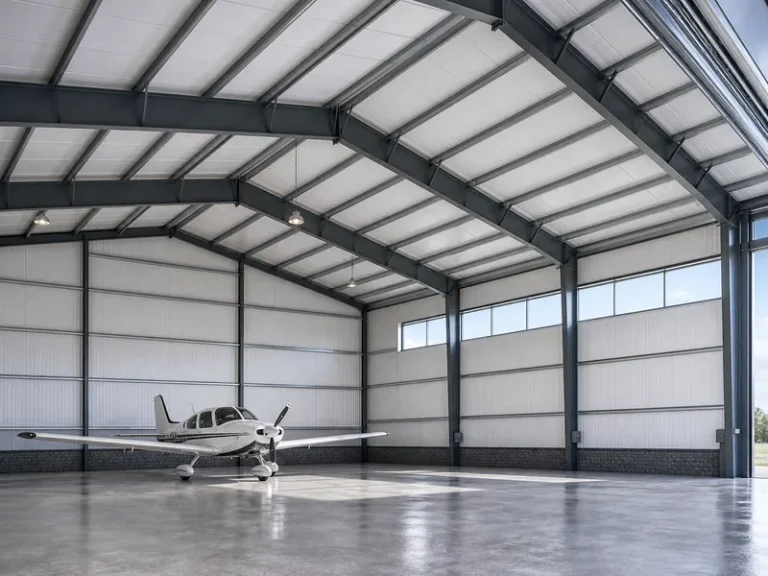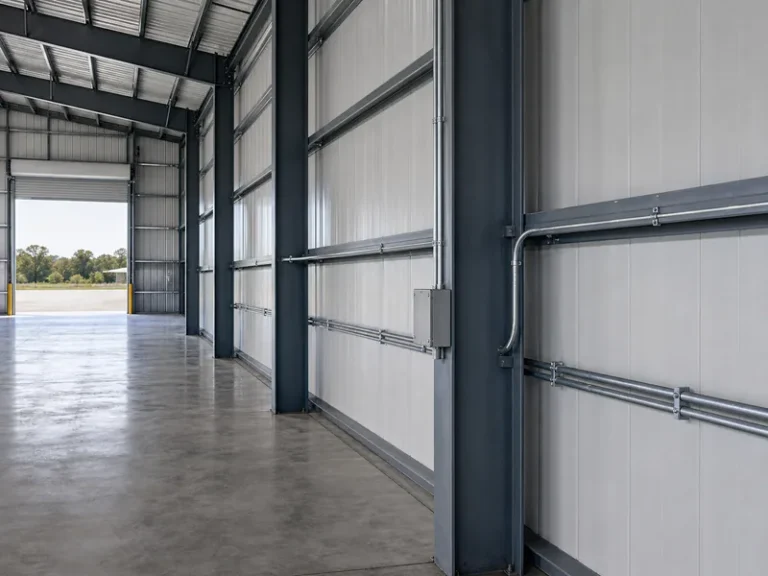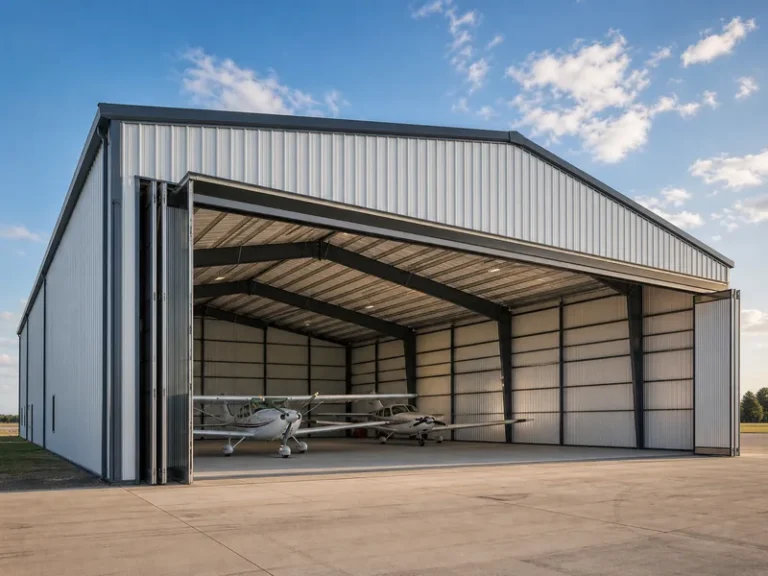





Five hangar door families cover almost every project, and the right one is set by three things: the clear-span width you need to open, the wind and snow your site sees, and the budget you can defend. Sliding (bottom-rolling) doors are the cheapest and most common way to open a very wide bay; bifold and hydraulic doors cost more but seal tighter and open faster; vertical-lift and fabric doors solve narrower, more specialized problems. The familiar or low-bid door is not automatically the right one, because the door is the largest moving element in the building and the widest unsupported span in the wall — it has to be engineered into the frame, not bolted on afterward. This comparison walks each type, then matches them to climate, cost, and how you actually operate a metal aircraft hangar.
The Main Hangar Door Types and Where Each Fits
Hangar doors split into five practical families, and each trades space, sealing, speed, and cost differently. The table below is the quick orientation; the sections after it explain the trade-offs that decide real projects.
| Door type | Space it needs | Seal & insulation | Opening speed | Wind & snow behavior | Upfront cost |
|---|---|---|---|---|---|
| Sliding / bottom-rolling | Wide side clearance to stack the leaves | Modest; bottom track exposed | Moderate | Closed leaves handle wind; exposed track ices and corrodes | $ |
| Bifold | Vertical headroom, little apron space | Good; folds with a drainage slope | Fast | Sheds snow when open; cables and hinges need upkeep | $$ |
| Hydraulic one-piece | Apron space for the outward swing | Best single-panel seal | Fast, one-button | Canopy catches wind and snow; few moving parts | $$$ |
| Vertical lift | Headroom pocket above the opening | Good | Fast, automated | Resists wind when latched; demands a stiff frame | $$$ |
| Fabric | Compact stack | Light; lower insulation | Fast | Handles wind if rated; far less mass | $ to $$ |
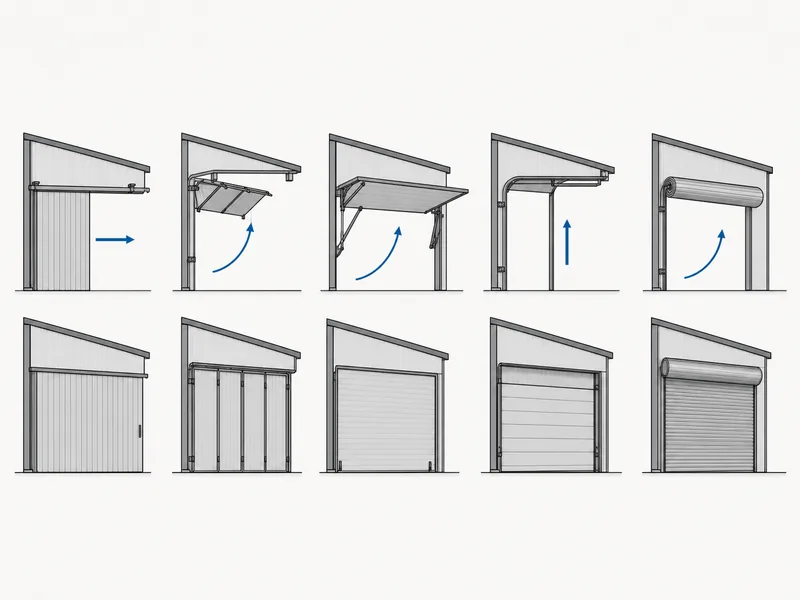
Sliding and Bottom-Rolling Doors
Sliding and bottom-rolling doors move horizontally along a top guide and a bottom rail set into the foundation. They are the workhorse for very wide openings because the design scales to almost any clear-span width by adding leaves, and the upfront price stays the lowest of any family. The cost is paid in two places: you need side clearance along the wall to park the open leaves, so a wall packed with leaves cannot also hold windows or another door, and the bottom rail sits outside in the weather. In wet, cold, or coastal sites that exposed track is the part to watch — it collects debris, freezes in winter, and corrodes near salt air, so drainage and routine clearing matter more than they do for any lifting door.
Bifold Doors
Bifold doors hinge across the middle and fold upward against the header as cables and a motor lift them. Folding instead of swinging out keeps the apron clear, so you can park aircraft or vehicles close to the opening, and the door clears the head faster than a sliding leaf travels sideways. The fold also creates a slope that sheds snow and water as the door opens. The trade-off is mechanical: cables, pulleys, and hinges are moving parts that need inspection and periodic replacement, and the design needs vertical headroom above the opening to take the folded panel.
Hydraulic One-Piece Doors
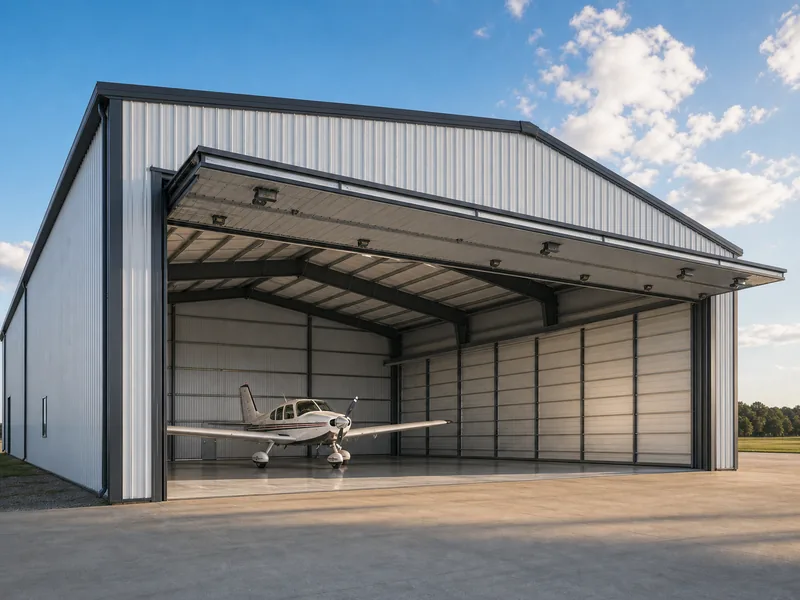
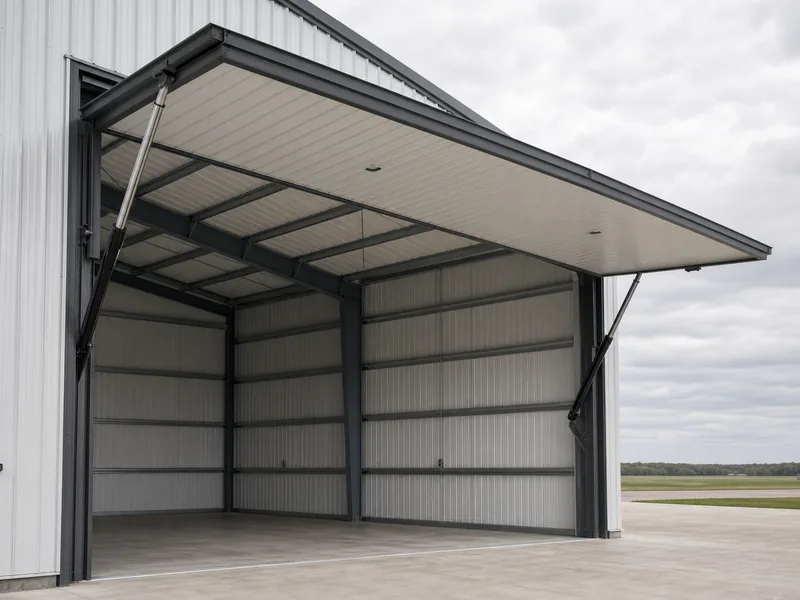
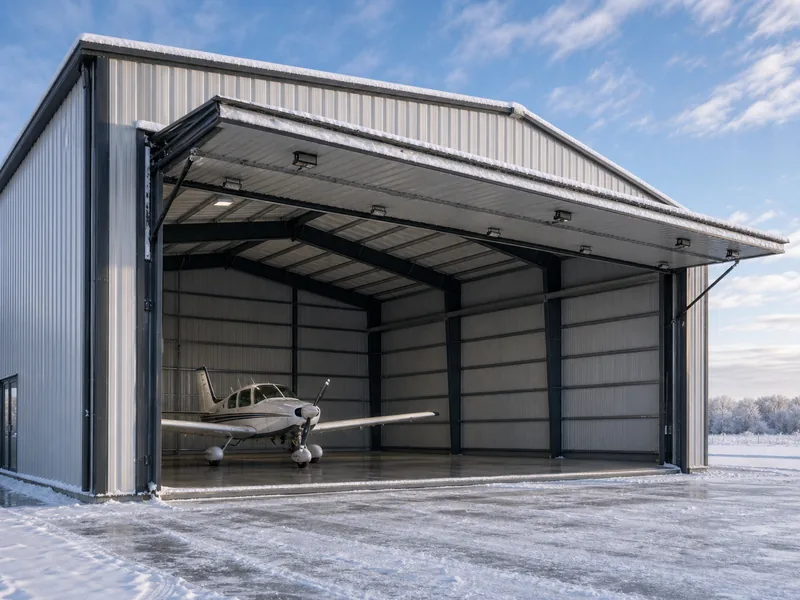
Hydraulic one-piece doors swing the entire leaf outward and up on two rams until it sits horizontal overhead, forming a canopy. A single rigid panel gives the tightest seal of these types against weather, dust, and pests, which makes hydraulic doors a common choice for climate-controlled or maintenance hangars, and the open leaf becomes a shaded canopy over the apron. Two trade-offs follow from that single panel. The door projects far in front of the building as it opens, so it needs apron clearance and can catch wind like a sail in an exposed location. The external truss that carries the leaf also collects snow that has to be cleared. In return, the mechanism itself is simple — two hydraulic rams and few moving parts to service.
Vertical Lift Doors
Vertical-lift doors raise a rigid panel straight up into a pocket above the opening, guided by side tracks. Lifting straight up consumes no apron space and no side clearance, which suits tight multi-bay layouts, and a rigid steel leaf resists wind well once it is up and latched. The constraint is structural: the building has to carry the door’s weight and the lift loads in a stiff frame and provide headroom for the raised panel, so vertical lift is most at home on purpose-built, often larger hangars rather than light retrofits.
Fabric Doors
Fabric doors replace steel leaves with a tensioned membrane that rolls or folds into a compact bundle. Trading steel for fabric cuts weight and upfront cost sharply, eases the structural demand on the opening, and stacks into very little space. The compromise is insulation and mass — a membrane seals and insulates less than an insulated steel panel and suits milder climates or buildings where light weight and a low price outrank thermal performance.
Climate, Wind, and Snow: Matching the Door to the Environment
Climate decides more hangar door specifications than aircraft size does. On a high-wind or coastal site, the exposed bottom track of a sliding door is the weak point — salt corrodes it and winter ice can freeze the leaves in place — while a wind-load-rated vertical-lift or hydraulic leaf rides out the same conditions better. The wind itself is a design number, not a guess: the leaf and its supports are sized to the site’s design wind speed under steel building wind load provisions, and a hydraulic canopy that projects into the wind needs that load checked carefully. Snow adds a second factor, because a hydraulic door’s external truss and a sliding door’s bottom rail both collect it, whereas a bifold sheds snow on its slope as it opens. Where the hangar is heated or cooled, sealing and insulation move up the priority list, which favors the tight single panel of a hydraulic door or an insulated bifold and ties the door choice to your broader aircraft hangar insulation options.
What Hangar Doors Cost and What Drives the Price
Sliding doors are the lowest-cost hangar door family upfront, bifolds sit in the middle, and hydraulic and vertical-lift doors sit at the top. A door’s price is set less by its style than by six things underneath it: the clear opening width and height, the lifting mechanism, the wind-load rating, the controls and automation, the insulation, and whether installation and the structural opening are included. Scale any of those up and every type gets more expensive. Within the same opening, a sliding or bottom-rolling door is usually the least expensive to buy, and a bifold costs more for its lift hardware. Hydraulic and vertical-lift doors carry the highest upfront price, with a large custom hydraulic leaf at the top of the range. A sectional overhead door can undercut all of them, but only on smaller openings of roughly 30 feet or less. Because the door is often one of the larger single line items in a build, it deserves the same scrutiny as the rest of the cost to build a hangar.
Reading a door quote: A price is only comparable when you know what is in it. A door-leaf-only number excludes the structural header and jamb columns, the motor and controls, wind-load certification, insulation, and on-site installation — each of which can move the figure substantially. The cheapest bare leaf often carries no wind-load rating at all. Before comparing two bids, confirm the clear opening size, the design wind speed, the controls, and whether the quote includes the structural opening and installation.
How to Choose the Right Hangar Door
Choosing a hangar door works best as an ordered process, not a feature checklist. Work the constraints in the order that actually removes options:
- Fix the clear opening first. Size the clear-span width and height to your largest aircraft plus tail and wingtip clearance; this alone rules some families in or out.
- Read the site loads. Establish the design wind speed and snow load and any coastal corrosion exposure before you weigh door styles.
- Match the operating pattern. Decide how often and how fast you open, whether you need automation, and how reliable site power is.
- Set budget against lifecycle. Compare the upfront leaf price together with maintenance — cables and seals on a bifold, rams on a hydraulic — and energy cost if the hangar is conditioned.
- Engineer the opening into the frame. Size the header, jamb columns, and wind posts for the chosen door as part of the steel building design, not as a later add-on.
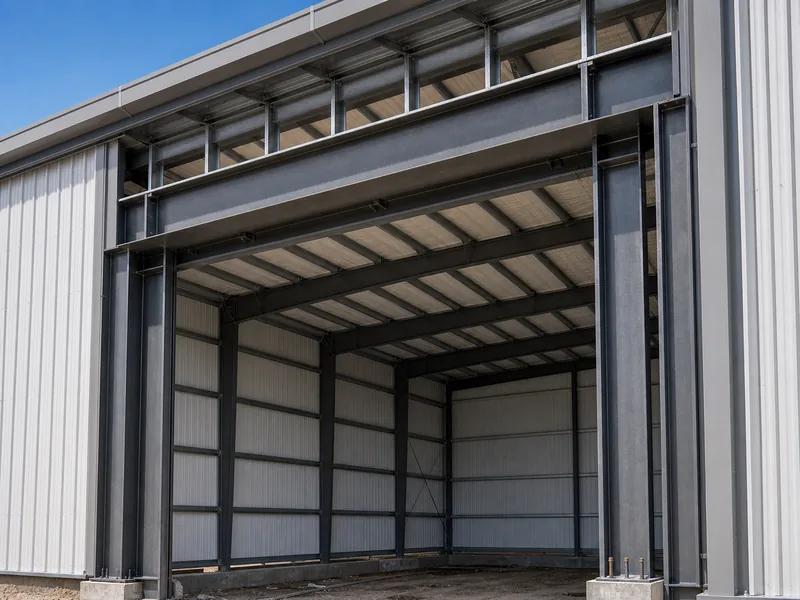
That last step is where door choice and building structure meet, and it carries the most weight for steel hangar buyers. The door is the widest unsupported opening in the wall, so its header and jamb columns carry the leaf’s weight and the wind load on the opening. A bottom-rolling door adds a foundation rail and concentrated reactions the slab has to be poured for, and a door set in an endwall changes how that wall is framed and braced. Controls, power, and the sequence in which the door is installed relative to the frame and cladding all follow from the type you pick. Selecting a door without designing its opening is how hangar projects back themselves into a costly change order.
The Right Door for Each Hangar
The right hangar door follows the opening, the weather, and the budget, in that order. Choose a sliding or bottom-rolling door when the opening is very wide, the budget is tight, and you can keep an exposed bottom track clear of ice and debris. Step up to a bifold when you want a faster, better-sealed door that folds clear instead of swinging out, and you have the headroom for it. Pick a hydraulic one-piece door when a tight seal, a full-height canopy, and climate control matter more than the apron space the leaf consumes. Reserve vertical-lift doors for tight, structure-ready bays and fabric doors for light, mild-climate openings where low weight and low cost lead. A sound door choice only becomes reliable when the opening is designed for it — the header, jamb columns, and wind posts that carry the leaf have to be sized with the frame. KAFA engineers and fabricates that structural opening as part of the steel hangar — header, jambs, wind posts, and foundation rail sized to the door and the site’s wind load — and coordinates it with the door supplier rather than treating it as a retrofit. If you are weighing two door types for a specific span and design wind speed, request a quote with your opening size and loads, and compare the structural opening, not just the leaf price.
FAQ
Which hangar door type is the most affordable?
Sliding and bottom-rolling doors are the most affordable hangar doors upfront, usually less than a comparable bifold of the same width. For small openings of roughly 30 feet or less a sectional overhead door can be cheaper still, but it does not scale to the wide bays where sliding and bifold doors are the practical choice.
What is the best hangar door for a high-wind or coastal site?
For high-wind and coastal sites, a wind-load-rated vertical-lift or hydraulic door usually outperforms a sliding door whose exposed bottom track corrodes in salt air and ices in winter. Ask the supplier for the door’s rated design wind speed and confirm it against your site’s load requirements before ordering, rather than assuming a heavier leaf is automatically rated.
Bifold versus hydraulic: which should I choose?
Choose a bifold for lower upfront cost and a door that folds clear without swinging outward; choose a hydraulic one-piece door when a tight single-panel seal and a full-height canopy matter more than apron space. A hydraulic door has fewer moving parts (two rams), but its outward swing and snow-catching external truss need front clearance that a folded bifold does not.
Do large hangar doors need extra structural support?
Yes — large hangar doors need a header and jamb columns engineered into the frame, because the door is the biggest moving load and the widest unsupported span in the wall. This is why a door type cannot be finalized independently of the building: the opening’s structure, and a bottom-rolling door’s foundation rail, have to be sized to the specific door and the site’s wind load.
Can I retrofit a different door type onto an existing hangar?
A different hangar door type can often be retrofitted, but the existing header, jambs, and foundation rail set the limits, and a heavier or wider leaf may require reinforcing the opening. Bottom-rolling doors in particular need a foundation rail and bottom track that an existing slab may not have been poured to carry.
Further Reading
- NFPA 409, Standard on Aircraft Hangars — National Fire Protection Association. Governs hangar classification, fire protection, and egress, which shape door operation and exit requirements.
- ASCE 7, Minimum Design Loads and Associated Criteria for Buildings and Other Structures — American Society of Civil Engineers. The standard behind the wind and snow loads a door leaf and its opening must be designed to resist.
- DASMA Technical Data Sheets — Door & Access Systems Manufacturers Association. Wind-load and performance references for large doors, aligned with ASCE 7.