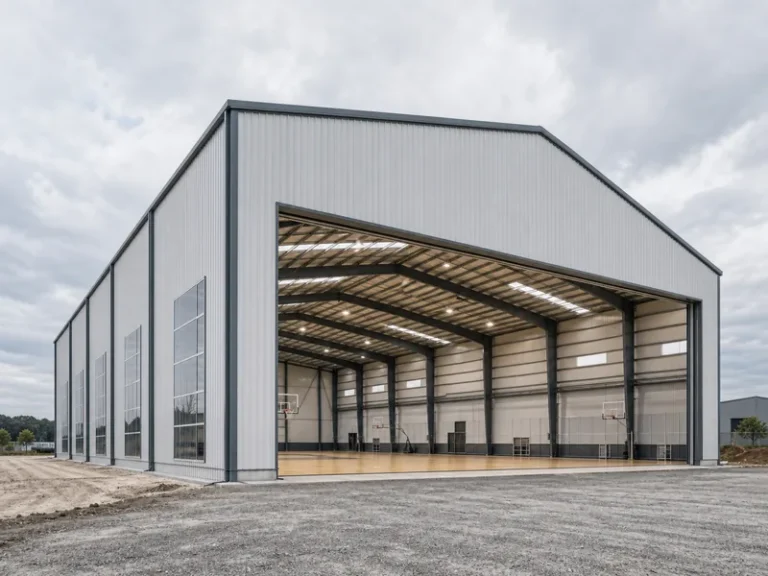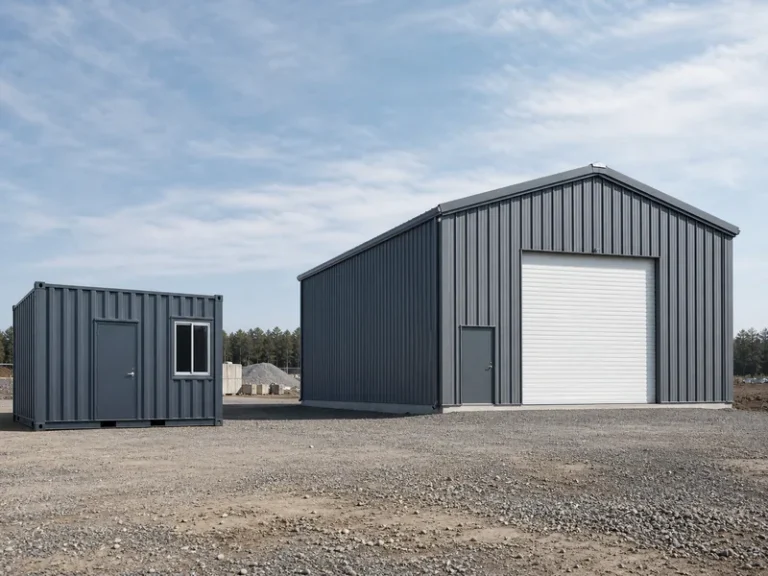





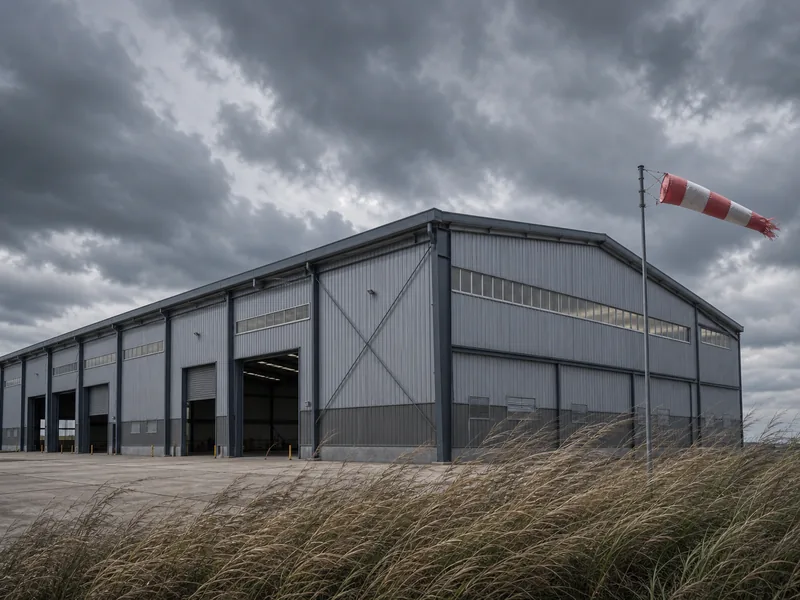
Wind load has to be set before price or finish choices mean much. It is not a single push against one wall; it is a system of pressures and suctions acting on walls, roof zones, corners, eaves, fasteners, and frames. A quoted rating such as “130 mph” is only the input. The useful checks are the site exposure, risk category, code edition, local pressure zones, and the path that carries the load into the foundation.
Wind pressure should be resolved during steel building design because frame reactions, bracing, anchors, doors, and wall panels all depend on the load path.
How Wind Actually Loads a Steel Building
Wind acts on a steel building as a combination of pressure and suction working on the walls, roof, corners, and eave edges at the same time, each zone carrying a different force in a different direction. Treating it as one horizontal push is a common way buyers underestimate what the frame and cladding have to resist. Three components show up in every code-based wind design.
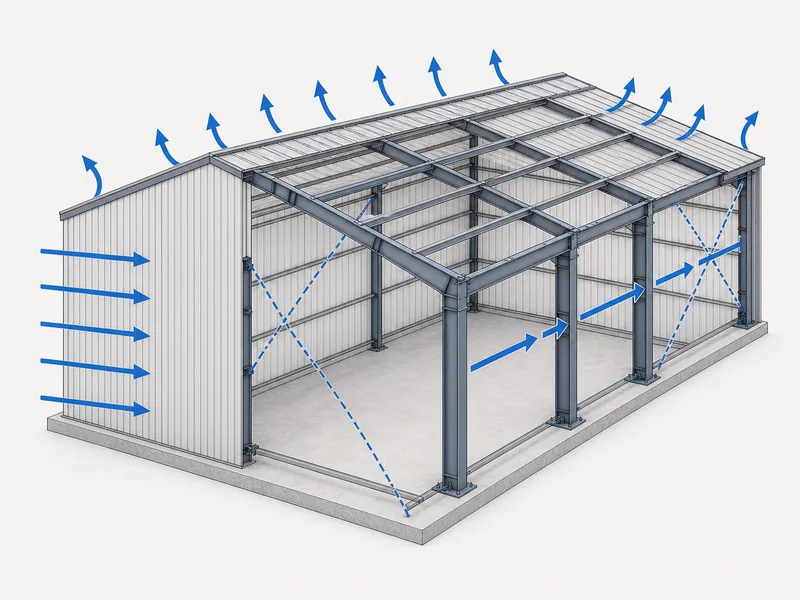
Lateral pressure on walls and frames
Lateral pressure is the wind pushing directly against the windward wall and end frames, and it is the force most people picture first. That pressure transfers through the rigid frame down to the anchor bolts and foundation, which is why the primary frame, not the sheeting, governs whether the building stays standing in a storm.
Roof uplift and suction
Roof uplift is suction generated as wind accelerates over the roof, and it often governs the design at roof edges and corners instead of at the center. Uplift is the reason fastener patterns tighten near the eaves and ridge, and why roof panel attachment is a wind decision and not only a weatherproofing one. The roofing system you choose, covered in our guide to types of metal roofs, changes how that uplift is carried into the structure.
Longitudinal load along the length
Longitudinal load runs the length of the building when wind strikes an end wall, and the wall and roof bracing carries it back to the foundation. Most steel buildings use X-bracing or rod bracing for this; remove or relocate that bracing for a large door opening and the load path has to be re-engineered, not just patched over.
Why a Single Wind-Speed Rating Isn’t the Whole Story
A wind-speed rating in miles per hour is an input to the design, not a measure of how much wind a building can survive. The same “130 mph” building can require very different steel depending on where it sits, how tall it is, and what surrounds it, so a quoted mph figure without the conditions behind it tells you very little. Three things have to travel with that number before it means anything: the exposure category of the site, the risk category of the building, and the way local pressures concentrate at corners and edges. Those edge zones, which the code handles as components and cladding, see higher pressures than the whole-wall average the main wind force resisting system (MWFRS) is sized for. Drop any of them and two buildings with the same headline rating can be engineered to meaningfully different strengths.
The Codes and Wind-Speed Basis Behind the Numbers
For projects governed by the 2024 International Building Code (IBC), ASCE 7-22 is the referenced load standard behind a steel building’s wind numbers. Some jurisdictions still enforce an earlier edition such as ASCE 7-16 or 7-10, or local amendments, so the version in force at your site is itself a variable important to confirm. Under these standards the basic wind speed is defined as a 3-second gust measured about 33 feet above the ground in the standard exposure basis (Exposure C), a different basis from the older “fastest-mile” speeds, which is why old and new ratings cannot be compared at face value.
Design wind speeds are mapped by region and risk category. As a rough orientation, sheltered interior sites fall near the lower end of the range while Gulf Coast and South Florida hurricane zones sit well above it, and high-velocity hurricane zones carry additional requirements beyond the base standard. The design speed for your project comes off the current map for your address and risk category, not from a generic national figure; the governing edition matters too, since in some documented western-region examples design speeds shifted by roughly 15% between ASCE 7-10 and 7-16. Use any single mph number as provisional until it is tied to your address and the edition your building department enforces.
The Variables That Determine Your Design Wind Load
Four site and building variables convert a basic wind speed into the actual design pressure a steel building must resist. Wind speed sets the baseline, but exposure category, risk category, building height and geometry, and local topography each scale it up or down; getting any of them wrong changes the steel, the connections, and the anchor design. The table below summarizes what each variable controls and how to confirm it for your own site.
| Variable | What it changes | How to confirm it for your site |
|---|---|---|
| Basic wind speed | The baseline pressure, read as a 3-second gust for your address | Current ASCE 7 wind map for your risk category and location |
| Exposure category (B / C / D) | How much the surrounding terrain shelters or exposes the building | Assessed from the actual ground roughness around the site, not assumed |
| Risk category (I–IV) | The importance factor, and for higher categories, added provisions | Set by occupancy and the consequences of failure |
| Height and geometry | Pressure rises with height; roof slope shifts the uplift zones | Building dimensions and roof pitch on the design drawings |
| Topography | Hills, ridges, and escarpments can amplify local wind | Site survey and the topographic factor in the calculation |
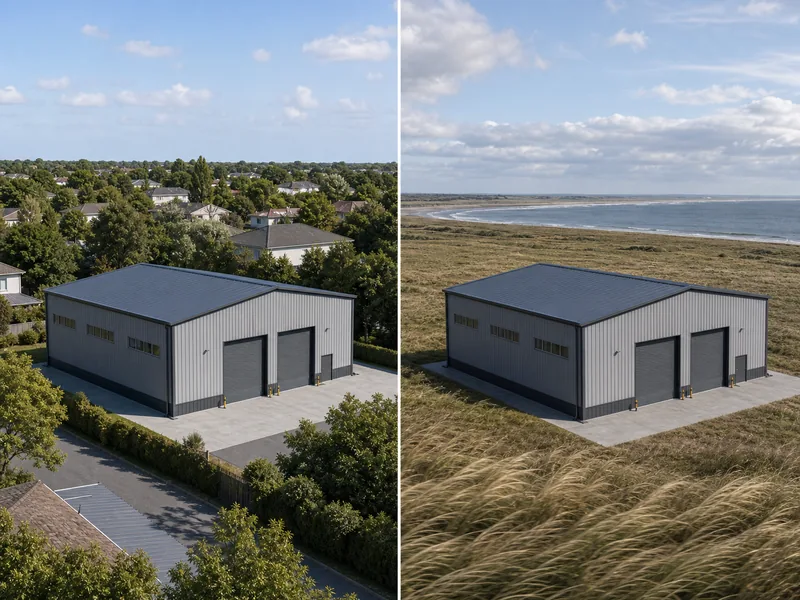
Exposure category
Exposure category is the variable buyers often overlook, and it can move the design pressure more than a modest change in wind speed does. It describes how open the terrain around the building is: a structure screened by other buildings and trees sits in a sheltered exposure, while one on open farmland or near open water faces fuller wind and a higher design pressure. Because it depends on the real surroundings of your lot, exposure should be assessed for your site instead of copied from a catalog example. The factors behind these adjustments are an engineering exercise: directionality, topographic, ground-elevation, and importance factors, plus a gust factor the engineer selects (often around 0.85 for many rigid-building checks) and the relevant pressure coefficients. The inputs in the table above are the ones you can check yourself.
How Wind Load Shapes the Steel Structure
Once the design wind load is set, it propagates through the whole structure, from the primary frame down to the smallest fastener, and dictates member sizes, connections, and bracing. A higher design pressure shows up first in the primary frames that carry lateral load to the foundation, then in the bracing, anchor bolts, eave struts, purlin clips, and panel fasteners. Reading the load this way explains why the same building costs more on an exposed coastal site than on a sheltered inland one: more steel and heavier connections, not a different-looking building.
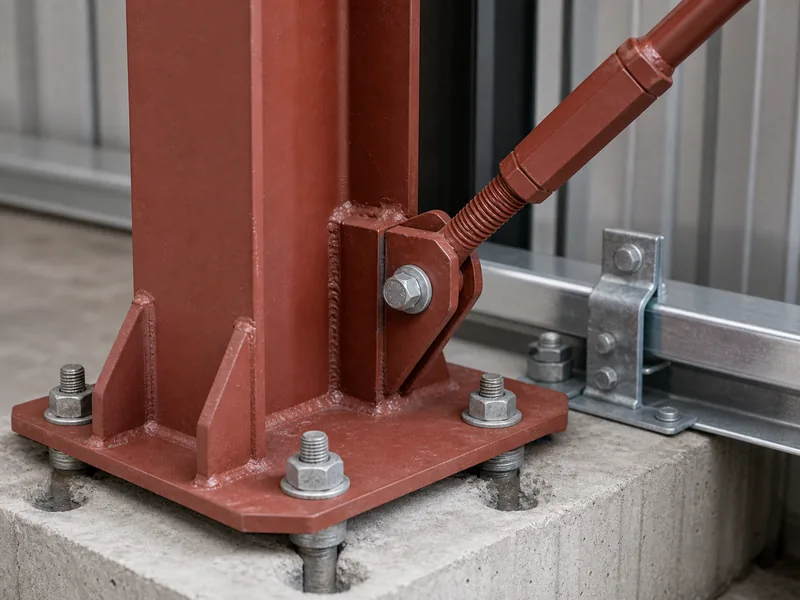
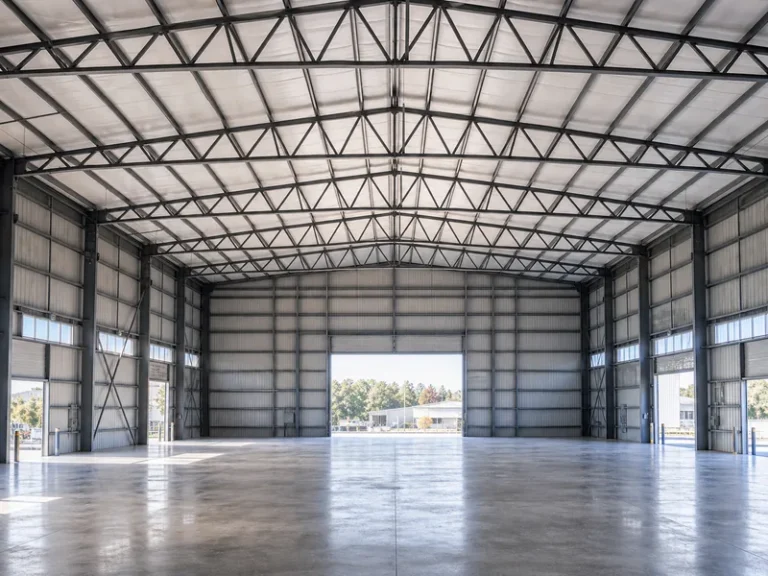
The primary frames do the heavy lifting. In most pre-engineered buildings these are the red iron buildings frames: the welded, factory-finished columns and rafters that take wind from the walls and roof and drive it into the anchor bolts. When a design removes interior columns, as in clear span buildings, the frame has to resist the full lateral and uplift demand across the span on its own, which is why clear-span widths and wind ratings are quoted together as one design issue.
Wind is also rarely the only load a frame is sized for. It combines with dead, live, and snow loads, and in buildings with lifting equipment it is checked alongside crane forces; the same member can be governed by wind in one load case and by the moving load addressed in steel building crane beam design in another. In the field, connections and edge fasteners are common vulnerability points under high local pressures and deserve close review, which is why experienced fabricators watch corner zones, eave details, and bracing terminations closely.
How to Confirm What Your Building Is Engineered For
The most reliable way to know what a steel building can resist is to read the engineering, not the marketing. A headline mph figure means little until you can trace it to your site and your code edition. Before you accept a design, confirm the following:
- The drawings are stamped or sealed by the engineer of record and reference the code edition in force at your site (ASCE 7-22 / 2024 IBC, or the edition your jurisdiction enforces).
- The design wind speed on the drawings matches the current map value for your address and risk category, not a generic national number.
- The exposure category reflects your actual terrain instead of a sheltered default.
- Component ratings are given in the right units: panels and fasteners are usually rated in psf of pressure, while the building’s headline figure is in mph, and the two are not interchangeable.
- Corner, edge, and eave zones carry their higher local pressures, since these areas govern uplift and are where under-design shows up first.
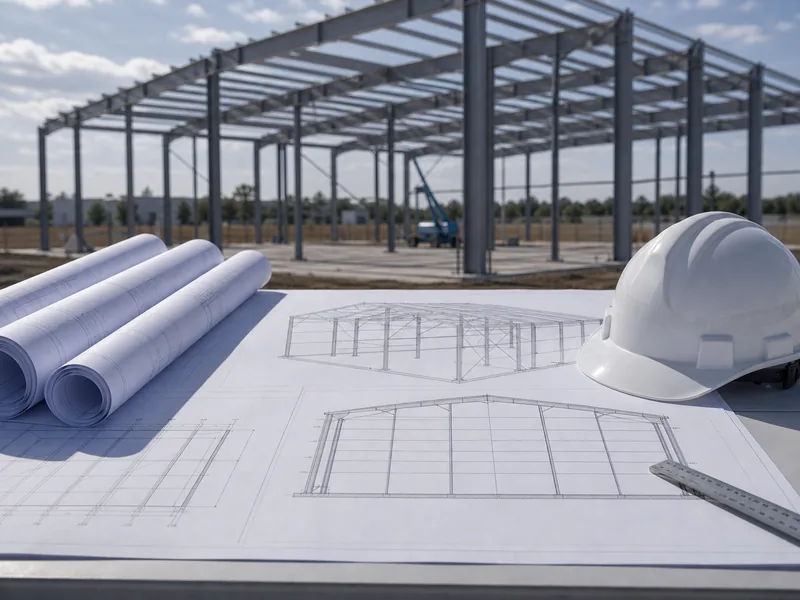
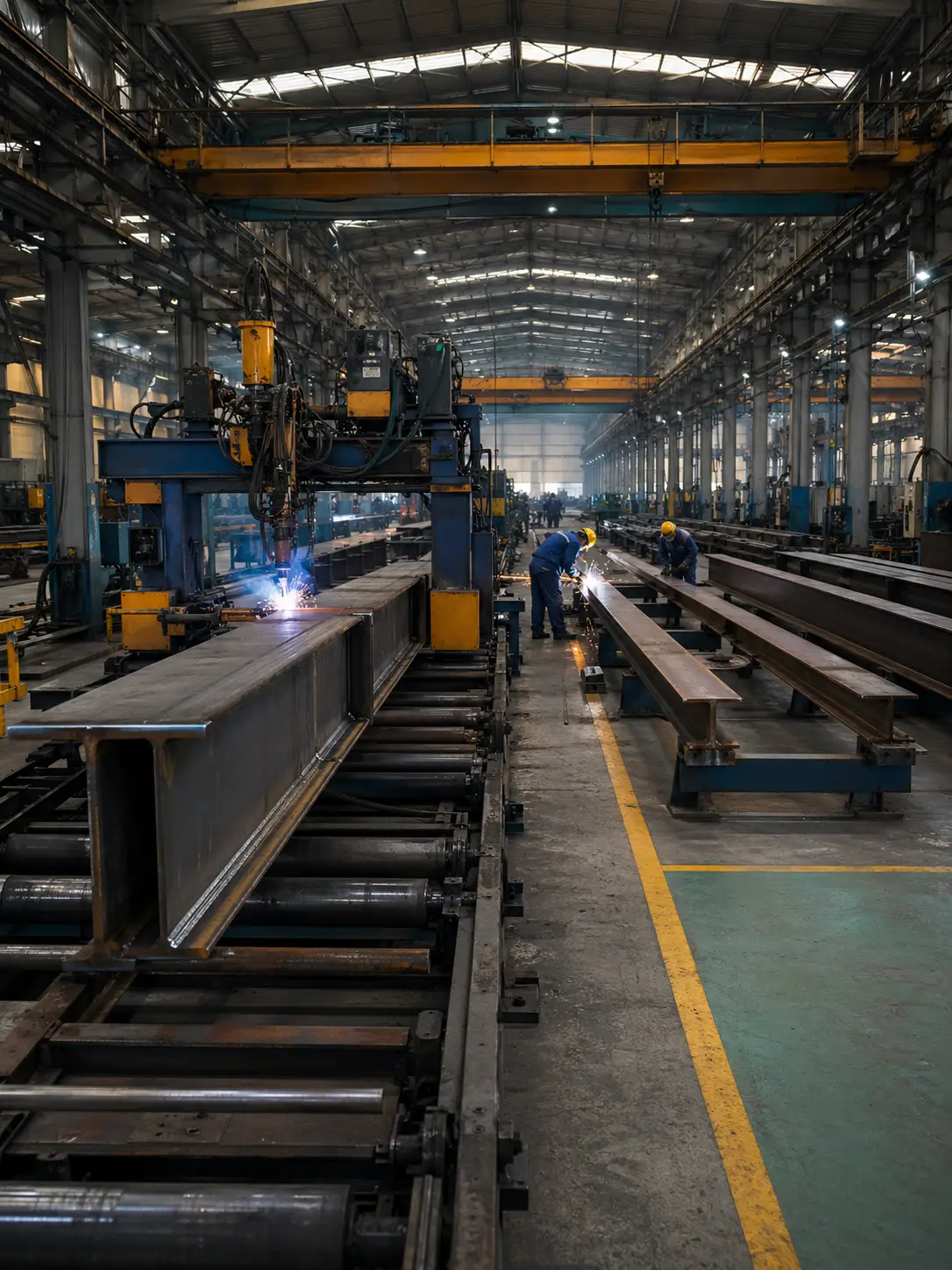
The engineer of record is who ties the design wind speed, exposure category, and load path to your site and code edition, and that stamped package, not a brochure figure, is what you verify a building against. A qualified metal construction company then fabricates to that engineered package. As a steel structure manufacturer, KAFA holds design, fabrication, and installation qualifications for light and heavy steel structures and produces H-beam frames, box sections, and C/Z purlins on dedicated production lines under documented quality procedures, so the engineering’s wind-related details carry through into fabrication. Where a project needs stronger proof for permitting, that proof should come from the project’s stamped engineering.
Lock the Site Inputs Before Comparing Quotes
Set the site’s design wind speed and exposure category first, then let those inputs drive the frame, connections, and roof attachment. A common specification risk is accepting a single mph figure up front and sorting out the exposure category and local edge pressures later, if at all. Lock the design wind speed and exposure to your actual address, confirm the risk category, and require stamped drawings that show those inputs; only then does comparing configurations or cost make sense. With those inputs fixed, the wind rating becomes a value you can trace through the engineering instead of a marketing number.
FAQ
How is wind load calculated for a steel building?
Wind load is calculated by converting a basic wind speed into pressure on each building surface using factors for exposure, height, topography, building importance, and surface location. A simplified way to read it is pressure = velocity pressure × gust factor × pressure coefficient (p = q × G × Cp), where the velocity pressure carries the wind speed, exposure, and height inputs; the published value still comes from the full engineering calculation, not this shorthand. The result is expressed as pressure in psf that varies across walls, roof, corners, and edges instead of as one uniform force.
What wind speed should a steel building be designed for?
The design wind speed comes from the current ASCE 7 wind map for the building’s address and risk category, not from a single national figure. Sheltered interior sites sit toward the lower end of the range while coastal hurricane zones sit well above it, so the right number depends on location, the code edition in force, and the building’s risk category.
What is an exposure category, and why does it change the wind load?
Exposure category describes how open the terrain around a building is, and it can change the design pressure as much as a modest change in wind speed. A site screened by buildings and trees sits in a sheltered exposure, while open farmland or open-water frontage produces a higher exposure and a higher design pressure, which is why it must be assessed for the actual site.
How much wind can a steel building withstand?
A steel building can be engineered to resist a wide range of wind speeds, from common inland design levels up to hurricane-zone requirements, depending on how it is designed and detailed. The capacity is set by the design wind speed, the exposure and risk categories, and the connection and bracing detailing by the design and detailing, not by the material alone, so two steel buildings can have very different wind capacities.
Does ASCE 7-22 apply to my building?
ASCE 7-22 applies where it has been adopted, and for projects built under the 2024 IBC it is the referenced edition. Some jurisdictions still enforce ASCE 7-16 or 7-10, so the edition that governs your building is the one your local building department has adopted; confirm it before accepting a design wind speed.