




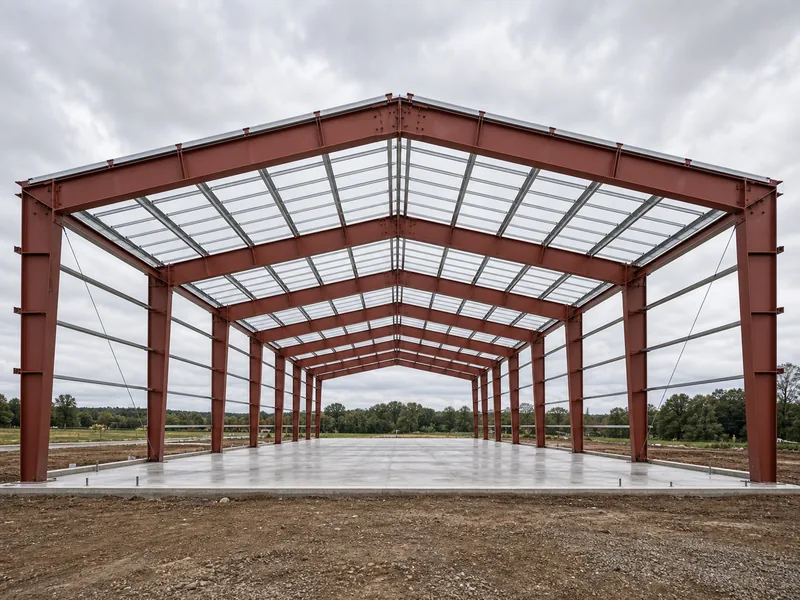
An i-beam building is a steel building whose primary frame, the columns and roof rafters that carry the load, is built from I-shaped steel sections, usually hot-rolled or shop-welded steel known in the trade as red iron. That one structural choice is what lets these buildings hold up wide, column-free floors that lighter framing cannot match. The sections below cover what actually makes a building an i-beam building, why the I-section spans so far, how red iron compares with tube and C-channel framing, the parts involved, where these buildings get used, and what moves the price. It does not cover residential stud framing or the bridge and high-rise design that sit outside metal building systems.
What Makes a Building an “I-Beam Building”
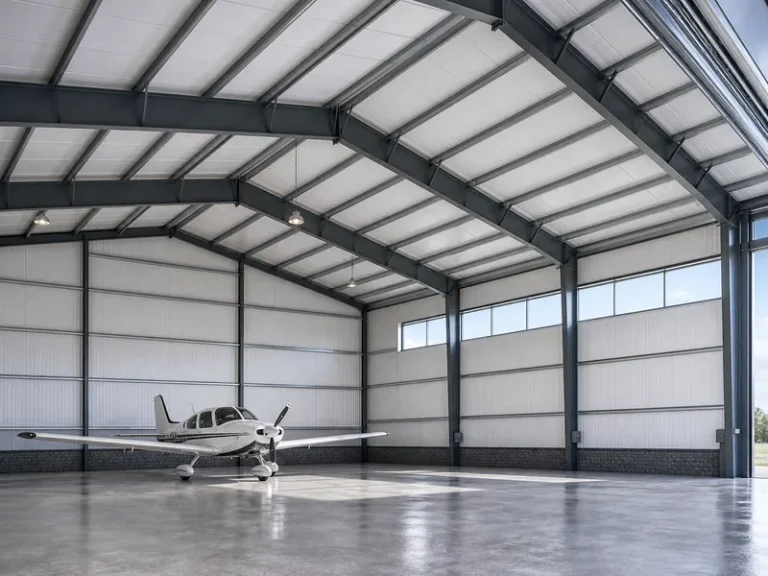
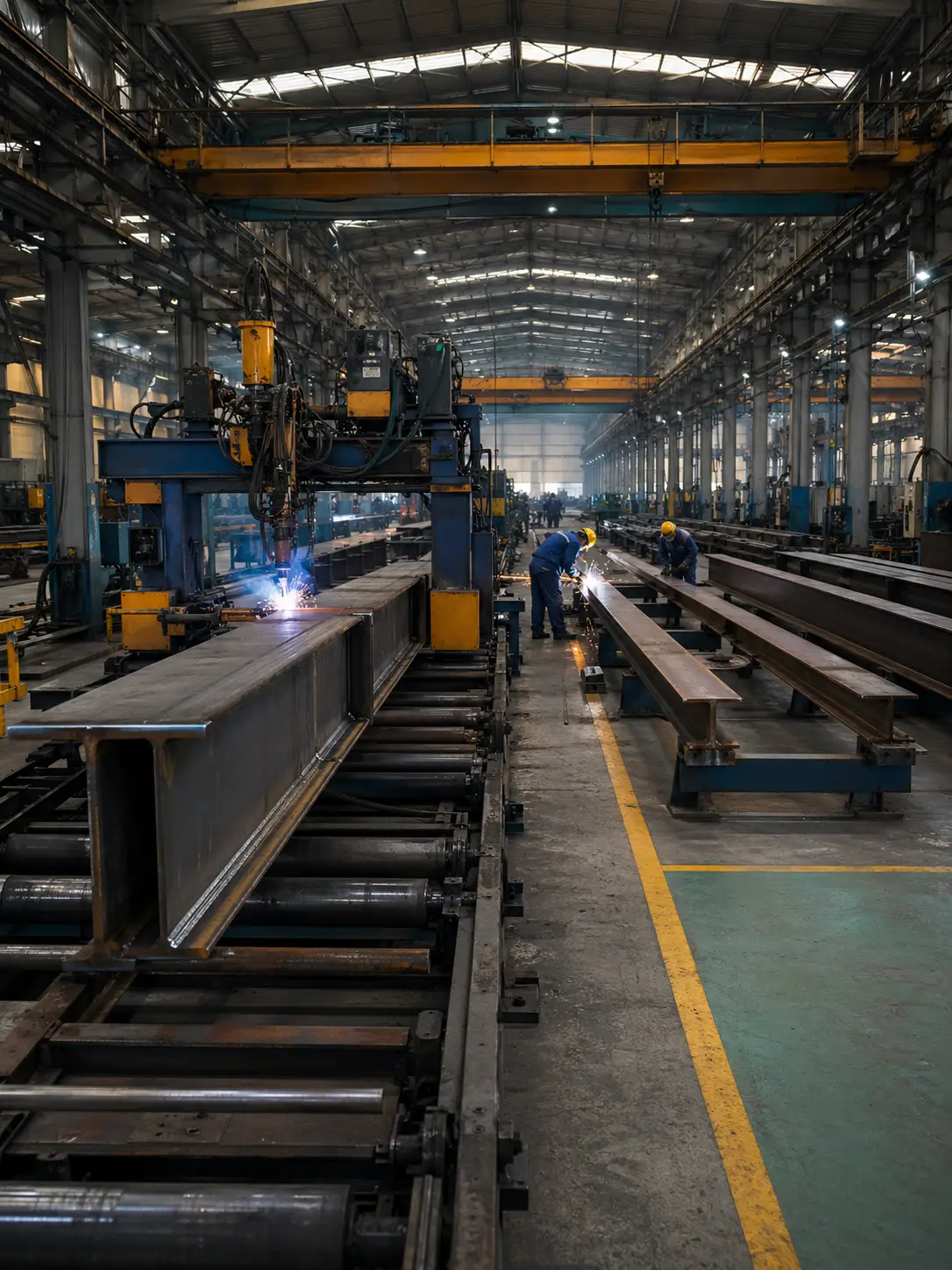
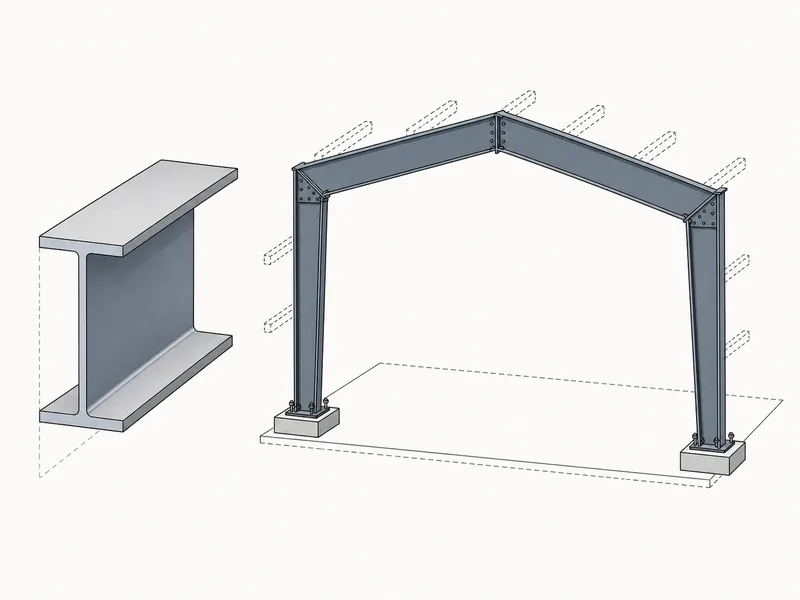
The label points to the cross-section of the main frame, not to a single beam: the columns and rafters are I-sections, each with two horizontal flanges joined by a vertical web. In practice the phrase is buyer shorthand for a red iron, rigid-frame steel building, where the shop-primed members get their name from the oxide-red coating they ship with, so a red iron building and an i-beam building describe the same structure from two angles. The frame may mix hot-rolled wide-flange sections straight from the mill with built-up plate sections welded to a tapered profile, and it leans on rafters, columns, girts, purlins, and bracing rather than one beam doing all the work. What separates the building system from a loose section is engineering: every member is sized as part of a frame that has to stand up to its own roof, its cladding, and the wind and snow at the site. For the background on the primed steel itself, that sits with red iron buildings; here the focus is the building it frames.
Why the I-Section Spans Farther Without Columns
The I-section puts steel where the bending stress is highest, in the top and bottom flanges, which is what lets an I-beam frame carry a long roof on widely spaced columns. The web in the middle handles shear and holds the two flanges apart, so for the same weight of steel the shape is far stiffer in bending than a tube or a channel of similar mass. Span is set by section depth and load, not by the material alone: a single rolled I-beam can reach on the order of 100 feet depending on how deep and heavy it is, while engineered rigid frames and built-up rafters push column-free widths much further. Kit suppliers advertise clear spans up to roughly 300 feet, but any such number is conditional. That figure is settled by the building width, eave height, roof pitch, the snow, wind, and seismic loads, and any crane loads hung from the frame, so check an advertised span against your actual design loads before trusting it. On wide buildings the rafter usually governs before the column does, which means the first section to grow when you add snow load is the roof beam overhead, not the post in the wall. The same column-free width that works in a mild climate needs a deeper, heavier frame under heavy snow, a trade-off covered in more depth under clear span buildings.
I-Beam (Red Iron) vs Tube and C-Channel Framing
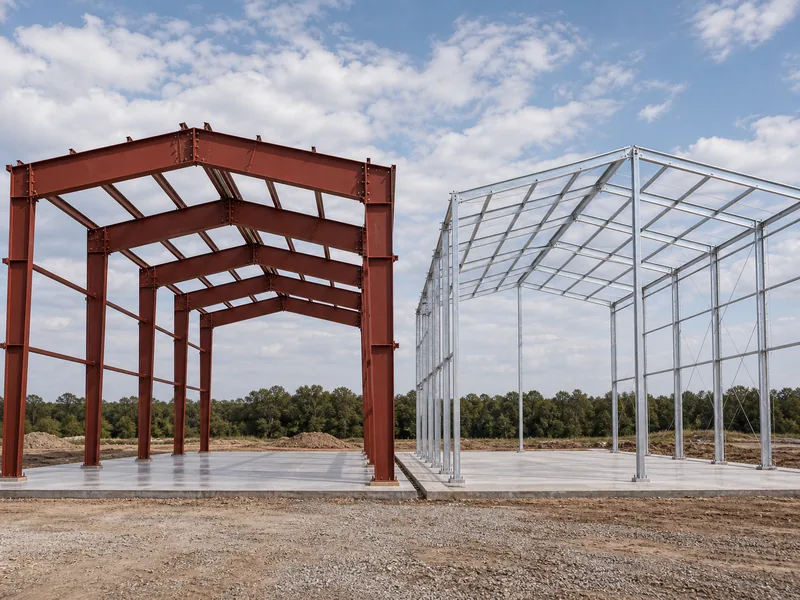
Red iron I-beam framing, tubular framing, and light-gauge C-channel framing solve different problems, and the right one follows the span, load, and use you actually need. Red iron uses thick structural I-sections engineered to meet snow, wind, and seismic codes, so it carries large column-free spans and suits buildings that have to stay open inside. Tubular framing uses galvanized square or rectangular tube, which goes up fast and cheap and is a sound choice within its range, usually clear spans of about 100 feet or less without interior columns. Light-gauge C-channel sits between simple covers and full red iron, common in lighter commercial work and as the secondary framing inside a red iron building.
| Framing | Typical clear span | Best-fit use | Cited lifespan (with maintenance) | Foundation and erection |
|---|---|---|---|---|
| Red iron I-beam | Wide, column-free | Workshops, warehouses, hangars, plants | 50+ years often cited | Poured slab and anchor bolts; crane erection |
| Tubular (square/rectangular tube) | About 100 ft or less without interior posts | Garages, carports, RV covers, small shops | 30+ years often cited | Lighter footing; fast bolt or screw assembly |
| Light-gauge C-channel | Short to moderate | Light commercial, secondary framing | Varies with gauge and coating | Light; quick assembly |
For a large building that has to clear a column-free width and carry real snow, wind, or seismic load, red iron I-beam framing is the one engineered to do it. For a small garage, carport, or cover where span and heavy load are not the constraint, a tube building is lighter, faster, and the more sensible spend. None of the three is structurally invalid; they simply fit different spans and loads, and the full structural and cost breakdown between the heavier and lighter systems is its own topic, covered under steel vs tubular building systems.
Core Components of an I-Beam Building
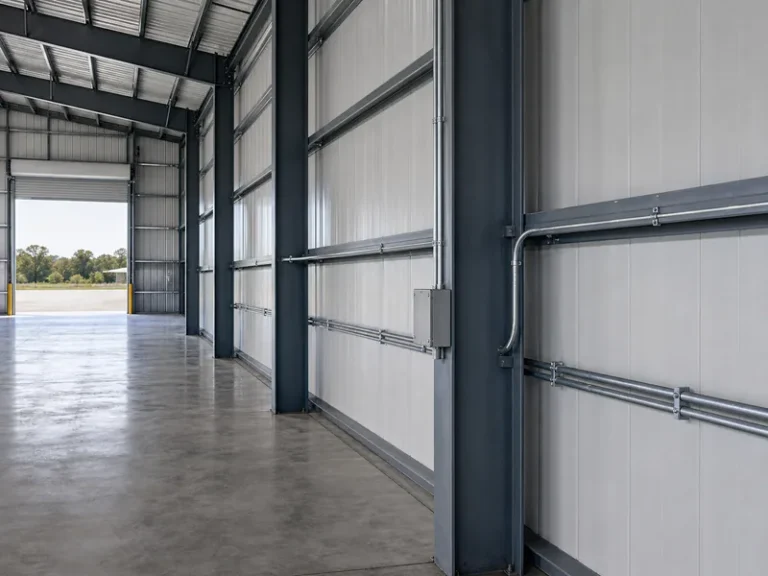
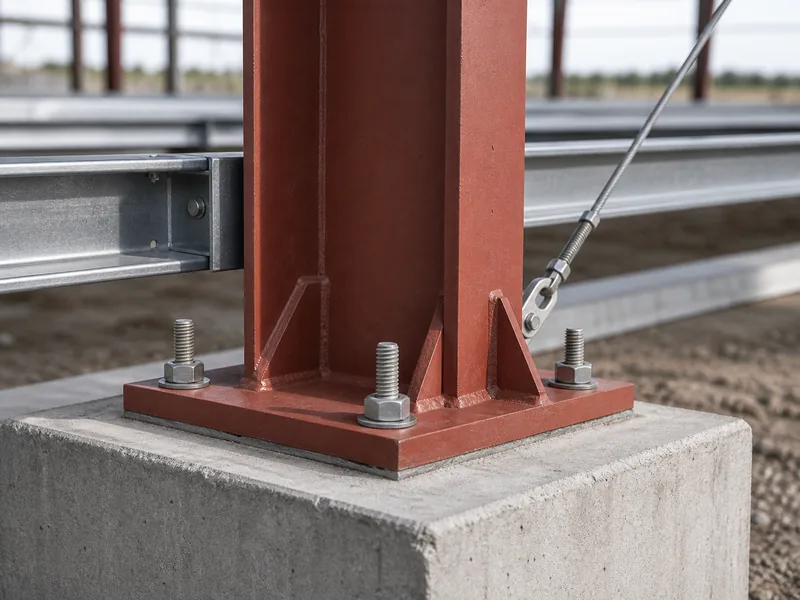
Beyond the I-beam columns and rafters, an i-beam building depends on a secondary system of purlins, girts, and bracing to turn the primary frame into an enclosed structure that shares its loads. The primary frame is the rigid frame itself, columns and rafters, sometimes a portal frame with tapered built-up sections at the knees where the bending moment is highest. Purlins run along the roof and girts along the walls, usually C- or Z-sections, carrying the panels and passing wind and snow back to the main frame. Bracing, whether cross-cable, rod, or portal, keeps the frame square against lateral load, and at the base, anchor bolts and base plates pin the concentrated column loads into the foundation. Each of these metal building components is sized together, which is why a frame, its purlins, and its bracing should come from one engineered package rather than mixed by guess. A maker that runs its own H-beam, box-section, and C/Z purlin lines, as KAFA does, can keep those members matched to one design and one set of site loads.
Where I-Beam Buildings Are Used
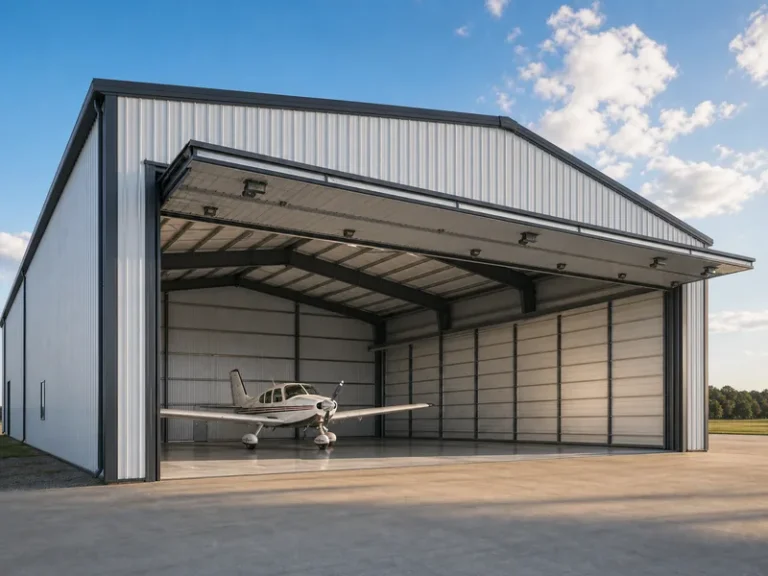
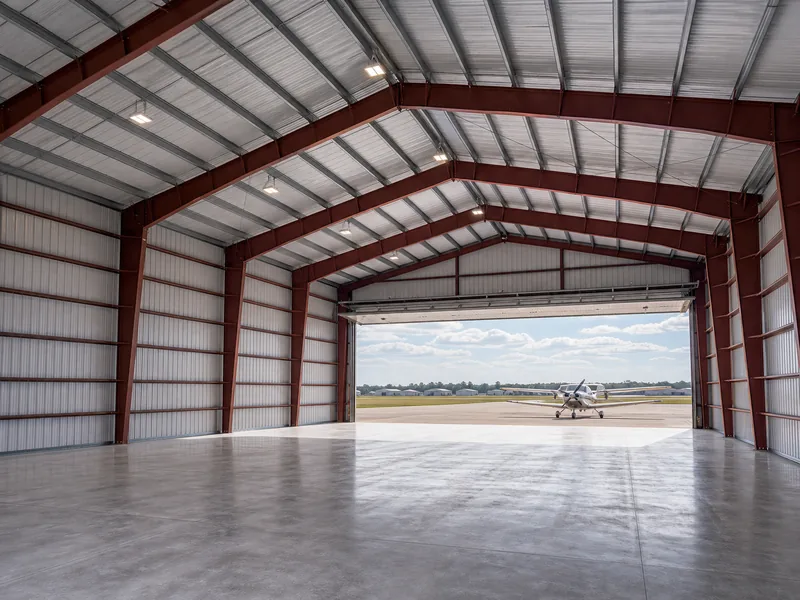
I-beam framing shows up wherever a building needs a large, open floor and a roof that carries real load, which is why workshops, warehouses, and manufacturing plants are framed this way. In each of these uses the column-free interior is the payoff: a warehouse needs clear aisles and rack runs, a workshop needs crane coverage end to end, and a plant needs floor it can re-lay out as the line changes. Aircraft hangars push the idea the hardest, because the structure has to clear the full door opening with nothing in the way of the tail or the wings; an aircraft hangar kit leans on red iron framing for exactly that reason. The same logic carries into large retail and other industrial steel buildings, where the span and the load, not the floor plan, decide the frame.
What Drives the Cost of an I-Beam Building
The cost of an i-beam building is driven less by the beams themselves than by frame weight, bay spacing, loads, and how much of the job sits inside the number you are quoted. Frame weight climbs with span and load. Cladding, insulation, doors, the slab or foundation, freight, and erection then drive the total, which is why two buildings of the same footprint can land at very different prices. As rough, evidence-based ranges that move with all of those variables: as a kit or shell, the frame and panels commonly land around $15 to $22 per square foot, so a 40-by-60-foot building of 2,400 square feet often falls near $36,000 to $53,000 before site work. Erected and closer to turnkey, with the foundation, erection labor, and accessories added in, the range moves to roughly $25 to $40 per square foot, putting that same 40-by-60 around $60,000 to $96,000. Two figures explain the gap: structural I-beam steel runs about $6 to $18 per linear foot as raw material, and professional erection alone adds about $5 to $10 per square foot. A field reality that catches buyers off guard is that the steel is rarely the expensive part; the foundation and the crane time are where a red iron budget actually moves.
Cost scope note. *Included* in the ranges above: the steel frame and panels, plus the foundation, erection, and basic accessories in the turnkey figure. *Excluded:* permits, site grading, interior finish, insulation, and freight. *Pushes the number up:* high snow, wind, or seismic loads, tall eave heights, wide bay spacing, and very wide clear spans, since each one calls for a deeper, heavier frame.
FAQ
Is a red iron building the same as an i-beam building?
Yes, red iron building and i-beam building name the same structure from two angles: red iron describes the oxide-primed structural steel, while i-beam describes the I-shaped section of the columns and rafters. The term to keep separate is a tube or light-gauge building, which uses a different, lighter frame and should not be treated as interchangeable with red iron.
How far can an i-beam building span without interior columns?
A single rolled I-beam typically reaches on the order of 100 feet, while engineered red iron rigid frames clear far wider, with kit suppliers advertising column-free spans up to roughly 300 feet. That ceiling is set by load rather than by the steel itself, so the deeper the snow and the stronger the wind, the heavier the frame a given clear span demands.
Are i-beam buildings worth it over tube buildings?
For a large, code-driven building that has to stay column-free, red iron i-beam framing is the only one of the two engineered to carry the snow, wind, and seismic load at that span. For a small garage, carport, or cover where clear span and heavy load are not the issue, a tube building is lighter and cheaper to put up, which makes it the more sensible spend.
What size i-beam does a steel building use?
There is no single size, because each frame is engineered for its own building, and sections are called out by depth and weight, such as a W20x86 that is 20 inches deep and weighs 86 pounds per foot. Wider spans and higher loads call for deeper, heavier sections, so the size falls out of the design rather than being picked first.
Do i-beam buildings need a concrete foundation?
Yes, a red iron frame concentrates its loads at the column bases and transfers them through base plates and anchor bolts into a poured concrete foundation. That base detail, along with the weight of the sections, is why these buildings usually need crane erection and a longer install than a bolt-together tube building.
Conclusion
Choosing an i-beam building is less a price comparison than an order of decisions. Fix the clear span and the design loads first, because those two decide whether you need red iron at all or whether a lighter tube frame would do. Set the eave height and bay spacing next, since they shape how the primary frame and the secondary members get sized. Only then does the section depth, and the scope of any quote, fall into place. Settle the clear span and design loads before putting two quotes side by side, because a dollar-per-square-foot number means little until you know whether it carries your snow load across a column-free width. With those fixed, a manufacturer that runs its own H-beam and purlin lines can confirm the section sizes against your local code before anything is ordered.
Further Reading
- Metal Building Manufacturers Association (MBMA) — industry association for engineered metal building systems; background on how steel building systems such as i-beam frames are designed, specified, and standardized.
- American Iron and Steel Institute (AISI) — U.S. steel industry body; reference for the structural steel and the material standards behind hot-rolled and built-up I-sections.
- American Society of Civil Engineers (ASCE) — publisher of the ASCE 7 minimum design load standard for the snow, wind, and seismic loads that govern how far an i-beam frame can clear-span.
- Xinguangzheng (XGZ) — Steel Building Kits — manufacturer guide to pre-engineered steel building kits: what a kit includes (primary and secondary steel, roof and wall panels, fittings), how span, wind and snow loads, and crane tonnage move the price, and when a kit is the wrong fit; useful alongside the component and cost sections above.