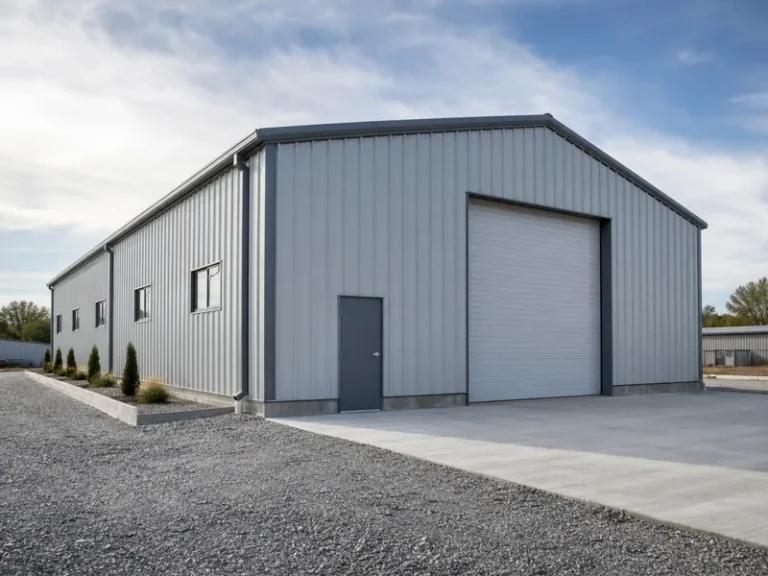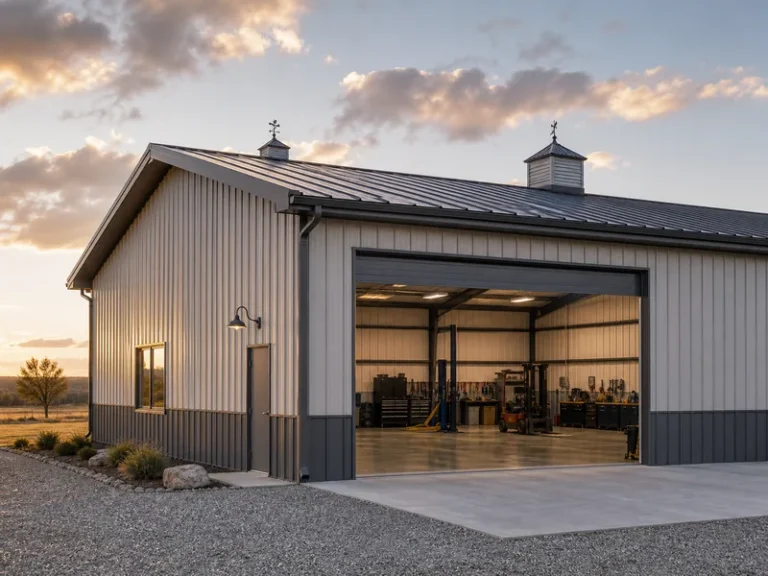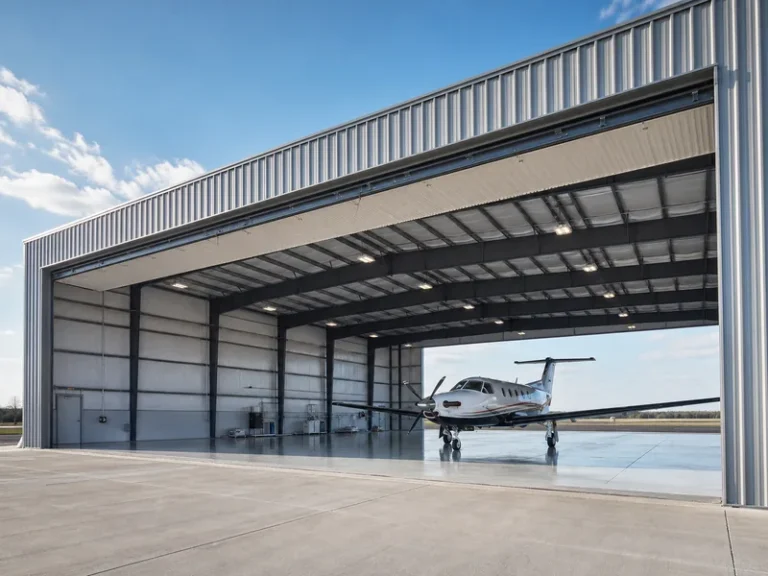





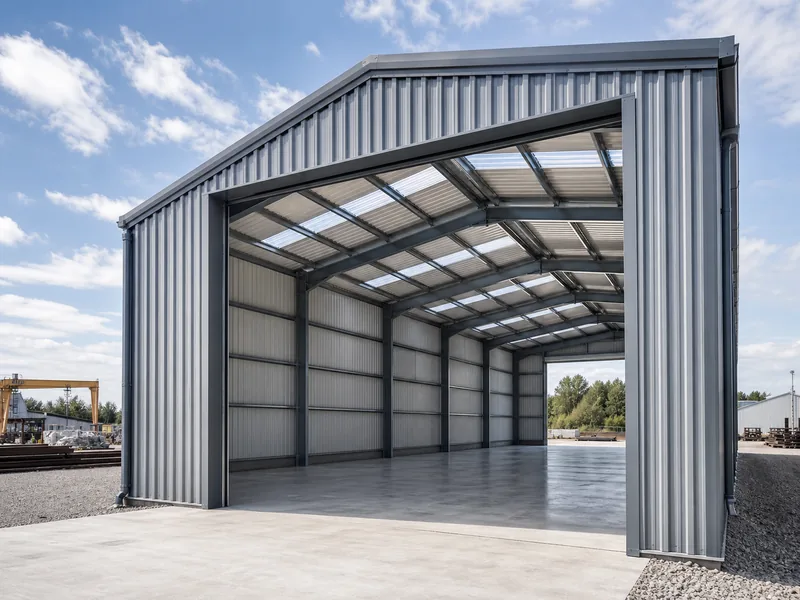
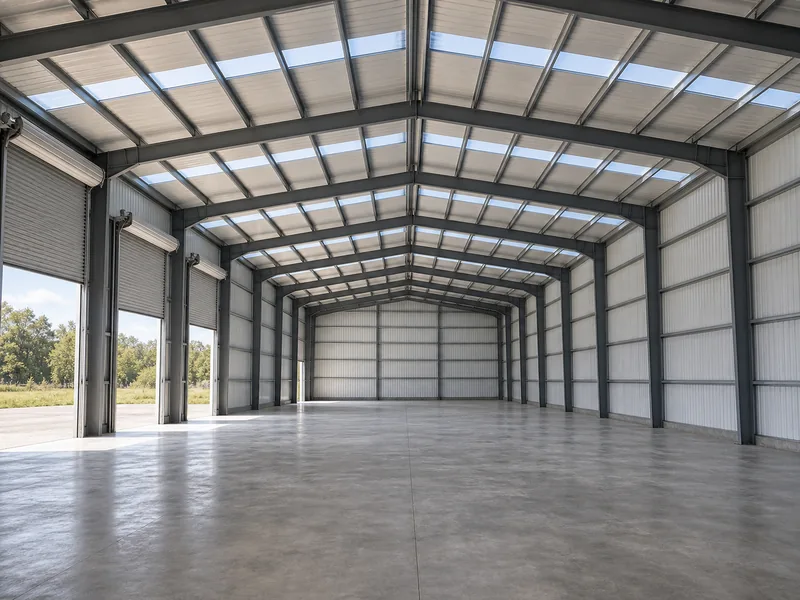
A steel portal frame is a rigid frame of columns and sloping rafters joined by moment-resisting connections, and that rigidity lets a single frame span a wide, column-free interior. Most single-span frames cover roughly 15 to 50 metres of clear width, and the 25–35 metre band is the most economical to build. Because no internal columns are needed, the system suits warehouses, factories, workshops, and aircraft hangars, where an open, unobstructed floor is the main requirement.
How a Steel Portal Frame Works
A portal frame carries load by acting as one rigid unit rather than as separate beams and columns. The columns and rafters are joined with stiff moment connections at the eaves, and often at the apex. Vertical load on the roof then becomes a mix of bending and axial force that travels down the rafters, into the columns, and out to the foundations. That continuity is the difference between a portal frame and a simple post-and-beam shed: the joints transfer moment, so the frame resists sideways movement on its own and keeps the interior clear of bracing in the plane of the frame.
The cost of that behaviour is concentrated at the eaves, where the bending moment peaks and a haunch is added to carry it. Stability then splits into two directions. In the plane of the frame, the rigid joints provide it; out of the plane, the building leans on bracing and the secondary steel that ties the frames together. This is also how portal frames deliver the clear-span buildings that open-plan storage and production lines depend on.
The Main Parts of a Portal Frame
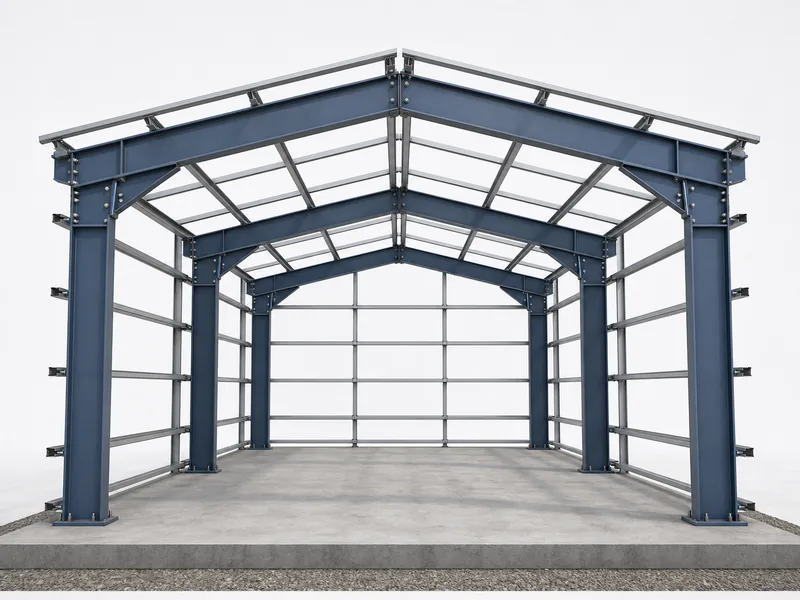
Every steel portal frame is built from the same short list of metal building components, each with a defined job:
- Columns — the vertical members that carry load to the foundations and take bending near the eaves.
- Rafters — the sloping members that form the roof line and span between columns.
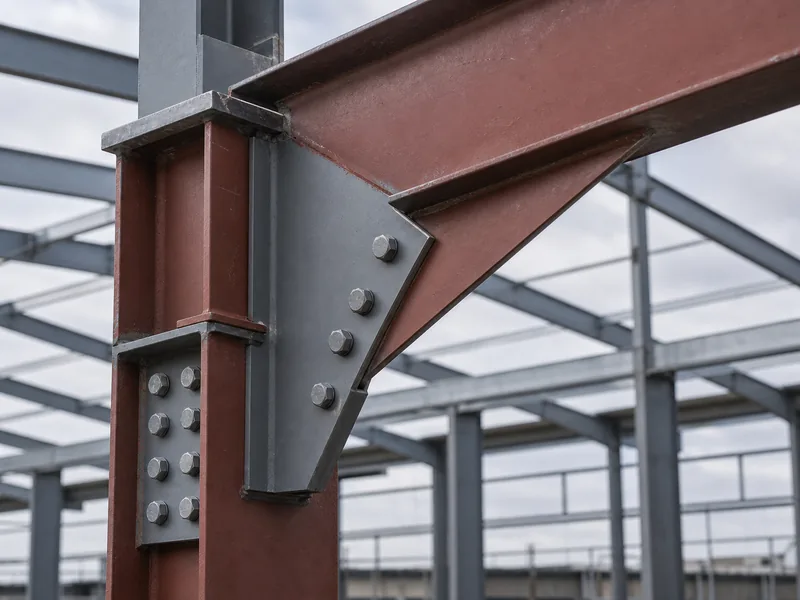
- Eaves haunch — a tapered section welded under the rafter at the column connection, where the bending moment is highest.
- Apex haunch — a much smaller deepening at the ridge, mainly to fit the bolted apex connection rather than to add strength.
- Base plate and anchor bolts — the detail that fixes each column to its foundation and sets whether the base acts as pinned or fixed.
- Purlins and girts — light cold-formed members, usually C- or Z-sections, that carry the roof and wall cladding back to the frames.
- Bracing — diagonal members that hold the building square along its length and against wind.
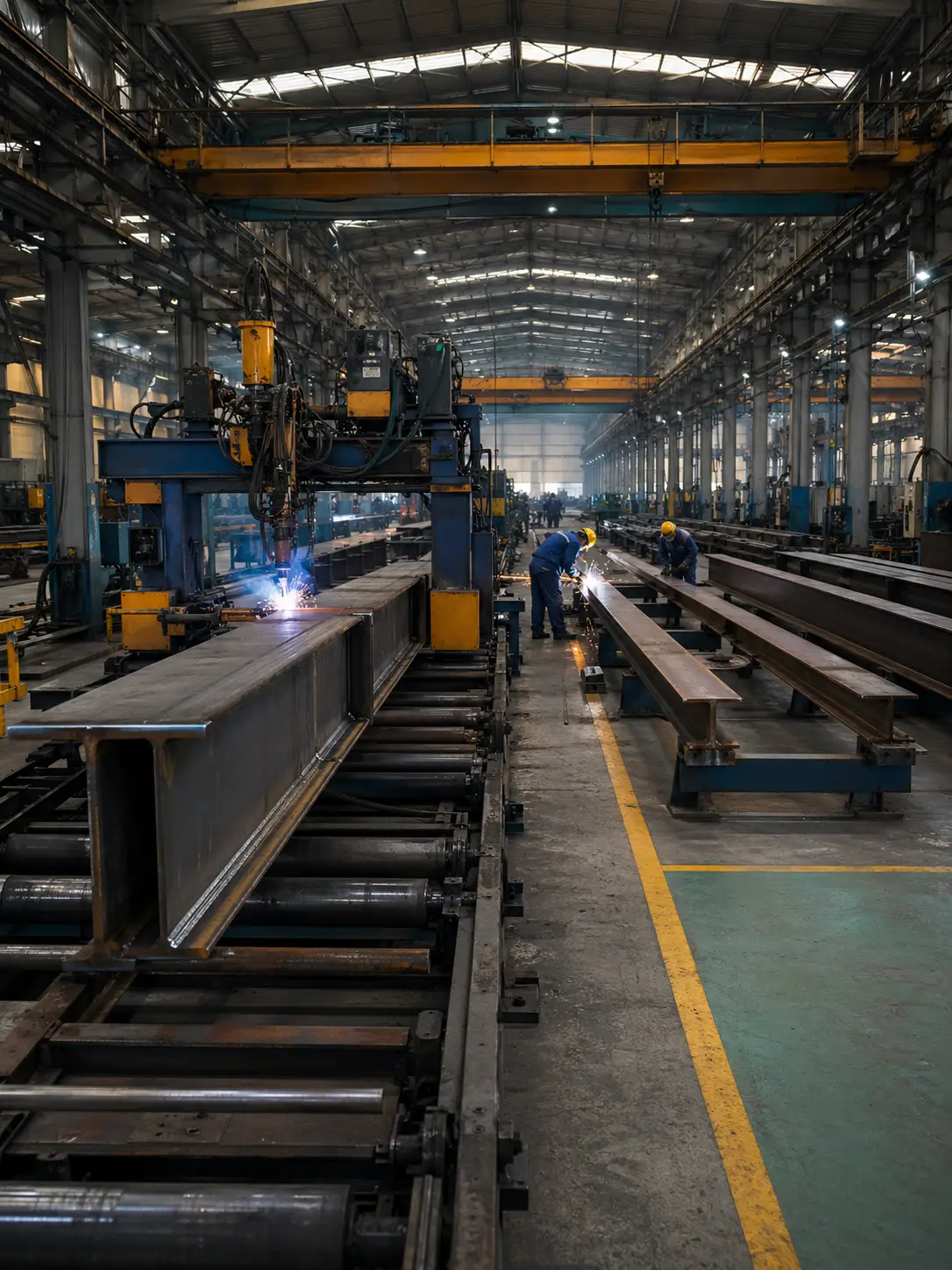
In hot-rolled practice, the columns and rafters are Universal Beam (UB) sections, with haunches cut from matching rolled sections and welded on. A fabricator running dedicated H-beam and C/Z purlin lines — as KAFA does at its Qingdao plant under ISO 9001:2015 quality management — produces these members from one set of drawings, which keeps the bolted site connections consistent.
Types of Steel Portal Frames
The portal frame family covers several configurations, and the right one follows the building’s width, height profile, and what hangs from the structure. The table below sets out the common types and where each is normally used.
| Type | What it is | Typical use |
|---|---|---|
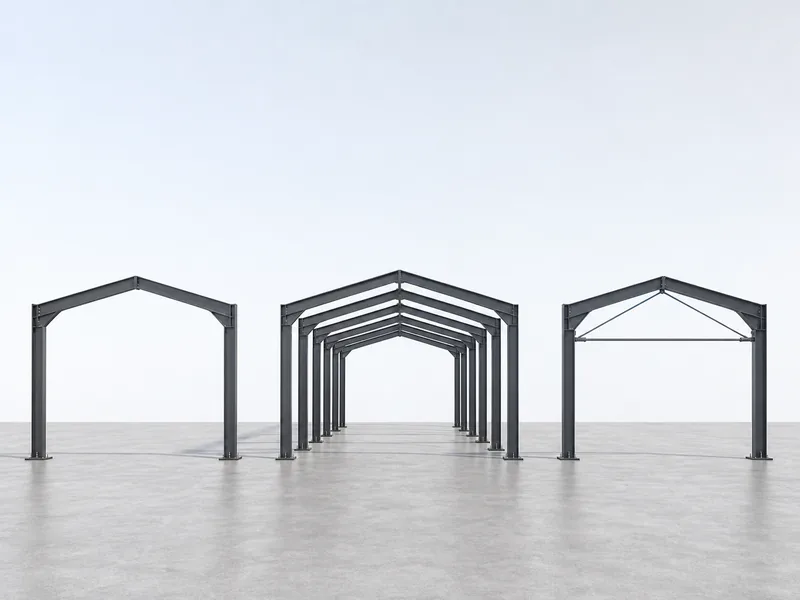
| Single-span (duo-pitch) | One symmetrical frame with a pitched roof | Warehouses, workshops, retail sheds — the default choice |
| Multi-span | Several frames joined side by side on internal columns | Large factories and distribution centres needing more width |
| Mono-pitch | A single slope from one eaves to the other | Smaller buildings up to about 15 m, lean-tos, infill bays |
| Propped | A single span with one or more internal props | Wide spans where a few internal columns are acceptable |
| Tied | A horizontal tie across the eaves resists spread | Cases where foundation thrust must be kept low |
| Curved rafter | Rafters curved rather than straight | Architectural roofs, leisure and retail buildings |
| Mansard | A multi-slope rafter line | Lower ridge height or specific roof profiles |
| Crane portal | A frame stiffened to carry a travelling crane | Production bays with overhead lifting |
A portal frame is not the only way to roof a wide space; for the head-to-head decision against a triangulated alternative, see portal frame versus a truss. In the United States, the same rigid-frame principle is usually delivered as a pre-engineered metal building with tapered, built-up I-section members. These are the painted steel frames sold as red iron buildings, rather than the hot-rolled UB sections common in the UK and Europe.
Span, Height, Pitch, and Bay Spacing
A handful of dimensions set most of a portal frame’s design, and they sit within well-established industry ranges. The figures below describe single-span pitched frames; multi-span and specialised frames shift them.
| Variable | Typical range | Notes |
|---|---|---|
| Span (clear width) | 15–50 m | 25–35 m is the most economical |
| Clear height (to underside of haunch) | 8–18 m | Set by use and equipment |
| Roof pitch | 5°–10° | 6° is commonly adopted |
| Bay spacing (frame centres) | 6–8 m | Drives purlin and cladding sizing |
| Eaves haunch length | about 10% of span | Where the eaves moment peaks |
| Purlin spacing | up to about 1.8 m | Closer near the eaves |
Span is the first lever, but it is not a fixed limit. Below about 50 metres a single span is usually workable, and the 25–35 metre band is the most economical. How far a frame can reach economically still depends on the roof snow and wind loads, the eaves height, the bay spacing, and whether it also carries a crane. Past that point, designers move to a multi-span, propped, or tied arrangement, or to a truss. Bay spacing then balances steel weight against the number of frames: wider bays use fewer, heavier frames but larger purlins and side rails. Pitch is kept shallow, around 6 degrees, because a steeper roof adds cladding area and wind exposure without much gain on a wide span. Member sizes follow from there — UK and European practice typically specifies grade S355 steel — and the final sizes are engineered for each project against the governing code rather than read off a chart. Getting these variables to settle together is the core of any steel building design for a portal-frame project.
Loads, Bases, and Bracing
Portal frame design starts from the loads the building must carry, combined according to the governing code. Dead load from the structure and cladding, imposed and snow load on the roof, and wind on every surface are combined into load cases. North American projects follow ASCE 7, UK and European projects work to the Eurocodes, and permits sit under local codes such as the IBC. Wind uplift matters as much as gravity here, because a light steel roof can be pushed up rather than down, which reverses the forces in the frame.
The column base is one of the bigger design decisions in a portal frame. Most frames use a nominally pinned base, which needs a smaller, cheaper foundation but allows more sideways deflection. A fixed base stiffens the frame and can save steel, but it pushes a larger moment into the foundation, so the saving moves into the groundworks. The right base, like the member sizes, is settled by the project engineer against the governing load code rather than fixed in advance. Either way, the eaves connection tends to spread the column feet apart, and that horizontal thrust has to be resisted by the foundation or by a tie across the frame. Out of the plane of the frames, the building stays square through vertical bracing in at least one bay near each end, plus plan bracing in the roof. Together these carry wind and any longitudinal crane forces back to the ground.
Where Steel Portal Frames Are Used
Steel portal frames are the standard structure for buildings whose main requirement is a large, unobstructed floor. Warehouses and distribution centres are the clearest case, but the same system frames factories, metal workshops, aircraft hangars, agricultural buildings, retail sheds, and sports halls. In the UK, around half of all structural steel goes into portal-frame buildings, which shows how routine the system has become for single-storey industrial work.
The use case usually points straight to a frame type. A workshop or a small-to-mid warehouse is almost always a single-span duo-pitch frame. A wide distribution centre that can take a line of internal columns suits a multi-span frame, which covers more width for less steel. An aircraft hangar needs a long clear span and a wide clear opening at one end, so the door-end frame and its bracing are designed around the door rather than a standard gable. A production bay with overhead lifting points to a crane portal, with stiffer columns and a base detailed for the crane loads. These uses share one requirement: columns must stay out of the working area, because racking aisles, machine lines, taxiing aircraft, and indoor courts all work better under a single clear span. Where a building also needs a part-height office or store, a mezzanine can hang inside the same frame.
Specifying the Right Portal Frame
The most reliable way to specify a portal frame is to settle its constraints in sequence rather than starting from a frame type. Fix the clear span and the clear height first, because both follow directly from what the building holds and how it is used. Settle the loads next — roof snow, local wind, and whether a crane or mezzanine is involved — since those decide member sizes and any extra stiffening. Only then choose the base type, trading foundation cost against frame deflection. Finally, pick the configuration: a single span for most buildings, multi-span or propped once the width outgrows an economical single span, or tied where foundation thrust has to stay low.
Working in that order keeps the decisions that drive steel weight and cost ahead of the ones that follow from them. Once span, height, loading, and base fixity are fixed, those figures are enough for a fabricator to size and price the frame, so you can request a quote on that basis rather than on a rough floor area alone.
FAQ
What is the maximum span of a steel portal frame?
A single-span steel portal frame is most economical between 25 and 35 metres and can be designed up to about 50 metres. Beyond that width the steel weight climbs quickly, so designers usually switch to a multi-span or tied portal frame, or to a truss, to cover the same floor more efficiently.
How is a portal frame different from a truss?
A portal frame resists load through bending in solid, rigidly connected members, while a truss carries the same load as axial tension and compression in many smaller triangulated members. Portal frames are quicker to fabricate and give a clean soffit, whereas trusses can be lighter at very long spans or very heavy loads.
How much steel does a portal frame use per square metre?
A single-span portal frame uses roughly 35 to 50 kilograms of steel per square metre of floor area, though the figure depends heavily on span, eaves height, and the snow, wind, and crane loads. Wider spans and taller eaves push it up, so steel weight per square metre is a rough planning guide rather than a fixed rate.
Do portal frames need fixed or pinned column bases?
Most portal frames use nominally pinned bases because they keep the foundations smaller and cheaper. A fixed base reduces frame deflection and can trim steel weight, but it transfers a larger moment into the foundation, so the choice is a trade between steelwork and groundworks rather than a fixed rule.
Can a steel portal frame support an overhead crane?
A light travelling crane of up to about 20 tonnes is commonly carried on brackets fixed to the frame columns. Heavier cranes call for a dedicated crane portal with stiffer columns and a stronger base, because the moving load and its braking forces add to the wind and gravity cases the frame already resists.
Further Reading
- Portal frames — SteelConstruction.info — The Steel Construction Institute and BCSA. Detailed reference on frame anatomy, economical spans, haunch proportions, and frame types behind the figures used above.
- ASCE 7, Minimum Design Loads — American Society of Civil Engineers — The standard governing the dead, live, snow, and wind load combinations a portal frame is designed to carry in US practice.
- Metal Building Manufacturers Association (MBMA) — Industry body for pre-engineered metal building systems, including the rigid-frame construction widely used for portal-frame buildings in North America.