




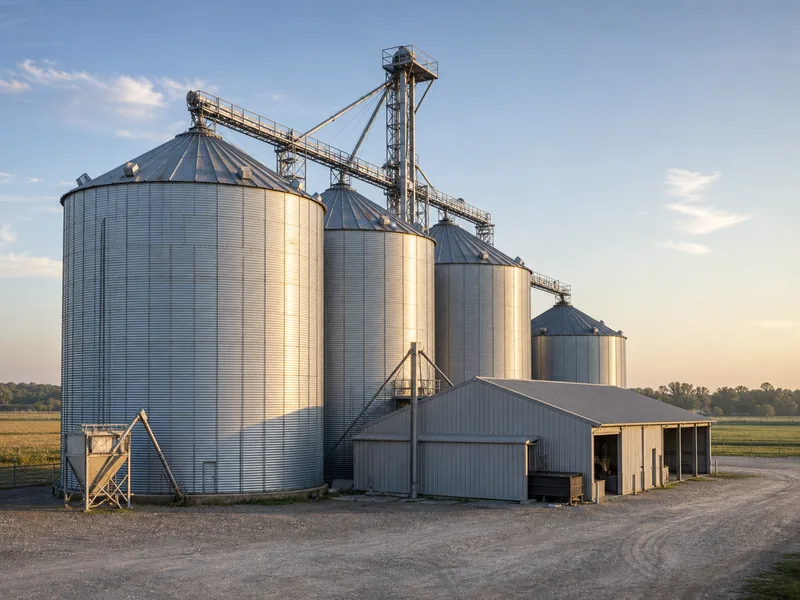
A grain steel silo is a vertical, mostly galvanized steel cylinder that stores dry bulk grain such as wheat, corn, rice, and soybeans. The unit that fits a site is settled by three linked choices: the silo type (corrugated bolted or field-welded), the base shape (flat-bottom or hopper-bottom), and the capacity you size it to. Those same three choices drive the cost, because the per-tonne price falls as capacity rises and the foundation and erection scope change with the bottom you pick. A steel grain silo is also distinct from the grain bin and the silage silo it often gets confused with, and that distinction changes what you get quoted.
What a grain steel silo is, and how it differs from a grain bin
A grain steel silo holds dry, free-flowing grain in a vertical steel cylinder and is emptied from the base, not the top. The shell is built from galvanized steel sheet — corrugated and bolted, or welded plate — stiffened against the outward pressure that grain exerts on the wall. A conveyor or bucket elevator fills it from the roof peak, and the grain is drawn off low so the column keeps moving rather than bridging.
The naming trips people up, and the trip has cost consequences. In North American farm usage the corrugated steel cylinder for dry grain is usually called a grain bin, while “silo” classically meant the taller structure that stores silage — green, wet fodder for dairy cattle. Across most of the world and in the commercial grain trade, the steel cylinder that holds dry grain is called a grain silo, which is the structure this article covers. The practical check is to confirm what a quote is actually for: a dry-grain silo carries aeration, a sweep system, and grain-temperature monitoring, whereas a silage silo is a different build with none of that. State the commodity, its moisture, and its bulk density up front and the quote stops drifting between the two.
Main types of steel grain silos
Steel grain silos divide into corrugated bolted, spiral-folded, and field-welded construction, and that split mostly tracks capacity. Corrugated bolted silos assemble galvanized corrugated sheets onto vertical stiffeners and cover the widest range, from farm bins to large commercial units. They make up most of the storage built today and are usually the cheapest per tonne to build. Spiral-folded (Lipp-type) silos roll a continuous coil into a seamed wall and sit in the mid-capacity range. Field-welded silos join steel plates on site and scale to the very large terminal storage that bolted construction cannot reach.
| Type | Construction | Typical grain capacity | Where it fits |
|---|---|---|---|
| Corrugated bolted | Galvanized corrugated sheet bolted to stiffeners | ~15 to ~15,000 t | Farm to large commercial; lowest cost per tonne |
| Spiral-folded (Lipp) | Continuous coil folded into a seamed wall | ~100 to ~7,000 t | Mid-range commercial and feed mills |
| Field-welded | Steel plates welded on site | ~1,000 to ~100,000 t | Very large terminals and ports |
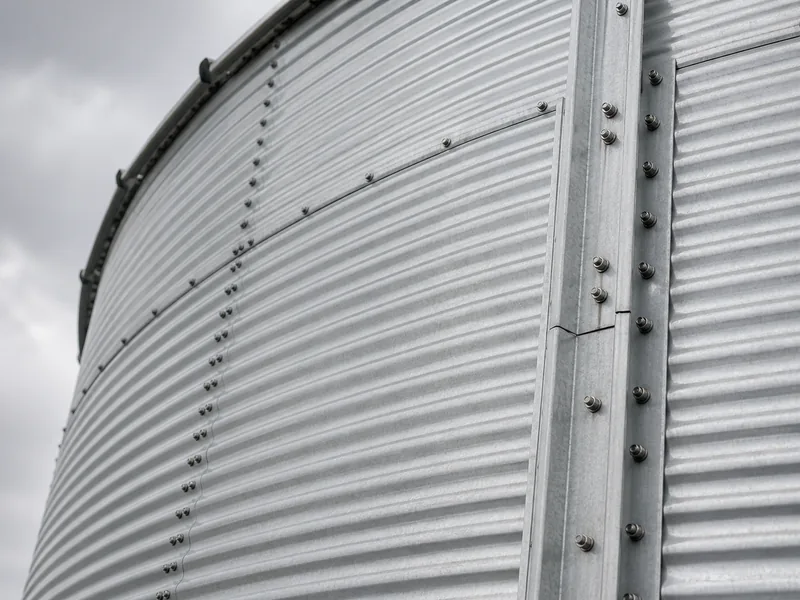
Material and wall gauge follow the load, not a catalog default. Galvanized (zinc) coating is the standard, while coastal and corrosive sites move up to an aluminum-zinc-magnesium coating for a longer coating life. Wall thickness increases toward the base because hoop pressure climbs with grain depth, so a tall narrow silo and a squat wide one of the same tonnage do not share the same wall schedule. The variable to verify is bulk density: a silo sized for wheat carries more wall load than the same volume of a lighter commodity, and a wall schedule copied from the wrong grain is where a silo gets under-built.
Flat-bottom vs hopper-bottom grain silos
The base choice — flat-bottom or hopper-bottom — follows capacity, how often the silo turns over, and how clean it has to empty. A hopper-bottom silo sits on a conical base that discharges by gravity straight into a truck or conveyor and cleans out almost completely, which matters for seed grain or a silo that rotates between commodities. A flat-bottom silo holds more for the money but leaves a residual layer that a sweep auger and the aeration floor have to clear. It discharges through a center well rather than by gravity alone.
| Dimension | Hopper-bottom | Flat-bottom |
|---|---|---|
| Discharge | Gravity, complete | Sweep auger + aeration assist |
| Cleanout | Near-complete; good for seed/rotation | Leaves a residual layer |
| Capacity fit | Small to mid (commonly up to a few thousand tonnes) | Mid to very large |
| Foundation | Elevated steel support structure on footings | Reinforced concrete slab with edge ring |
| Per-tonne cost | Lower at small capacity | Lower per tonne at large capacity |
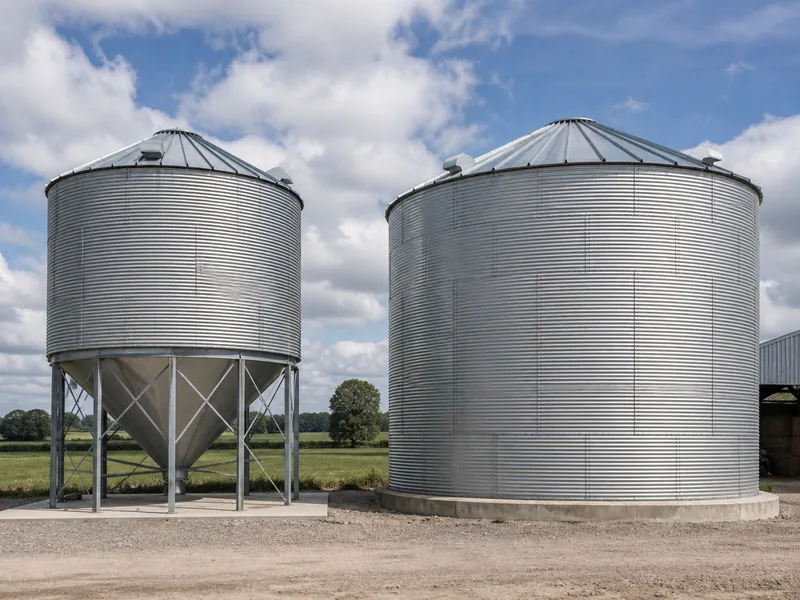
The economics cross over as capacity grows. At farm scale the hopper’s gravity draw and complete cleanout usually justify the support-steel it stands on, especially when you switch commodities and cannot afford to carry residue between fills. Past a few thousand tonnes the flat-bottom’s lower cost per tonne takes over, and the trade you accept is the sweep auger, the unload well, and a residual layer you manage rather than eliminate. Once the expected tonnage is fixed, this base choice usually settles itself.
Keeping stored grain in condition
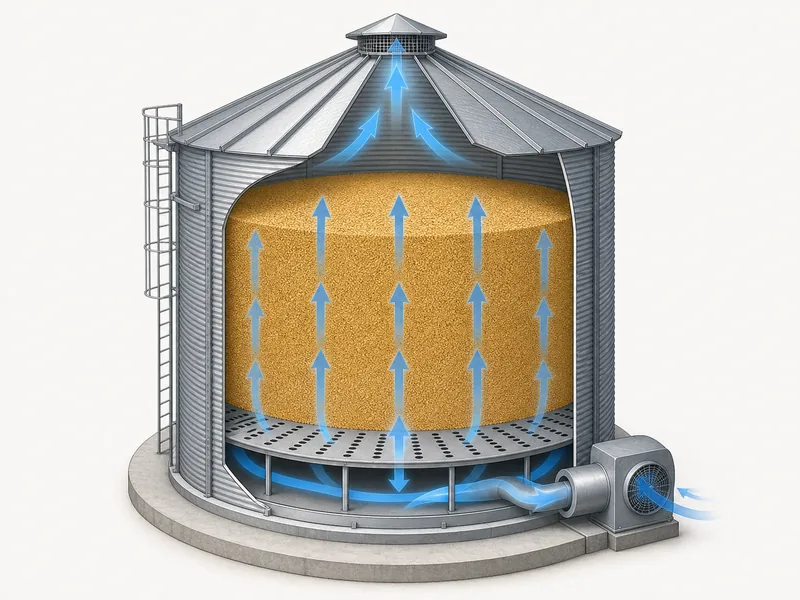
Stored grain holds quality only when its temperature and moisture stay uniform, and that is the aeration system’s job, not the steel shell’s. Without airflow, the temperature difference between the warm core and the cold wall in autumn drives moisture from warm grain toward cold grain, and the migrated moisture crusts and spoils where it collects. Aeration fans push cool, even air through the mass to flatten that gradient and hold the grain cold.
The numbers that matter are airflow and moisture. On-farm storage targets at least 0.1 cubic feet per minute of airflow per bushel, which is the rate university extension programs treat as the workable floor for cooling a grain mass. The aim is to keep grain temperature within roughly 15 to 20 °F of the average monthly air temperature. Cool it down through autumn and hold it cold as deep into spring as the weather allows. On the moisture side, corn is generally stored below about 15 percent and soybeans below about 13 percent, tighter for longer storage or warmer climates. Undersize the fan below that 0.1 cfm-per-bushel floor and the mass cools unevenly, so the first warm spell finds the grain out of condition before the season’s selling window. Put a temperature cable or probe in early, and read the grain temperature on a roughly two-week cadence through the warm months — the peak and the sun-facing wall heat first, so that is where a problem shows up.
Foundation and site considerations
A grain steel silo drives a large, concentrated load into its foundation, so the slab or support structure is engineered to the filled weight rather than the empty shell. A flat-bottom silo bears on a reinforced concrete slab with a stiffened edge ring, because the wall transfers a heavy line load around its perimeter when the silo is full. A hopper-bottom silo instead carries its load through a steel support structure and legs onto footings, which keeps the discharge cone clear above the ground. Bearing capacity, drainage, and frost depth then set the detail, and a foundation sized to an empty silo is the kind of error that surfaces only after the first full fill.
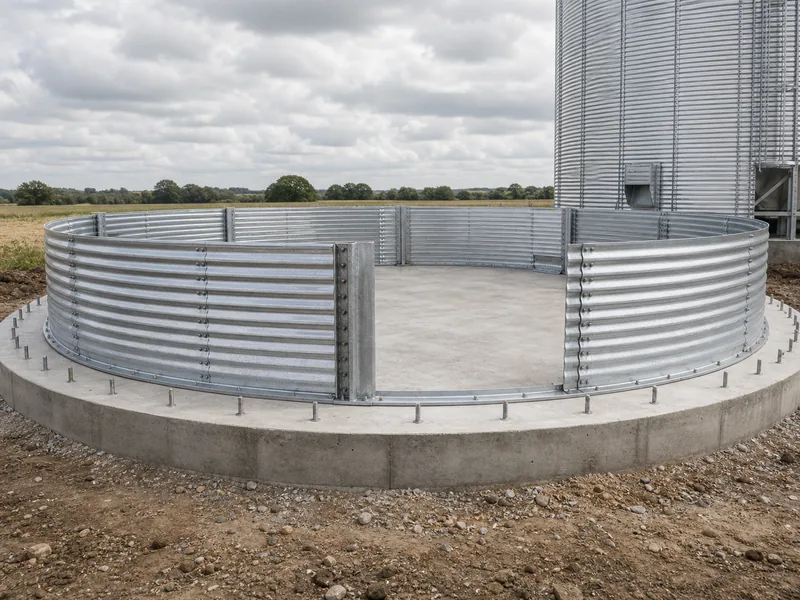
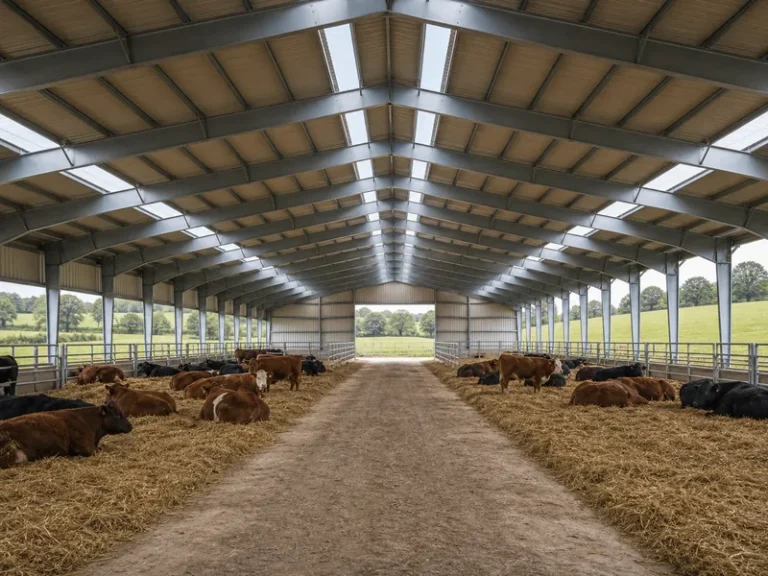
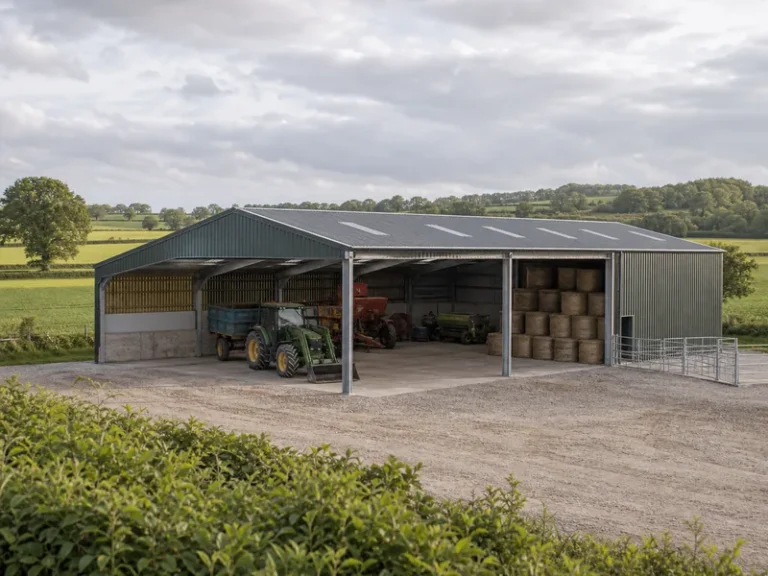
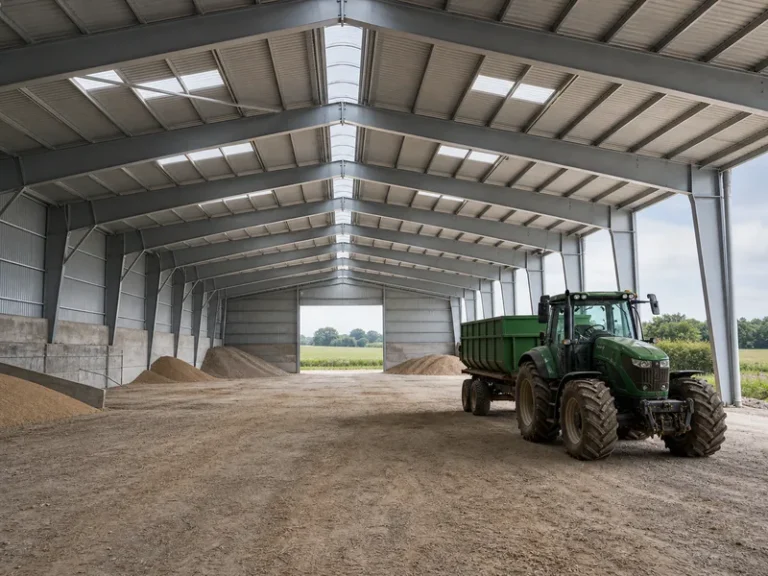
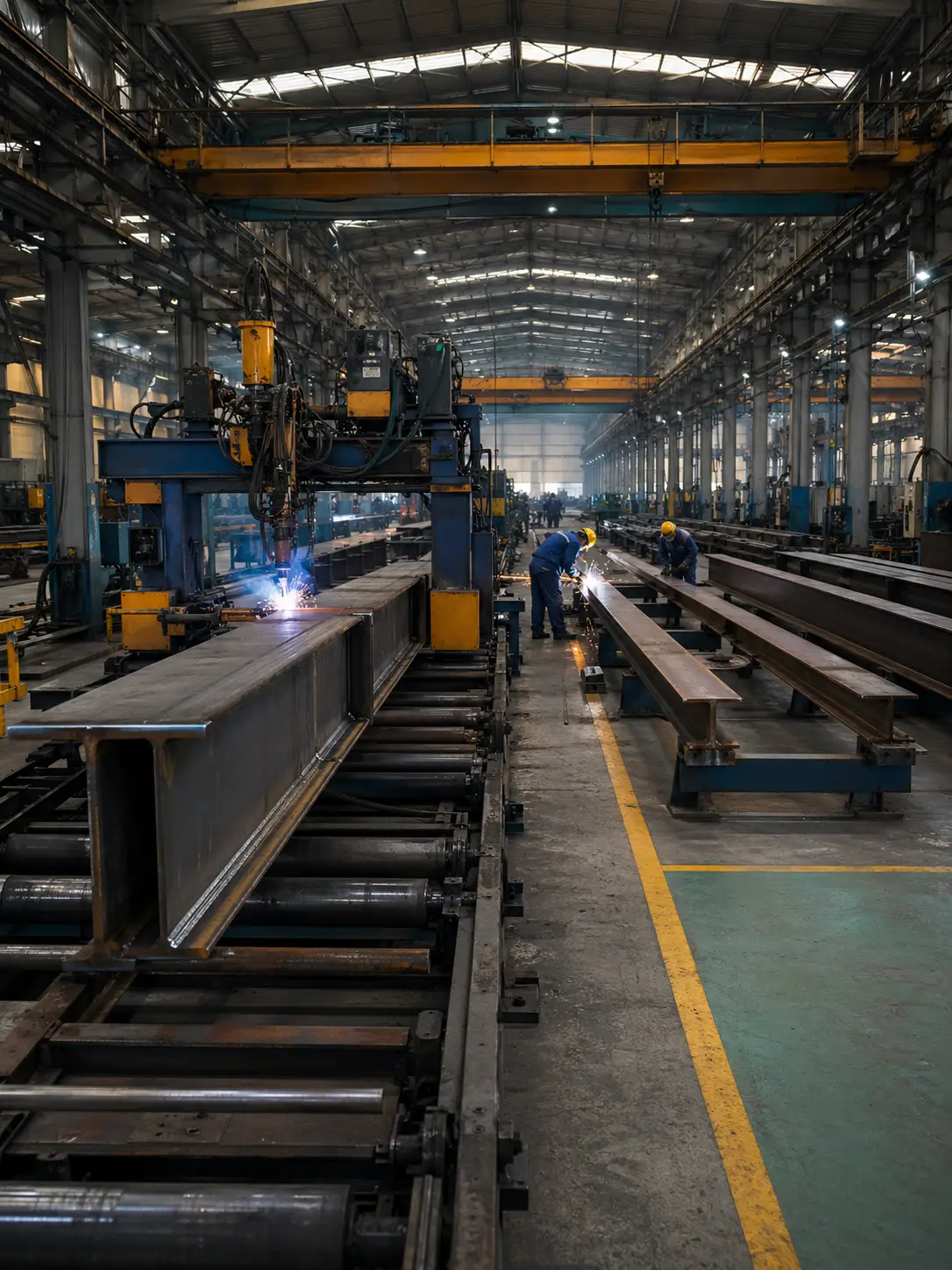
This is the part of a grain storage project that overlaps with structural steel fabrication rather than the silo shell. Grain silos sit within the broader category of agricultural steel buildings, where the hopper support towers, access catwalks, and any attached grain-handling sheds are fabricated alongside the storage. As a steel structure manufacturer running H-beam, box-section, and C/Z purlin lines at a 20,000 m² Qingdao facility, KAFA fabricates that support steel and the surrounding farm buildings to the filled-load case. It can also coordinate the steel building foundation detailing that the silo loads demand. Where flat storage suits the operation better than a vertical silo, a single-story grain storage building is the alternative form to weigh against it.
What drives grain steel silo cost
Grain steel silo cost is set mostly by capacity, the bottom type, the steel weight and coating, and the site work — not by a single per-tonne sticker. Per-tonne pricing falls as capacity rises, and corrugated bolted construction generally lands at the lowest cost per tonne, which is why it dominates the farm-to-commercial range. A hopper bottom adds the support steel it stands on; a flat bottom adds the concrete slab plus the sweep and aeration gear it needs to unload. Coating choice, wind and seismic loads for the region, and freight from the fabricator each move the number further.
Read any per-tonne figure as configuration-dependent, and check what the quote includes before comparing two of them. An equipment price commonly excludes the foundation, freight, erection, the aeration system, and accessories such as ladders, catwalks, and temperature monitoring. Two quotes at the same headline rate can therefore carry very different scopes once the site work is added. A small farm-scale galvanized silo and a large commercial flat-bottom unit sit at opposite ends of the per-tonne curve, and the same tonnage costs differently as a tall narrow silo than as a squat wide one. For how silo budgets sit against other farm structures, the broader picture in steel agricultural buildings prices gives the surrounding context, and the same scope-checking discipline applies. Within the range of farm buildings types, a silo is one of the more foundation-sensitive choices, which is why the site work belongs in the budget from the start.
Conclusion
Sizing a grain steel silo well starts by fixing the stored tonnage and how fast it fills and draws. That one number sorts you toward corrugated bolted or welded construction and decides whether a hopper bottom is even practical. From there the base choice follows cleanout and turnover — hopper for complete discharge and commodity rotation, flat-bottom once capacity makes the lower per-tonne cost worth the residual layer. Only then do coating and aeration get matched to the climate and the bushels, and the foundation gets engineered to the filled weight rather than the empty shell. Get those in order and the budget stops being a single per-tonne guess and becomes a defined scope you can compare quotes against. If you are scoping the support structure, foundation, or the agricultural buildings around a silo, KAFA can size that steel to the filled-load case — request a quote with your tonnage, commodity, and site loads.
FAQ
Is a grain silo the same as a grain bin?
Not quite, and the difference is regional rather than structural. In North American farm usage the corrugated steel cylinder for dry grain is usually called a grain bin, while “silo” classically meant the taller structure for wet silage. Across the commercial grain trade and most of the world, the steel dry-grain cylinder is called a grain silo. Spec sheets sometimes use the terms interchangeably, so confirm whether a quote covers dry-grain storage or silage before comparing it.
How much grain does a steel silo hold?
Steel grain silos commonly range from about 15 tonnes at farm scale to roughly 100,000 tonnes for the largest field-welded units. Corrugated bolted silos cover most of the farm-to-commercial range up to about 15,000 tonnes, while welded construction handles terminal-scale storage above that. The exact capacity depends on diameter, eave height, and the bulk density of the grain stored.
Flat-bottom or hopper-bottom for a farm?
Hopper-bottom usually fits farm-scale storage because it discharges by gravity and cleans out almost completely, which suits seed grain and operations that rotate commodities. Flat-bottom becomes the economical choice once capacity runs past a few thousand tonnes, where its lower cost per tonne outweighs the sweep auger and residual layer it requires. The crossover point depends on how often you change what is stored.
What moisture is safe for stored grain?
Corn is generally stored below about 15 percent moisture and soybeans below about 13 percent, with aeration holding the mass cool and uniform. Those thresholds tighten for longer storage periods and warmer climates, where even slightly wetter grain can spoil. Pairing the right moisture with steady aeration is what keeps the grain saleable through the season.
Does a steel grain silo need a concrete foundation?
A flat-bottom silo needs an engineered reinforced concrete slab sized to its filled weight, with a stiffened edge ring under the wall line. A hopper-bottom silo instead transfers its load through a steel support structure onto footings, so the foundation detail differs by base type. Site bearing capacity, drainage, and frost depth decide the final design in either case.
Further Reading
- Managing stored grain with aeration — University of Minnesota Extension. Airflow rates and seasonal temperature targets for cooling and holding stored grain; supports the aeration section above.
- 2021 Stored Grain Management — Iowa State University Extension and Outreach. Moisture thresholds and monitoring practice for stored corn and soybeans; supports the grain-condition targets.
- Grain Handling — Overview (29 CFR 1910.272) — U.S. Occupational Safety and Health Administration. Engulfment, bin-entry, and dust-explosion rules for grain storage facilities; supports the operating and safety boundary.