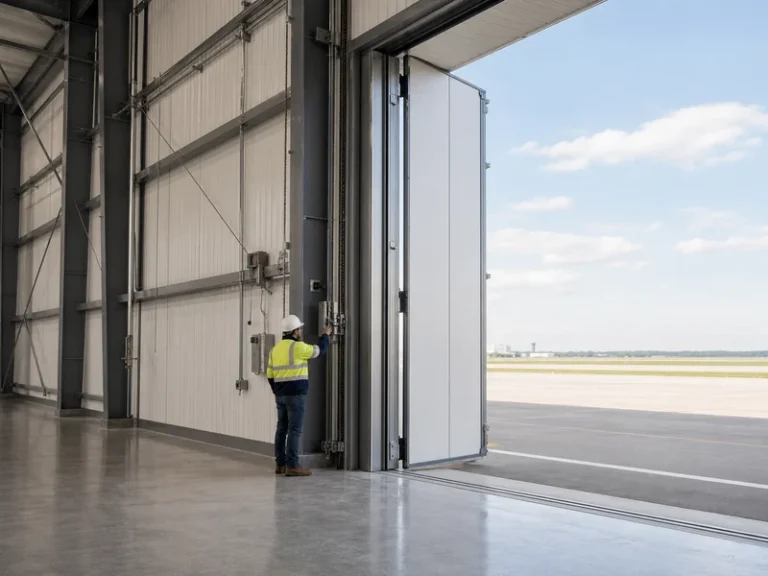






Aircraft hangar insulation has two jobs that often get treated as one: holding a workable temperature, and keeping moisture from condensing on the cold steel directly above your aircraft. Miss the second job and even a thick, expensive insulation package can still let water drip onto avionics, paint, and tooling. The better approach is to settle three things first: your climate, whether the hangar will be heated or cooled, and where the dew point falls inside the roof and walls. From there, treat condensation control as the priority rather than chasing the highest R-value you can fit. A working metal aircraft hangar is a large, mostly empty steel envelope wrapped around a huge door, and that shape is why its insulation behaves differently from a house or a small workshop.
This guide covers how climate and use decide the system, and why moisture control comes first. It does not price each material line by line, walk through installation steps, or weigh specific hangar door models; those are separate decisions.
Why a Hangar Is Harder to Insulate Than a Standard Metal Building
A hangar pairs a very large enclosed volume with one enormous moving opening, and that combination drives almost every insulation choice that follows. Warm air stratifies and collects against the roof, which becomes the largest cold surface in the building and the first place condensation tends to show up. The door, often a full wall that opens, is the largest break in the thermal envelope, so even a well-insulated roof and walls lose ground every time it cycles.
Scale changes the math, too. A clear-span, column-free roof puts a lot of uninterrupted metal overhead, and the deeper the structure, the more purlins and girts act as thermal bridges that shortcut heat straight through the insulation. Many owners condition a hangar specifically to protect avionics or to run comfortable maintenance shifts. That goal means holding steady interior conditions across a far larger, leakier envelope than a typical metal building.
Why Insulation Alone Will Not Stop Condensation
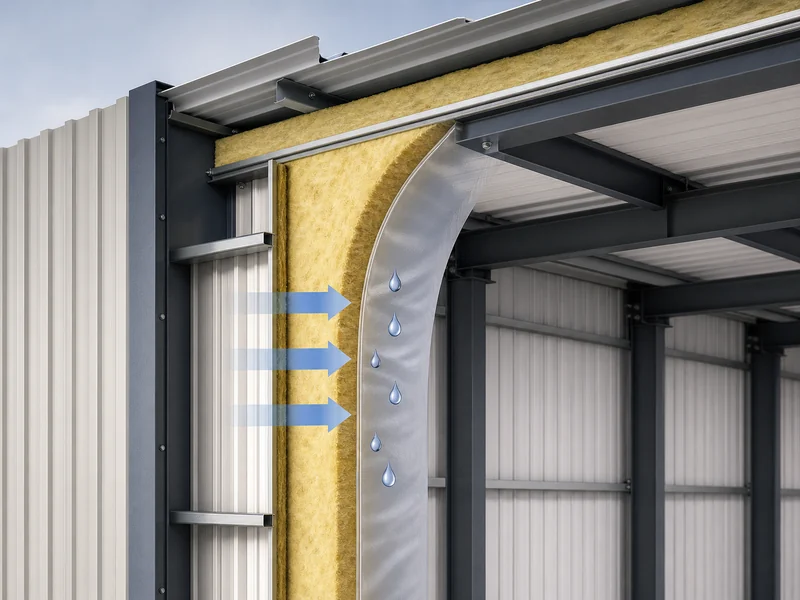
Insulation slows heat flow, but by itself it does not stop water vapor from reaching cold metal and condensing there. The U.S. Department of Energy is blunt about this for porous products. Even a thick layer of fiberglass does little to slow the movement of moisture-laden air, so it has to be paired with a vapor retarder to control condensation. Skip that pairing in an unheated hangar and batt insulation can make things worse, holding humid air against the cold panel exactly where it will condense.
Condensation control depends less on a nominal R-value than on keeping warm, moist interior air away from the cold steel, and on where the vapor retarder sits. As a rule, the retarder belongs on the warm side of the assembly: toward the interior in cold climates, toward the exterior in hot, humid ones. Closed-cell spray foam is popular in hangars partly because it acts as its own vapor retarder and air seal, so interior air never reaches the panel to condense. The same logic applies to any metal building insulation system: the question is not only how much you install, but whether air and vapor are stopped before they reach a cold surface. If R-value as a concept is new to you, our primer on what an R-value of insulation means is a useful side read.
Matching Insulation to Climate and Whether the Hangar Is Conditioned
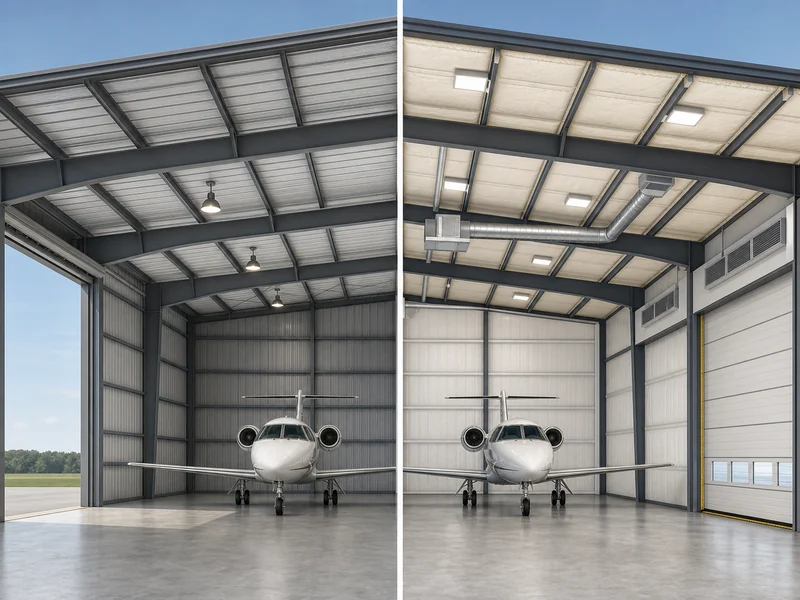
Whether the hangar will be heated, cooled, or dehumidified is the fork that decides how much insulation the building actually needs. A space you never condition asks a different question than one kept at a steady temperature for avionics, and the two answers can point to completely different systems.
Unconditioned tie-down and storage hangars
An unconditioned hangar is mainly fighting radiant heat and roof drip, not heat loss, so deep R-value is rarely the goal. In a hot, dry climate, a reflective or radiant barrier under the roof often does most of the useful work by cutting solar gain and surface temperature. What matters more than thickness is weather-tightness: closing gaps so humid outside air is not constantly washing across cold metal. Piling thick, permeable batt into a building you never heat can backfire, trapping moisture without delivering comfort you are not paying to maintain anyway.
Heated, cooled, or avionics-grade hangars
Conditioning the space flips the priorities toward continuous insulation and a controlled vapor path. The goal becomes a continuous thermal layer that limits bridging at purlins and girts, plus a vapor retarder placed for your climate so the dew point never lands on bare steel. Hangars holding sensitive avionics, or used for paint and long maintenance jobs, lean hardest on this, because stable temperature and humidity protect the aircraft as much as the people. This is the case where higher R-value pays back, once the moisture path is already under control.
Hangar Insulation Systems and Where Each One Fits
Five system families cover almost every hangar: reflective and radiant barriers, fiberglass batt, rigid board, closed-cell spray foam, and insulated metal panels. They differ less in raw R-value than in how they handle moisture, bridging, and the sheer area of a hangar roof. The table below is a quick orientation, not a spec sheet.
| System | Relative R-value | Moisture behavior | Best fit |
|---|---|---|---|
| Reflective / radiant barrier | Low; reflects radiant heat | Helps limit surface condensation | Unconditioned hangars in hot, sunny climates |
| Fiberglass batt | Moderate per inch | Needs a vapor retarder; risky if left open | Budget conditioned hangars with a proper facing |
| Rigid board | Moderate to high per inch | Works well as continuous insulation over framing | Cutting thermal bridging on walls and roof |
| Closed-cell spray foam | High per inch | Acts as its own air and vapor barrier | Humid or cold climates, retrofits, avionics |
| Insulated metal panel (IMP) | About R4 per inch of foam core and up | Factory facings and built-in thermal breaks | New builds wanting envelope and finish in one |
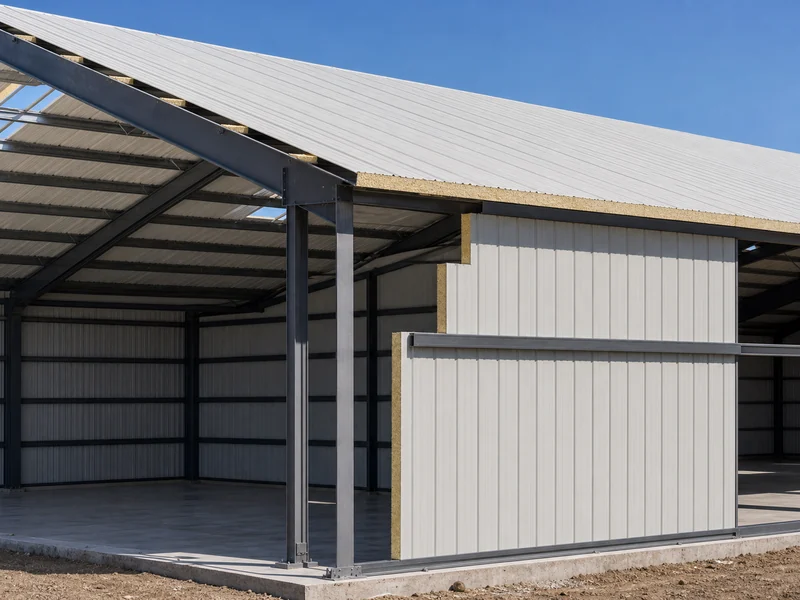
EPS- or PIR-cored sandwich panels build the insulation into the wall and roof themselves. They arrive factory-formed at roughly R4 per inch and up depending on the core, with thermal breaks already engineered in. Spray foam and IMPs cost more up front than batt or a bare radiant barrier, but they remove the moisture guesswork that causes the expensive failures. For a material-by-material breakdown sorted by climate and budget, see our companion guide to aircraft hangar insulation options. Insulation also moves the overall cost to build a hangar, so it is best scoped alongside the structure rather than treated as an afterthought.
Insulating the Roof, Walls, and Hangar Door
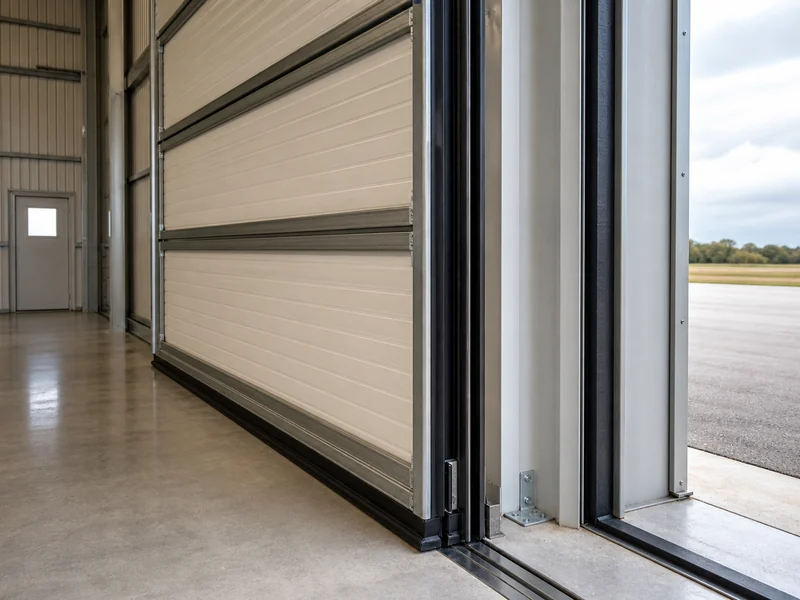
The roof, the walls, and the door each fail in a different way, so a hangar envelope is only as strong as whichever of the three you neglect. The roof is the priority: it is the largest cold surface, it catches the most sun, and it is where stratified warm air gives up its moisture, so continuous insulation plus the right vapor control matters most overhead. Walls are more forgiving but still bridge heat at every girt, which is where a continuous layer or panel system does better than batt stuffed between framing.
The door is the variable that undoes the rest. A large hangar door is the hardest part of the envelope to seal and insulate, and its perimeter leaks air no matter how good the panels are. Insulated door leaves and solid weather seals help, but the door still sets the realistic ceiling on how tight the building gets. Door type drives much of this, which we cover separately in hangar door types. This is also where buying the envelope as an engineered system pays off. When the steel frame, purlins, panels, and vapor control are detailed together — the way we draw up a hangar shell at KAFA — the bridging and air-leak paths get resolved on paper instead of on site.
Conclusion
Insulating a hangar well is a matter of ordering the decisions, not buying the thickest product on the shelf. Lock in two things before anything else, your climate and whether the building will be conditioned, because together they decide whether you are managing radiant heat and weather-tightness or building a continuous, vapor-controlled envelope. Settle the moisture path next: where the vapor retarder sits and how the air seal is detailed, especially across the roof and around the door. Only then does picking a specific system — radiant barrier, batt, board, spray foam, or insulated metal panel — become a straightforward call instead of a guess. If you are scoping a new hangar shell and want the frame, panels, and vapor control engineered as one envelope, get in touch about the climate and use you are designing for.
FAQ
Do you need to insulate an aircraft hangar?
Not every hangar needs insulation, but most benefit from at least basic moisture control. An unheated tie-down hangar in a mild, dry climate may only need a radiant barrier and a weather-tight roof, while any hangar that is heated, cooled, or stores avionics needs real insulation plus a vapor retarder to keep condensation off the aircraft.
What R-value does an aircraft hangar need?
There is no single target R-value, because the right number depends on climate and whether the hangar is conditioned. Conditioned hangars in cold climates push toward higher continuous R-values, while unconditioned hangars gain little from deep R-value and more from radiant control and air sealing. Set the moisture strategy first, then size R-value to the climate.
Does hangar insulation stop condensation?
Insulation by itself does not stop condensation. It slows heat flow, but moisture still condenses wherever warm, humid air reaches cold steel; controlling it takes a vapor retarder on the warm side of the assembly plus a continuous air seal. Closed-cell spray foam is common in hangars because it delivers insulation, air sealing, and vapor control in one layer.
What is the best insulation for a metal aircraft hangar?
The best system depends on climate and use rather than one universal winner. Closed-cell spray foam and insulated metal panels handle moisture best for conditioned and humid-climate hangars; reflective barriers suit hot, dry, unconditioned hangars; fiberglass batt works for budget-conscious conditioned spaces when it is paired with a proper vapor retarder.
Does insulating a hangar lower energy costs?
A conditioned hangar generally sees lower heating and cooling loads once it has continuous insulation and a sealed envelope, since less conditioned air escapes through the roof and door gaps. The savings depend on climate, how the building is used, and how well the door and bridging are detailed, so treat efficiency as one result of getting the envelope right rather than a fixed percentage.
Further Reading
- Insulation — U.S. Department of Energy, Energy Saver — Government primer on how R-value works and why both thickness and type matter when sizing insulation.
- Vapor Barriers or Vapor Retarders — U.S. Department of Energy, Energy Saver — Explains where to place a vapor retarder by climate, which is the core of hangar condensation control.
- Types of Insulation — U.S. Department of Energy, Energy Saver — Overview of batt, board, spray foam, and panel systems and where each is typically used.