




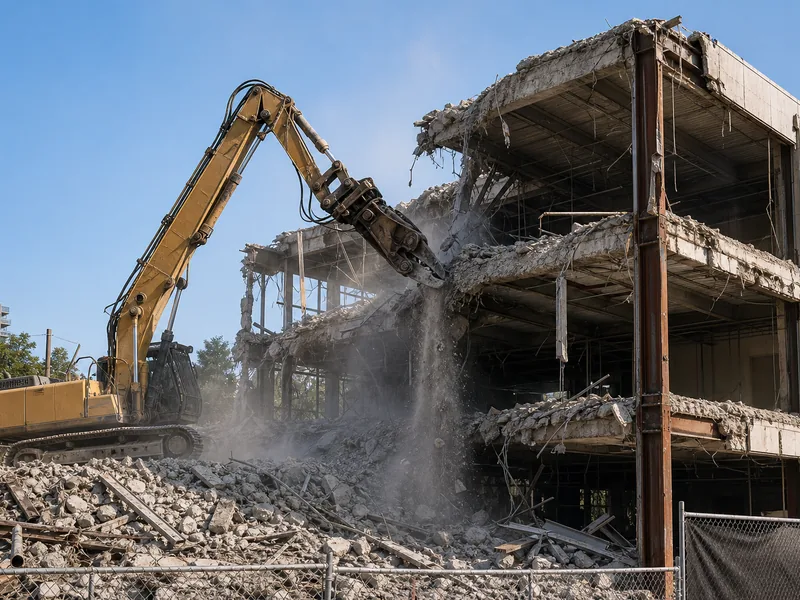
The demolition of buildings cost is best understood as a range, not a single figure. The spread is wide enough that two owners with similar buildings can pay very different totals. What drives the number is how big the structure is, what it is made of, where it sits, and how much of the work is hauling debris rather than knocking walls down. This guide breaks the cost into the parts that move the price, so you can tell a fair estimate from a vague one before you sign.
Demolition planning should also consider the next metal building construction scope if the site will be rebuilt on the same pad.
Cost scope note: Treat the ranges below as scope-specific planning numbers. Kit or shell figures exclude the slab, site work, delivery, permits, insulation, utilities, and interior finish unless the line item says otherwise. Heavy loads, poor soil, tight access, and custom openings can move a quote above the base band.
Building Demolition Cost Per Square Foot: Typical Ranges
Building demolition is usually priced per square foot, and the rate splits sharply between residential and commercial work. Commercial and industrial teardowns commonly fall around $4 to $8 per square foot, while residential mechanical demolition tends to run higher per foot, often near $5 to $17. Larger, taller, or more complex projects can sit well above these base ranges, so treat the figures below as published planning ranges, not quotes.
| Building type / scenario | Typical range (per sq ft) | What pushes it up |
|---|---|---|
| Commercial / industrial (general) | ~$4–$8 | Size, downtown location, interior fit-out, occupied surroundings |
| Residential, mechanical teardown | ~$5–$17 | Brick or masonry, poor access, hazardous materials |
| Residential, full manual deconstruction | Above mechanical rates | Salvage requirements, hand-dismantling, time on site |
| Larger or more complex commercial | Rises with size and complexity | Multiple stories, composite floors, heavy structural sequencing |
As a rough illustration, demolishing a 2,000-square-foot house often lands between $10,000 and $34,000, depending on whether foundation removal, debris hauling, permits, and abatement are included. You will also see a single national average quoted near $30,000, but that figure blends houses and high-rises and means little until you fix your own building’s size and type.
What Makes One Demolition Quote Far Higher Than Another
Two buildings of identical floor area can draw quotes that differ by tens of thousands of dollars, and the gap almost always traces back to a handful of variables. Understanding them is what separates a defensible budget from a guess. The three that move quotes the most are size, material, and site conditions.
Size, height, and square footage
Bigger buildings cost more in total, but the per-square-foot rate does not reliably fall as they grow. Taller structures need more machine hours, generate more debris truckloads, and often require structural sequencing that a single-story building does not. A multistory commercial building can therefore carry a higher rate per square foot than a sprawling single-level one, which is the opposite of what many owners expect when they assume bigger means cheaper per foot.
Construction material
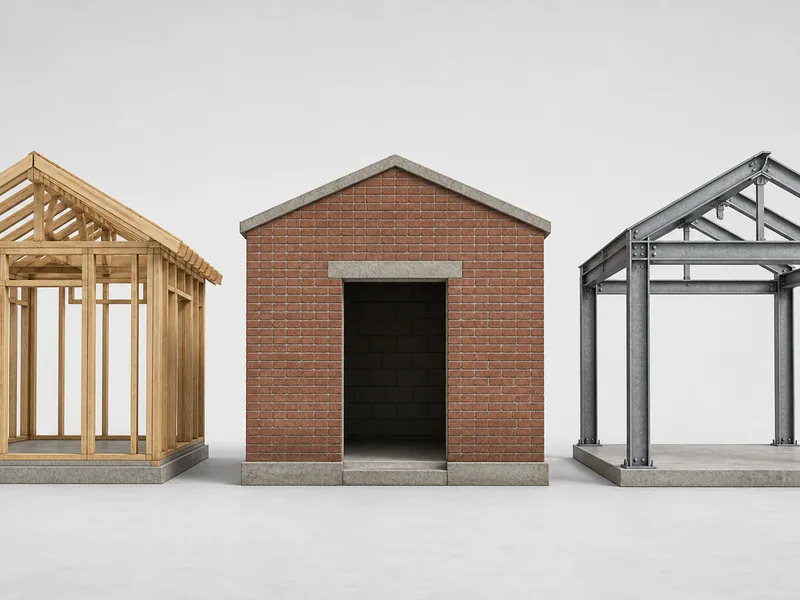
What the building is framed and clad with sets the floor and ceiling of the demolition rate. Wood-frame structures come apart relatively easily, while brick, stone, and reinforced concrete demand hydraulic hammers, more equipment time, and heavier debris handling, which is why masonry consistently lands at the expensive end. Metal and steel buildings sit at the cheaper end for reasons covered in the next section.
Location and site access
Where the building stands changes the price as much as what it is. Dense urban sites raise costs through stricter permitting, limited equipment staging, traffic control, and protection of adjacent structures, while a rural building with open access on all sides is cheaper to work. Permit fees alone swing with the jurisdiction, and a tight lot can force smaller equipment that slows the whole job.
Why Steel and Metal Buildings Cost Less to Demolish
Bolted, pre-engineered metal buildings tend to sit at the low end of demolition pricing because their connections come apart instead of breaking apart. A bolted frame can be unbolted in sequence, where poured concrete or laid masonry has to be broken up and hauled out as heavy, low-value debris. That advantage is strongest for standardized, bolted structures; welded frames, corroded fasteners, composite floors, added fireproofing, or tight sites can each narrow it.
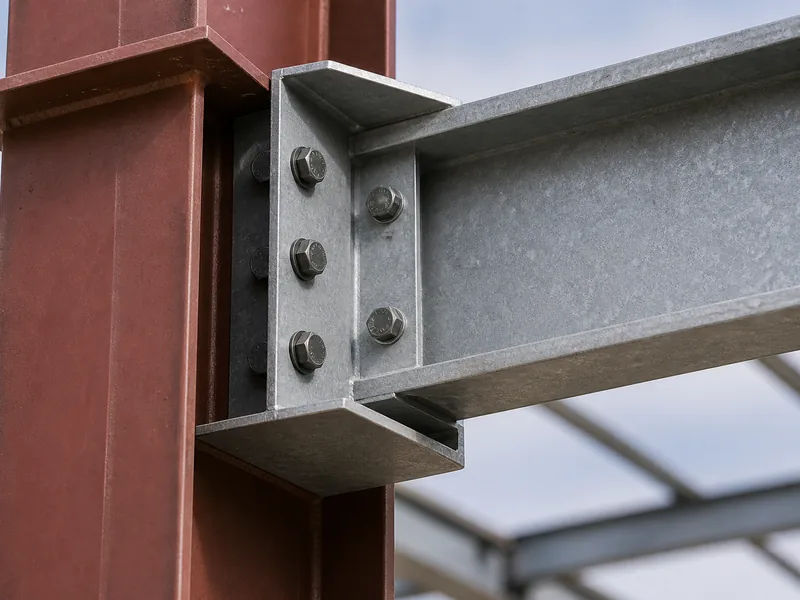
Because the steel members and cladding hold scrap value, recovered material can offset part of the net cost, though how much depends on the steel price and how cleanly the debris is sorted. In some cases a bolted, prefabricated building can be dismantled and relocated rather than torn down. That option is rarely free: a fair comparison prices demolition, dismantling and labeling, transport, re-erection, foundation work, replacement parts, and scrap credit side by side, then looks at the net. Whether it pays off also depends on how much service life the building has left, a question covered in how long metal buildings last.
This is one place where the choice made at construction time shapes cost decades later. Structures assembled from standardized, bolted parts, the same logic behind modern custom metal building kits, are easier to take apart than poured or welded ones. That recyclability is part of the broader benefits of steel buildings. Masonry usually does not offer the same combination of bolted disassembly and steel scrap value. For a demolition budget the takeaway is narrow: if your building is steel, price the scrap credit and the dismantle-and-relocate option before assuming a straight teardown.
Costs Beyond the Teardown: Asbestos, Permits, and Debris
The teardown line item rarely tells the whole story of a demolition budget. Before comparing bids, separate the four costs below from the per-square-foot rate, because each can land well outside it.
Hazardous material removal: asbestos and lead
Asbestos and lead must be identified and handled before general demolition begins, and skipping the inspection can stop a job mid-stream. When asbestos is present, abatement commonly adds on the order of $2 to $3 per square foot, or several thousand dollars on a whole-house basis. The work should be handled by a qualified or licensed abatement contractor where applicable regulations require one. Federal rules such as the EPA’s Asbestos NESHAP generally call for a pre-demolition inspection and advance notification, though the exact triggers and procedures depend on the building and the jurisdiction. Either way, the cost and timeline hinge on what the inspection finds.
Demolition permits and inspections
Most jurisdictions require a demolition permit, though the fee and process vary widely by locality and building type. Typical permits run from a few hundred to about a thousand dollars, while large or multistory projects in major cities can run substantially higher once reviews and inspections are added. Budget for the permit plus the inspections it triggers, not just the headline fee.
Debris hauling and disposal
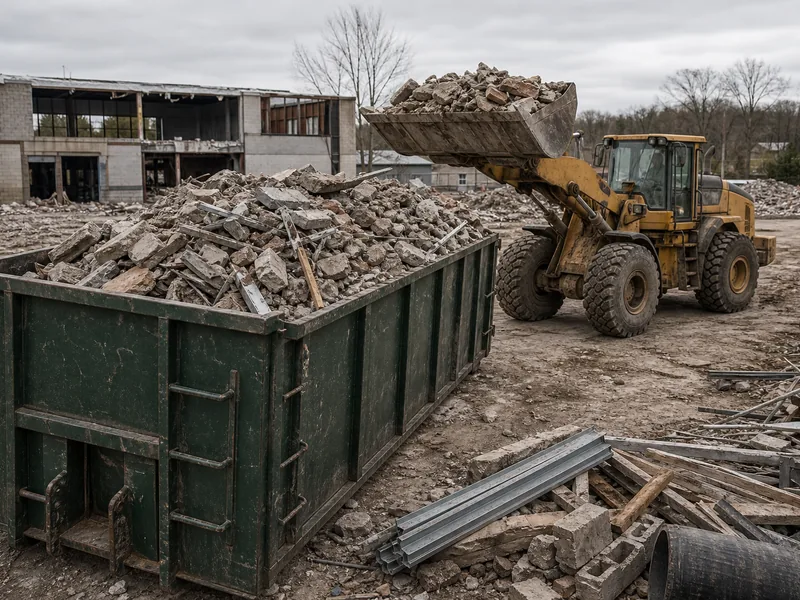
Hauling and disposing of debris is often the most underestimated part of the bill, and on heavy structures it can account for a large share of the total. The cost is driven by debris volume and weight, the distance to the landfill, tipping fees charged by weight, and how much material can be recycled rather than dumped. Concrete and masonry are expensive here precisely because they are dense and high in volume.
Utility disconnection
Disconnecting water, gas, electric, and sewer service is a required step before demolition and is usually billed separately by each utility. Lining these up early matters, because a missed disconnection can halt the work or create a safety hazard. Confirm who schedules each one and whether it appears in the demolition quote or arrives as a separate charge.
How to Turn These Ranges Into a Reliable Estimate
A reliable demolition estimate comes from a site visit, not a per-square-foot table. The ranges above tell you whether a quote is in the right neighborhood; closing the gap to a real number takes verification of the specific building and lot. Work through the checklist below before comparing bids.
- Get a hazardous-materials inspection first. Asbestos and lead findings change both price and schedule, so an inspected building is the only one you can quote accurately.
- Collect at least three itemized quotes. Compare them line by line, because a low headline number often excludes permits, abatement, or disposal.
- Lock the scope. Decide and state whether you need structure-only demolition, foundation and slab removal included, or a site cleared and ready to rebuild.
- For a steel or metal building, price the paths separately. Ask bidders to quote straight demolition, dismantle-and-relocate, scrap credit, and foundation/slab scope as distinct lines.
- Check permit and utility timing. Confirm who pulls the permit and who schedules disconnections so neither stalls the job.
A note on scope: this guide covers what drives demolition cost, not the field methods, equipment selection, or regulatory procedures. Those are governed by safety standards such as OSHA’s demolition rules and are best handled through a licensed contractor.
Bringing Your Demolition Budget Into Focus
For most owners the budget turns on three things a per-square-foot table cannot show: whether hazardous materials are present, how much the debris will cost to haul and dispose of, and how the structure’s material and size affect the rate. Lock those down first, because they are the variables most likely to move the total by five figures. Decide early which frame you are working in, a bare teardown rate or a full budget that includes abatement, permits, disposal, and disconnection, so bids stay comparable.
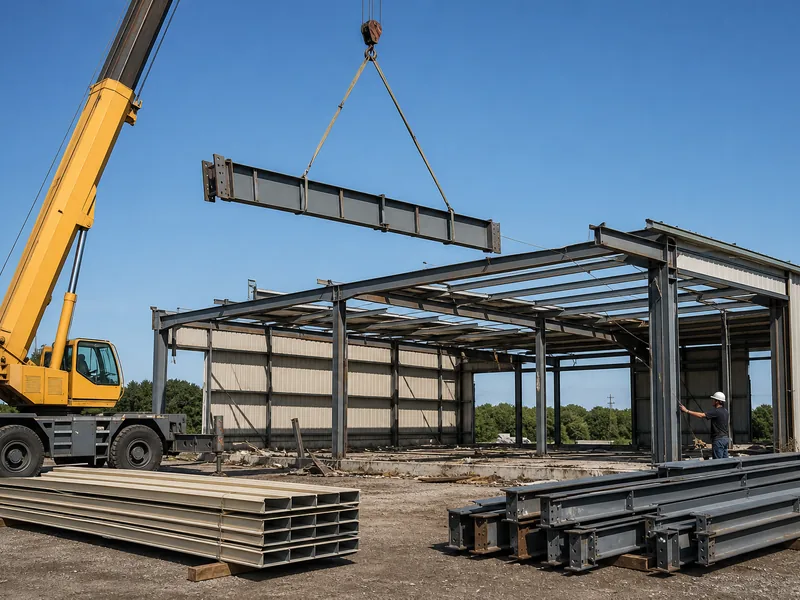
If the structure is steel, our perspective as a steel building manufacturer is straightforward. Before defaulting to a straight teardown, have contractors price three paths side by side: a straight demolition, a dismantle-and-relocate, and a teardown that credits the scrap. A bolted frame often holds value that masonry does not. Owners weighing a rebuild rather than a relocation can set the salvage figure against the cost of a new structure, such as a 30×50 metal building. Whatever the material, use these ranges to sanity-check bids, then let a hazardous-materials inspection and a clearly defined scope set the figure you actually budget.
FAQ
Does building demolition cost include removing the foundation?
Foundation and slab removal is not always included in a base demolition price and is often quoted as a separate line. Whether you need it depends on your end use, since a rebuild may reuse parts of the existing foundation while a clean site sale usually requires full removal. Ask each bidder to state explicitly whether the foundation, slab, and below-grade elements are in or out of the quote.
Does insurance cover the cost of demolishing a building?
Insurance may cover demolition when it is part of a covered loss, such as a fire or storm that leaves a structure unsafe. Routine teardowns for redevelopment are normally the owner’s expense. Coverage and limits vary by policy, so the cost treatment depends on why the building is coming down. Confirm with your insurer before assuming demolition is reimbursable.
How long does it take to demolish a building?
Most standard buildings come down in a matter of days once permits and disconnections are in place, while larger or multistory structures can take weeks. The timeline is driven less by the teardown itself than by the lead time for inspections, permits, hazardous-material abatement, and utility disconnection. Front-load those steps and the on-site demolition is usually the fast part.
Are metal buildings actually cheaper to demolish?
Bolted, pre-engineered metal buildings are generally cheaper to demolish than masonry or concrete, because their connections dismantle quickly and the steel retains scrap value. The saving is smaller for welded frames, corroded fasteners, or composite floors, and it depends on the steel price and how cleanly material is sorted. In some cases a bolted building can be relocated instead of demolished, though that path carries its own dismantling, transport, and re-erection costs to weigh against a straight teardown.
What hidden costs catch property owners off guard?
The costs owners often miss are hazardous-material abatement, debris hauling and disposal, utility disconnection, and foundation removal, none of which show up in a simple per-square-foot rate. Permit and inspection fees can also climb in dense jurisdictions. Asking for fully itemized quotes is the most reliable way to surface these before they appear on the final invoice.