




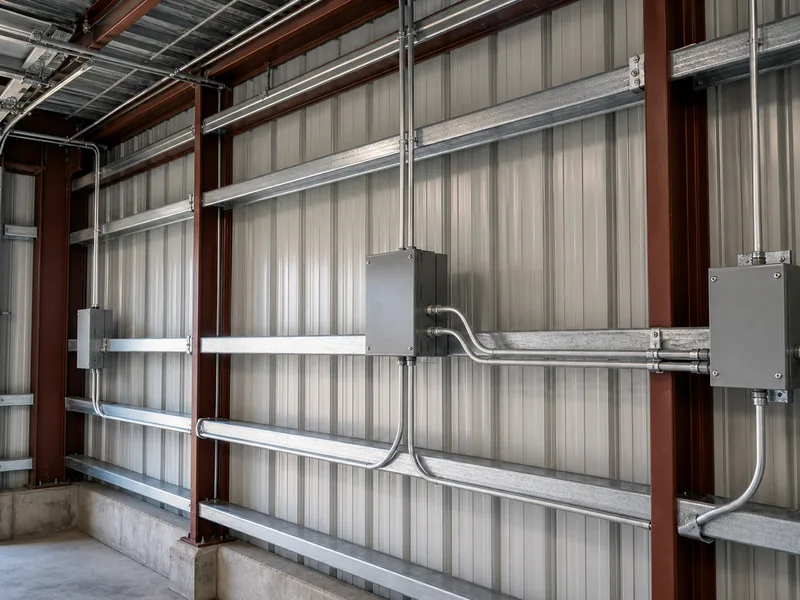
Electrical boxes in a metal building rarely behave like the ones in a wood-framed house. The structure around them is conductive steel, the framing is often exposed instead of hidden inside finished walls, and the same steel that holds the building up sweats when the temperature swings. Those three facts change which box you buy, how you fasten it, and how you keep the system safe and code-compliant.
Electrical boxes are small items, but they must coordinate with metal building components such as girts, panels, insulation, and interior liners.
This guide stays at the box level: the types you will actually use, how to choose by material, size, and rating, how to mount boxes to steel framing, how to ground them, and which NEC rules apply. It does not cover full building wiring, service panel sizing, or load calculations. Treat what follows as planning guidance; the final installation and sign-off belong to a licensed electrician and the local authority having jurisdiction (AHJ).
Why Metal Buildings Change How You Handle Electrical Boxes
A metal building’s steel frame is electrically conductive and frequently left exposed, which reshapes both how you mount a box and how you bond it. In a finished wood house you recess boxes into stud cavities and lean on the wood as an insulator. In a steel building you are often surface-mounting onto girts and purlins, or fastening into light-gauge metal studs, with the conductive frame only inches away.
Condensation is the second difference most people miss. Steel panels and framing cool quickly, so interior surfaces that look dry can carry moisture during temperature swings. A box that would be fine in a heated, finished room may need a damp-location rating in an unconditioned metal shop or barn.
A practical check is to read the wall before you read the catalog. Decide first whether a location is open framing or a finished-out interior, because that single variable drives the box style, the mounting hardware, and often the rating you need. Get it wrong and you end up buying boxes twice.
Types of Electrical Boxes for Metal Buildings
Most metal building jobs draw on three box families: device boxes for switches and receptacles, junction or pull boxes for splices and routing, and weatherproof boxes for damp or outdoor locations. Each family comes in metal or nonmetallic versions, and that material choice carries more weight here than it does in wood construction.
Device boxes
Device boxes hold the switches, receptacles, and similar devices a user touches. In open framing they are usually surface-mounted in a metal handy box or a weatherproof enclosure; behind finished interior walls they can be standard new-work boxes set on metal studs.
Junction and pull boxes
Junction and pull boxes house splices and let conductors change direction without strain. They have to stay reachable after the building is finished, which matters in metal buildings where interior liner panels and insulation are added later.
Weatherproof and outdoor boxes
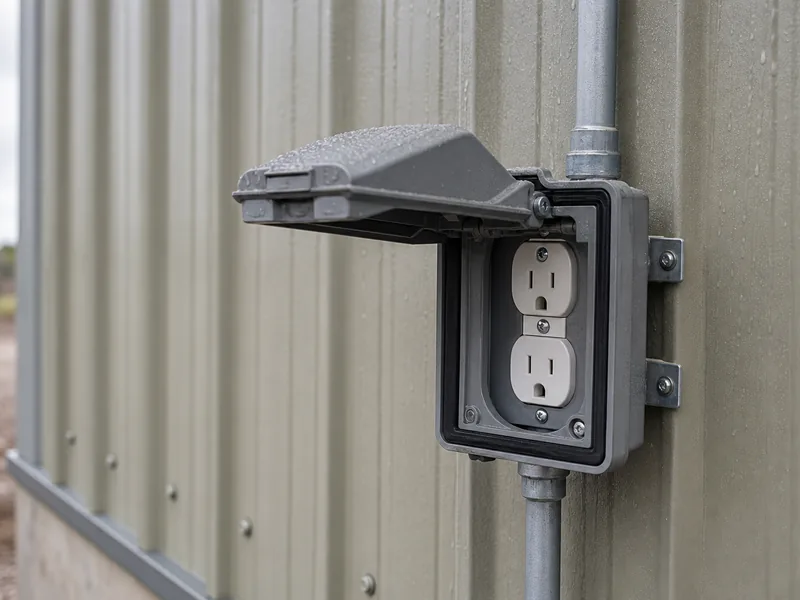
Weatherproof boxes protect connections wherever moisture reaches them, including many “indoor” spots in an unconditioned metal building. Outdoor and damp-location boxes use gasketed covers and corrosion-resistant bodies, and they pair with fittings rated for the same conditions.
Choosing the Right Box: Material, Size, and Rating
Choose the box material by the wiring method, the box size by NEC fill, and the enclosure rating by moisture exposure. On an exposed shop wall, start with the raceway and the moisture it sees before you settle on a box body.
Material follows the wiring method. Where the method is metallic, such as EMT or MC cable, a metal box keeps the bonding path continuous and is generally required, and a properly bonded metal box can serve as part of the equipment grounding path. Nonmetallic boxes resist corrosion and cost less, but they provide no bonding path of their own, so they suit nonmetallic wiring methods rather than conduit systems.
Box size is a fill calculation, not a guess. The NEC sets box fill in Article 314.16 by assigning each conductor a volume allowance and having you total them. The published table lists values such as roughly 2.25 cubic inches for 12 AWG and 2.00 for 14 AWG, so work from the edition your jurisdiction has adopted. A quick way to size a box:
- Count the conductors landing in the box, then add allowances for the clamps and each device per NEC 314.16.
- Look up each conductor’s volume allowance in the adopted NEC table.
- Add the allowances together to get the minimum internal volume.
- Pick a box whose listed volume meets or exceeds that total, with room for circuits you may add later.
Where the box sits decides how weatherproof it has to be. Damp and wet locations call for boxes rated accordingly under NEC 314.15, commonly expressed through NEMA or IP enclosure ratings, and receptacles in many non-dwelling or damp areas need GFCI protection under 210.8(B). Keep the condensation point in mind: in an unconditioned metal building, “indoor” is not automatically “dry.”
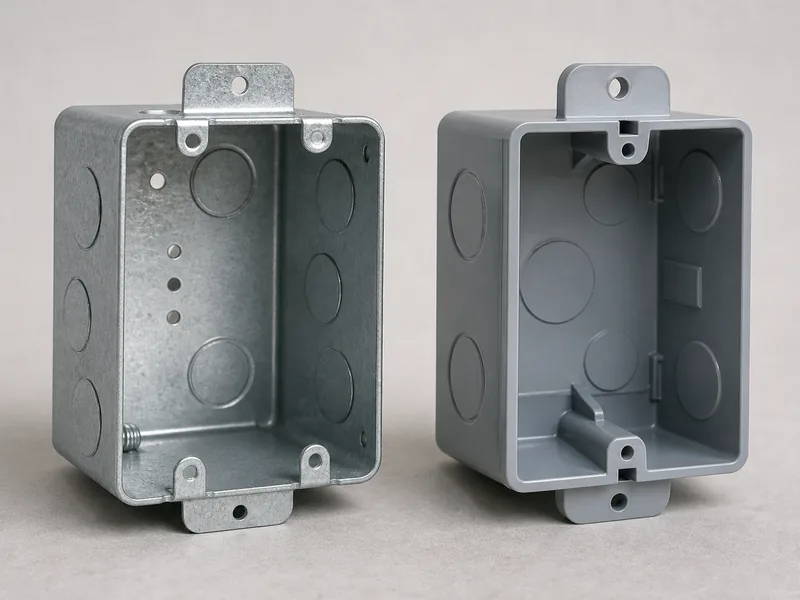
| Decision factor | Metal box | Nonmetallic box |
|---|---|---|
| Grounding and bonding | Provides a bonding path; supports device grounding when properly bonded | No bonding path of its own; grounding relies on a separate arrangement |
| Metallic conduit (EMT/MC) | Compatible, and usually required | Not suited to metallic raceway systems |
| Corrosion in damp areas | Needs a galvanized or coated body | Naturally corrosion-resistant |
| Relative cost | Higher | Lower |
| Best fit in a metal building | Conduit runs and exposed industrial areas where bonding matters | Nonmetallic-cable circuits in finished, dry interiors |
Mounting Boxes to Steel Framing
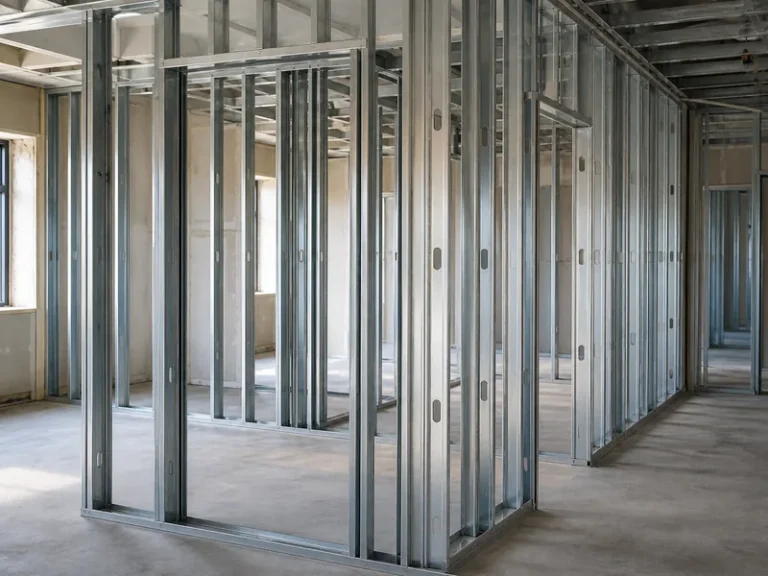
In a metal building you fasten boxes to secondary steel, girts, purlins, metal studs, or added strut and hat channel, not to drywall or wood the way you would in a house. Self-tapping or self-drilling hex-head sheet-metal screws drive directly into the steel, commonly around three-quarter-inch fasteners, though you should verify length against the box listing and the steel gauge. The mistake to avoid is overtightening, because light-gauge steel strips easily and a stripped hole lets the box work loose over time.
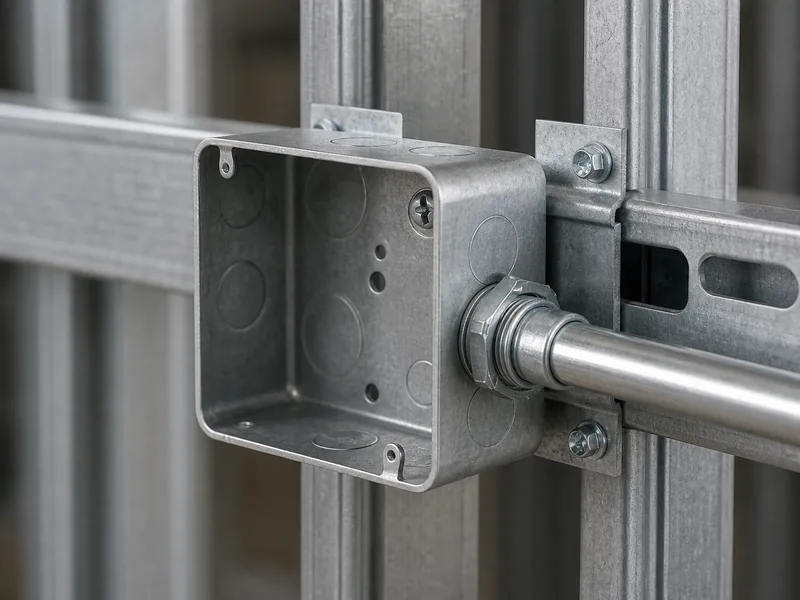
Horizontal girts rarely land at outlet height, so electricians often run strut channel or hat channel vertically between girts to create a continuous mounting surface. If you are finishing the interior, set each box to project past the framing by the thickness of your finish, commonly about one-half to five-eighths of an inch for drywall, so the front sits flush with the wall.
Where you have solid steel to fasten into depends on the building’s framing layout, which is why the girt and purlin spacing of steel custom buildings shapes box placement as much as the electrical plan does. Because the girts, purlins, and studs you fasten into are usually light-gauge, cold-formed members, your fastener choice follows the steel gauge rather than a wood-screw habit. Where cold rolled steel framing forms those secondary members, match the screw to its thickness. Finally, seal every spot where a box or conduit penetrates the wall panel, since each opening is a path for the warm, moist air that drives condensation.
Grounding and Bonding Metal Boxes
Bonding ties every metal box and the building’s steel frame into one low-resistance path back to the source, and in a steel building that path carries more weight than it does in wood. A properly bonded metal box becomes part of that path when the equipment grounding conductor lands on the box’s grounding screw or a listed connection, following NEC 250.148 and 314.40. The devices themselves still ground through the EGC, a listed self-grounding means, or a grounding pigtail. Skip those connections and the conductive frame becomes a shock and fire hazard the moment an energized conductor touches it. Verify continuity from each box back through the grounding system before you close anything up.
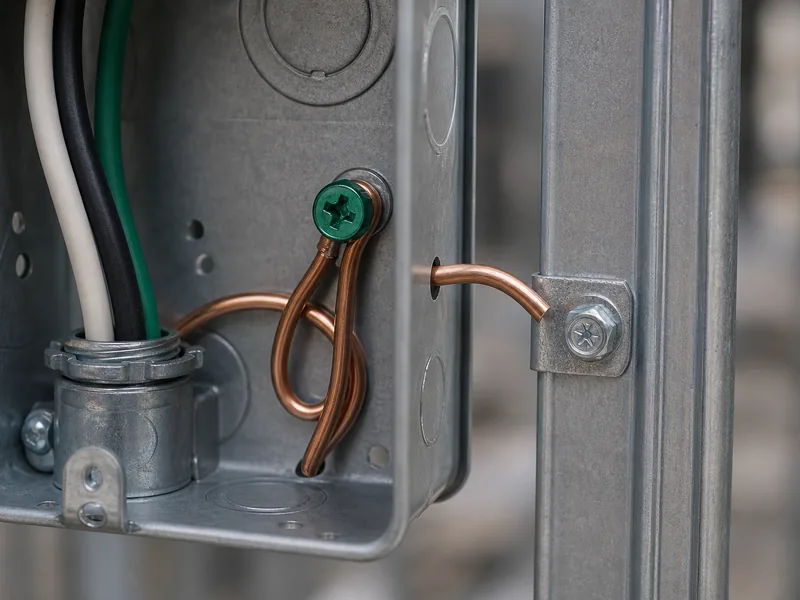
This is where electrical work and the building envelope overlap. Faulty connections and arcing can create ignition risk, so bonding the steel and tightening connections correctly belongs to the same risk picture as fire protection in a steel building.
NEC Rules That Apply to Boxes in Metal Buildings
Beyond bonding, the NEC governs how full a box can be, whether it stays reachable, how it is held in place, and what it must withstand outdoors. None of these rules are unique to steel buildings, but exposed framing and added liner panels make a few of them easy to violate. Treat the points below as the checkpoints an inspector actually looks for, and confirm the details against the NEC edition your local jurisdiction or AHJ has adopted.
- Box fill (314.16): total the conductor, clamp, and device allowances, then pick a box that meets the minimum; for large pull or junction boxes, size by the raceway dimensions in 314.28 instead.
- Accessibility (314.29): junction boxes with splices must stay reachable, so never bury one behind liner panels, insulation, or a finished wall.
- Support (314.23): secure every box to the structure or a listed support, and do not rely on the conduit alone unless the box, raceway, and local code permit a listed conduit-supported installation.
- Damp and wet locations (314.15): outdoor and condensation-prone boxes need a rated enclosure and matching fittings.
- Conductor entry (300.14, 314.17): leave enough free conductor, generally at least six inches, and secure the cable or raceway to the box, running a nonmetallic-cable jacket in past the clamp.
- Flush openings (314.21): where a box sits in a finished surface, keep the surrounding gap within the limit that section allows.
Common Box Mistakes That Fail Inspection
Most box problems in metal buildings trace back to four shortcuts an inspector spots quickly: overfilled boxes, buried junctions, the wrong outdoor rating, and weak bonding. Overfilling shows up when someone reuses an existing box for an added circuit instead of recalculating fill. Buried junctions happen when interior liner goes up over a splice that should have stayed accessible.
The quieter failure is mechanical. An overtightened self-tapper that stripped its hole, or a box mounted to a single liner panel instead of structural steel, can pass on day one and loosen later. Because a steel frame expands and contracts with every hot and cold cycle, fastenings and connections deserve a place in your steel building maintenance routine, with periodic checks that boxes are still tight and connections still clean.
Before ordering boxes for a metal building, run a short field check rather than a generic decision tree. Confirm five things in order:
- where the girts, purlins, or studs actually land, so you know your mounting surface;
- whether each wall stays open framing or gets a finished interior;
- the wiring method, which sets metal versus nonmetallic;
- the conductor count, which sets box size under NEC 314.16;
- the moisture each location sees, which sets the damp or wet rating.
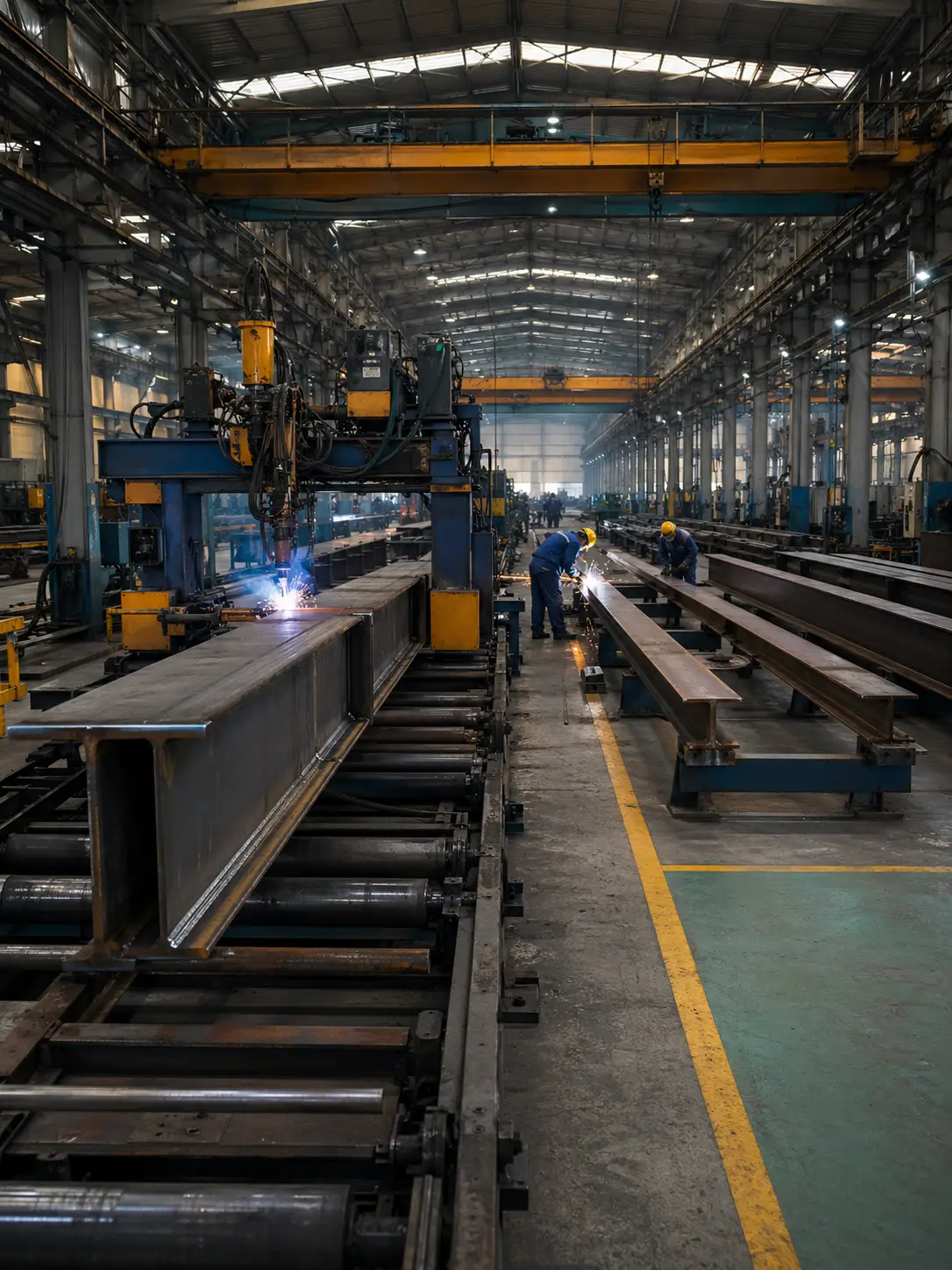
Lock the framing and mounting reality first, since the steel is the one thing you cannot change after it is standing. The frame, girts, and C/Z purlins those boxes fasten to are fabricated by a steel structure manufacturer such as Qingdao KAFA Fabrication Co., Ltd., which builds light and heavy steel structures under documented quality procedures. Coordinating framing layout, secondary supports, panel openings, and attachment zones against the structural drawings early prevents rework. Box fill, circuit routing, bonding, and inspection stay with the electrical team and the AHJ. On a steel frame, the mounting surface decides the box, not the other way around.
Frequently Asked Questions
Can I use plastic (nonmetallic) electrical boxes in a metal building?
Nonmetallic boxes are allowed in many metal building circuits, but the wiring method decides whether they fit. They work with nonmetallic-cable systems in dry, finished interiors and resist corrosion well, yet they are not suited to EMT, MC, or other metallic raceways, where a metal box keeps the bonding path continuous. Match the box material to your raceway before you buy.
Do metal electrical boxes have to be grounded?
Metal boxes must be bonded so they form part of the building’s grounding system. Land the equipment grounding conductor on the box’s grounding screw or a listed connection per NEC 250.148 and 314.40, ground each device through the EGC or a listed self-grounding means, and verify continuity back to the panel.
How do you attach an electrical box to a steel stud or girt?
Boxes fasten to secondary steel with self-tapping or self-drilling sheet-metal screws driven into a girt, purlin, metal stud, or added strut and hat channel. Match the screw length to the steel gauge and avoid overtightening, since stripped light-gauge steel will not hold the box. Confirm you are hitting structural steel, not just a liner panel, before you drive the screw.
What size electrical box do I need for a metal building?
Box size depends on the number and gauge of conductors, not on the building type. Total each conductor’s volume allowance along with clamps and devices using the adopted NEC 314.16 table, then choose a box that meets or exceeds that minimum, and add capacity if you expect future circuits.
Do outdoor electrical boxes on a metal building need to be weatherproof?
Outdoor boxes need a damp- or wet-location rating under NEC 314.15, and so do many unconditioned interior spots. Condensation on cooling steel can wet a box that never sees rain, so match the enclosure rating and fittings to the moisture the location sees, and confirm the rating marked on both the box and its cover.