




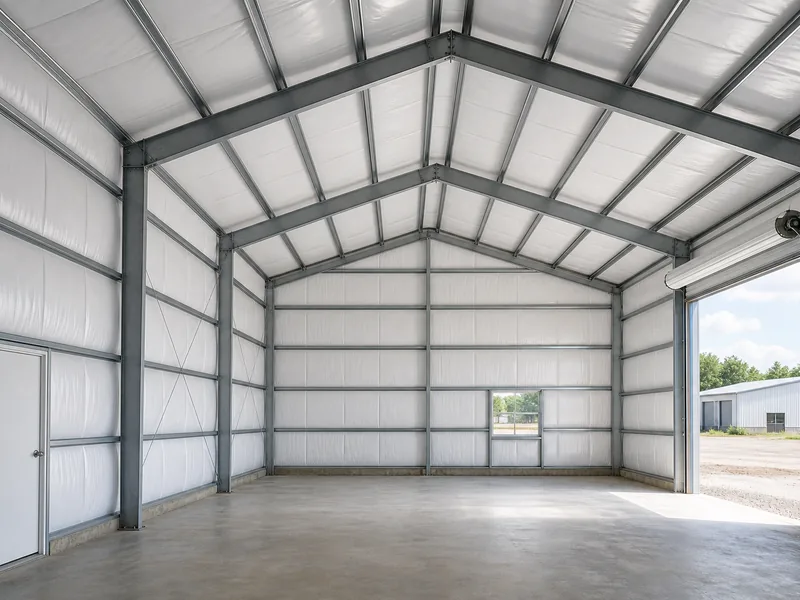
A metal building vapor barrier belongs on the warm-in-winter side of the insulation, which is the interior face in most heated buildings, because its job is to keep humid indoor air from reaching cold steel and condensing there. That one placement rule prevents the rust, soaked insulation, and ceiling stains that show up when moisture is allowed to migrate into the assembly. The barrier is not a standalone fix. It works as one layer of a complete metal building insulation system that also needs the right insulation thickness and controlled ventilation.
This guide explains what the barrier does, whether your building needs one, which side it faces in your climate, the common material types, and the installation details that decide whether it actually works. It does not cover full HVAC sizing or climate-by-climate R-value tables, which depend on your conditioning load and local code.
Why Metal Buildings Sweat
Condensation forms when interior air at or above its dew point touches a steel surface that has cooled below that temperature. Bare panels and purlins track the outdoor temperature closely, so on a cold night the underside of an uninsulated roof can sit well below the dew point of the air inside. Water then beads on the steel, runs down the purlins, and drips onto whatever sits below.
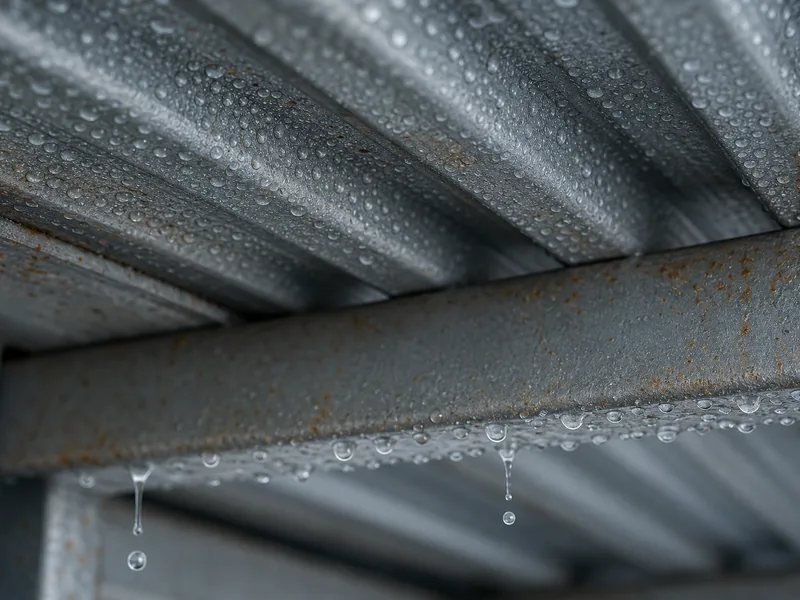
The damage builds over several seasons. Standing moisture rusts fasteners and panel edges, soaks blanket insulation until it sags and loses R-value, and feeds mold on any organic surface. It also appears cosmetically as dark streaks on interior liner panels, the same moisture-and-dust pattern behind ceiling ghosting. If you already see rust freckles along the purlin lines or a damp insulation facing, the assembly is condensing and needs a moisture strategy, not just more heat.
What a Vapor Barrier Does (and How It Differs From an Air Barrier)
A vapor barrier, also called a vapor retarder, slows water vapor from diffusing through the building envelope, and it is rated in perms, where a lower number means less vapor passes. Building codes sort these materials into three classes: Class I at 0.1 perm or less, Class II above 0.1 up to 1.0 perm, and Class III above 1.0 up to 10 perms. A polyethylene sheet or foil facing falls in Class I, while a kraft-faced fiberglass batt sits around Class II.
An air barrier does a separate job, and the two get confused constantly. Vapor diffusion through a solid material is slow, but air leakage through a gap, seam, or unsealed penetration carries far more moisture and moves it far faster. That is why a torn or gapped barrier underperforms so badly. It also explains why several metal-building products combine both roles: a foil-faced bubble wrap or a faced blanket acts as a vapor retarder and, once its seams are taped continuously, as part of the air barrier too.
Do You Actually Need One?
Most enclosed metal buildings that are heated, cooled, or filled with moisture-generating activity need a vapor barrier, while a fully open, unconditioned shed in a dry climate often does not. The deciding variables are the interior moisture load and how much you condition the space. A heated workshop, a gym, a livestock barn, or any building where people, animals, or wet processes add humidity will reach the dew point against cold steel on a regular basis.
A persistent misconception is that insulation alone handles moisture. Insulation slows heat flow, which keeps surfaces warmer and helps at the margin, but it does not stop vapor, and uncontrolled vapor migrates through or around it to condense on the first cold surface it finds. Insulation and a vapor retarder solve two different problems, which is why a sound energy efficiency in metal buildings plan treats thermal performance and moisture control as separate line items.
Which Side Does It Face? Placement by Climate
In heating-dominated climates, the vapor barrier goes on the warm-in-winter side of the insulation, meaning the interior face. The model codes (IBC and IRC) call for a Class I or II vapor retarder on that warm-in-winter side in the colder Climate Zones 5, 6, 7, 8, and Marine 4. That side is where warm, humid air pushes outward toward cold sheathing in winter. Place the low-perm layer there, and vapor is stopped before it reaches the cold steel.
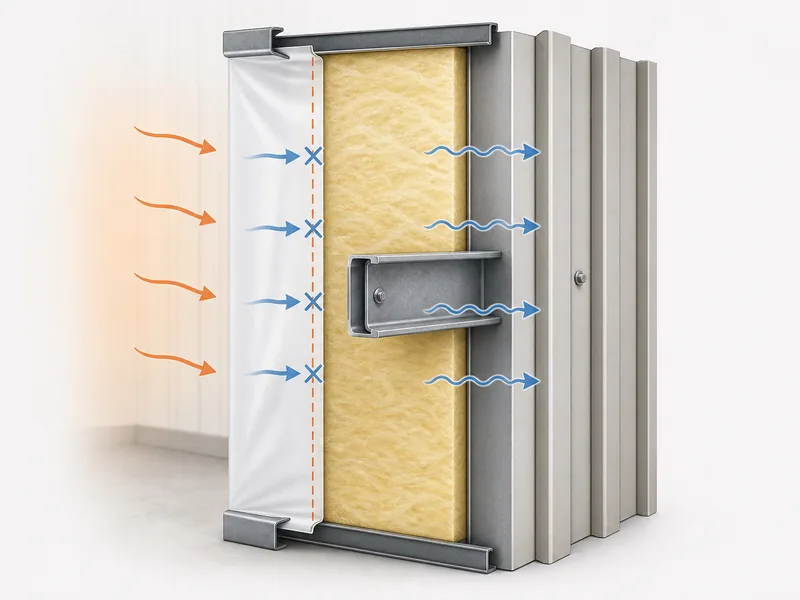
Hot, humid, air-conditioned climates reverse the logic. When a building runs its air conditioning for much of the year, the warm, moist air sits outside, so a low-perm barrier on the interior can trap inbound moisture against the cool interior surface. Designers in those zones move toward a more vapor-open interior, often a Class III assembly, or shift the retarder toward the exterior.
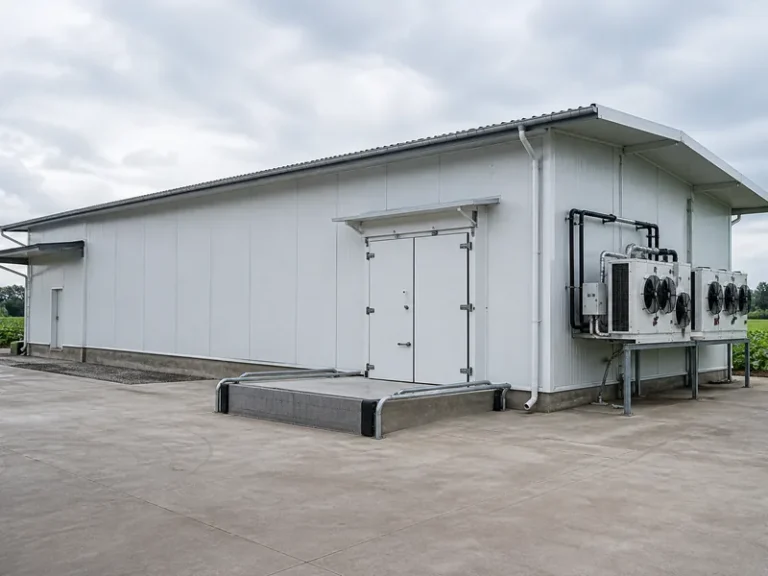
Refrigerated and cold-storage buildings invert the rule outright, since their warm side is the exterior and the vapor barrier belongs on the outside of the insulation. That detail carries real weight in insulated metal cold storage, where a barrier placed on the wrong face will ice up the insulation within a season.
| Vapor retarder class | Perm rating (ASTM E96) | Typical material | Where it fits |
|---|---|---|---|
| Class I | 0.1 perm or less | Polyethylene sheet, foil facing | Strong vapor control in cold climates |
| Class II | Above 0.1 to 1.0 perm | Kraft-faced fiberglass batt | General metal-building use |
| Class III | Above 1.0 to 10 perm | Latex or enamel paint, some facings | Milder control, vapor-open assemblies |
Types of Vapor Barriers and Insulation Facings
Metal buildings rely on a handful of vapor-control products, and they are not interchangeable. The standard choice is the faced fiberglass blanket, long rolls of insulation with a vapor-retarder facing of vinyl or reinforced polyethylene laminated to one side, installed facing-in over the steel during erection. Single- and double-bubble foil is a thinner reflective product that acts as a vapor barrier and radiant barrier while adding only a small R-value, and it suits tight cavities or a panel-side radiant layer.
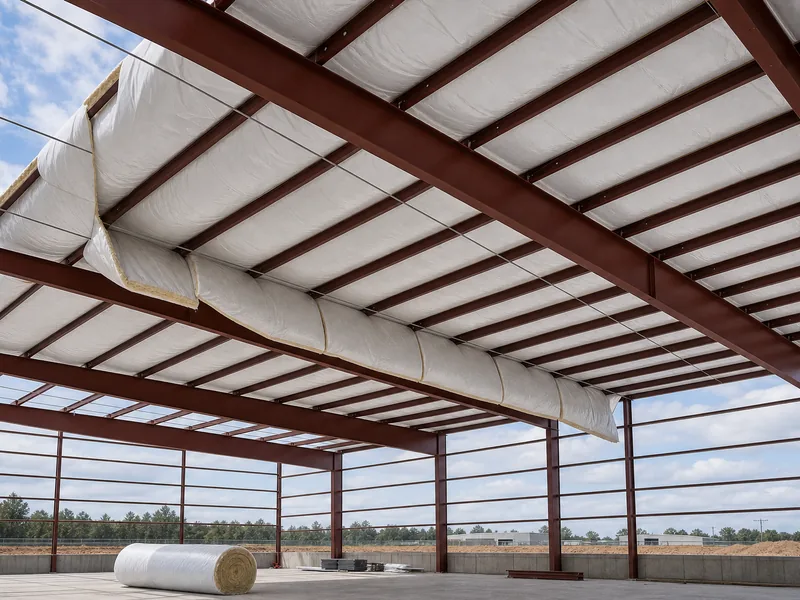
Closed-cell spray foam is the one product that delivers air sealing, a vapor retarder, and meaningful R-value in a single application, which is why it is a frequent pick for problem retrofits. Rigid foam board adds continuous insulation at low permeance. A newer option is a factory-applied anti-condensation membrane bonded to the underside of the roof panel. It does not retard vapor in the usual sense but holds and then releases dew so it cannot drip, a practical choice for unlined agricultural or storage roofs.
| Product | Vapor control | Approx. R-value | Best fit |
|---|---|---|---|
| Faced fiberglass blanket | Class II facing | R-7 to R-30 by thickness | Standard new-build envelope |
| Single/double bubble foil | Class I foil | Low, about R-1 to R-2 | Tight cavities, radiant control |
| Closed-cell spray foam | Vapor retarder plus air barrier | About R-6 to R-7 per inch | Retrofits, complex framing |
| Anti-condensation membrane | Holds and releases dew | Negligible | Unlined ag or storage roofs |
Installation: Sealing, Continuity, and the Double-Barrier Trap
A vapor barrier only performs if it is continuous and sealed, so installation decides the outcome more than the product grade does. Seams have to be lapped and taped, and every penetration, including fasteners, framing, doors, vents, and conduit, has to be sealed, because one unsealed gap leaks more moist air than the intact field of the barrier blocks by diffusion. In metal buildings the facing goes on during erection, draped over the secondary framing before the panels are attached, so the window to get it right closes once the building is buttoned up. A true retrofit means opening walls or switching to spray foam.
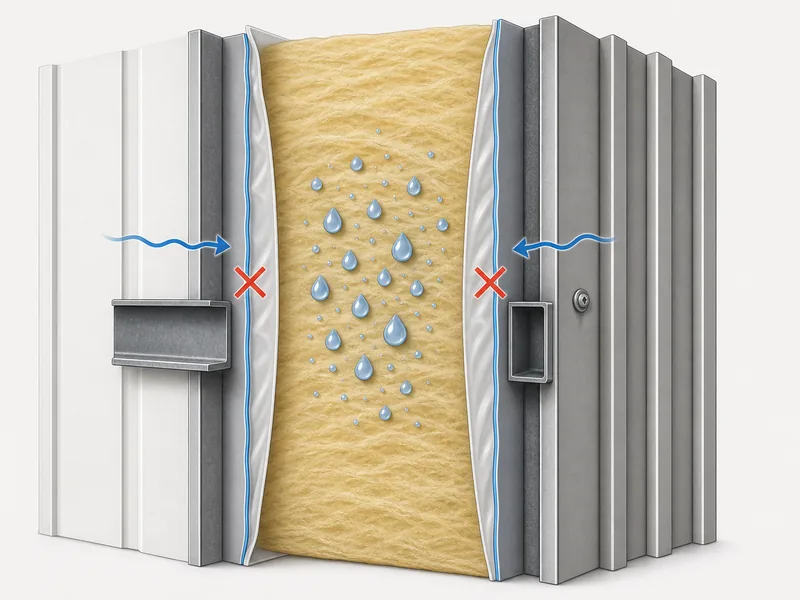
One installation mistake traps moisture for good: sandwiching insulation between two vapor barriers. Sealed rigid foam on the outside plus an interior poly sheet, or a faced batt with a second retarder added later, builds a cavity that moisture can enter but never dry out of. The trapped water does more harm than no barrier at all. Use one continuous retarder on the correct side, and let the assembly dry toward the other.
A barrier also needs a ventilation partner, because even a sealed building gains interior humidity that has to leave somewhere. Pair the retarder with controlled airflow from ridge vents, louvers, or fans sized to the space. A common baseline is near 1 square foot of net free vent area per 300 square feet of footprint, plus dehumidification for high-moisture uses. The floor matters too: a polyethylene vapor retarder under the metal building slab stops ground moisture from wicking up before it can reach the walls.
Get the Side and the Seal Right
The vapor barrier decision reduces to three checks, run in order. First, confirm how the building is conditioned and which climate zone it sits in, which fixes the side the barrier faces. Second, choose one continuous retarder facing matched to that side. Third, back it with ventilation sized to the interior moisture load. The order matters because the correct side is set by physics and code, and no amount of sealing rescues a barrier installed on the wrong face.
Since the facing is integrated during erection, the warm-side detail has to be settled while the building is still on the drawing board, not after the panels are up. As a steel building manufacturer, we specify the insulation and vapor-retarder facing as part of the fabricated envelope, so the placement and perm class are engineered for the building’s climate and use before the frame ships. If you are scoping a new building, request a quote with your location and intended use, and the vapor-retarder side gets detailed with the rest of the envelope.
FAQ
Do I need a vapor barrier in an unheated metal garage?
Usually yes, if the space sees any temperature swing or added moisture. An unheated garage still warms during the day and cools at night, and a single vehicle brings in rain, snowmelt, and exhaust moisture that condenses on cold panels. A genuinely open, dry-climate carport is the main case where you can skip it.
Which side of the insulation does the vapor barrier face?
The warm-in-winter side, which is the interior in heating-dominated climates. In hot, air-conditioned climates the moisture drive reverses, so the assembly shifts toward a vapor-open interior or an exterior-side retarder, and refrigerated buildings place it on the exterior.
Can you have too many vapor barriers?
Yes, and it is a frequent, costly mistake. Two low-perm layers on opposite sides of the insulation trap any moisture that gets between them, so the assembly cannot dry. Use a single continuous retarder on the correct side instead.
Does metal building insulation already include a vapor barrier?
Sometimes, but not always. Faced fiberglass blankets ship with a vapor-retarder facing laminated on, while unfaced batts, bare bubble wrap, and loose fill do not seal on their own. Check the facing’s perm rating and confirm the seams are taped.
Will a vapor barrier stop condensation by itself?
No. The barrier limits how much vapor reaches the steel, but interior humidity still has to go somewhere, so it only works alongside adequate insulation and ventilation. The three function as one system.
Further Reading
- Insulation Institute (NAIMA): Moisture Control — Vapor Retarders — North American Insulation Manufacturers Association guidance on perm ratings, vapor retarder classes, and warm- versus cold-climate placement.
- Building Science Corporation: IRC FAQ — Vapor Retarder Requirements — Building science reference for Class I, II, and III definitions and warm-in-winter-side placement by climate zone.
- UpCodes: Vapor Retarders (IBC §1404.3) — Code text for vapor retarder classes and climate-zone placement requirements in the International Building Code.