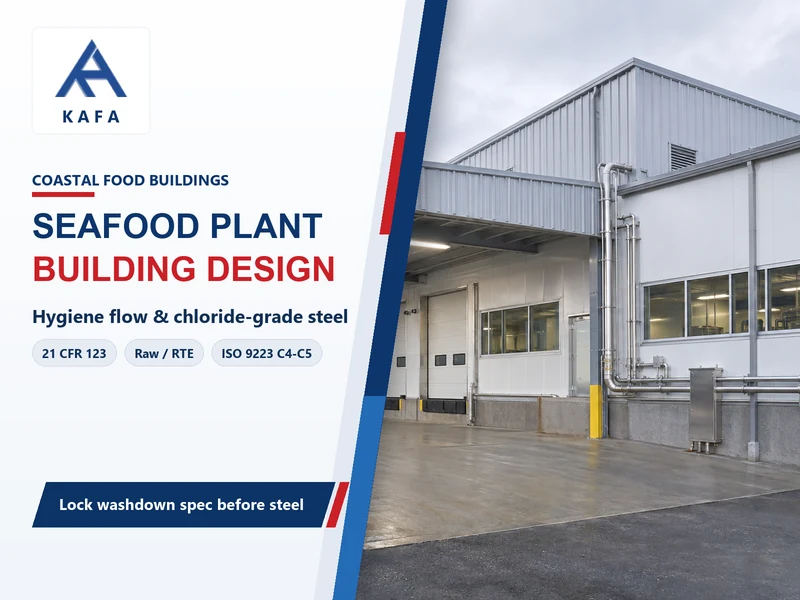
Seafood processing plant design lays out a fish or shellfish facility around the raw material’s spoilage clock, the raw-to-ready-to-eat hygiene split, and the chloride environment that attacks the steel shell. Most US plants follow FDA HACCP rules in 21 CFR Part 123; catfish fall under USDA FSIS inspection. The species and product mix fix the flow and zone boundaries first, and drainage, corrosion protection, and the building brief follow from those choices.
What spoilage clocks shape seafood processing plant design?
The spoilage clock of seafood raw material sets the receiving and staging design before any wall is drawn, because histamine and microbial growth start at capture, not at the plant gate. A general food factory can often hold chilled raw material for a shift; scombroid and other fresh-fish intake has far less margin.
The clearest case is scombroid toxin-forming species. Under 21 CFR 123.3(m), these include tuna, bluefish, and mahi mahi, plus other species. In them, significant histamine forms by decarboxylation of free histidine. That happens when the fish, after capture, is held at temperatures permitting mesophilic bacteria to grow. The hazard is chemical, not just microbial: cooking does not remove histamine once it has formed. The regulation therefore lists decomposition in scombroid species as a hazard the HACCP plan must address (21 CFR 123.6(c)(1)(vi)).
That definition moves the design boundary upstream. The time-temperature history starts at capture and carries through landing, so the receiving dock, the ice supply, and the chilled staging area must not add to it. Assume a plant lands 10 t of tuna per hour and holds it in chilled staging before filleting. Suppose the staging room pulls the fish to a chilled core temperature only after a 4-hour warm queue. The histamine clock has already run during that queue. The same 10 t/h moved through a dock that ices or uses refrigerated seawater immediately slows the clock. The input that matters is the warm-hold time. The FDA Fish and Fishery Products Hazards and Controls Guidance treats scombrotoxin formation as a time-and-temperature control problem (Chapter 7).
A second clock is enzymatic and microbial spoilage, which softens flesh and raises bacterial load even in non-scombroid species. This is why chilled staging and short raw-to-process distances recur in seafood layouts. The cold store itself is a separate building decision; its envelope and refrigeration are covered in refrigerated warehouse design, not here.
How do species and product mix set the layout?
Species and product mix determine a seafood plant’s floor plan, since a filleting line, a shellfish depuration room, and a smoked ready-to-eat line each need different flows and separations.
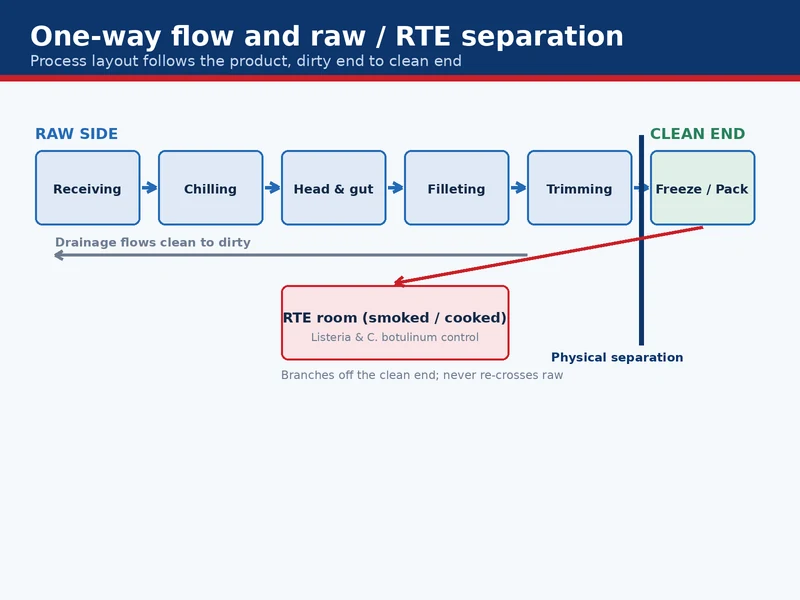
For finfish, the one-way flow runs receiving → chilling → heading and gutting → filleting → trimming → freezing or packing. Each step sheds water, scales, and offal, so the dirty end sits at receiving and the clean end at packing. Any ready-to-eat room branches off the clean end behind a physical separation, never re-crossing the raw side. Filleting yield changes the building load: a low-yield species sends more mass to waste and effluent than to product. For example, take 10 t/h of whole fish at a 35% fillet yield. The product stream is then about 3.5 t/h, and the remaining 6.5 t/h leaves as heads, frames, and offal. Substitute your own species yield into the same split: product = whole fish × yield, non-fillet stream = whole fish × (1 − yield). The non-fillet stream sizes the by-product and solids handling. Wastewater flow and its BOD, COD, TSS, and fat load are set separately, from water use and how much solid material is captured before the drain.
Shellfish add a source-control step that finfish do not have. Under 21 CFR 123.28, molluscan shellfish must come from growing waters approved by a shellfish control authority. Each container carries a shellstock tag, or a bulk shipment travels with a bill of lading carrying the same information. A shellfish plant therefore needs a receiving and tagging area, plus a depuration or wet-storage room where the raw material or product calls for one. These are wet, saline rooms with their own drainage and corrosion demands.
A cooked or hot-smoked ready-to-eat line changes the plan again, because a validated lethality step creates a clean side that must not re-cross the raw side. Cold-smoked product has no such kill step for Listeria, so its control rests on raw material, sanitation, and separation instead. The frozen product path runs to a steel cold storage building; the RTE path runs to a separate high-hygiene room. Mixing the two in one open hall is a layout error that often forces expensive rework later.
Which hygiene zones must a seafood plant separate?
A seafood plant must separate raw handling from ready-to-eat handling into distinct hygiene zones, with the boundary set by the product’s pathogen risk and the direction of drainage and airflow. The layout here uses a physical split; 21 CFR 117.20 also accepts separation by location, time, airflow, or enclosed systems where those control the same crossings.
The driver is the hazard list. Raw seafood can carry Listeria monocytogenes, and the organism persists in wet processing environments. In smoked fishery products, Clostridium botulinum is the concern the process must control. Under 21 CFR 123.16, processors of smoked and smoke-flavored fishery products must show in their HACCP plans how they control C. botulinum toxin formation. Products already covered by 21 CFR Part 113 or 114 are excepted. The control must hold for at least the shelf life of the product under normal and moderate abuse conditions. That control lives in the RTE zone, separated from raw traffic.
The eight sanitation monitoring areas in 21 CFR 123.11(b) translate directly into building decisions. They cover water and ice safety, the condition of food contact surfaces, and cross-contamination prevention. They also cover hand-wash and toilet facilities, protection from adulteration, toxic compound storage, employee health, and pest exclusion. Several are fixed at the shell stage. Pest exclusion and cross-contamination prevention depend on sealed envelopes, separated entries, and drainage that flows from clean to dirty.
| Zone | Product state | Key control | Building implication |
|---|---|---|---|
| Receiving and raw storage | Raw, unprocessed | Time-temperature hold | Insulated dock, chilled staging, drainage away from clean side |
| Raw processing | Raw, being cut | Cross-contamination prevention | Washdown floors, solids capture, physical separation from RTE |
| Ready-to-eat handling | Smoked, cooked, RTE | Listeria and C. botulinum control | Separate room, dedicated entry, airflow toward lower-risk areas |
| Freezing and cold store | Frozen | Temperature holding | Insulated envelope, vapor control, separate cold-chain boundary |
The envelope that holds these zones is an insulated, sealed shell. Condensation at thermal bridges undermines the same hygiene boundary, so metal building insulation and a continuous vapor barrier are hygiene decisions.
Why does chloride attack the steel shell?
Chloride attacks a seafood plant’s steel shell from two directions at once: coastal atmosphere outside and salt-bearing washdown water inside, so the coating system must be specified for both. A shell rated for one exposure can still fail at the other.
Outside, the site’s atmospheric corrosivity sets the baseline. ISO 9223:2012 classifies atmospheric environments into corrosivity categories by the first-year corrosion rate of standard specimens. A coastal seafood site often sits in a high corrosivity category, which pushes the coating and fastener specification up.
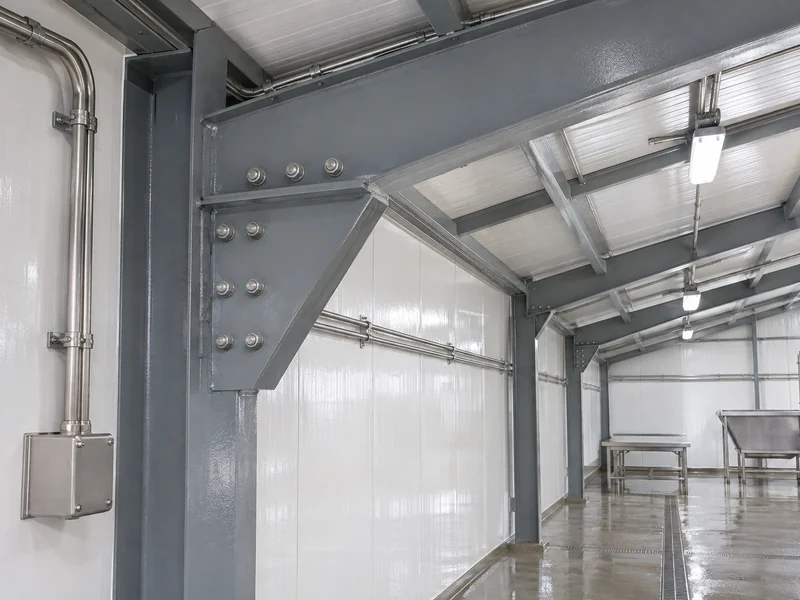
Inside, the exposure is different in kind. Brine, seawater, and chlorine-based sanitizers wet the frame, purlins, and fasteners during washdown. ISO 9223 rates atmosphere only; it does not certify a coating against chemical washdown. Resistance to the actual sanitizer must be verified against its concentration, temperature, and contact time. A coastal atmospheric rating alone does not prove the interior will survive daily chloride washdown.
| ISO 9223 category | Typical atmosphere | Shell implication |
|---|---|---|
| C2 | Low; rural areas or unheated interiors where condensation may occur | Standard coating often adequate |
| C3 | Medium, urban or light coastal | Upgraded coating, attention to fasteners |
| C4 | High, industrial or coastal | High-durability coating, corrosion-resistant fasteners |
| C5 | Very high, marine or heavy industrial | High-durability system, sealed details, inspection access |
| CX | Extreme, offshore or tropical marine | Specialist system, verified against site data |
Table note: categories follow ISO 9223:2012 atmospheric classification; they do not rate resistance to chloride washdown chemicals, which is verified separately against the sanitizer used.
The failure pattern is predictable. When a coastal atmospheric rating is assumed to cover the interior too, the first rust appears at washdown-wetted purlins, girt connections, and fastener heads. The choice between galvanizing and painting steel and the grade of metal building components should follow the wetted interior exposure, with the atmospheric category as the floor. If a plant is inland, dry-processing only, and away from coastal salt, a standard painted shell with sound drainage is usually sufficient. The upgraded system earns its cost when chloride washdown or a marine atmosphere is present.
What water, ice, and drainage loads must floors take?
Floors and drainage in a seafood plant must carry meltwater, washdown water, and solids at peak simultaneous flow, not at the daily average, because ice melt and washdown cycles arrive in bursts. Three streams converge on the floor. Ice melt from staging and glazing adds continuous cold water. Washdown adds hot, chemically loaded water in short pulses. Processing adds scales, offal, and solids that can block a drain sized for liquid only. The peak is the sum of these streams when a washdown cycle overlaps heavy ice melt, not the 24-hour mean.
Suppose a 2,000 m² processing hall is washed down with 5 L/m² per cycle. The cycle completes in 20 minutes, while ice melt adds 0.5 L/s continuously. The washdown flow is 2,000 × 5 ÷ 1,200 ≈ 8.3 L/s, and the combined cycle-average flow is about 8.8 L/s. Branch drains are sized for the maximum simultaneous discharge, including hose pulses and equipment dumps, which run higher than this average. A drain sized for the daily average would miss even the cycle average by a wide margin. The floor must slope toward the drains to make that flow move. A common design target for the drainage slope is a fall of roughly 1:100 to 1:50, verified against the chosen floor finish and local code rather than assumed as a universal value.
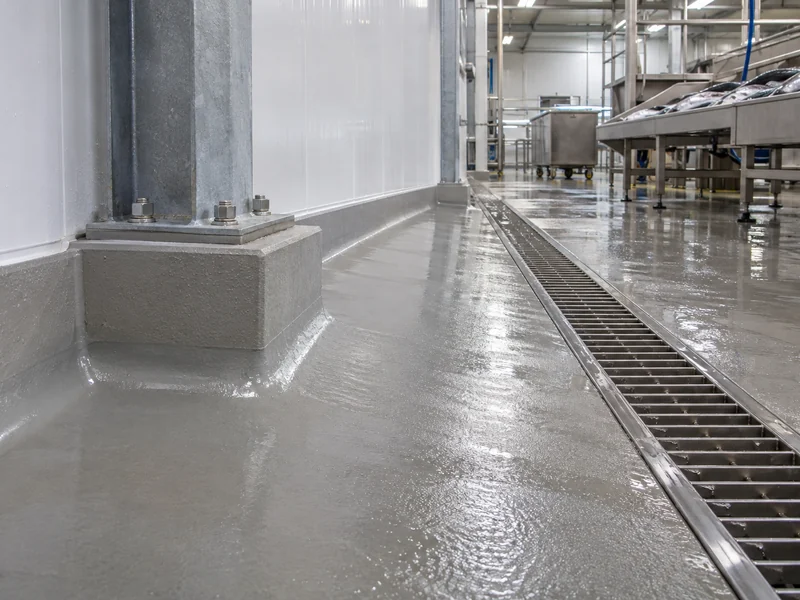
The slab and the falls are structural decisions made before the pour. The concrete slab for a steel building and the foundation carry the falls, the drain positions, and the thickened edges at the wall base. The failure mode here is wall-base ponding. Where the slab falls away from the drain or the wall-base detail is flat, saline water sits at the frame line. It then corrodes the base plate from below. Effluent is also saline and high in organic load, so its treatment is a separate process decision the client procures. The building’s job is to capture and convey it without ponding.
Which rules govern a seafood processing plant?
A seafood processing plant follows FDA HACCP rules in 21 CFR Part 123 for most species, but catfish (Siluriformes) follow mandatory USDA FSIS inspection under the Federal Meat Inspection Act. The species list, not the building type, decides the path.
For most fish and shellfish, 21 CFR Part 123 requires every processor to run a hazard analysis and to implement a written HACCP plan whenever that analysis finds a hazard reasonably likely to occur. Sanitation monitoring, corrections, and records under 123.11 are mandatory; a written SSOP is recommended. Importers of product entering the United States must additionally verify their foreign suppliers under 21 CFR 123.12. The cGMP baseline in 21 CFR Part 117 applies underneath. This is a HACCP-based system: the plant owns the plan and the records, and FDA inspects against it. It is not the continuous carcass-by-carcass inspection model used for red meat and poultry.
Catfish are the exception. Through the 2008 and 2014 Farm Bills, FSIS inspects Siluriformes under the Federal Meat Inspection Act. The mandatory inspection rules sit in 9 CFR Subchapter F, Parts 530–561, and since a 2017 FSIS rule inspectors cover Siluriformes slaughter at least once per production shift rather than continuously. A catfish plant therefore needs the facilities and inspection access that a FSIS establishment requires. A generic seafood HACCP plant does not. Confusing the two paths is a design-stage error that surfaces at approval.
For plants exporting to the European Union, Regulation (EC) No 853/2004 sets specific hygiene rules for food of animal origin, including fishery products. It requires establishment approval. The US voluntary NOAA Seafood Inspection Program offers fee-based inspection and grading that some buyers request. It is a commercial program that sits alongside the FDA or FSIS path. The regulatory path belongs in the seafood processing plant design brief before the layout is fixed. It changes the rooms, the entries, and the inspection access the shell must provide.
What belongs in the seafood plant building brief?
A seafood plant building brief should lock the species and product mix, the raw/RTE zone split, and the chloride exposure class before the steel is ordered. These fix the slab, drainage, and coating decisions that are costly to change later. Of these, the species and product mix and the raw/RTE split are confirmed first. They set the flow, the zone boundaries, and the drainage layout. Those are the most expensive things to move after the slab is poured. The chloride exposure class is assessed early, but its coating detail can be refined against the sanitizer data without re-pouring the floor. Sound seafood processing plant design converges these inputs before fabrication.
When a washdown-wetted frame is specified from the atmospheric category alone, the corrective work usually lands on fasteners and connections after handover. That is far costlier than specifying them correctly at order. The brief below is what we ask a seafood client to confirm before we release a steel building design, so the shell matches the process.
- Species and product mix: The list of species and the split between fresh/frozen, smoked RTE, and shellfish, because each fixes a different flow and zone.
- Throughput and yield: Whole-fish intake per hour and the expected fillet yield, because the non-fillet stream sizes by-product and solids handling.
- Raw/RTE zone split: The physical boundary and the product path, because it sets entries, airflow direction, and separate drains.
- Temperature program: Staging and cold-store temperatures and the warm-hold limit at receiving, because it sets the dock and insulation.
- Freezing handoff: Which rooms freeze product (blast or IQF) and which only hold frozen stock, with the transfer door, floor level, and roof loads for each, because the two are often bought from different suppliers.
- Chloride exposure class: The coastal atmospheric category and the interior sanitizer chemistry, because they set the coating and fastener grade.
- Water, ice, and drainage peak: Washdown volume per cycle, cycle time, and ice-melt rate, because they set the drain capacity and floor falls.
- Regulatory path: FDA HACCP, FSIS catfish, or EU approval, because it changes the rooms and inspection access.
- Site and slab constraints: Soil, slab falls, and wall-base details, because they fix the foundation and drainage before the pour.
If your mix includes a smoked RTE line or a marine-site shell, the next step is to fix the zone split and the chloride class before the frame is ordered, and bring both into your steel industrial buildings enquiry. Within our supply scope, we check the shell’s openings, drainage falls, and coating exposure against your process data; food-safety validation stays with your HACCP team.
FAQ
What is seafood processing plant design?
The layout and building specification of a fish or shellfish plant, organized around the raw material’s spoilage clock, the raw-to-RTE hygiene split, and the chloride environment. The species and product mix set the flow first; the shell, drainage, and coatings follow.
Does a seafood plant need FSIS inspection?
Only for catfish (Siluriformes), which FSIS inspects under the Federal Meat Inspection Act at least once per production shift. Most other seafood follows FDA HACCP rules in 21 CFR Part 123. The species list decides the path, so confirm it before designing the rooms.
Why do seafood floors need larger drains?
Seafood floors carry ice melt, washdown pulses, and solids at the same time. Drains sized for the daily average miss the simultaneous discharge. The floor falls and solids capture are set before the slab is poured.
Can a coastal-rated steel shell handle interior washdown?
Not automatically. ISO 9223 rates atmospheric corrosivity only. Interior chloride washdown is a chemical exposure, so the coating and fasteners must be verified against the sanitizer’s concentration, temperature, and contact time.
What should I confirm before ordering the steel frame?
The species and product mix, the raw/RTE zone split, and the chloride exposure class come first, because they fix the slab, drainage, and coating decisions that are costly to change after the pour. The full brief adds six more inputs, including the freezing handoff; the coating detail can be refined later against sanitizer data.