




Spray foam insulation will not rust a metal building when it is applied correctly. Rust appears when moisture gets trapped against the steel, not because of the foam itself. A properly adhered closed-cell layer keeps that moisture away from the panel, which reframes most of the worry about spraying polyurethane foam onto steel.
The decisions that matter for a metal building are which foam to use, open-cell or closed-cell, how thick to spray it, and who installs it. The sections below work through each one, from how the foam behaves on steel to what a full job costs. It is one piece of the larger question of how to insulate a metal building.
What Spray Foam Does in a Metal Building
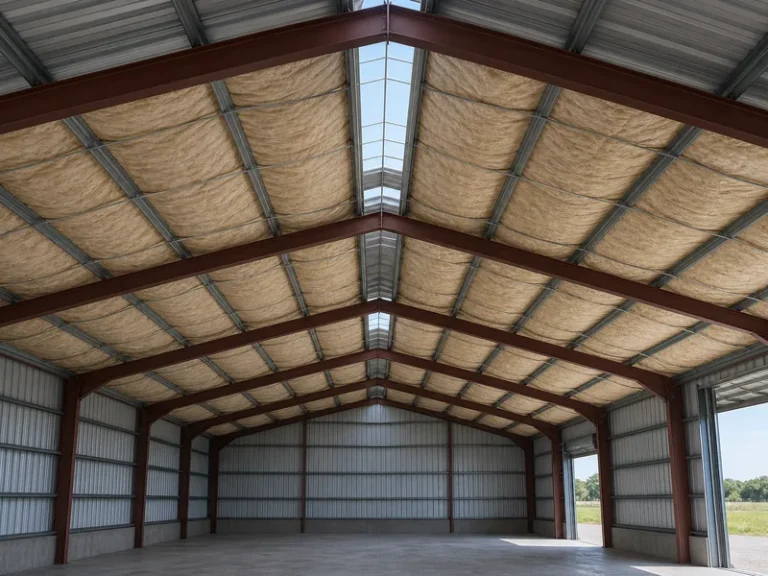
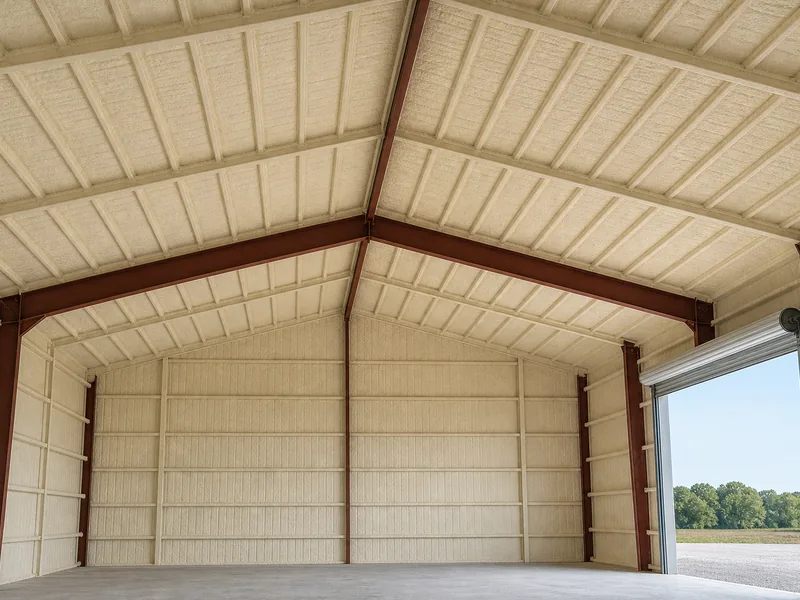
Spray foam insulation is a two-part polyurethane liquid that expands on contact and cures into a continuous layer bonded directly to a metal building’s roof and wall panels. Because it goes on as a liquid, it fills the ribs of corrugated panels and the seams at purlins and girts. It also closes the small gaps where fiberglass blankets sag and leave thermal holes.
Steel is the reason a metal building needs that kind of coverage. Steel conducts heat far more readily than wood, by a common industry comparison roughly 300 to 400 times. Every uninsulated frame member and fastener then becomes a thermal bridge that drains heating and cooling energy. A continuous foam layer slows that path and seals the air leaks that let conditioned air escape.
Among the materials used for metal buildings insulation, spray polyurethane foam is the one that bonds to the steel instead of sitting loosely behind it. That bond is not only a thermal feature. With no air gap between the foam and the panel, interior humidity has nowhere to collect against cold metal. That detail decides whether a steel building stays dry.
Open-Cell vs. Closed-Cell Foam on Steel
Closed-cell spray foam is the usual pick for a metal building’s envelope because it combines high R-value, water resistance, and a built-in vapor retarder in one layer. Open-cell is lighter and cheaper, but better kept to interior partitions. The two products behave differently enough on steel that the choice changes how the wall handles moisture, not just how well it insulates.

| Property | Open-cell SPF | Closed-cell SPF |
|---|---|---|
| R-value per inch | about R-3.5 to R-3.8 | about R-6 to R-7 |
| Density | about 0.5 lb/ft³ | about 2 lb/ft³ |
| Acts as an air barrier | at roughly 3.75 in. and up | at roughly 1 in. and up |
| Acts as a vapor retarder | no, stays vapor-open | yes, at roughly 2 in. and up |
| Water behavior | can absorb and hold moisture | resists water |
| Cost per board foot | lower | higher |
| Best fit on steel | interior walls, sound control | roof and wall envelope |
On the building envelope, where condensation risk lives, closed-cell foam’s water resistance is why it dominates on steel panels. It is also the default for temperature-controlled builds such as insulated metal cold storage. Open-cell foam can suit interior framing or an assembly designed to dry inward. Pressed against a cold panel in a humid, temperature-swung building, though, it can wick moisture toward the steel rather than block it.
Will Spray Foam Rust a Metal Building?
Spray foam does not corrode steel on its own. Rust shows up when moisture is trapped against the panel, which is an installation and product problem, not a property of the foam. Closed-cell foam sprayed in full contact with clean, dry steel seals the panel from interior humid air. The metal never meets the moist air that would otherwise reach its dew point and condense.
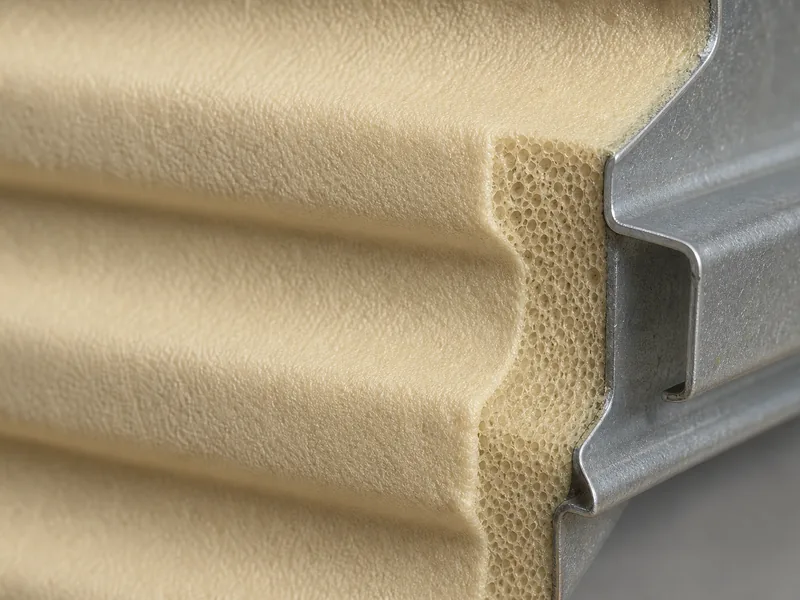
Three installation mistakes account for most rust complaints. A plastic sheet or vapor liner left between the foam and the panel creates an air gap that condenses on the cold metal. Foam covered or enclosed before it has fully cured traps its own off-gassing moisture against the substrate. And a moisture-wicking open-cell foam applied directly to the envelope can hold water against the steel instead of shedding it.
The fixes are mechanical, not chemical. A thin flash coat goes on first, then the substrate is wiped clean and dry. The foam is built up in full-contact passes with no voids, using a product that does not retain water. Because a 2-inch-or-thicker closed-cell layer usually performs as the vapor retarder itself, many steel assemblies skip a separate metal building vapor barrier. Whether yours can depends on your climate zone and wall build-up, so confirm it rather than assume. Beyond the foam, how the wall is vented and how water drains at the base also shape long-term corrosion risk. Treat spray foam as one part of a moisture plan, not a standalone cure.
How Much R-Value (and Thickness) You Need
Thickness, not just foam type, sets the R-value you get. Closed-cell delivers roughly R-6 to R-7 per inch, so 2 inches lands near R-12 to R-13 and 3 inches near R-19. Open-cell reaches the same numbers only at greater thickness, so its lower price per board foot does not always mean a lower price for a given R-value.
Your target R-value depends on climate zone and on whether you are insulating roof or wall, with roofs generally needing more. It helps to know what an R-value of insulation represents across an assembly before you set a number. Published climate-zone targets, like the ENERGY STAR table linked below, are a practical starting reference for U.S. zones. Because steel moves heat so efficiently, a continuous foam layer over the framing matters as much as the nominal R-value on a spec sheet. A high number with gaps at every purlin will underperform a modest number applied without breaks.
What Spray Foam Insulation Costs on a Metal Building
Closed-cell spray foam on a metal building typically runs about $1.50 to $3.50 per square foot of sprayed surface, installed. Thicker passes and roof work sit toward the upper end. Open-cell is often quoted lower per square foot, but the extra thickness it needs to match a given R-value narrows the real saving.
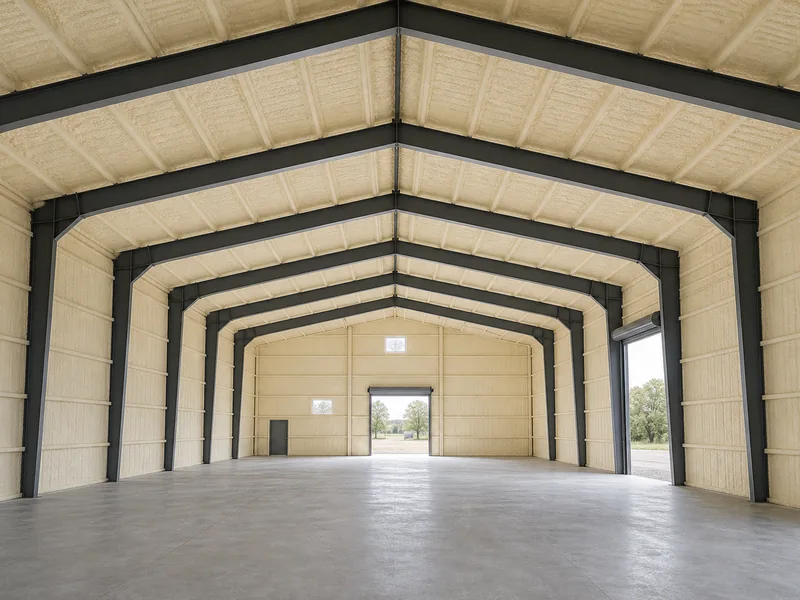
The figure that trips up budgets is area. A 30×50 metal building has roughly 2,100 square feet of wall and roof surface to spray, well above its 1,500-square-foot floor. Two inches of closed-cell foam then lands around $3,150 to $7,350 installed. A quote priced against the floor area will read low, because the foam has to cover the walls and the roof plane, not the slab.
Beyond foam type and thickness, the main cost drivers are sprayed surface area, building height and access, and region. A retrofit around existing framing, lighting, and partitions also runs higher than spraying an open new shell.
What a spray foam quote does and doesn’t include
A spray foam price usually covers the foam material and the labor to apply it. It does not include removing old insulation, interior liner panels or finishes over the foam, the steel building itself, or fixing a wet or oily substrate. Complex access, very thick passes, and tight winter scheduling push the number toward the top of the range.
Installation: Professional vs. DIY, and Surface Prep
Spray foam for a full metal building is a professional job. Consistent thickness, full adhesion, and a clean, dry substrate decide whether the foam insulates or traps moisture. Small DIY kits exist for patching a gap or a doghouse, but they cannot hold even thickness across the surface area of a building.
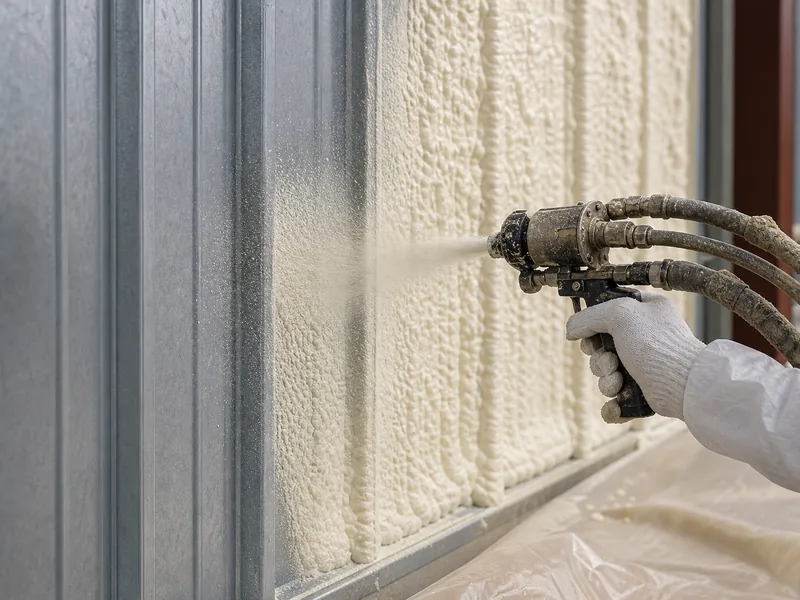
Surface preparation decides the outcome more than any product choice. The steel must be free of dirt, moisture, and the oils or release agents left from rolling, or the foam will not bond. Installers build an even base with a picture-frame or flash technique, then add lifts to the target thickness. On thin panels such as 29-gauge sheet, over-spraying a single pass can warp the metal into visible oil-canning, so the foam goes on in controlled passes. The cure is an exothermic reaction that briefly reaches high core temperatures, so crews respect a maximum pass thickness instead of hitting depth in one shot.
Part of the insulation result is set earlier, during steel building design, when framing, panel selection, and eave details are decided. Thermal bridging and condensation both start at the frame and the panels. As a steel structure manufacturer, Qingdao KAFA Fabrication designs and fabricates the light and heavy steel building itself, under ISO 9001:2015 quality management at its 20,000-square-meter Qingdao facility. The shell then arrives ready for an insulation contractor’s plan, and the foam is applied on site by spray foam specialists, not by the fabricator. If you are still at that stage, contact our team about detailing the building around your insulation plan.
Choosing Spray Foam for Your Metal Building
For most metal buildings, closed-cell spray foam on the roof and walls is the safer envelope choice. Open-cell makes more sense on interior partitions, or where an assembly is built to dry inward. The product decision is rarely the hard part once the moisture behavior is clear.
Decide the target R-value from your climate and from whether you are insulating roof or wall. Then confirm the foam thickness that reaches it, and check the installer on substrate prep and full adhesion. Those two verifications — thickness for performance and adhesion for dryness — matter more than which brand of foam shows up on the truck. Get them right and a steel building stays dry, quiet, and inexpensive to condition for years. Get the adhesion wrong, and no R-value on paper will stop the panels from sweating.
FAQ
How much does it cost to spray foam a 30×50 metal building?
A 30×50 metal building usually costs about $3,150 to $7,350 to spray with 2 inches of closed-cell foam, installed. The number tracks sprayed surface area: roughly 2,100 square feet of walls and roof, not the 1,500-square-foot floor. A quote priced by floor area will read low.
Should you use open-cell or closed-cell spray foam on a metal building?
Closed-cell foam is the better fit for the roof and wall envelope of a steel building, because it resists water and adds a vapor retarder that open-cell does not provide. Open-cell can serve on interior partitions or where a wall needs to dry inward. It only becomes an air barrier at about 3.75 inches, versus roughly 1 inch for closed-cell.
Does spray foam replace a vapor barrier in a metal building?
Closed-cell spray foam at about 2 inches or more usually acts as the vapor retarder on its own, so a separate sheet barrier is often unnecessary. Whether you still need one depends on your climate zone and wall assembly. Confirm the perm rating required for your build instead of assuming the foam covers it.
Can you spray foam an existing metal building?
An existing metal building can be spray foamed from the inside, as long as the panels are accessible, clean, and dry. The retrofit work that adds cost is removing any old insulation or liner first, then protecting wiring and light fixtures before the crew sprays.
Will spray foam cause condensation behind the panels?
Properly applied closed-cell foam prevents condensation rather than causing it, because a fully adhered layer leaves no air gap where interior humidity can reach the cold steel. The failures trace back to gaps left by a plastic liner, foam enclosed before it cured, or a moisture-wicking open-cell foam pressed against the panel.
Further Reading
- U.S. Department of Energy — Insulation Materials — DOE Energy Saver. Background on how open-cell and closed-cell foam differ in R-value and how thermal drift changes long-term performance.
- ENERGY STAR — Recommended Home Insulation R-Values — EPA / ENERGY STAR. Climate-zone R-value targets to size your foam thickness against.
- Spray Polyurethane Foam Alliance (SPFA) — Spray foam industry association. Installer certification and application standards behind the professional-installation guidance above.