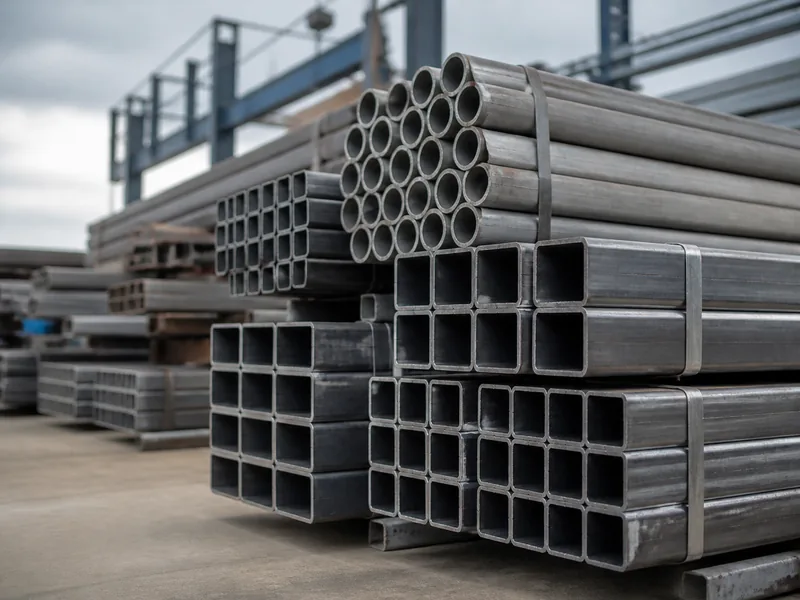
A tube steel structure is a steel frame built from hollow structural sections (HSS)—the closed square, rectangular, and round tubes that carry load as columns, beams, braces, and truss members. In the steel trade, “tube steel” is simply the older North American name for HSS, once abbreviated TS, so the two terms point at the same family of closed sections. This guide treats tube steel as a structural member: what the closed section does, the shapes and grades it comes in, and where it frames a building. It does not cover the high-rise “tube system” used in tall towers, and it does not price tube-frame against red-iron buildings—that buyer-level comparison sits with tubular building systems.
What a Tube Steel Structure Actually Means
Tube steel structure refers to framing made from hollow structural sections rather than open, rolled shapes like the I-beam. The defining feature is the closed cross-section: a square, rectangular, or round tube with a continuous wall, as opposed to the exposed flanges and web of a W-shape. That closed wall is what gives tube steel its structural character, and it is what sets HSS apart from the open shapes it competes with.
The phrase trips people up because it carries three meanings. As a member, tube steel is the HSS column or brace described here. As a tall-building term, a “tube structure” is a lateral system where the perimeter acts like a hollow cantilever—a separate subject. As a sales category, a “tube building” often means a light tube-frame carport or garage kit, which is a packaged product rather than a section type. The rest of this article stays on the first meaning.
Why a Closed Tube Section Behaves Differently
A closed tube resists twisting and buckling far better than an open shape of the same weight, which is the main reason engineers choose it. Torsion runs around a continuous wall with nowhere to unwind, so a hollow section carries twisting loads several times more stiffly than a comparable open profile—useful for spandrel beams, cantilevers, and any member loaded off its center.
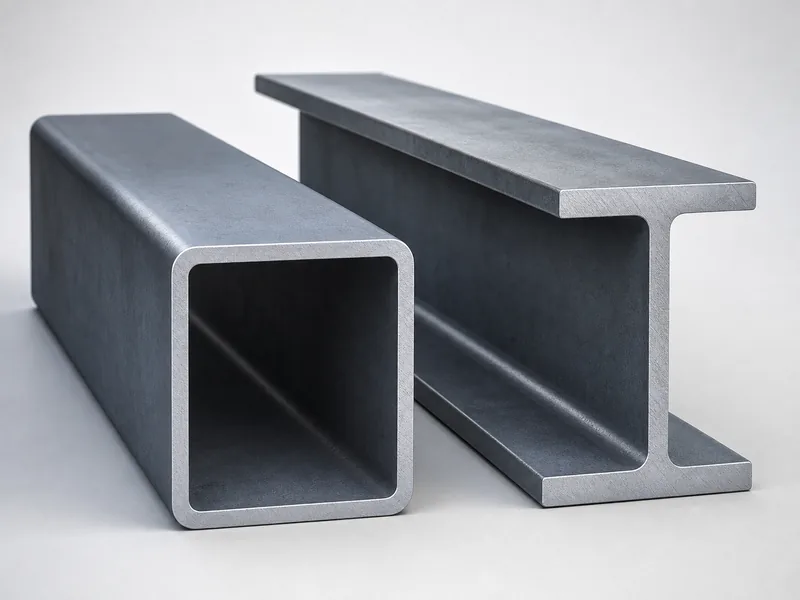
The closed shape also helps in compression. A tube has a high radius of gyration about both axes at once, so it braces itself almost equally in every direction and makes an efficient column. An I-section, by contrast, is strong about one axis and weaker about the other. On top of that, a rectangular HSS exposes about a third less surface area than an open section of similar capacity, which trims the paint, galvanizing, or fire coating a project has to buy and maintain. The catch shows up at the joints, where a sealed wall you cannot reach inside changes how the member is connected—covered further down.
Square, Rectangular, and Round HSS — and Where Each Fits
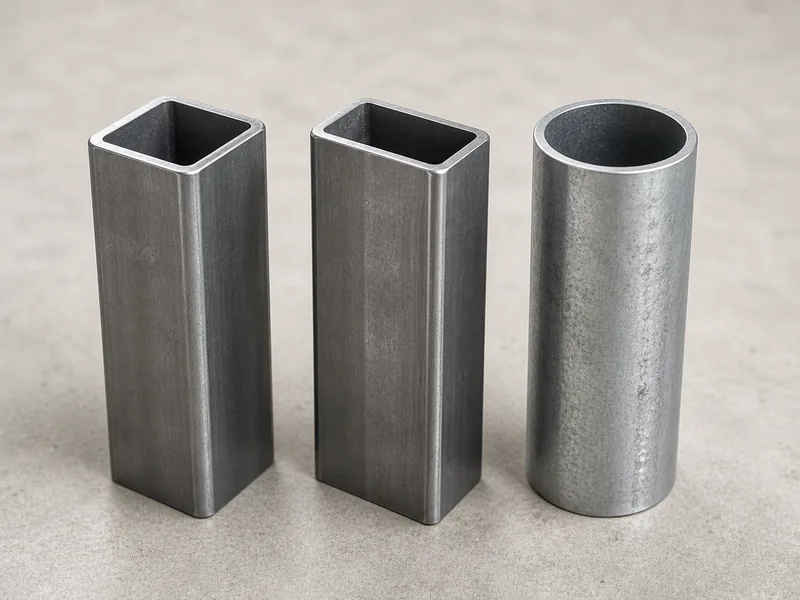
HSS comes in three working shapes—square, rectangular, and round—and each leans toward a different structural job.
Square (SHS)
Square tube carries load evenly on both axes, so it makes a clean, predictable column or bracing member. The flat faces are straightforward to lay out, cut, and weld or bolt to, which is why square HSS is the default where members frame into one another at right angles.
Rectangular (RHS)
Rectangular tube puts more depth in one direction, so it behaves more like a beam when the load is mostly bending in a known plane. It suits headers, mezzanine beams, and wall framing where one axis clearly governs.
Round (CHS)
Round tube spreads stress evenly around its wall and handles multidirectional and torsional load well, on top of reading cleanly as exposed architectural steel. Round sizes tend to track standard pipe dimensions, so it pays to specify a widely produced diameter and wall rather than an unusual one a mill rarely rolls.
Standards and Steel Grades for Structural Tube
Most structural tube in North America is made to ASTM A500, with A1085, A53, and A847 covering tighter-tolerance, pipe, and weathering needs. A500 is the cold-formed, welded carbon-steel spec that most square, rectangular, and round HSS is ordered to, and it is graded A, B, and C by strength. A500 Grade B is the common workhorse, with a minimum yield of 46 ksi and a minimum tensile strength of 58 ksi per ASTM A500 Grade B. Grade C carries a higher minimum yield where the design calls for it.
| Spec | What it covers | When you reach for it |
|---|---|---|
| ASTM A500 (Gr B/C) | Cold-formed welded HSS in square, rectangular, round | The default for building framing |
| ASTM A1085 | HSS with tighter wall and tolerance control | When you want predictable, less conservative design |
| ASTM A53 | Pipe that doubles as a structural round | Round members that also carry fluid or are sourced as pipe |
| ASTM A847 | Weathering, atmospheric-corrosion-resistant HSS | Exposed members meant to patina instead of paint |
Design itself follows AISC 360, and AISC publishes HSS-specific guidance for connections and for torsion; the coefficients and detailing rules belong to those documents, not to a product page. For selection, the useful takeaway is that the grade fixes strength and tolerance, while the spec you cite tells the mill and the detailer how the section will actually behave.
Where Tube Steel Frames a Building
Inside a steel building, tube members tend to appear as columns, truss chords and webs, bracing, mezzanine beams, and exposed framing. A column that has to stand free in a room, a brace that takes load from several directions, or a truss meant to be seen all favor the closed section. The main rigid or portal frame usually still carries the primary span, with tube members working around it rather than replacing it. Tube steel also turns up at a smaller scale—handrails, guards, door frames, and edge members—because the same wall that resists twist also shrugs off knocks.
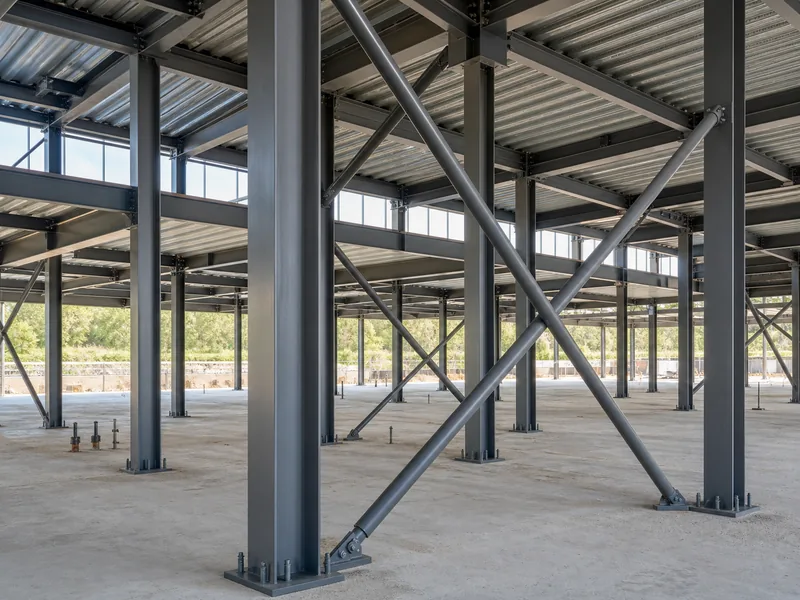
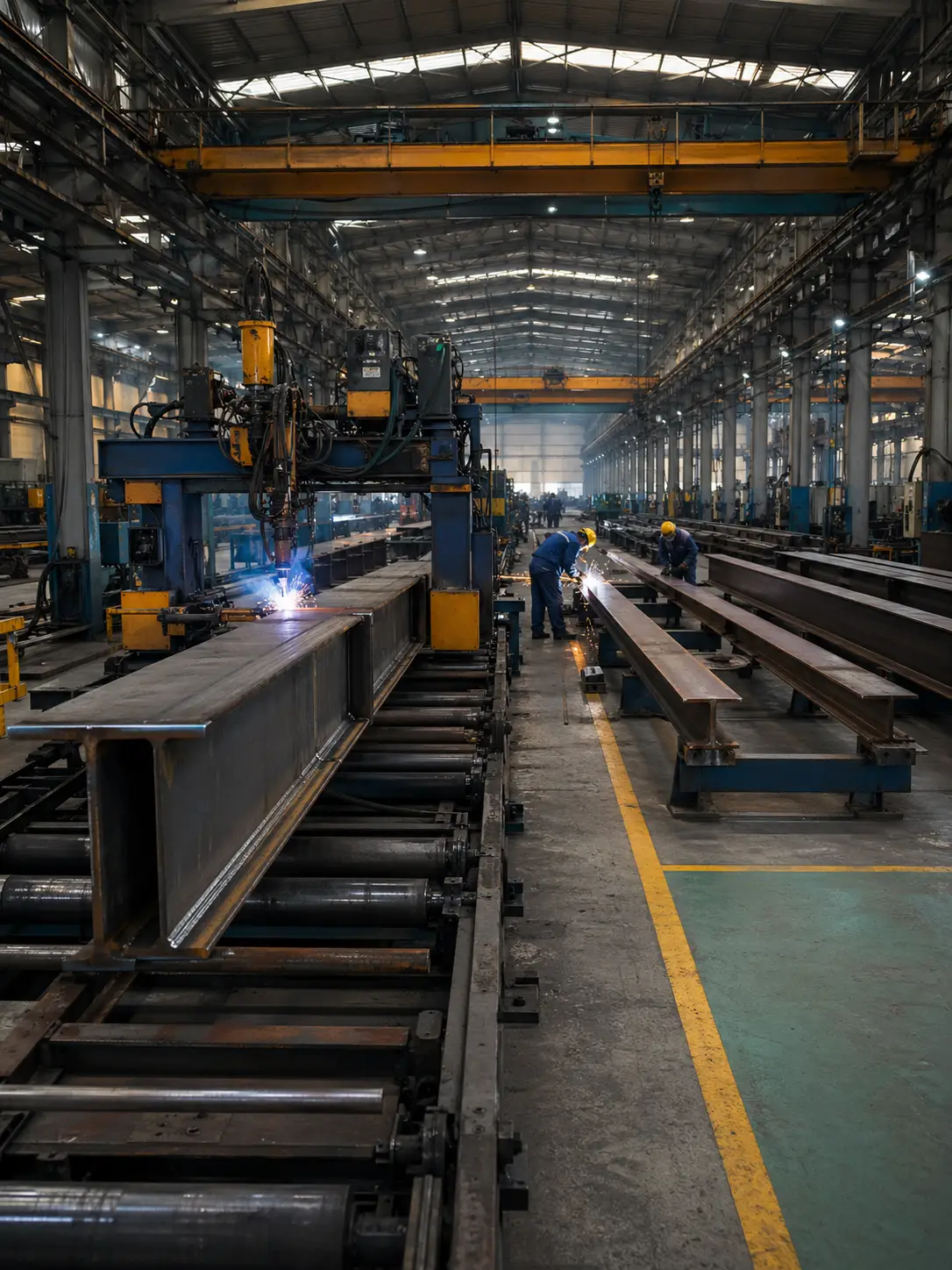
The closed section sits beside the other metal building components—the purlins, girts, and cladding that complete the frame—rather than replacing them. As a fabricator, the box-section and H-beam lines we run at our Qingdao plant cut, weld, and finish closed members to the same shop drawings as the rest of the frame. That keeps the tube work in step with the connections and the wider steel building design. Heavy non-building uses—machine frames, towers, trailers—draw on the same sections but fall outside what a building owner has to weigh.
Tube vs Open Sections: When to Reach for HSS
Reach for tube steel when torsion, multidirectional load, exposure, or a clean column governs; reach for an open I-section when long-span bending or simple bolted connections matter more. For the same weight of steel, an I-beam puts its material out at the flanges and resists straight bending more efficiently. That is why long spans and heavy roof loads often stay with rolled shapes—the logic behind an i-beam building or a red-iron frame.
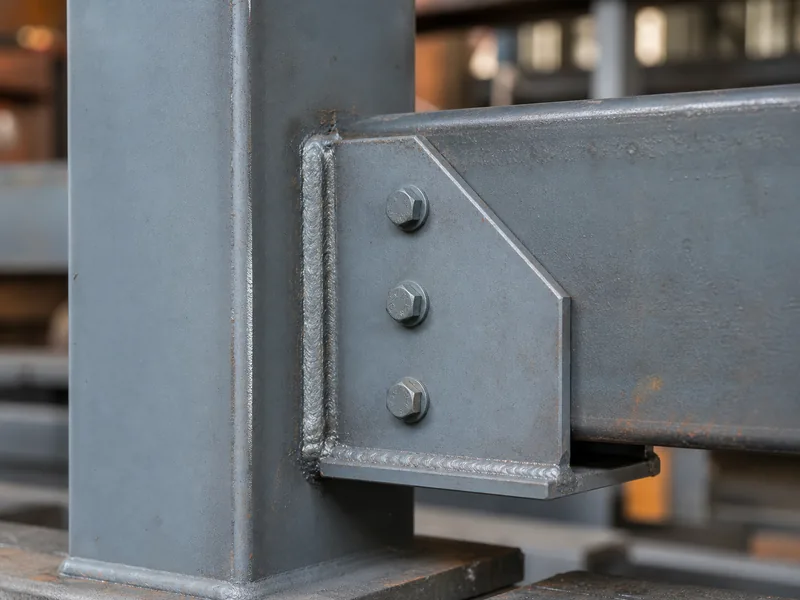
HSS earns back ground on torsion, on biaxial columns, on exposed steel, and on coating cost. Where it asks for more care is the connection. You cannot reach inside a sealed tube to back-weld or tighten a bolt, so HSS joints lean on gusset plates, slotted-and-welded details, or through-plates, and round-to-round joints need a saddle cut shaped to the matching tube. Those details have to be decided before the steel is cut, which is why tube framing rewards early coordination with whoever handles the steel structure connections. Choosing between systems at the building level—cost per square foot, kit sizing, erection crews—is a separate decision and is not covered here.
Conclusion
Selecting tube steel works best as an ordered set of choices rather than a single call. Start with the member’s job and dominant load: bending in one plane points toward an open section or a deep rectangular tube, while twist, biaxial compression, or an exposed column points toward HSS. Settle the shape next—square for square-framed connections, rectangular where one axis governs, round for multidirectional or architectural members. Then fix the grade and spec: A500 Grade B as the baseline, A847 where the steel stays exposed, A1085 where tighter tolerances earn less conservative design. Last, confirm the connections can actually be made on a closed section before the cut list is released, because a tube that is easy to size can still be awkward to join. If you are speccing closed sections for a frame, our shop can request a quote against your drawings and member schedule.
FAQ
Is tube steel the same as HSS?
Tube steel and HSS are the same family of closed sections under two names. “Tube steel,” once abbreviated TS, is the older North American term; the industry standardized on “hollow structural section” so the language matched Canadian, European, and Asian usage.
Is square or round tube steel stronger?
Neither is stronger outright—it depends on the load. Square HSS distributes load evenly and is easier to connect at right angles, while round HSS handles twisting and multidirectional load better and reads more cleanly when left exposed.
What ASTM grade is structural tube steel?
Most structural tube is ordered to ASTM A500, usually Grade B at a 46 ksi minimum yield or the higher Grade C. A1085 is specified where tighter tolerances help the design, and A847 where weathering steel will stay exposed.
Can you weld and connect tube steel?
Tube steel welds and bolts readily, but the closed wall changes the detailing. Connections rely on gusset or through-plates and, for round-to-round joints, saddle-cut profiles, and the inside face cannot be coated once it is sealed—so the joints are settled before fabrication.
Is a “tube structure” the same as a skyscraper tube system?
No—they share a name but not a meaning. A skyscraper “tube system” is a lateral-load layout where the building perimeter works as a hollow cantilever, whereas tube steel here means individual HSS members used to frame a building.
Further Reading
- Atlas Tube — Hollow Structural Sections (HSS) — Manufacturer product overview for square, rectangular, and round HSS shapes and structural uses; backs the shape and section-language points above.
- Atlas Tube — HSS vs. TS: Understanding Steel Section Terminology — Manufacturer note on why “tube steel” (TS) became HSS, useful for the terminology used here.
- STRUCTURE Magazine — Round HSS Essentials — Engineering article on round HSS selection, connection, and detailing considerations.