




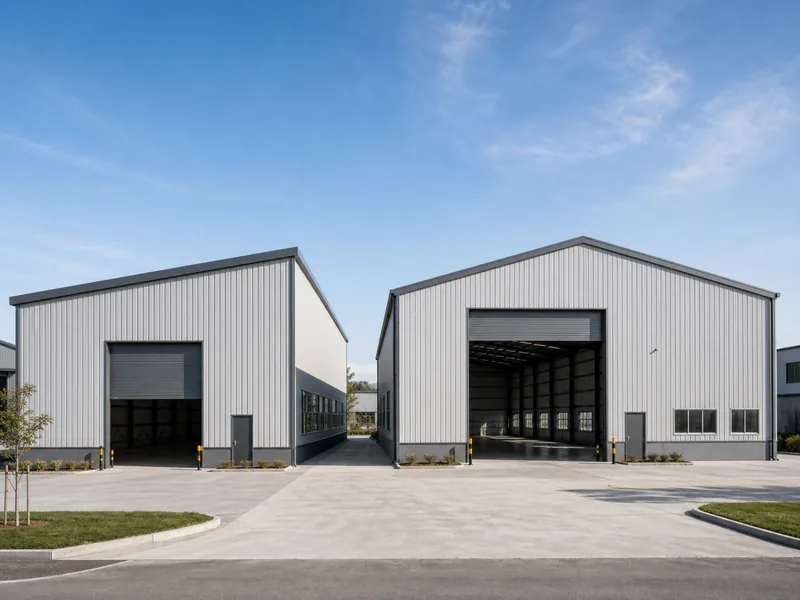
Most single-story steel buildings start with one framing choice: portal frame or truss. Neither system wins in every case. Span, roof load, clear height, site access, and the trade-off between steel tonnage and erection hours decide which one fits. Member-by-member force calculations, foundation design, welding procedures, purlins, and cladding come after the framing system is set.
The portal-versus-truss choice belongs in steel building design, because the right answer depends on span, load, height, and enclosure requirements.
Portal Frame and Truss: Two Ways Steel Carries Load
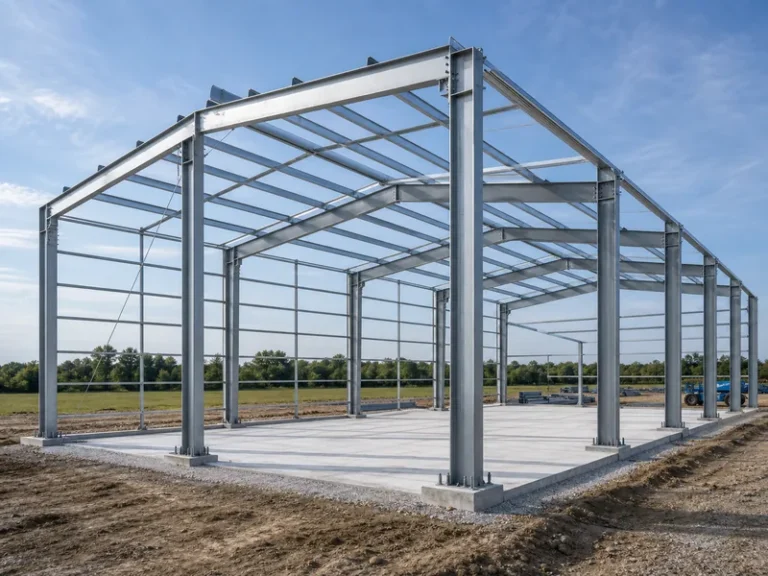
A portal frame and a truss solve the same problem of spanning open space, but they do it through opposite load paths. A portal frame ties columns and rafters together with rigid, moment-resisting connections. The structure then carries load by bending and passes lateral force through stiff joints, usually thickened with a haunch at the eaves where the moment peaks. A truss takes the span apart instead, splitting it into a triangulated web of members joined at nodes idealized as pins, so each member works mainly in axial tension or compression with little bending.
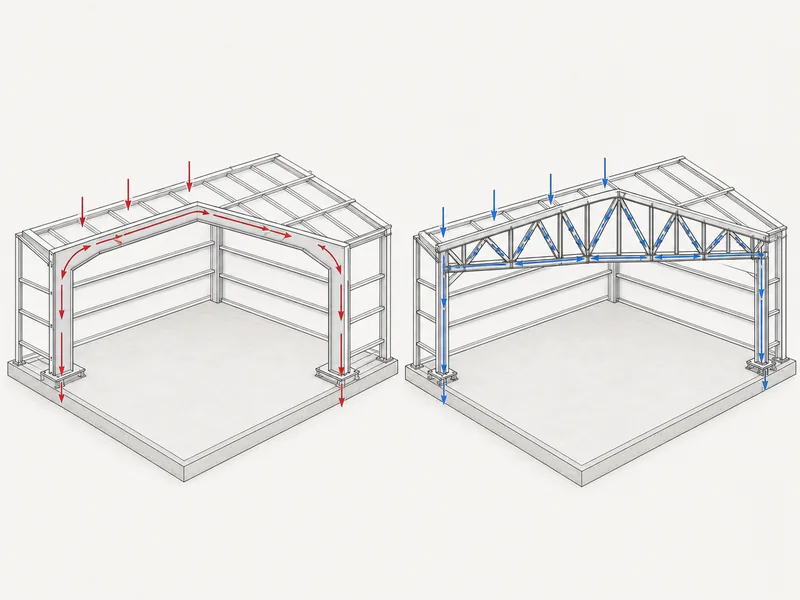
That contrast in load path is the root of every trade-off that follows. A bending frame concentrates steel where the moment is highest and leans on connection stiffness to stay rigid. An axial truss spreads the same force through many lighter members and through its overall depth, which is why a deep truss can look almost delicate member by member yet still cross a wide span. Once you can see which system is bending and which is pulling and pushing, its span, weight, and cost behavior stops looking arbitrary and starts following from that one decision.
The Span Where the Choice Actually Flips
Cost economy between the two systems flips with span, which is why “trusses are lighter” and “portal frames are cheaper” are both only half true. For single spans in roughly the 18 to 36 meter range, about 60 to 120 feet, under standard single-story loading, a portal frame is usually the most economical option and the quickest to erect. Past that band the picture changes. Trusses turn competitive from around 30 meters and pull clearly ahead on long, column-free spans above roughly 60 meters, where a frame would need uneconomically deep rafters to hold its shape.
The practical ceiling for a portal frame is not a fixed figure. Published sources put it anywhere from about 40 to 60 meters, because the real limit depends on load intensity, frame spacing, and how tightly deflection has to be controlled. Serviceability limits in the adopted building code often govern long-span roof members. Some IBC roof cases use a limit such as L/240, but the exact value depends on the ceiling condition, load case, and local jurisdiction. Holding that limit on a long bending span means adding section depth and weight. The economics tip for a structural reason: a long-span frame controls deflection by growing its rafter sections, so steel weight climbs steeply with span, while a truss gains the same stiffness by adding depth through light web members and avoids most of that penalty.
Loading shifts those bands more than any single span figure suggests. A heavy snow region, a crane hanging off the structure, or wide bay spacing all work the rafter harder and bring a portal frame to its practical limit at a shorter span, while a lightly loaded long roof lets a truss pay off earlier. Treat the meter ranges as a starting band tied to standard loading, then move them with the real load case before committing to either system.
| Decision variable | Portal frame | Steel truss |
|---|---|---|
| Most economical span | ~18–36 m (60–120 ft) | ~30 m and above |
| Long-span / column-free | Limited; sections grow fast | Strong above ~60 m |
| Steel tonnage on long spans | Higher | Often lower |
| Erection speed | Faster, fewer pieces | Slower, more joints |
| Clear height under roof | Open soffit | Web members intrude |
Cost and Build Speed: Steel Tonnage vs Site Hours
“Less steel” and “lower total cost” are not the same line item, and the gap between them is where budgets usually slip. On long spans a truss generally wins on material. Some industry sources cite a tonnage saving in the order of 30 to 40 percent against an equivalent frame under long-span, standard-load assumptions, though the actual saving depends on load and geometry instead of holding at any headline percentage. One thesis-style cost study of portal frames against truss systems found truss systems became more cost-effective beyond roughly 30 meters under its modeled spans, heights, and frame spacing, which lines up with the weight argument.
The frame earns it back on labor. It has fewer pieces, simpler connections, and goes up fast, while a truss trades that speed for many node connections, more alignment work, and more lifting and high-level assembly. On a tight programme that site-hours difference is the part people underestimate: the tonnage saving shows up in the steel quote, then the saving can be offset by shop joint work, crane time, and erection labor. Foundation reactions differ between the two systems and can shift the final comparison as well, though foundation design itself is a separate check. To compare the two honestly, hold a single budget basis, fabricated and erected instead of bare tonnage, and price both against the same span, loads, and bay spacing before you read off a winner.
Depending on panel size, route limits, and site access, a truss can be split into shop-built panels that the crew bolts together on site, whereas a long-span frame can mean large, heavy rafter sections that push up transport and craneage more than fabrication. Where road or site access is the real constraint, that handling difference can outweigh a modest tonnage gap on paper.
Matching Structure to Load and Use
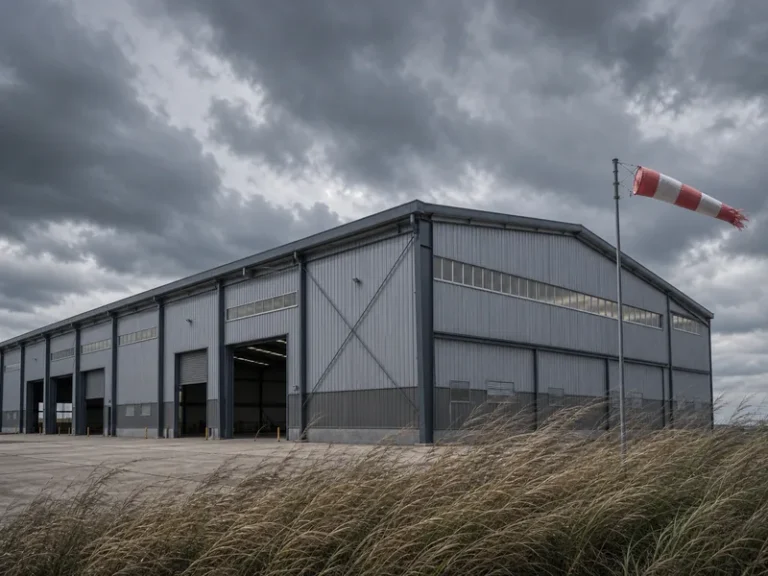
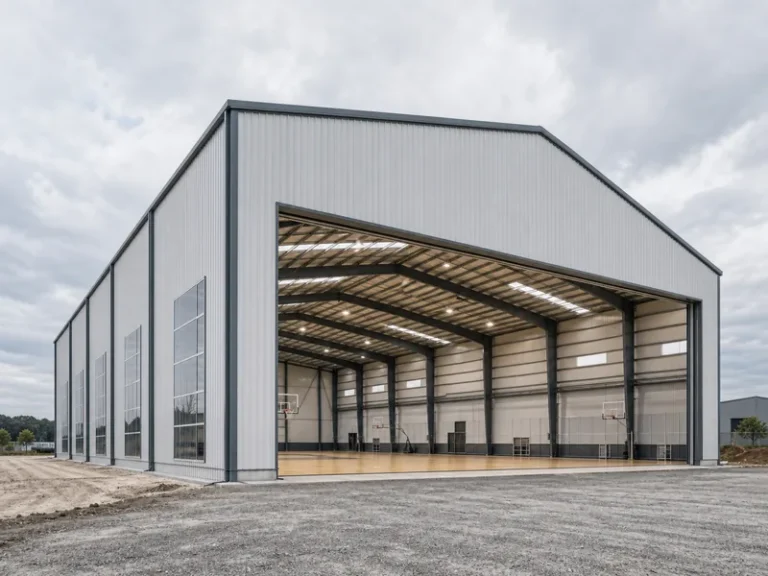
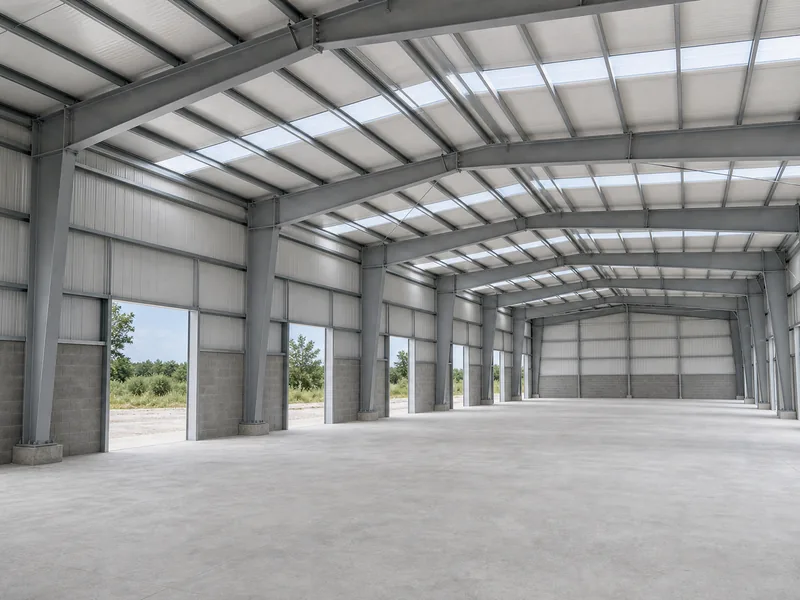
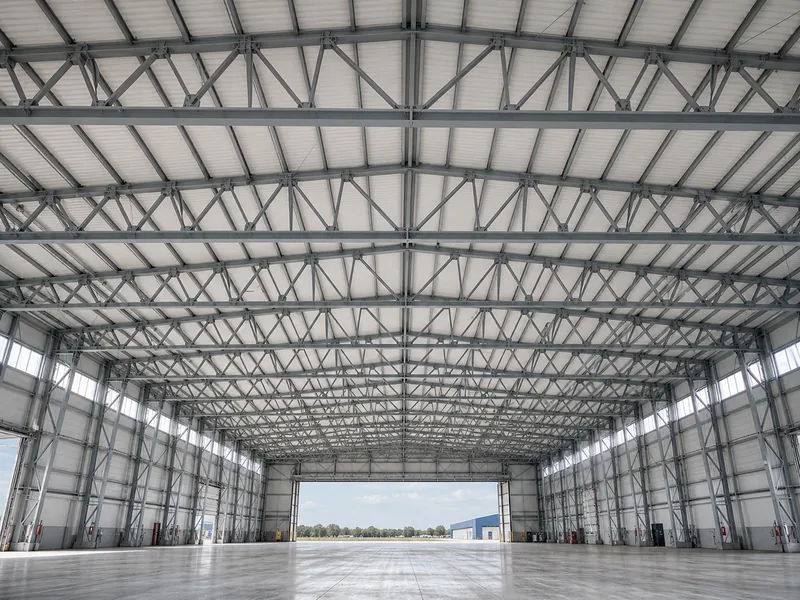
Loads and intended use often settle the choice before cost does. Roof, snow, and wind loads set the baseline every design has to meet, but the two variables that actually swing the decision are clear-height demand and whether the building carries a crane. A portal frame keeps the volume under the rafter clean, which suits workshops, warehouses, and distribution buildings where open floor matters more than record span. A truss buys long span and structural depth, accepting that its web members reach down into the headroom, which is exactly why it has a clear role in big-volume halls, hangars, and wide agricultural buildings where the span itself is non-negotiable. Roof form plays in as well: some truss layouts adapt readily to flat, multi-pitch, or nonstandard roof forms, while a portal frame is most natural as a clean single or double pitch.
Crane load is the variable to confirm first. Adding crane capacity after the framing is chosen is expensive. Retrofitting crane beams into a frame, or revisiting a truss bottom chord for hung loads, costs far more than designing for the duty from the start, so confirm the crane requirement before you commit to a system. For heavy or repeated lifting the load path down into the columns matters more than the roof span, and the steel building crane beam design deserves a separate check. Where the real driver is uninterrupted floor area instead of lifting, the comparison is essentially about clear span, and the trade-offs in clear span buildings carry straight over. If a truss roof already looks likely, the member and connection detail in a steel web truss building is the next thing useful to read.
Decide by Span, Loads, and Site Handling
Working the decision in the right order keeps you from pricing two systems on the wrong basis. The sequence that holds up on real projects runs like this:
- Fix the span and the clear height first; on their own these push most buildings toward a frame under about 36 meters or a truss well above it.
- Confirm the loads, including snow, wind, and any crane duty, before you compare systems.
- Price both on the same fabricated-and-erected basis, across the same bay spacing, never on bare tonnage.
- Check the fabrication and site sequence, including joint count, the lifting plan, and corrosion exposure at the connections.
- Then choose the system, and only after that move on to foundations, purlins, and cladding.
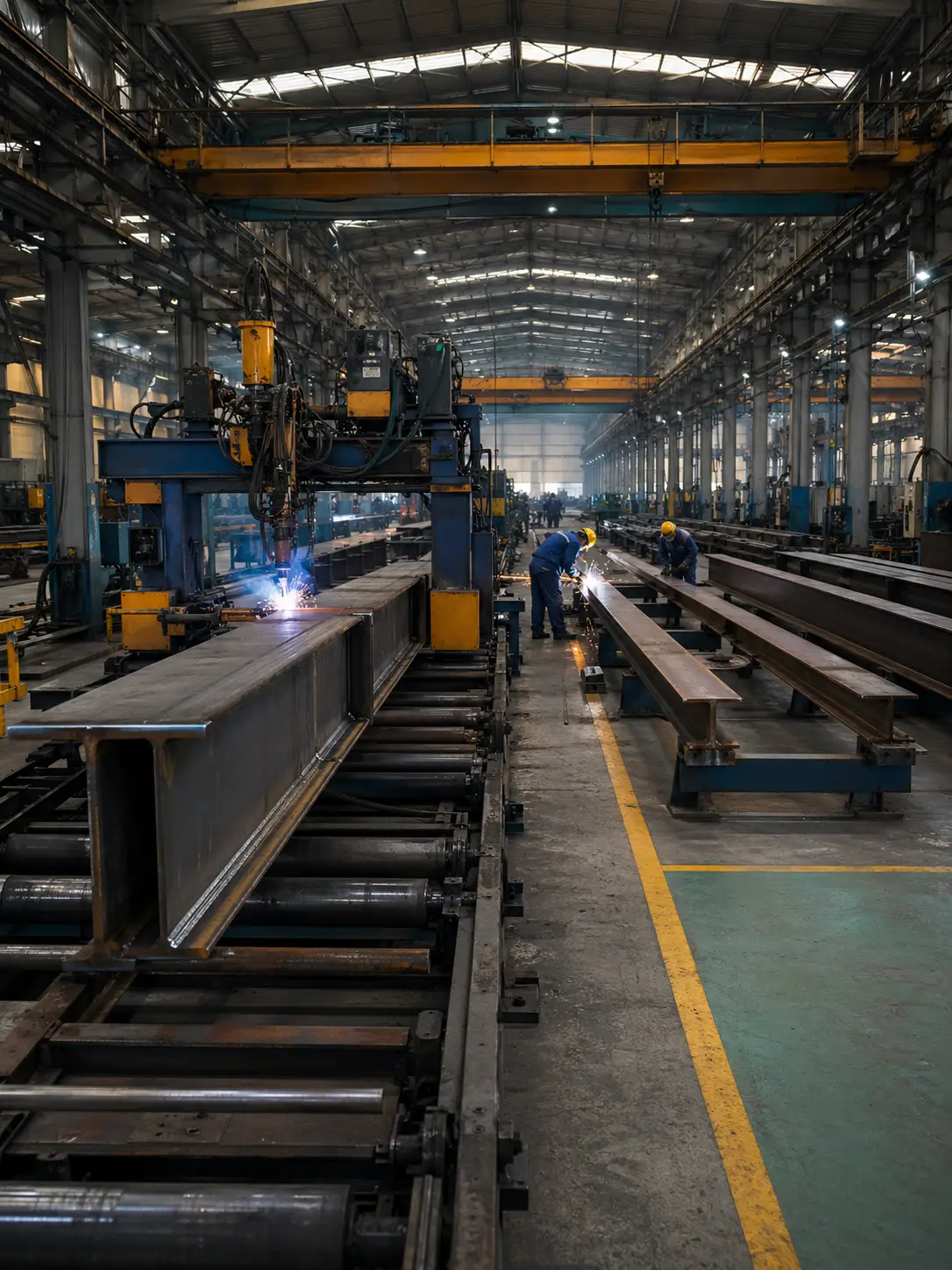
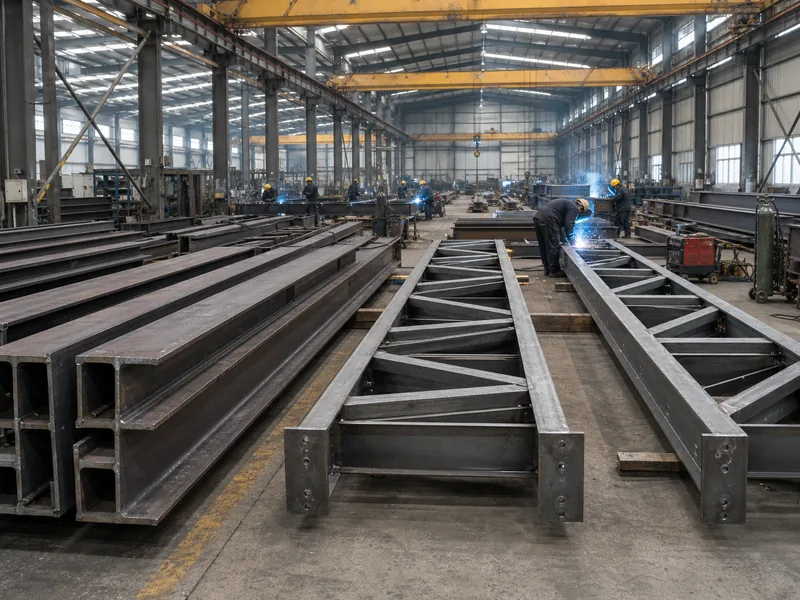
Fabrication reality belongs inside that decision, not after it. On coastal or high-humidity sites a truss’s many node connections add more inspection and coating points, so connection detailing and corrosion protection deserve more attention there than a frame’s cleaner joints would need. Supplier capability matters here too. A metal building contractor with in-house design, fabrication, and installation for light and heavy steel structures can coordinate either system on one project. KAFA’s Qingdao facility runs dedicated H-beam, box-section, C/Z purlin, and profile steel plate processing lines under documented quality procedures.
Which Structure to Choose
For most moderate-span workshops and warehouses, choose a portal frame when the span sits under roughly 36 meters, the interior needs a clean soffit, and fast erection matters. Choose a truss when the roof has to cross a longer column-free span, when clear volume is worth the extra depth, or when material efficiency on a wide roof outweighs the added joints and slower erection. Fix the span, clear height, and crane duty first, then price both systems on the same fabricated-and-erected basis.
FAQ
What is the main difference between a portal frame and a truss?
The core difference is load path: a portal frame carries load by bending through rigid, moment-resisting joints, while a truss carries it through axial tension and compression in triangulated members at their connecting nodes. That single difference drives how each one behaves on span, weight, and cost.
Which is cheaper, a portal frame or a truss?
Cost depends on span, not on the system alone. Under about 36 meters a portal frame is usually cheaper to fabricate and erect, while on long spans a truss often uses less steel and can cost less overall, even though it spends more on joints and site labor.
What is the maximum span of a portal frame?
There is no single maximum, but practical single-span portal frames typically top out somewhere around 40 to 60 meters depending on load, frame spacing, and deflection limits. Beyond that range, section depth and tonnage usually make a truss the better-value choice.
When should you choose a truss instead of a portal frame?
A truss is the better choice once the span runs past what a frame handles economically. Around 30 meters a truss starts to enter the comparison, and by roughly 60 meters and above it often becomes the stronger long-span option, subject to load and geometry, especially where a wide column-free interior or material efficiency outweighs its extra joints and slower erection.
Is a truss stronger than a portal frame?
Neither is stronger in every case. A truss is usually more efficient over long spans, while a portal frame can be the better structural and economic fit at moderate spans; the right choice depends on span, load, and geometry instead of raw strength.