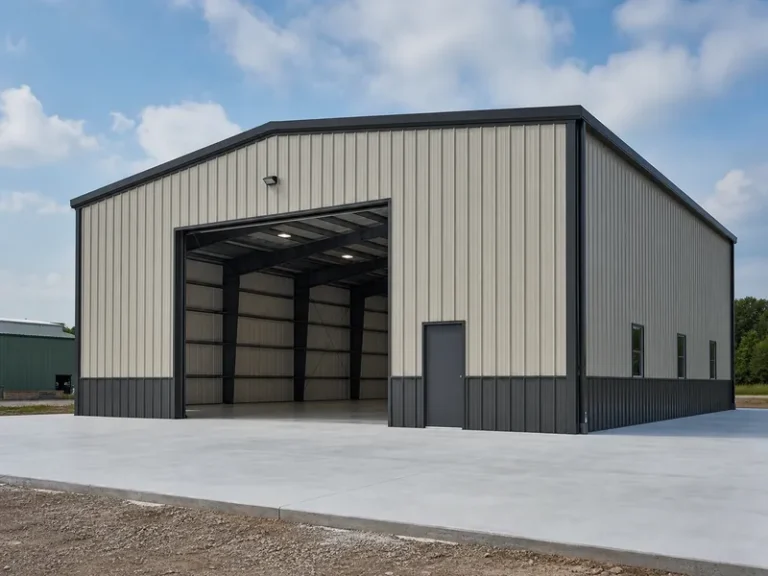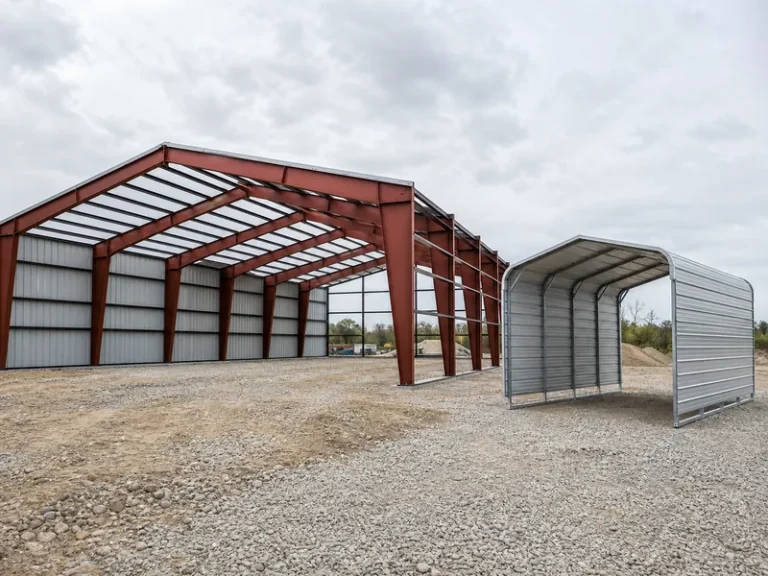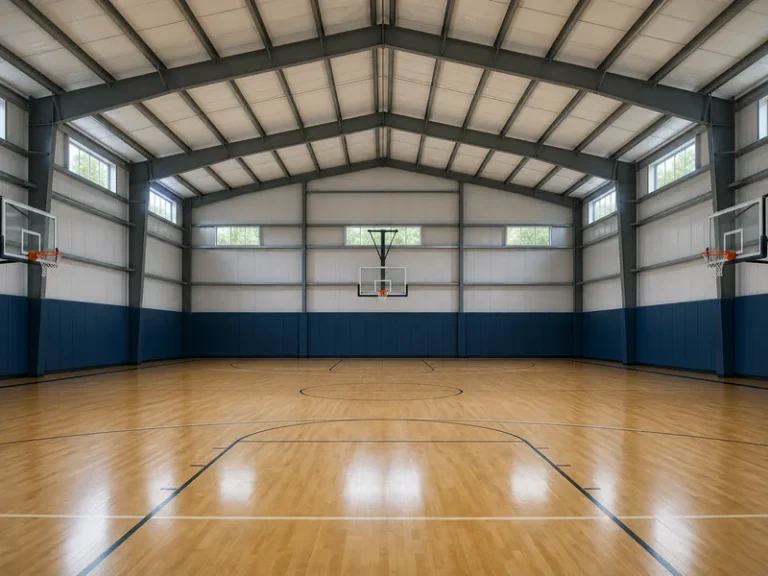





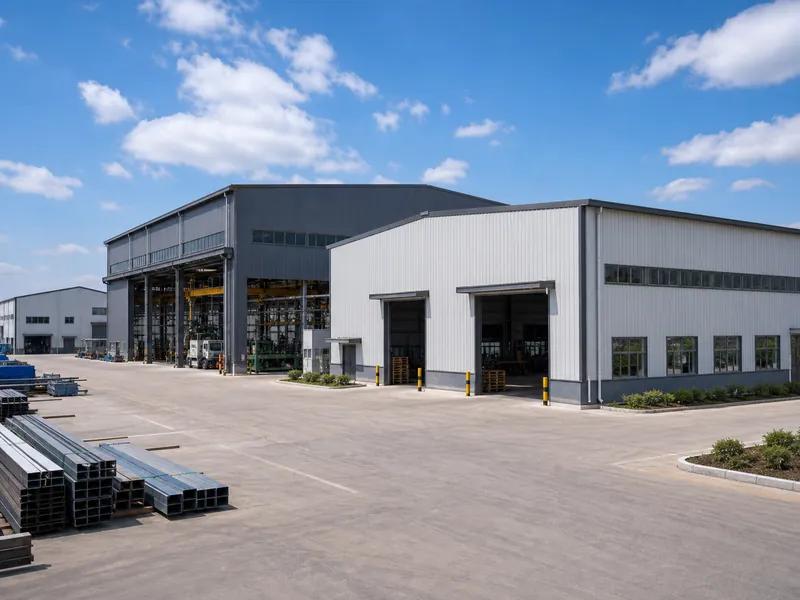
Industrial buildings fall into three working families—manufacturing plants, storage and distribution facilities, and flex space—and many real projects blend two of them. The cladding you see from the road tells you little about which family a building belongs to; the spans, clear heights, floor loads, and loading-dock layout underneath carry that distinction. Steel framing has become the default skeleton for nearly all of them, since a wide, column-free floor is the one requirement every industrial use shares. This guide covers each category, its main sub-types, and the structural traits that decide which one suits a given operation.
What Counts as an Industrial Building?
An industrial building is a structure built around a process, such as making, storing, or moving goods, rather than around people or foot traffic. That single priority shapes the rest of the design. Large open floors, high clear (eave) heights, heavy-duty slabs, and direct truck access take precedence over windows, finishes, or street frontage. This is also the practical line between industrial and commercial property, and the reason building codes classify them under different occupancy groups, such as Factory and Storage uses.
A few traits show up across almost every industrial building, whatever its use:
- Clear, column-free floor area so racking, machinery, or production lines can be arranged without working around posts.
- High eave height for stacked storage, overhead cranes, or tall equipment.
- A floor rated for heavy loads, from forklifts and pallet racking to stamping presses.
- Loading access: dock-high doors for trailers, grade-level doors for drive-in traffic.
- Industrial services such as three-phase power, strong ventilation, and sometimes process drainage or compressed air.
The mix and intensity of these traits decide which of the three families below a building belongs to. The table maps them before each section breaks one down.
| Category | Primary job | Typical clear height | Office share |
|---|---|---|---|
| Manufacturing | Make or assemble products | Low for light assembly, very high for heavy plants | Usually under 20% |
| Storage & distribution | Hold and move inventory | Tall, commonly 18–32 ft for warehouses | Small |
| Flex | Mix work, display, and light storage | Moderate, around 14–24 ft | Higher, often a third or more |
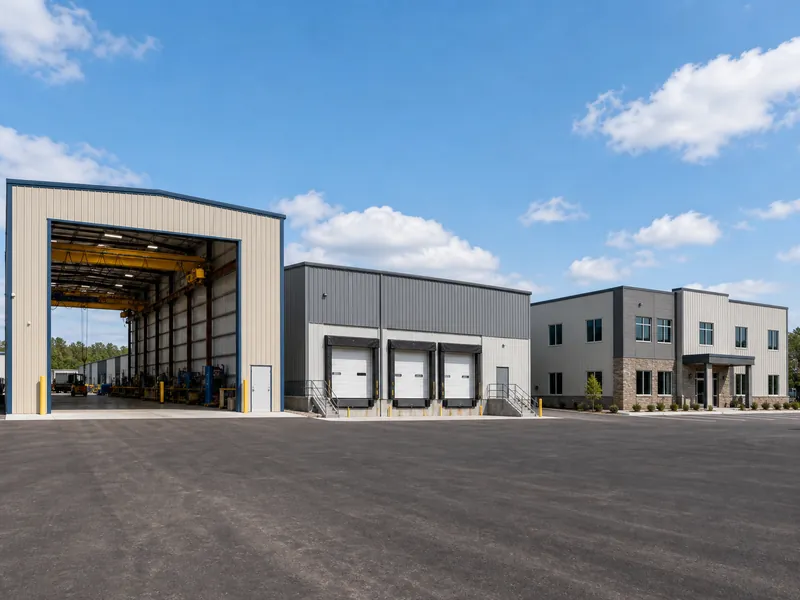
Manufacturing Buildings: Heavy and Light Production
Manufacturing buildings house production lines and the equipment that runs them, and they divide into two very different structural classes: heavy manufacturing and light assembly.
Heavy Manufacturing Plants
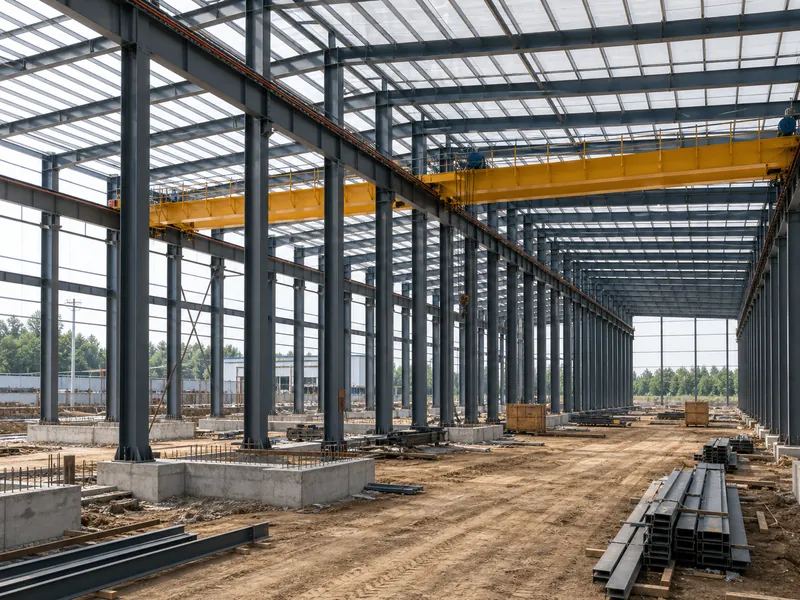
Heavy manufacturing plants are built to carry weight—both the products they make and the machines that shape them. Automotive, steel, cement, and shipbuilding operations run presses, furnaces, and overhead cranes that drive the structure long before the walls go up. The frame usually needs a heavy reinforced slab, three-phase power, wide bay spacing for equipment, and a steel building crane beam sized to the lift it will carry.
A detail that catches first-time owners is that on a crane building, the crane comes first. The crane tonnage and rail height set the column spacing, corbel positions, and eave height, so deciding the lift capacity late in design usually forces a structural redo. Heavy plants also keep office space well under a fifth of the floor area, because production rather than desks is the reason the building exists.
Light Assembly and Workshop Buildings
Light assembly and workshop buildings handle production that is lighter on the structure: electronics, textiles, furniture, food packaging, and small-batch fabrication. Clear heights are lower than a heavy plant needs, floors carry ordinary forklift and bench loads rather than presses, and the layout is meant to be rearranged as product lines change.
Because these buildings are simpler, they are the easiest to adapt, which is why many serve as combined workshop buildings with attached office space for a growing business. The structural ask is modest: clear, column-free bays and enough eave height to add a mezzanine if the operation later expands upward instead of outward.
Storage and Distribution Buildings
Storage and distribution buildings move and hold goods rather than make them, so they are judged on cubic capacity, throughput, and truck access instead of production infrastructure.
General and Bulk Warehouses
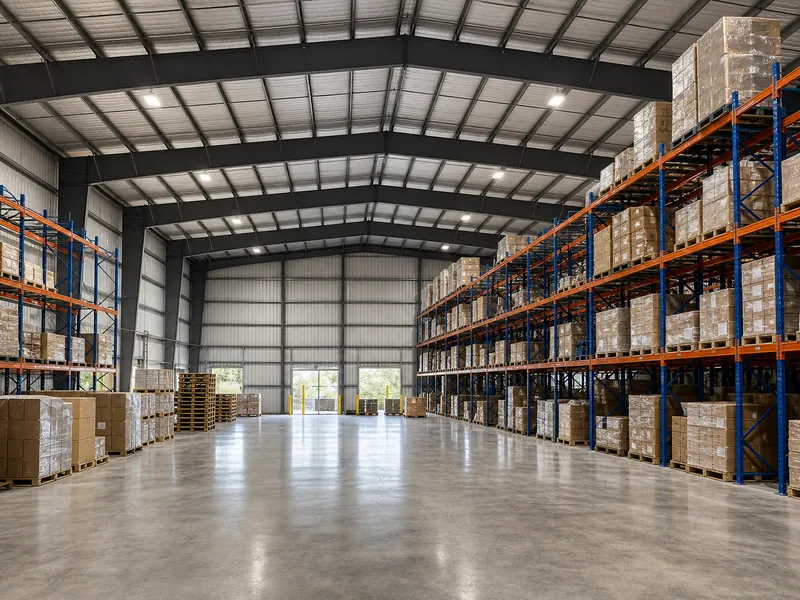
General and bulk warehouses are the large, single-story boxes most people picture when they hear “industrial.” This is the classic steel warehouse building. Clear height usually runs from about 18 to 32 feet so pallet racking can stack upward, floors are flat and hard-wearing, and dock-high doors set near trailer-bed height line one or more walls. Office content stays small, just enough for shipping, receiving, and a supervisor.
The variable that drives the structure here is rack height, not floor area. Taller racking needs more eave height and a wider clear-span building layout so aisles run uninterrupted by columns. Owners storing dense or bulk goods such as grain, aggregates, or packaged stock often turn to a dedicated grain storage building or bulk shed, where the span and wall design suit the bulk material rather than standard pallets.
Distribution and Fulfillment Centers
Distribution and fulfillment centers are warehouses optimized for speed of movement rather than long-term storage. They carry far more dock doors than a general warehouse, sit near highways and airports, and increasingly run automation that needs flat floors held to tight tolerances. A cross-dock terminal pushes this further: goods cross from inbound to outbound trailers in hours, so the building becomes a long, narrow rectangle lined with doors on both sides.
The bottleneck on these projects is rarely raw floor area; it is the number of dock positions and how trucks circulate around the site. Getting the dock count and yard layout right matters more than adding square footage, because a center that cannot stage its trailers will choke no matter how much room sits inside.
Cold Storage and Refrigerated Warehouses
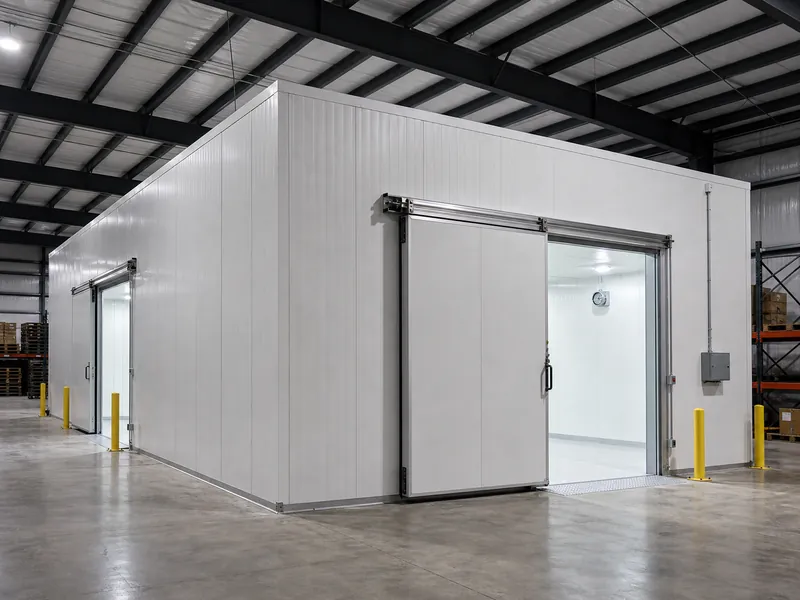
Cold storage and refrigerated warehouses hold temperature-sensitive goods such as food and pharmaceuticals behind heavily insulated envelopes. The refrigeration load, vapor control, and airtight cladding define these buildings far more than the steel frame, which is usually the straightforward part. Insulated panels, sealed joints, and managed thermal bridging keep the cold in and condensation out.
In practice, the frame is the part least likely to cause trouble on a cold store; the envelope and its detailing are where projects succeed or struggle. That is why an experienced builder spends design time on panel systems, door seals, and how the structure penetrates the insulation, not only on the rigid frame.
Flex and Specialized Industrial Buildings
Flex buildings blur the line between warehouse and office, pairing a modest amount of clear-span work space with a higher share of finished, occupied area than any pure storage building carries.
Flex Buildings and Showrooms
Flex buildings are designed to be reconfigured, and that adaptability is the draw for tenants who do not fit neatly into “warehouse” or “office.” A typical flex unit gives moderate clear height, a roll-up door or two, and a finished front section that can run from a third of the floor to well over half. Industrial showrooms are a flex variant that adds a retail-style display area, letting a business store, sell, and handle back-office work under one roof—common for breweries, equipment dealers, and trade suppliers.
Data Centers and R&D Facilities
Data centers and R&D facilities are specialized flex buildings where the fit-out costs far more than the shell. A data center carries reinforced floors for dense server racks, redundant power, backup generators, and heavy cooling, and large facilities reach into the hundred-thousand-square-foot range. R&D buildings combine labs, testing bays, and offices, adding clean rooms or high-tech assembly where the product demands it.
For both, the steel structure is a small fraction of the project value, yet it still has to provide the clear spans, floor loads, and service routing the equipment dictates. Settling the equipment loads early keeps the frame from being oversized, or worse, undersized once the racks and machines arrive.
Why Steel Framing Leads Industrial Construction
Steel framing leads industrial construction because it delivers, more efficiently than concrete or timber, the feature every category above demands: wide, column-free floor space. Across manufacturing, storage, and flex, the same structural logic repeats. A clear-span steel frame opens uninterrupted floor area for racking, lines, or vehicles; it goes up quickly from pre-engineered, shop-fabricated parts; and its load path adapts to a crane, a mezzanine, or a heavier roof added later. For owners comparing options or browsing industrial buildings for sale, the span and eave height a steel system reaches are usually the deciding structural advantages for large footprints.
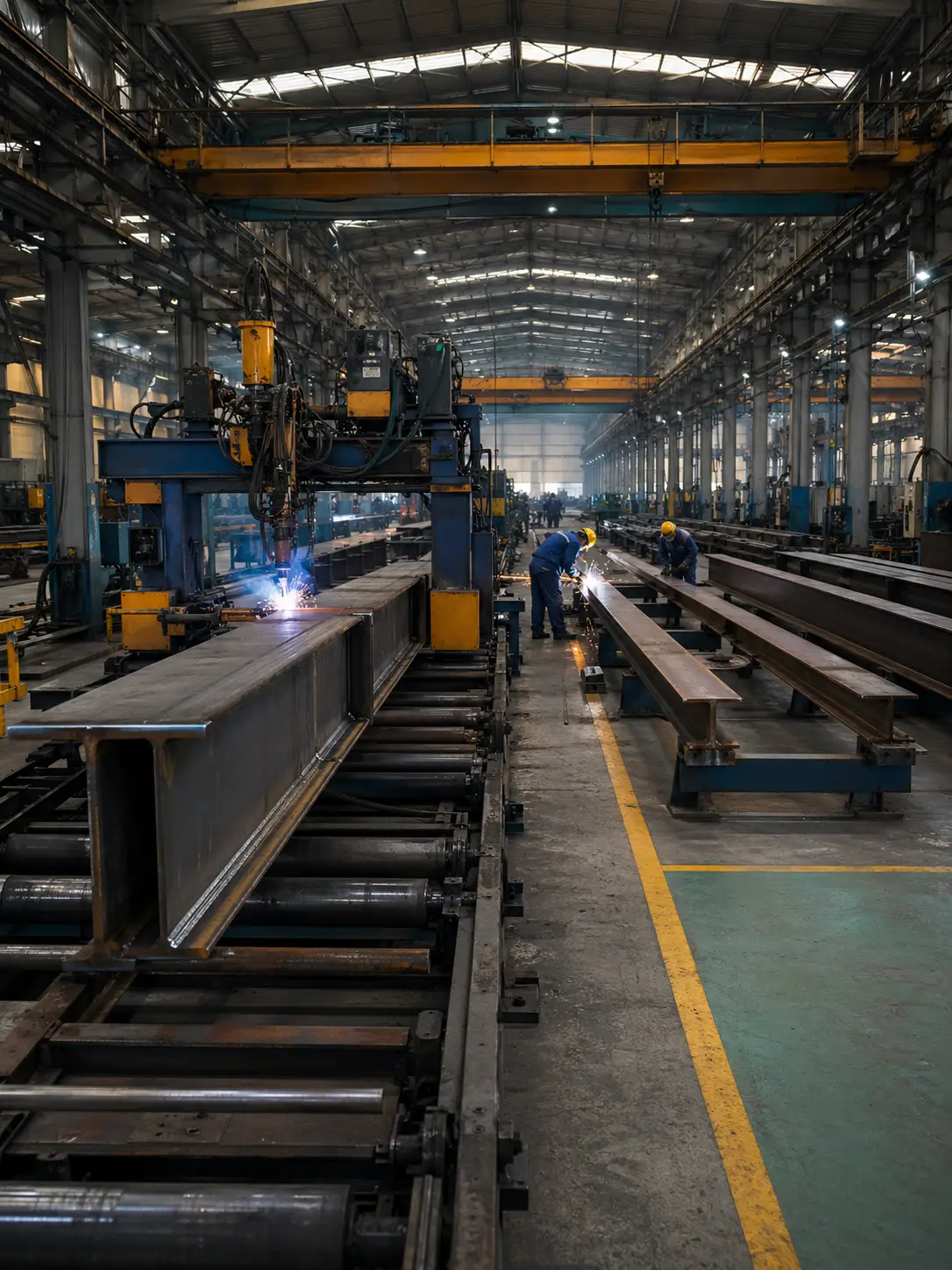
This is also where fabrication quality shows. Qingdao KAFA Fabrication, for instance, runs dedicated lines for H-beam, box-section, and C/Z purlin production. The rigid frames, purlins, and girts that carry an industrial building come off those lines to consistent tolerances under ISO 9001:2015 quality management. Steel does not make every decision automatic—corrosion protection and fire detailing still vary by use—but for the spans and loads industrial work demands, it stays the practical default.
How to Match a Building Type to Your Operation
Matching an industrial building to your operation works best from the inside out: define the process first, then let its loads, heights, and access needs point to a category. Start with what the building has to do, then translate it into structural terms:
- What moves through it? Production lines point to manufacturing; pallet throughput points to warehouse or distribution; a mix of work and display points to flex.
- How heavy, how tall? Cranes and presses set floor loads and eave height; high racking sets clear height and clear-span width.
- Any special environment? Refrigeration, clean rooms, or hazardous goods add envelope and compliance requirements that reshape the whole design.
- How much will change? Operations that expect to grow favor adaptable, column-free layouts over tightly fitted ones.
The sequence matters because deciding the shell before the process is a common source of expensive rework. Size a frame, then discover a crane or a freezer was needed, and you are usually back to reworking columns and foundations. Browsing types of metal buildings early helps orient the search, but the structural brief should still start from the operation, not the catalog.
Choosing the Right Industrial Building Type
Choosing the right industrial building type is an exercise in ordering constraints, not picking a label off a list. The use case sets the process; the process sets the loads, clear height, and any special environment; and only then does the building resolve into manufacturing, storage, or flex. Owners who fix the hardest constraint first—usually a crane, a freezer envelope, or a racking height—rarely rebuild the design around it later.
If one decision deserves to be settled before the rest, it is the combination of clear-span width and eave height the operation needs, because that pair drives the frame, the foundations, and the room to grow. Get it right, and the category mostly chooses itself.
FAQ
What makes a building industrial instead of commercial?
An industrial building is organized around a process—production, storage, or distribution—while a commercial building is organized around people and customer access. In practice, industrial space prioritizes clear height, floor loads, three-phase power, and truck docks over the parking, frontage, and finishes a retail or office property needs. Building codes separate the two through occupancy groups, while local zoning limits where each use is allowed to operate.
What is the most common type of industrial building?
Warehouse and distribution space makes up the largest share of industrial floor area being built today, pushed by e-commerce and logistics demand. That share does not make it the right type for every owner, though, since a manufacturer or a cold-chain operator has needs a plain warehouse cannot meet. The more useful question is which category fits your process, not which one is built most.
Are steel buildings suitable for every industrial type?
Steel framing suits the full range of industrial buildings, from light workshops to crane-served heavy plants to insulated cold stores. What changes between them is not whether steel works but how the frame is configured: span width, eave height, crane beams, and the connection to the envelope all shift by use. Cold stores and corrosive settings are the cases where detailing the cladding, coatings, and thermal breaks matters as much as the frame itself.
How much clear height does an industrial building need?
Clear height depends on the type: light assembly can work with relatively modest height, general warehouses commonly run about 18 to 32 feet to allow pallet racking, and high-bay or cold-storage facilities can go higher still. The deciding factor is what stacks or hangs inside—racking, cranes, or mezzanines—rather than the building’s footprint. Settling the storage or equipment plan first tells you the clear height the frame has to provide.
What is a flex industrial building?
A flex industrial building combines work or storage space with a larger finished, occupied area than a pure warehouse, so it can shift between uses as a tenant’s needs change. The office or showroom share is typically much higher than a warehouse’s, and the same shell may house light assembly, R&D, a showroom, or a small data suite. Flex space trades some raw storage efficiency for adaptability, which is why growing businesses with mixed needs gravitate toward it.
Further Reading
- Metal Building Manufacturers Association (MBMA) — Industry association for metal building systems. Background on why steel framing and pre-engineered systems suit the large, column-free spans industrial buildings need.
- ASCE 7 Minimum Design Loads (American Society of Civil Engineers) — Structural-engineering standards body. Supports the floor-load and structural-load basis for matching a building type to its use.
- OSHA Warehousing Safety (U.S. Occupational Safety and Health Administration) — U.S. government workplace-safety source. Supports the forklift, racking, and dock-operation considerations behind warehouse and distribution buildings.