




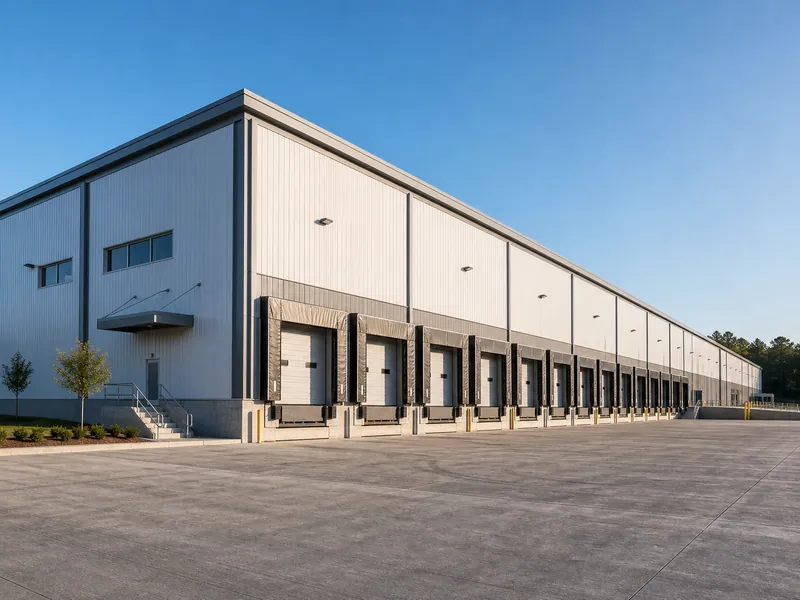
A custom distribution center is built backward from how goods move through it, not forward from a square-foot target. Throughput, the SKU profile, and the balance of receiving, storage, and shipping work set the clear height, the column grid, the number of dock doors, and the floor flatness. Those few decisions, far more than the footprint, drive both how the building performs and what it costs. Most owners can frame the budget around two figures: a structural shell with envelope and slab runs roughly $55 to $115 per square foot, while a turnkey facility with full site work, mechanical systems, fire protection, and offices generally lands between $100 and $200+ per square foot. Treat the figures in this guide as planning benchmarks to size against your own operation, not fixed quotes.
What “Custom” Means in Distribution Center Construction
“Custom” means the building is engineered around an operation rather than leased as a generic box. A distribution center is often mistaken for a larger warehouse, but the two answer different questions. A warehouse mainly stores; a distribution center is tuned to move inventory quickly between inbound and outbound, which pressures dock count, internal flow, and clear height in ways pure storage never does. Building to suit means the structural design, dock configuration, and slab are matched to the racking layout, the equipment, and the daily order volume the facility has to absorb.
A prefabricated warehouse engineered as a distribution hub usually starts from a throughput study — how many pallets move in and out per day, what share is full-pallet versus case or piece picking, and whether cross-docking bypasses storage altogether. Those answers decide whether the priority is vertical storage density, dock capacity, or staging space, and that priority cascades into every structural choice downstream. This guide stays on the building side of that decision: the structure, envelope, docks, slab, fire protection, site, and cost. Material-handling equipment, warehouse software, and rack engineering are their own disciplines, flagged here only where they constrain the building.
Specs That Shape the Steel Structure
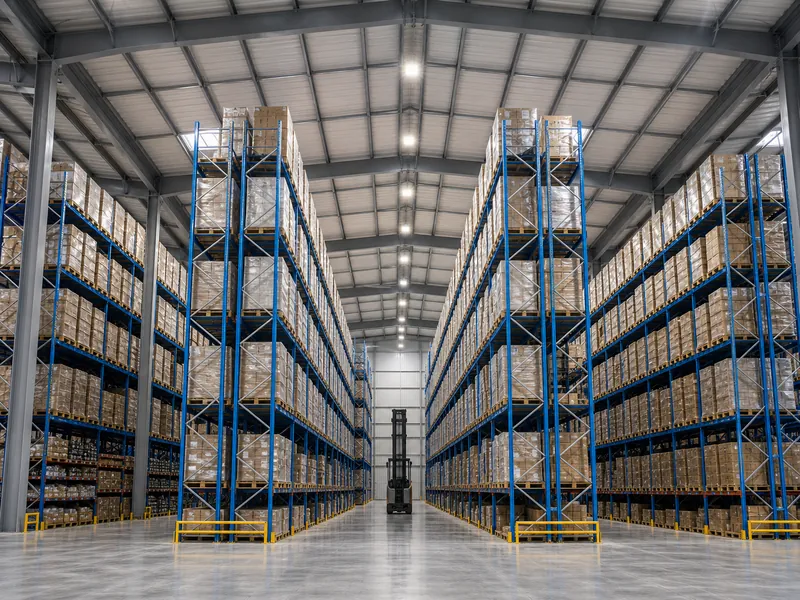
Clear height is the single spec that most changes how much a distribution center can hold. Modern facilities are designed for 32 to 40 feet of clear height, up from the 24 to 28 feet typical of older buildings, because every additional foot adds roughly 7 to 10 percent of usable storage in the same footprint. Raising the roof on a 100,000-square-foot building from 18-foot to 32-foot clear can free more than 75 percent additional usable space without expanding the slab, according to NAIOP’s analysis of logistics buildings. That is why high-bay designs keep pushing toward 40 feet and beyond wherever racking and lift equipment can use the height.
Clear height and storage density
Clear height only pays off when the racking and handling equipment are specified to match it. Reach trucks, very-narrow-aisle turret trucks, and high-bay automation each have a working-height ceiling, so a 40-foot clear building paired with equipment that tops out at 28 feet wastes the steel it paid for. The practical sequence is to size the rack system and lift fleet first, then set clear height to the rack top plus the clearance fire protection requires — not to pick a height and hope the operation grows into it.
Column grid, bays, and clear-span framing
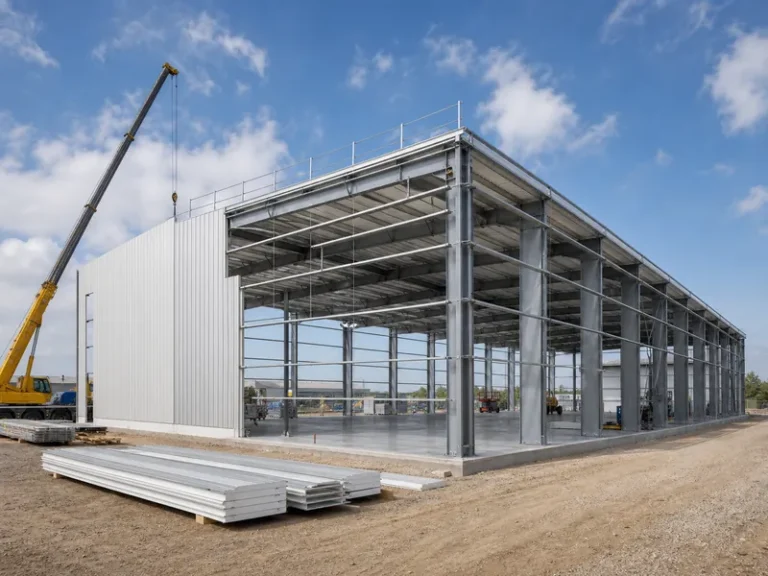
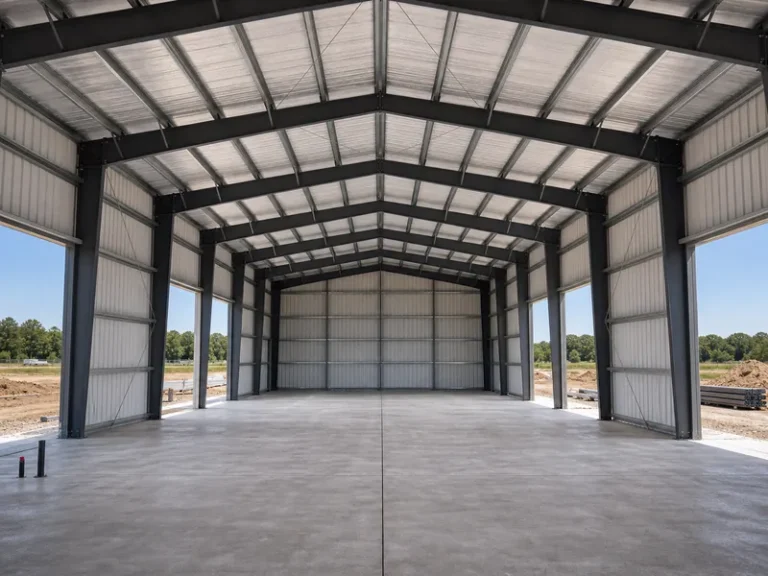
Column spacing decides how cleanly racking and traffic lanes fit between structural supports. Typical modern bays fall in the range of about 50 by 52 to 60 by 60 feet, sized so rack rows and forklift aisles line up with the grid instead of fighting it; wider bays cost more in steel but remove columns a forklift can hit. Where an interior has to stay fully column-free — staging zones, cross-dock lanes, or buildings whose rack layout may change — a clear-span steel frame drops the interior columns entirely, and clear-span buildings trade a heavier primary frame for complete floor flexibility.
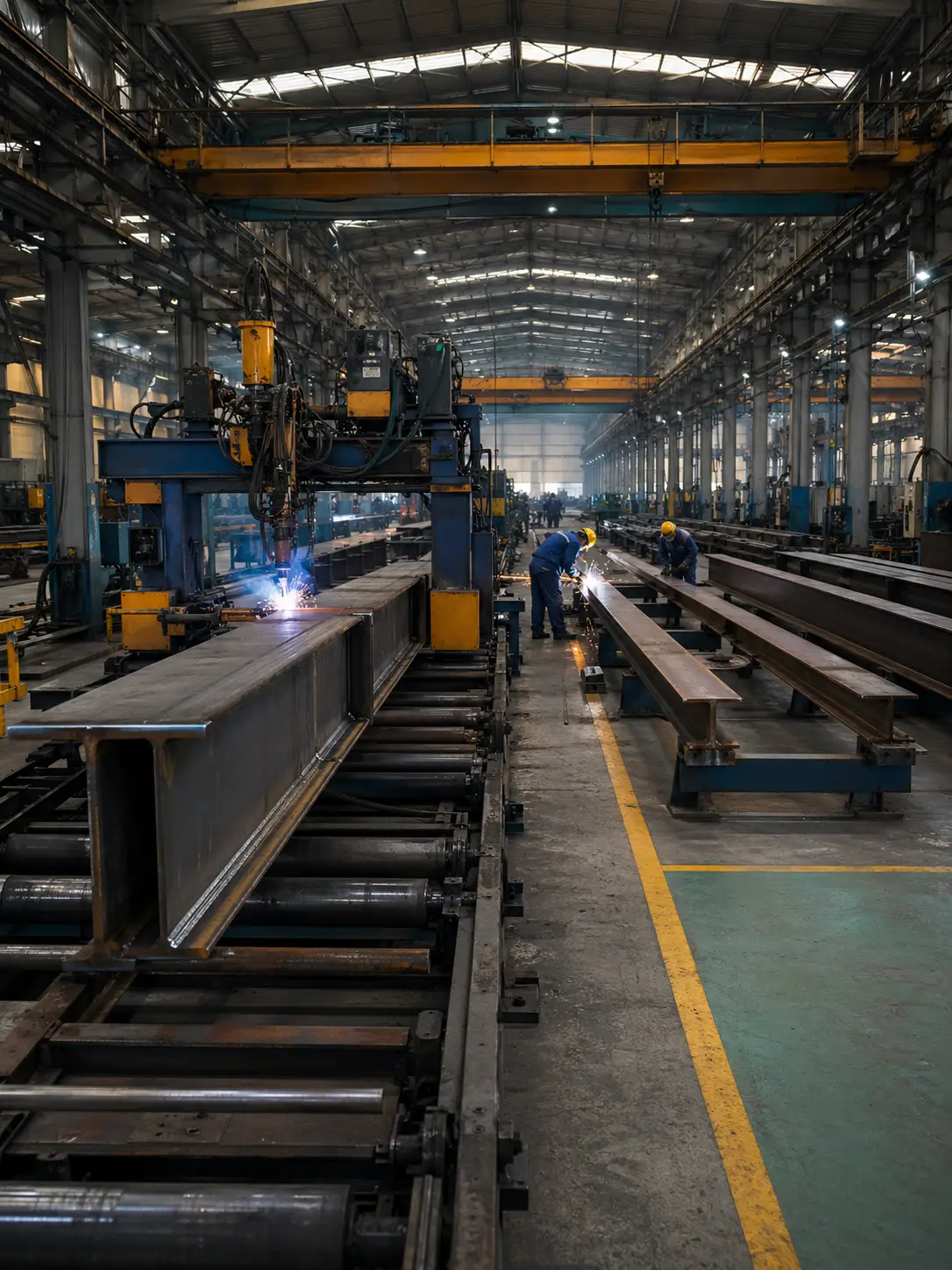
This is where fabrication quality shows up in the finished building. Distribution centers are, structurally, large industrial steel buildings, and the primary frame, secondary framing, and connections all carry the roof, wind, and any future rack or rooftop loads. KAFA fabricates the H-beam rigid frames, box-section columns, and C- and Z-section purlins these buildings rely on, cut and welded on dedicated lines under an ISO 9001:2015 quality system. That keeps the steel defining the clear span and the bay spacing built to the design rather than improvised on site.
Docks, Truck Courts, and Internal Flow
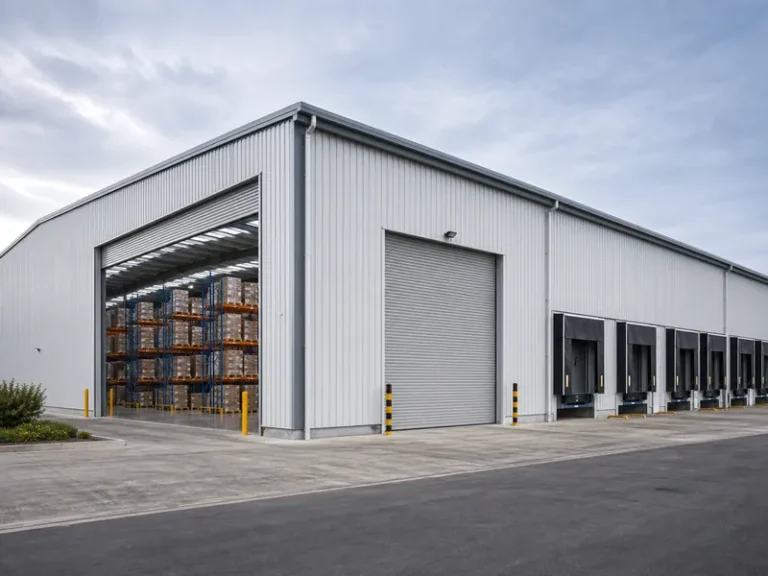
Dock capacity, not floor area, usually sets the ceiling on how fast a distribution center can turn freight. A common planning ratio is one dock position per 5,000 to 10,000 square feet, with high-volume and cross-dock operations sitting at the busy end of that band and storage-heavy facilities at the relaxed end. Dock-high doors are generally set 48 to 52 inches above the drive to meet trailer beds, fitted with levelers rated around 25,000 to 50,000 pounds depending on the loads crossing them, and backed by a few grade-level drive-in doors for oversized or containerized freight.
Outside the wall, the truck court has to let 53-foot trailers maneuver without choking the dock face. Apron depth typically runs 130 to 185 feet — 120 feet is a workable minimum, and trailer storage pushes past 170 — because a 53-foot trailer needs roughly a 105-foot outside turning radius to spot cleanly, and the trailer mix on site sets where in that range a given court lands. Skimping here is hard to undo later, since court depth is fixed by the property line and the building setback once the slab is poured.
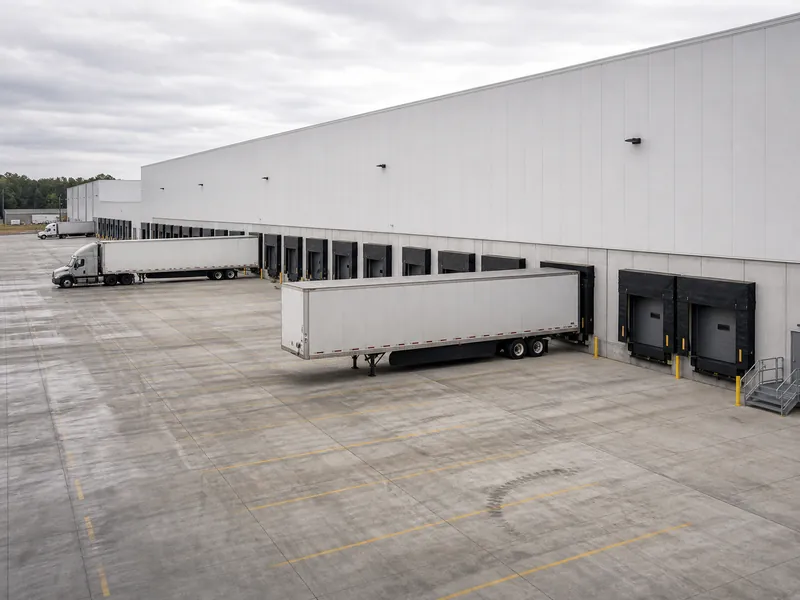
Inside, the layout follows the flow of goods from receiving to shipping. Three patterns dominate: a U-shaped flow that puts receiving and shipping on the same side for shared docks and staging, an I-shaped (through) flow that runs receiving and shipping at opposite ends for one-directional movement, and an L-shaped flow for sites where the footprint or truck access favors a turn. The right pattern depends on whether dock sharing, separation of inbound and outbound, or site geometry matters most — an operational question that a warehouse building design study should settle before the steel is ordered.
Floor Slabs, Fire Protection, and Power
The floor slab carries more risk than its line-item cost suggests, because rack loads and lift traffic concentrate on it for decades. High-bay distribution centers need a slab engineered by a structural engineer for the rack post loads and the forklift type, with a floor flatness — measured as FF/FL numbers — tight enough that very-narrow-aisle and high-reach trucks stay stable at height. A floor acceptable for foot traffic can still be out of tolerance for a turret truck working at 35 feet. Thickness, joint layout, and reinforcement follow the rack and traffic plan, which is why the metal building slab is designed alongside the structure rather than treated as generic concrete.
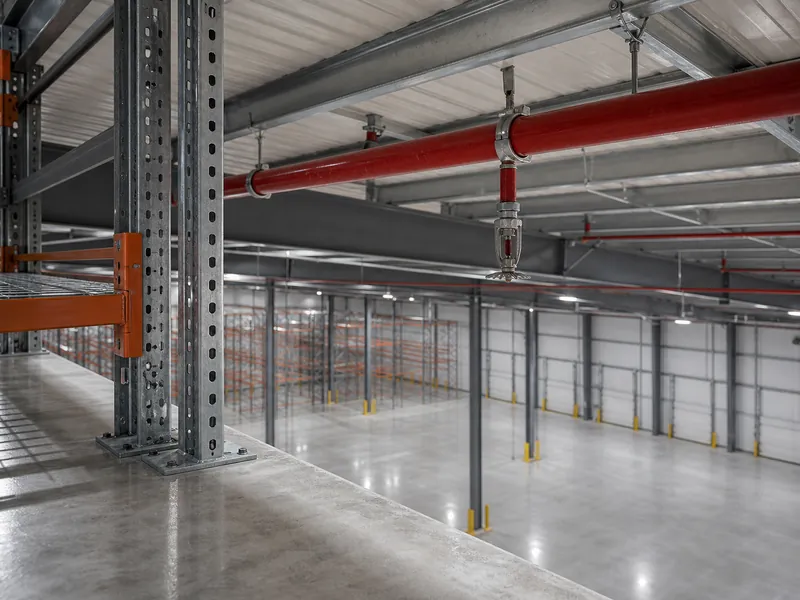
Fire protection is usually the deciding mechanical system in a high-pile storage building. Early Suppression Fast Response (ESFR) sprinklers are a common choice for distribution centers because they aim to suppress rather than merely control a fire in high-piled storage, but they are not a default. The commodity class, storage height, ceiling height, and available water supply determine whether ESFR or another system applies. The design rules live in NFPA 13 and are subject to the authority having jurisdiction, so the sprinkler system has to be engineered for the specific storage rather than assumed from a building’s clear height alone.
Electrical service scales with the operation, not the square footage. General warehousing often lands around 400 to 600 amps of three-phase power at roughly 10 to 15 watts per square foot, but conveyor lines, automated storage and retrieval, or battery-charging rooms can multiply that — so the service and switchgear should be sized against the equipment plan, not a per-foot rule of thumb.
Site Selection and Site Development
Site selection decides the building’s logistics economics before the first column goes up. Distribution centers live or die on drive time to highways, ports, rail, and the labor pool, so a parcel is chosen for access and workforce as much as for price; a cheaper site that adds an hour to every outbound route rarely pencils out. The land also has to physically hold the program — a deep truck court, trailer parking, stormwater detention, and room to expand all compete for the same acreage.
Site development is a larger share of the budget than many first-time builders expect. Grading, utilities, the truck court and aprons, stormwater systems, and paving typically account for around 15 to 25 percent of total project cost on industrial facilities, and a difficult site — poor soils, steep grades, or tight stormwater rules — pushes that higher. The phased sequence mirrors building a warehouse of any kind, but a distribution center front-loads more civil work because of the truck court and trailer yard. Soil borings and a civil concept belong early, since discovering bad soil after the slab is designed is one of the more expensive surprises in this building type.
What Drives Cost and Build Timeline
Distribution center cost is easiest to estimate in two layers: shell and turnkey. A structural shell — primary frame, envelope, and slab, without racking, deep mechanical systems, or automation — runs roughly $55 to $115 per square foot. A turnkey facility that adds full site development, mechanical and electrical systems, ESFR fire protection, and office build-out generally runs about $100 to $200+ per square foot, and specialized configurations climb from there.
| Cost layer | What it includes | Typical range |
|---|---|---|
| Structural shell | Primary steel frame, roof and wall envelope, slab | ~$55–115 / sq ft |
| Turnkey facility | Shell + site work, MEP, ESFR fire protection, offices | ~$100–200+ / sq ft |
| Cold-chain facility | Turnkey + insulation and refrigeration | ~$130–220 / sq ft |
Cost scope note. These ranges are planning benchmarks, not a KAFA quote, and they move with region, market timing, and specification. A shell figure covers the primary steel frame, the roof and wall envelope, and the slab; it excludes racking, deep mechanical and electrical work, automation, fire-protection engineering, permits, and land. Turnkey adds site development, MEP, ESFR fire protection, and offices. Expect the number to rise with greater clear height, heavier automation, cold-chain refrigeration, poor soils, or tight permitting.
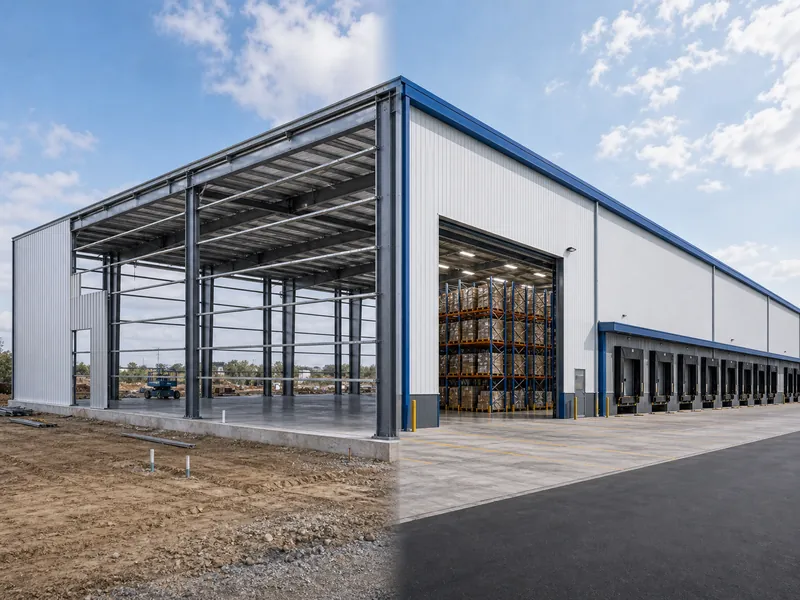
Keeping the two layers separate prevents the common mistake of comparing a shell quote against a turnkey budget. Within those layers, a handful of variables move the number most: clear height and the steel it requires, dock count and equipment, slab flatness, fire protection, site difficulty, and any automation. Automation in particular can rival the building itself in cost, which is why it belongs in the budget conversation from the start instead of as an afterthought. For a fuller breakdown of how these line items stack up on general storage, the same logic appears in the cost to build a warehouse.
Timeline tracks scope more than size. A mid-size facility of roughly 75,000 to 200,000 square feet often takes about 12 to 15 months from site control to first shipment, with permitting, site conditions, and long-lead equipment as the usual schedule drivers; cold-chain and heavily automated projects typically add several months for specialized systems and commissioning. Steel fabrication lead time sits on this critical path, so releasing the frame design early is one of the more reliable ways to protect the schedule.
Sequencing a Custom Distribution Center Build
The cleanest way to keep a custom distribution center on budget is to lock the operational specs before the architectural ones. Settle throughput and the rack-and-equipment plan first, because they set clear height; let clear height and the dock ratio drive the structural frame and the site footprint; then design the slab and fire protection to the storage they actually have to serve. Owners who reverse that order — fixing a footprint or a façade first — tend to discover late that the building cannot hold the racking or turn the freight, which is the expensive way to learn it.
Two numbers are worth fixing early so the rest of the design has a frame: the clear height the racking needs, and whether the budget is a shell or a turnkey figure. With those settled, the structural design, dock layout, and slab specification fall into place against real constraints instead of guesses. KAFA designs, fabricates, and installs the clear-span and rigid-frame steel these facilities depend on — the structural scope, not the site work, mechanical systems, or automation that the rest of the project team handles. If you are scoping one, you can request a quote on the steel structure with your target clear height, footprint, and dock count.
FAQ
How much does it cost to build a custom distribution center?
A structural shell typically runs about $55 to $115 per square foot, while a turnkey distribution center generally falls between $100 and $200+ per square foot. The gap is mostly site development, mechanical and electrical systems, ESFR fire protection, and office build-out, plus any automation — which is budgeted separately and can rival the building itself. Refrigerated cold-chain space runs higher, often $130 to $220 per square foot. Treat these as planning ranges that shift with region, specification, and market timing.
What clear height does a distribution center need?
Most modern distribution centers are designed for 32 to 40 feet of clear height. The right number depends on the racking and lift equipment, since each additional foot adds roughly 7 to 10 percent of storage capacity only if the trucks and rack system can reach it. High-bay and automated facilities increasingly justify 40 feet or more, while smaller or low-throughput operations often do not need it.
How many loading docks does a distribution center need?
Plan for roughly one dock position per 5,000 to 10,000 square feet, then adjust for how the facility operates. Cross-dock and high-volume fulfillment sit at the busy end of that ratio, while storage-heavy operations need fewer. Dock count is hard to expand after the slab and truck court are set, so it is safer to slightly over-provide than to run short.
What is the difference between a warehouse and a distribution center?
A warehouse primarily stores inventory, while a distribution center is built to move it quickly between inbound and outbound. That difference shows up in the building: distribution centers carry more docks, tighter dock ratios, and layouts organized around flow instead of dense static storage. The structural shell can look similar, but the dock, slab, and circulation design diverge.
How long does custom distribution center construction take?
A mid-size facility of about 75,000 to 200,000 square feet usually takes around 12 to 15 months from site control to first shipment. Permitting, site conditions, and long-lead items such as steel and material-handling equipment are the usual schedule drivers. Cold-chain and heavily automated builds typically add several months for specialized systems and commissioning.
Further Reading
- NAIOP — The Logistics Building of the Future — Commercial Real Estate Development Association. Background on how distribution-center clear heights have climbed from 32 to 40 feet and beyond, supporting the storage-density reasoning in this article.
- MBMA — Metal Building Systems Design Resources — Metal Building Manufacturers Association. The Metal Building Systems Manual and load guidance (aligned with the IBC and ASCE 7) behind the structural-frame and bay-spacing decisions covered here.
- NFPA 13 — Standard for the Installation of Sprinkler Systems — National Fire Protection Association. The governing standard for ESFR and storage-occupancy sprinkler design referenced in the fire-protection section.