




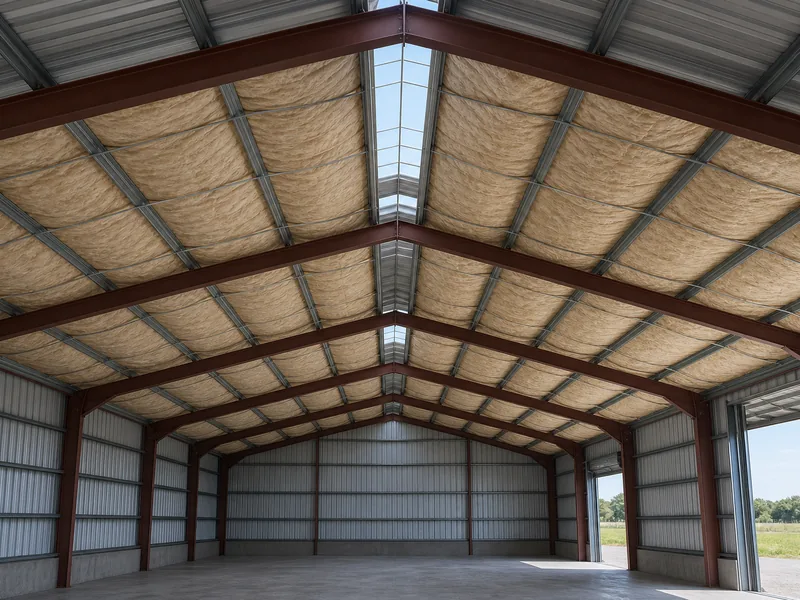
An R-value tells you how strongly a material resists heat passing through it: the higher the number, the slower heat moves across it, and the better the material insulates. That one figure drives most insulation choices, from the batts in an attic to the blanket draped under a steel roof. The detail to know up front is that the R-value printed on a package is a lab rating, and the R-value a building actually gets once that insulation is installed and squeezed around framing is often lower. The sections below cover what the rating measures, what changes it, how materials compare per inch, how much you need by climate and use, and why the gap between the rated and the real number is wider in steel-framed shells.
What an R-value actually measures
Thermal resistance is the property an R-value puts a number on, and it climbs with both the thickness and the insulating quality of the material. Heat always flows from warm to cold; insulation slows that conductive flow, and R-value is the standardized way to rate how much it slows it. Because resistance adds up, the R-values of separate layers stack: a wall built from an R-13 batt and an R-6 board reads as R-19 on paper before any real-world losses.
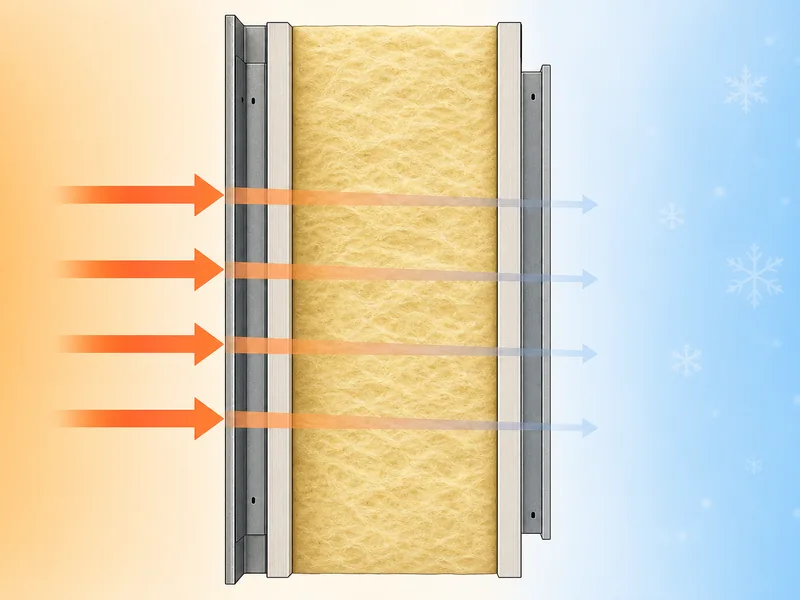
What sets a material’s R-value is mainly its type, thickness, and density, though temperature, moisture, and age shift it too. A damp or aged product can resist less heat than its label suggests, which is one reason published numbers are measured under controlled conditions. In building insulation the practical range runs from about R-1 for a thin reflective layer to roughly R-60 for a deep cold-climate attic.
R-value has a close partner to keep straight: U-factor. Where R-value rates a single material or layer and gets better as it rises, U-factor rates how much heat a whole assembly lets through and gets better as it falls. For a simple layer the two are inverses, but a real wall or roof has framing running through it, so its U-factor reflects more than the insulation alone. That distinction is exactly where rated and real start to diverge.
Nominal R-value vs. the R-value you actually get
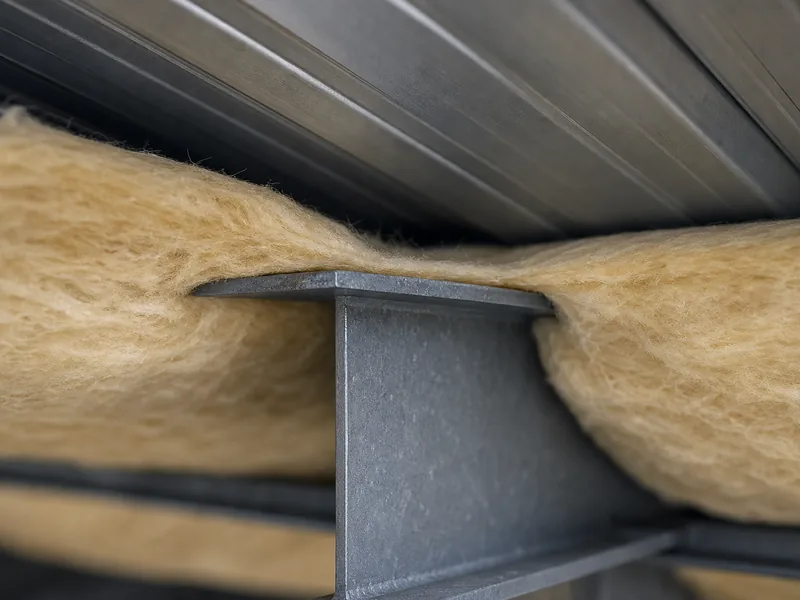
The rated R-value on a label comes from a controlled lab test that assumes the material sits at full thickness, uncompressed, with nothing conducting heat around it. A finished building rarely matches those conditions. Studs, joists, purlins, and girts all conduct heat more readily than the insulation beside them, so heat takes the shortcut through the framing — an effect known as thermal bridging. That shortcut leaves the assembly performing below the insulation’s nominal figure.
Compression is the other common gap. Insulation that is squeezed thinner than its rated loft cannot deliver its full R-value, because the trapped air that does the insulating has been pressed out. A batt rated R-19 at six inches but pinched to three over a framing member is no longer an R-19 batt at that line. Add small installation faults such as gaps at seams or a poorly lapped metal building vapor barrier that lets moisture into the cavity. Together these can push the effective R-value noticeably below the label, with field estimates commonly landing in the 10–25% range depending on the work.
None of this means the label is wrong; it means the label is a ceiling the assembly rarely reaches. The number to design around is the installed, whole-assembly R-value, which is why codes for larger buildings increasingly specify performance as an assembly U-factor rather than a single product rating.
R-value per inch: how insulation types compare
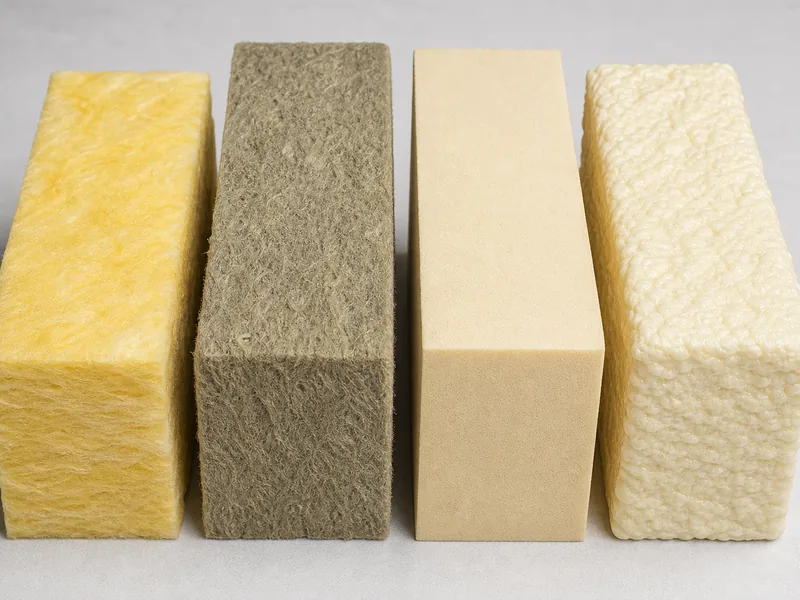
Insulation materials differ widely in R-value per inch, so two products of the same thickness can perform very differently. That per-inch figure decides how much space a target R-value will eat, a real constraint when a wall cavity or a purlin depth is fixed. The table below gives typical ranges; exact numbers vary by product and test conditions.
| Insulation type | R-value per inch (typical) | Notes |
|---|---|---|
| Fiberglass batt / blanket | ~R-3.0 to R-4.3 | Standard metal-building blanket; easy to compress |
| Mineral wool | ~R-3 to R-4 | Similar to fiberglass; better fire and sound performance |
| Cellulose (blown) | ~R-3.5 | Settles over time, which lowers effective R |
| Open-cell spray foam | lower per inch (often cited near R-3.5) | Air-seals but resists less heat per inch |
| Closed-cell spray foam | ~R-6 to R-7 | Highest per inch; also air-seals and adds stiffness |
| Rigid foam board | ~R-4 to R-6.5 | Often used as continuous insulation over framing |
The practical takeaway is that a high per-inch material buys R-value where depth is tight, while a cheaper, lower per-inch material can hit the same target if there is room for thickness. Rigid board stands apart because it is usually installed as a continuous layer over the framing rather than between members, which is how it helps with the thermal-bridging problem from the previous section.
How much R-value you actually need
How much R-value you need depends mostly on your climate zone and which part of the building you are insulating, not on a single universal target. The International Energy Conservation Code (IECC) divides the country into climate zones from warm to cold, and the colder the zone, the higher the recommended R-value. Roofs and attics carry more than walls because heat rises and roof area dominates the heat loss of a low building.
For wood-framed homes, ENERGY STAR and the IECC put attic targets in roughly the R-30 to R-60 band depending on zone, with walls lower. Metal and other commercial buildings are governed by the IECC together with ASHRAE Standard 90.1, which usually express the requirement as an assembly U-factor or as a prescriptive “R-value plus continuous insulation” pairing. In a cold zone such as Climate Zone 5, for example, a metal building roof might be specified as an R-19 blanket plus an R-11 liner system, and a wall as R-13 plus R-14 of continuous insulation. Both pairings are written to hit an assembly U-factor target rather than a bare R number.
Use pushes the target as hard as climate does. A conditioned workshop and a refrigerated cold storage building in the same town need very different envelopes; cold and food storage commonly reach R-38 or higher, often with a double layer or liner to kill thermal bridging at the purlin flanges. Because higher effective R-value is a major lever for energy efficiency in metal buildings, it usually pays to confirm the local code minimum first and then decide how far above it the operating use justifies going.
R-value in metal buildings: closing the gap
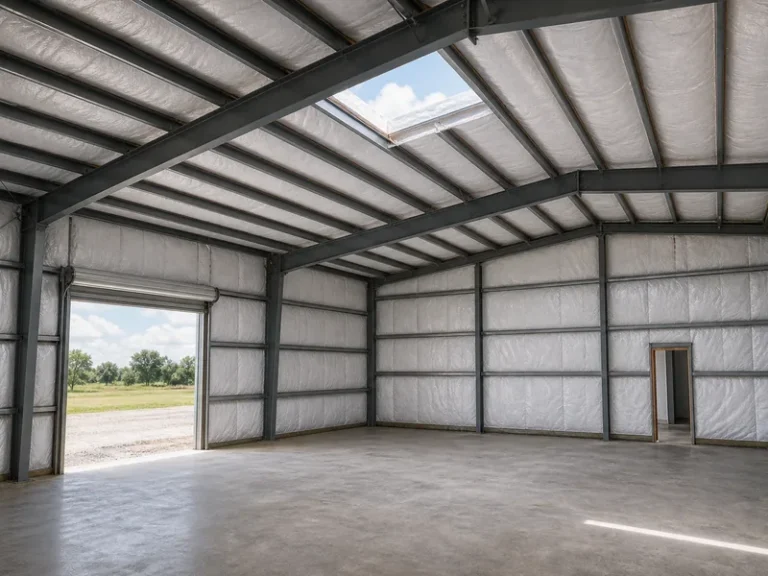
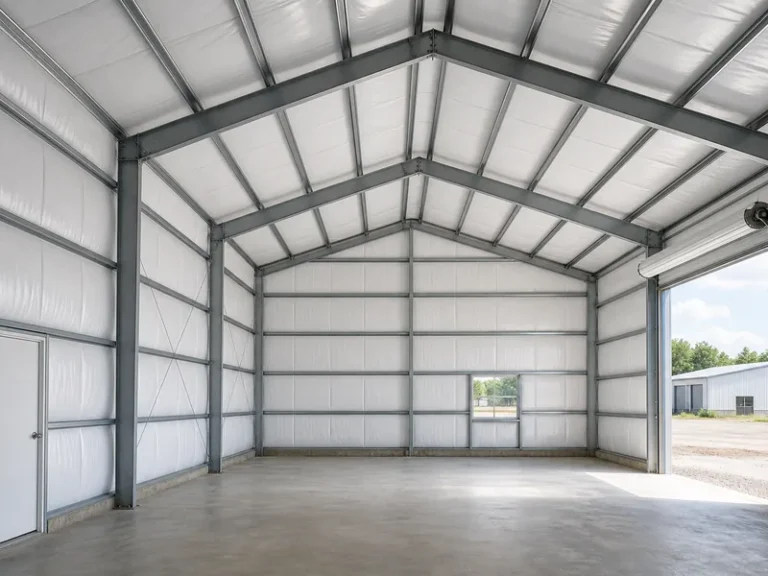
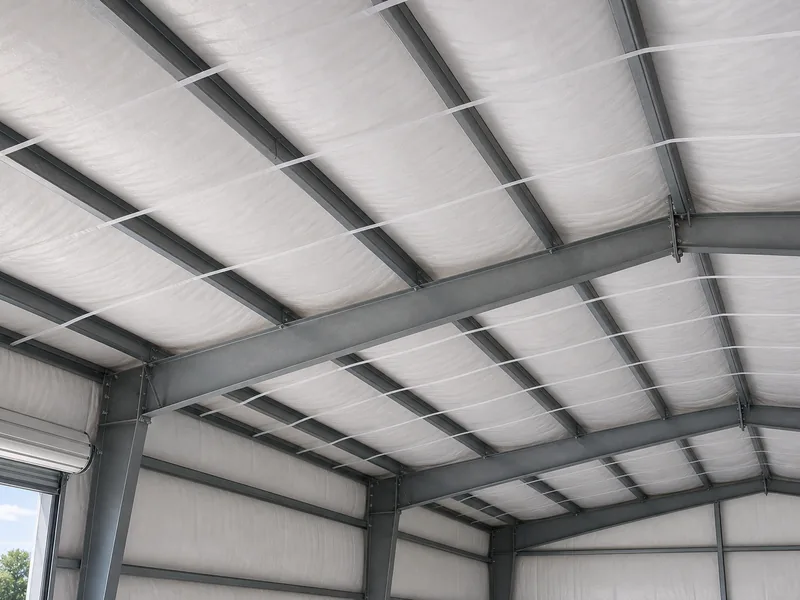
Metal buildings shed more of their rated R-value than wood-framed ones because steel conducts heat far more readily than wood, so every purlin and girt becomes a thermal bridge. A fiberglass blanket laid over the purlins and pinched between the roof sheet and the steel is compressed to a fraction of its rated R right along each framing line, and those lines repeat across the whole roof. The result is an assembly that can test well below the blanket’s label if nothing is done about the bridge.
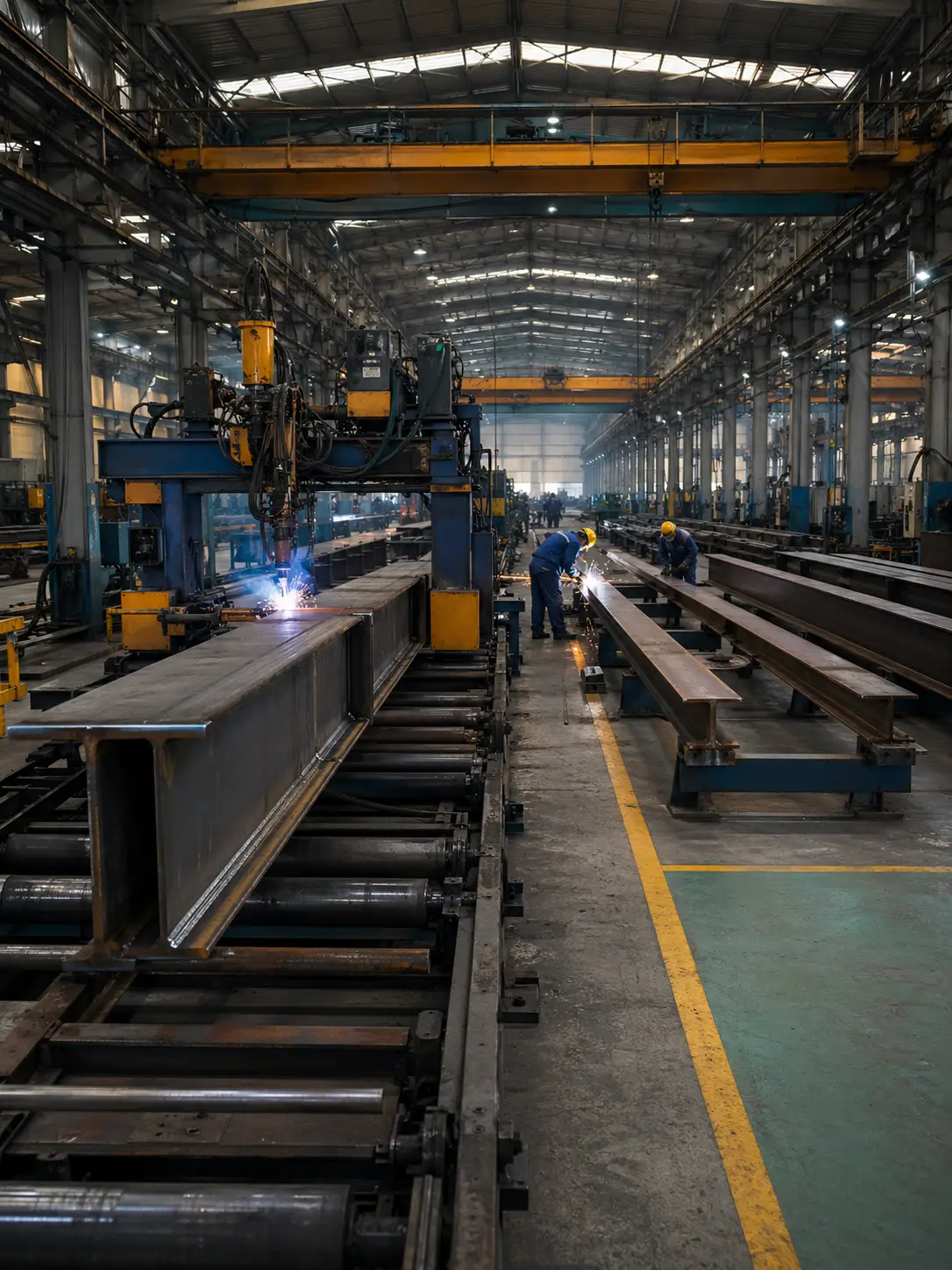
The fixes all work by getting insulation between the steel and the sheet, or by breaking the metal-to-metal path. Thermal spacer blocks lift the sheeting off the purlin and hold some blanket thickness at the bridge; liner systems run two layers of unfaced blanket with a banded fabric facing for a cleaner, deeper cavity; continuous rigid insulation above the framing covers the bridges outright; and insulated metal panels build the resistance into the panel itself. Each adds cost and depth, which is the trade-off behind every metal-building envelope decision. Because the purlins and girts — the metal building components that carry the roof and wall sheets — are fabricated to the frame, the thermal-bridge lines are fixed before any insulation arrives. A steel fabricator like KAFA accounts for those lines when detailing the liner and spacer layout. All of this is why insulating metal building shells well is as much about detailing the framing line as about choosing a high label number.
The goal here is to explain what R-value means and how to target it, not to size insulation for a specific building or replace a local code calculation; both depend on your zone, use, and assembly.
Putting the number to work
A package R-value is a starting specification, not a finished one: it tells you what a material can do in a lab, not what your wall or roof will do in the field. The order that keeps the decision honest is to fix the climate-and-use target first, ideally the assembly U-factor your code lists, then size the material to clear it once the purlin line and any compression have taken their cut. For the step-by-step methods of getting that insulation into a steel shell, see our guide to how to insulate a metal building, so the label number is where the sizing math starts.
FAQ
Is a higher R-value always better?
Higher is not automatically better once you pass your climate-and-use target. Beyond the level your zone and use call for, the added thickness and cost stop paying back. In a tight cavity, a thick batt that gets compressed can even resist less heat than a thinner one installed at full loft.
What R-value do I need for a metal building?
The right figure depends on climate zone and use, but conditioned metal buildings often land around R-13 for walls and R-19 to R-30 for roofs, with colder zones and cold storage pushing higher. Just as important, metal-building codes are usually written as a maximum assembly U-factor, so the target is the finished assembly, not the blanket’s label.
Do R-values add up if I layer insulation?
The R-values of separate layers do add together, so an R-13 batt under R-6 of continuous board reads as about R-19 on paper. The catch is that framing and gaps still pull the installed assembly below that sum, so the layered total is a ceiling the installed assembly stays under.
What is the difference between R-value and U-factor?
R-value measures a single material’s resistance to heat flow and improves as it rises, while U-factor measures how much heat a whole assembly lets through and improves as it falls. Commercial and metal-building energy codes usually set a maximum U-factor because it captures thermal bridging that a bare R-value misses.
Does insulation lose R-value over time?
Some insulation does lose effective R-value as it ages. Loose-fill and cellulose can settle, moisture can soak a cavity, and certain foams lose a little resistance as their blowing agent ages, all reasons the real-world number tends to trail the label.
Further Reading
- U.S. Department of Energy — Energy Saver: Insulation — Government source. Explains R-value and how thickness, density, temperature, and moisture affect it, plus why compression and thermal bridging lower installed performance.
- ENERGY STAR — Recommended Home Insulation R-Values — Government program. Climate-zone R-value recommendations for attics, walls, and floors, based on the IECC.
- ANSI/ASHRAE/IES Standard 90.1 — Energy Standard for Buildings — Standards body. The commercial energy standard behind assembly U-factor and continuous-insulation requirements for metal and other non-residential buildings.