




Aerospace flooring is the resin floor system that lines the working areas of aviation facilities — hangar bays, maintenance shops, assembly halls, and avionics labs — not the lightweight panels installed inside an aircraft cabin. The right system depends on four things an ordinary shop floor never has to handle at once: aggressive aviation chemicals like Skydrol and jet fuel, the concentrated point loads of a parked aircraft, a seamless surface that will not shed debris into an engine, and, in electronics areas, controlled static discharge. Rank those four demands for your operation and the choice between epoxy, urethane cement, polyaspartic, and a static-dissipative build mostly settles itself.
What sets aerospace flooring apart from ordinary industrial floors
An aerospace floor has to survive exposures that would soften or strip a standard industrial coating within a season. Hydraulic fluids such as Skydrol — a phosphate-ester chemistry — attack many common epoxies, and spilled jet fuel, de-icing glycols, and cleaning solvents add to the chemical load. The surface also carries concentrated wheel and jack-point loads from aircraft far heavier than forklift traffic, so it has to resist abrasion and impact without cracking or delaminating at the joints.
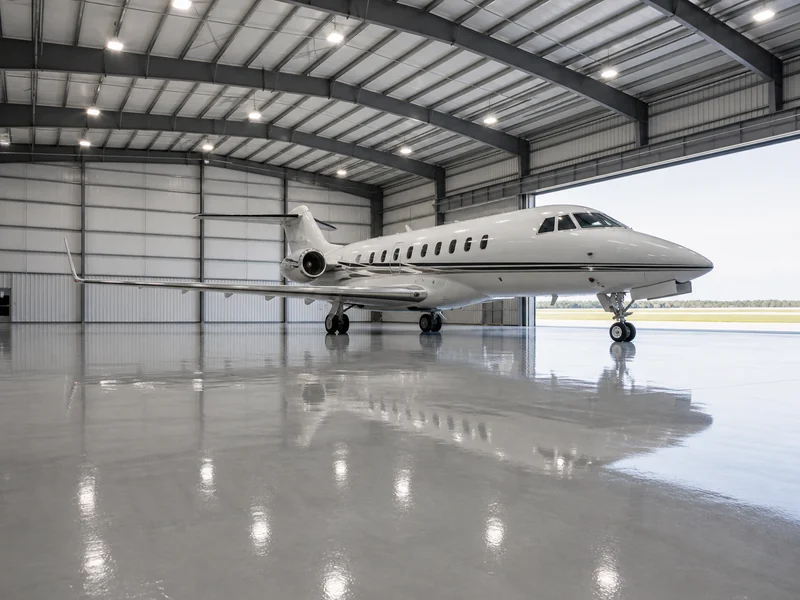
Two further demands separate a hangar floor from a warehouse slab. The finish should be seamless, because control joints and hairline cracks collect grit that becomes foreign object debris (FOD) — the loose material that damages tires and engines. And the topcoat is often deliberately light-reflective, lifting ambient light so technicians can inspect skins, rivets, and fasteners without dragging in extra task lighting.
One clarification before going further: aerospace flooring here means the floor of the facility, not the floor of the aircraft. Cabin, galley, and cargo floor panels are a separate composite product built to airframe specifications from manufacturers like Boeing, Airbus, or COMAC. This article covers the slab-based systems your building sits on.
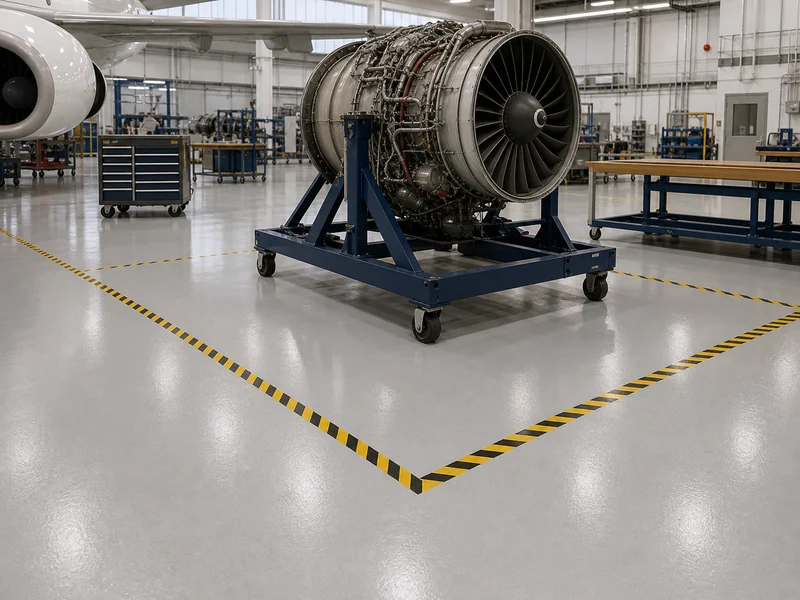
Performance demands that drive every aerospace floor decision
Specifying a floor is mostly a matter of ranking measurable demands, because no single system maxes out all of them at once. The same product that shrugs off Skydrol may amber under UV, and the toughest mortar system may cost several times what a coated bay needs. The list below runs roughly in the order most aerospace projects should weigh them.
- Chemical resistance: the spectrum here is wide — Skydrol and other phosphate-ester hydraulic fluids, Jet A and JP-8 fuels, lubricants, glycol de-icers, and solvents. Match the system’s published immersion data to the chemicals your bay actually sees.
- Load and impact: parked-aircraft point loads, tow tractors, and automated vehicles carrying fuselage or engine sections all bear on a small contact area, so compressive and impact strength matter more than they would in a storeroom.
- Seamless and slip-resistant: a seamless monolithic surface controls FOD and cleans easily, while a textured topcoat keeps it from turning slick under fluids — the slip side of the equation tracks OSHA walking-working-surface expectations.
- UV stability and reflectivity: bays lit by skylights need an aliphatic topcoat that resists yellowing, and a high-gloss finish amplifies light for inspection work.
- Static control: wherever sensitive electronics or fuel vapors are present, a static-dissipative or conductive build replaces a standard insulating floor.
Resin flooring systems used in aerospace facilities
Four resin families cover most aerospace floors, and they differ mainly in thickness, chemical range, and how much abuse they absorb. The table sets the trade-offs side by side; the notes after it explain where each one fits.
| System | Typical build | Best fit | Main trade-off |
|---|---|---|---|
| High-build epoxy | ~45–60 mils | General hangar bays, broad chemical resistance | Slower cure; can amber under UV unless top-coated |
| Polyaspartic / aliphatic urethane topcoat | Thin film over a base | Fast return to service, UV-stable color and gloss | Usually a topcoat, not a standalone wear layer |
| Urethane cement (mortar) | ~1/8–1/4 inch (3–6 mm) | Wash bays, thermal shock, heaviest loads | Higher cost; coarser appearance |
| ESD / conductive system | Varies, with integrated grounding | Avionics labs, fuel-handling areas | Requires grounding design and resistance testing |
High-build epoxy is the workhorse for general hangar floors, giving a thick, seamless wear layer with broad chemical resistance at a moderate price. Polyaspartic and aliphatic urethanes are usually specified as a fast-curing, UV-stable topcoat over that base, shortening the time before a bay can take traffic again. Urethane cement — a resinous mortar laid far thicker — is the choice for wash bays and areas that see thermal shock or the heaviest rolling loads, trading a coarser look for durability. Static-dissipative and conductive systems add a grounded, controlled-resistance path for areas where electronics or vapors make static a hazard. Resilient sheet goods and polished concrete still appear in offices and lower-demand support spaces, but they rarely meet the chemical and load demands of an active bay.

Matching the floor system to each aerospace zone
Different zones inside the same facility pull toward different systems, so it helps to map the building before settling on a single product. A floor specified for the main bay will be wrong for the avionics lab next door, and vice versa.
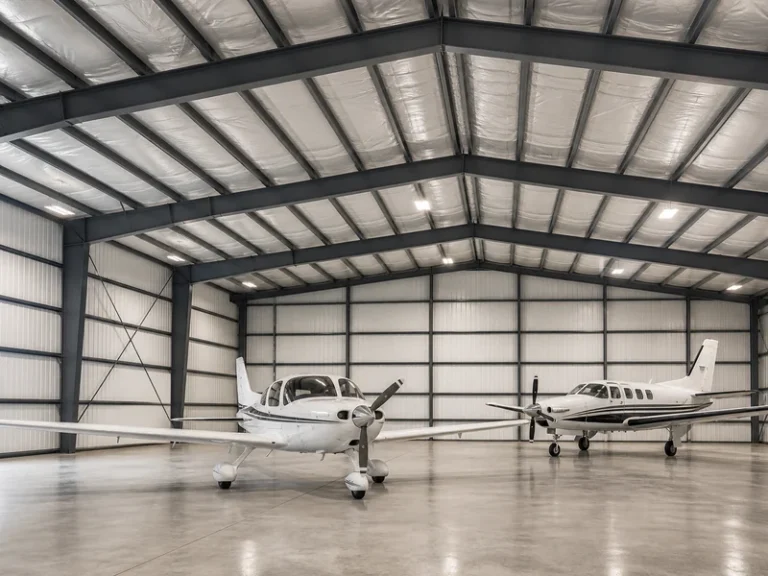
Hangar bays carry the wheel loads and fuel exposure that point toward a high-build epoxy or a urethane-cement base with a light-reflective topcoat, ideally integrated into the overall aircraft hangar design rather than added as an afterthought. A dedicated maintenance hangar or MRO bay sees the most concentrated chemical and impact abuse, which is where urethane cement tends to pay back its higher cost. Assembly and composite-layup areas prioritize cleanliness and dimensional stability, often on a smooth epoxy or a static-dissipative build. Avionics and electronics labs are where ESD or conductive systems become non-negotiable. Fuel storage and de-icing areas combine chemical attack with spill risk, so the floor pairs a chemical-resistant system with drainage and containment detailing.

The concrete slab decides how a resin floor performs
The concrete slab decides how a resin floor performs long before the topcoat is chosen, which is why the structure deserves attention first. Many aerospace floors fail early not in the resin but in the substrate — a slab poured too wet, troweled too smooth for the coating to grip, or never shot-blasted to the right profile. High slab moisture is a frequent culprit, driving blisters and delamination months after a clean-looking install. Confirming moisture content, surface profile, and cure on the concrete slab is the unglamorous step that protects everything laid over it.
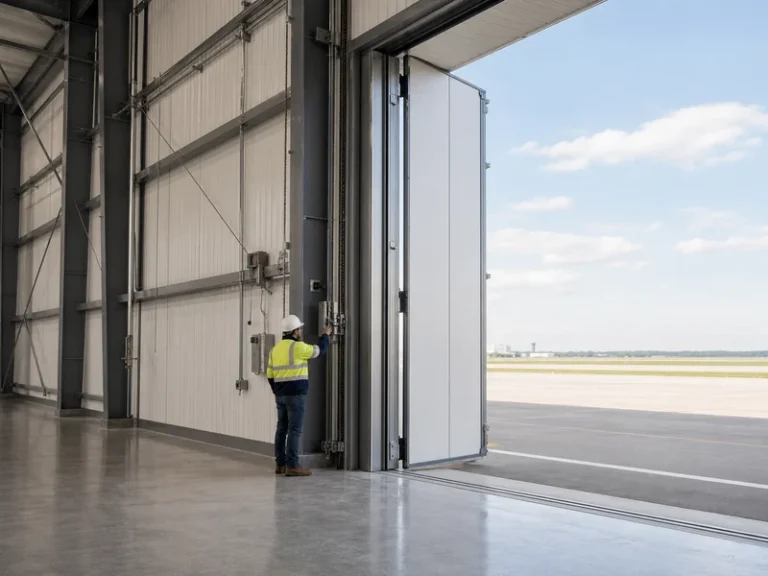
Joints and spans shape the result too. Control joints in the slab telegraph through thin coatings, so a seamless system needs those joints detailed and filled rather than ignored. A column-free bay also makes it far easier to pour and coat one uninterrupted surface, which is one reason a clear-span hangar shell — an aircraft hangar kit with no interior columns — pays off in floor quality as much as in aircraft clearance.
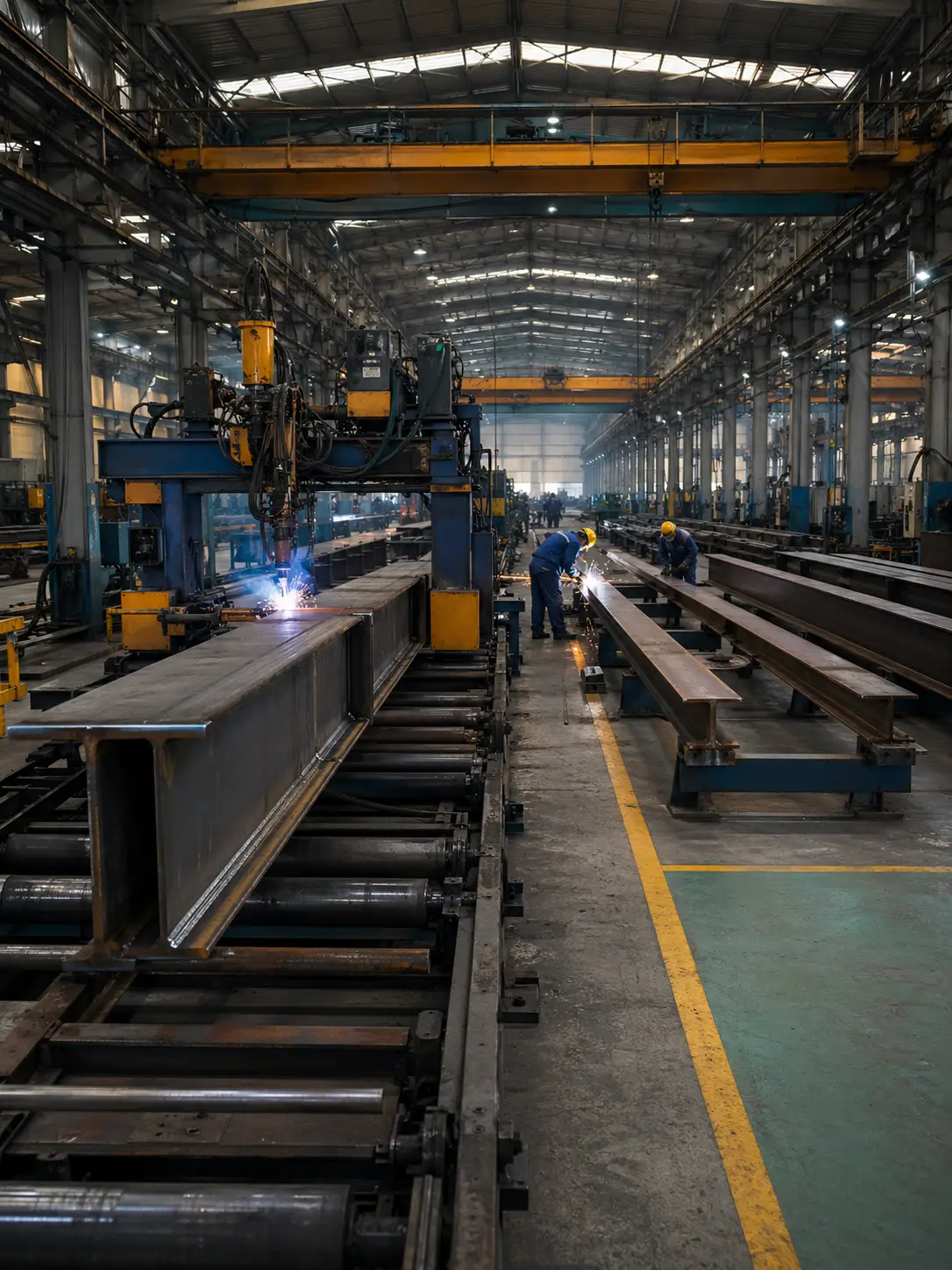
This is where the building manufacturer and the flooring contractor have to coordinate. As a steel structure manufacturer, Qingdao KAFA Fabrication builds column-free hangar shells and prepares the slab and metal building foundation conditions a resin floor depends on, while the topcoat itself is installed by a specialist flooring contractor. Getting the slab flatness, joint layout, and load design right at the structural stage avoids expensive remediation once the resin is down.

Standards and verification for aerospace floors
Standards turn vague performance claims into something you can verify on the specification and at handover. Rather than trusting marketing language, tie each requirement to the document that governs it and ask for the test data.
For static control, ANSI/ESD S20.20 from the EOS/ESD Association defines how a static-control program is built and verified, including the difference between conductive and static-dissipative ranges confirmed by resistance testing. Slip resistance and floor markings track OSHA walking-working-surface rules. Military and federal hangars may call out DOD coating specifications — the MIL-PRF family — in which case the system data sheet should match the named spec rather than a generic equivalent. Fuel and hydraulic handling areas fall under EPA spill-prevention rules, which shape the drainage and containment built around the floor. None of these need to be memorized clause by clause; what matters is naming the right standard in the specification and verifying compliance before sign-off.
Conclusion
The reliable way to specify an aerospace floor is to take it in sequence: define the zone’s real exposures first — which chemicals, what loads, whether static matters — then confirm the slab is dry, profiled, and jointed for a seamless finish, and only then choose the resin system and the standards it must meet. A wash bay that sees Skydrol daily and an avionics lab that needs static dissipation will land on different systems even under the same roof. Both, though, depend on a concrete slab and a structure that were ready before the first coat went down — which makes the floor a decision to settle during building design, not after the hangar is up.
FAQ
How thick should an aerospace hangar floor be?
Aerospace hangar floors usually run thicker than a standard shop coating. High-build resinous systems commonly land around 45–60 mils, while urethane-cement mortars are laid far heavier — roughly 1/8 to 1/4 inch — where loads, wash-down, or thermal shock are severe. The right build depends on the loads and chemicals in that specific bay, not on a single universal number.
Does aerospace flooring resist Skydrol and jet fuel?
Chemical resistance is system-specific, so not every epoxy qualifies. Skydrol is a phosphate-ester hydraulic fluid that is aggressive toward many standard coatings, and jet fuels add their own exposure. Specify a system whose data sheet documents immersion resistance to Skydrol and the fuels your operation handles, rather than assuming any resin floor will cope.
When do aerospace facilities need ESD or conductive flooring?
Static control becomes necessary wherever sensitive electronics or flammable vapors are present — avionics and electronics labs, weapons-handling areas, and fuel zones are typical cases. Those areas call for a static-dissipative or conductive system specified to ANSI/ESD S20.20 and verified by resistance testing, rather than a standard insulating floor.
Can aerospace flooring be installed without shutting down operations?
Phased and off-hours installation is common in working hangars, with bays taken out of service one at a time. Fast-curing polyaspartic topcoats shorten the return to traffic, though full chemical cure still takes time and surface preparation cannot be rushed. The realistic schedule depends on the system, the slab condition, and the temperature during the install.
How much does aerospace flooring cost?
Cost spans a wide range because the systems do. Thin DIY-style epoxy kits cover materials only, at a few dollars per square foot. A professionally installed high-performance urethane-cement or ESD system costs significantly more once surface preparation, thickness, and static control are included. That figure still excludes slab repair, which is priced separately when the substrate is not sound, and surface prep and the required performance level move the number more than the resin choice alone.
Further Reading
- ANSI/ESD S20.20 standards — EOS/ESD Association — the ANSI-accredited body for electrostatic-discharge control; the reference for specifying and verifying ESD or conductive aerospace floors.
- Walking-Working Surfaces — OSHA — the U.S. workplace standard behind slip-resistant finishes and floor markings in hangars and maintenance shops.
- Spill Prevention, Control, and Countermeasure (SPCC) — U.S. EPA — federal oil and fuel spill-containment rules that shape drainage and containment around fueling and maintenance floors.