Beverage warehouse design sizes the storage building around three inputs: the weight of a loaded beverage pallet, the SKU mix, and the temperature each product needs. A beverage warehouse for water and carbonated drinks carries heavy floor loads; juice and dairy drinks add a chilled envelope. Lock the slab and the temperature program first; racking and fire protection follow from them. This guide covers finished-goods storage, not the bottling plant upstream.
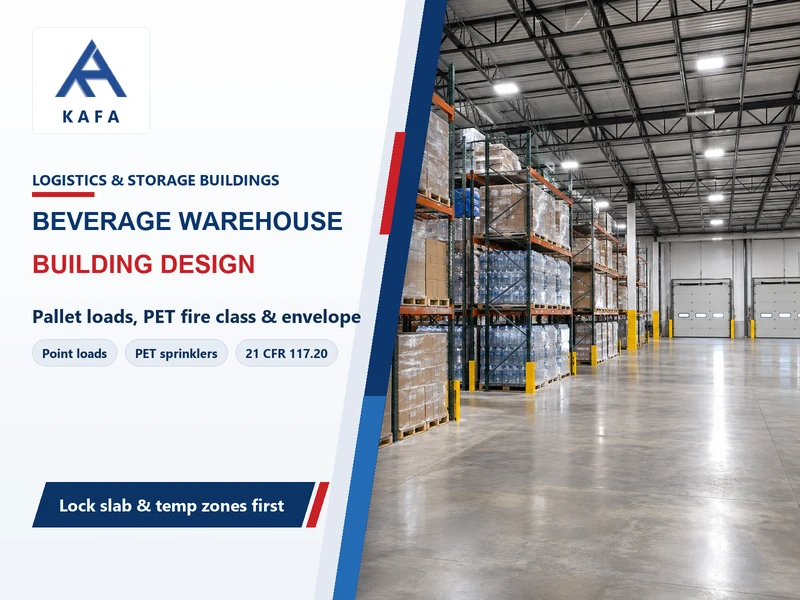
How heavy is a beverage pallet?
A loaded beverage pallet ranks among the heaviest unit loads in dry storage, since water and carbonated drinks weigh about 8.34 lb per gallon before packaging. The density of water is the starting point for beverage warehouse design. It catches owners who picture drinks as light consumer goods.
Work through an illustrative pallet of bottled water. A 24-pack of 16.9 fl oz bottles holds 3.17 gallons of water. At 8.34 lb per gallon, the water alone weighs 26.4 lb. Add about 2 lb for bottles and carton, and one case lands near 28 lb. Assume 50 cases on a standard 48 in by 40 in pallet, five layers of ten.
Pallet product weight = 50 cases × 28 lb = 1,400 lb
Add a 40 lb pallet, and the loaded unit reaches about 1,440 lb. Substitute your own bottle size, cases per layer, and layer count (which depends on bottle type and stacking strength) into the same chain to get your number. Spread over the 13.3 ft² pallet footprint, that is roughly 108 psf of net average pressure.
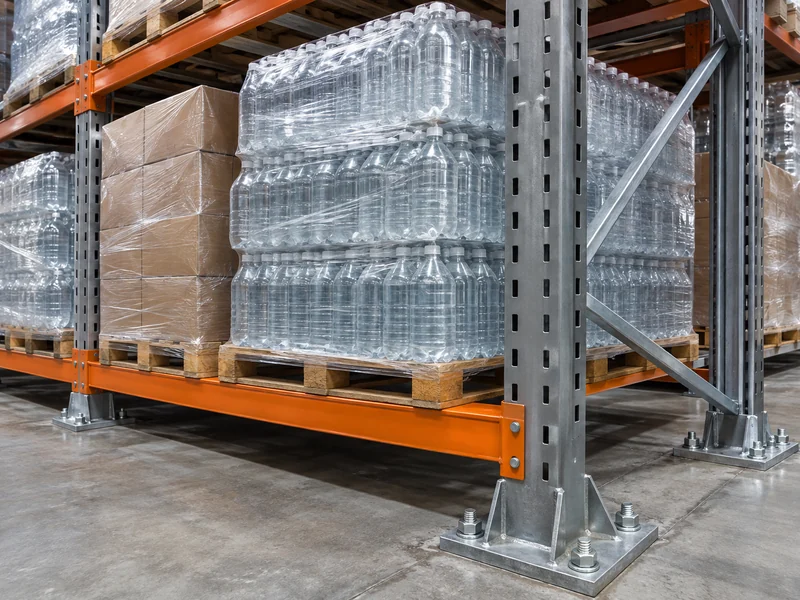
The 108 psf figure is not the slab design load. A selective rack upright gathers the weight of several pallet positions onto a base plate of a few square inches. The governing check is that concentrated reaction, plus forklift wheel loads and the rack’s own steel. The ACI PRC-360-10 Guide to Design of Slabs-on-Ground covers these slab-on-grade methods, including rack loads and joint detailing. Size the concrete slab for a steel building and the metal building foundation from the rack supplier’s engineered upright reactions. The pallet average is only the input that produces them.
Flatness matters as much as strength. A narrow-aisle truck running at height amplifies floor waviness into mast sway, so finished flatness is a rack-interface specification rather than a cosmetic one. Joint layout and curling control, covered by the slab guide, are what hold that flatness over time.
Which storage system fits your beverage SKU mix?
The right storage system for a beverage warehouse depends on SKU count and throughput: few fast-moving SKUs favor dense lane systems, while many slow SKUs favor selective racks. The Rack Manufacturers Institute publishes ANSI MH16.1, the design specification its member suppliers engineer to. Ask for the engineered rack design and its upright reactions before the slab is fixed.
| Beverage operation | Storage system that fits | Where it does not fit |
|---|---|---|
| High-volume water and CSD, few SKUs | Pallet flow (FIFO) or drive-in (LIFO) lanes for dense cube | Selective rack leaves more aisle space per pallet on uniform stock |
| Mixed RTD brands, many SKUs, moderate throughput | Push-back or selective rack for access | Deep drive-in lanes bury slow SKUs and block rotation |
| High-value wine and spirits, slow movement | Selective rack with a security cage | Drive-in sacrifices the access and counting these need |
Pallet flow gives first-in-first-out lanes, which suits inventory rotation on dated stock. Push-back stores several pallets deep on nested carts, and the lane depth is set by your rack supplier. It runs last-in-first-out, so dated product needs care. Drive-in lanes are also last-in-first-out, so like push-back they need lot control for dated stock; pallet flow is the dense option that keeps first-in-first-out rotation. A warehouse management system tracks lot and expiry so rotation picks the right pallet; the building must provide clean, unobstructed location access for it.
Beverage volume also swings with seasonal demand peaks — summer, holidays, and promotions. The storage cube must absorb that surge without leaving permanent empty space the rest of the year. For a general tour of pallet racking systems and their components, that guide covers the hardware. Here the choice turns on the beverage SKU profile. Whatever the system, the clear height and column grid must clear the rack and the forklift mast, a layout question settled in warehouse building design. Keep a staging strip near the docks for inbound checking and outbound consolidation, sized to the peak shift rather than the average, so a surge does not push pallets into the aisles.
What temperature and humidity do beverages need?
Beverage storage temperature follows the product, not the building: ambient water and spirits, chilled juice and dairy drinks, and stable cool conditions for wine each set a different envelope. Temperature control and humidity together decide whether the shell is a dry warehouse or a refrigerated one.
| Beverage category | Storage condition | What drives it |
|---|---|---|
| Bottled water, carbonated soft drinks | Dry ambient, protected from freezing | Water freezes near 32°F (0°C) and bursts bottles |
| Refrigerated juice and dairy RTD (not aseptically packed) | Chilled, about 34–40°F (1–4°C) | Microbial spoilage above the chilled band; shelf-stable aseptic/UHT packs store ambient until opened |
| Pasteurized beer | Stable ambient; unpasteurized craft often chilled | Flavor stability; yeast activity only in unpasteurized or bottle-conditioned beer |
| Wine | Cool and stable, a common planning target about 50–59°F (10–15°C) | Quality; wine is sensitive to heat and swings |
| Spirits | Ambient, stable | High alcohol lowers the freeze point |
The chilled band follows KAFA’s refrigerated warehouse design guidance for produce, dairy, and beverages. Refrigerated juice and dairy RTD ride a cold chain from the plant to the shelf, and the warehouse is one node in it. Aseptically packed shelf-stable juice and UHT dairy drinks store ambient until opened, a distinction the FDA Juice HACCP guidance draws between refrigerated and shelf-stable juices. In cold climates, an unheated water warehouse needs freeze protection even though the product is “ambient,” because freezing bursts glass bottles and deforms PET, turning a pallet into a loss or a rework job. Hold relative humidity near a common dry-store planning target of about 50–60% so labels and cartons stay dry and steel stays out of the corrosion range. In a chilled room, keep the air dew point below the coldest surface. A chilled room also needs temperature monitoring with an alarm, because a silent refrigeration fault overnight can drift a whole pallet of juice out of the band before anyone arrives. The monitoring catches an excursion that the envelope alone cannot prevent.
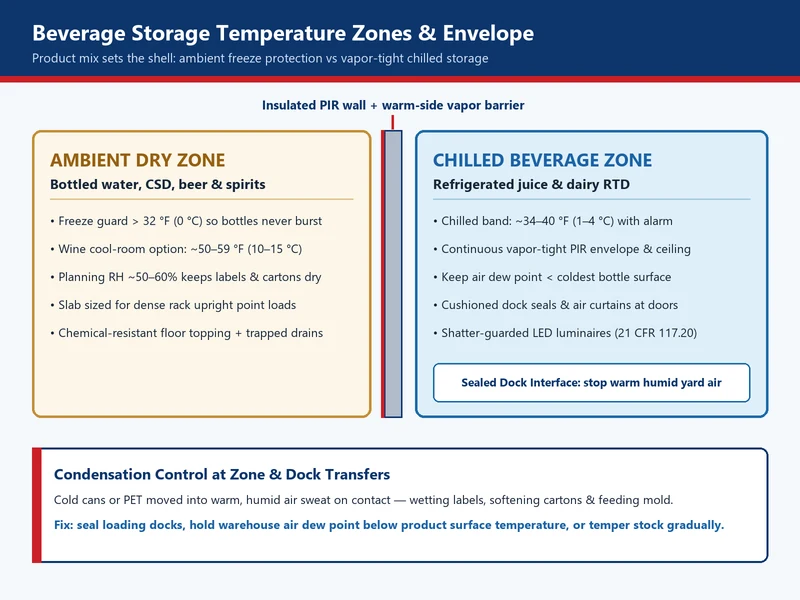
Condensation damage accumulates unnoticed. Cold product moved into a warm, humid warehouse sweats on contact. The drip wets labels, softens cartons, and feeds mold on the pallet. Dock seals and air curtains limit humid-air infiltration; the fix is to keep the warehouse-air dew point below the cold product’s surface temperature, or to temper the product gradually, so moisture cannot condense on it. The thermal side — insulation R-value, vapor barrier, refrigeration sizing, and frost heave — belongs to the refrigerated guide. This storage overview stops at the envelope interface.
How do spills and washdown shape the floor?
Spilled syrup, juice, and beer turn a beverage warehouse floor into a chemical and hygiene load, so the slab needs a sealed, sloped, cleanable surface rather than bare concrete. Sugar residue is sticky, acidic, and a pest attractant. That accumulation is what the OSHA 1910.176(c) housekeeping rule requires you to remove.
Specify a sealed, chemical-resistant topping pitched to trapped drains, so washdown water and product carry away instead of pooling. The floor must tolerate the actual product: sugar acids, juice acids, and the caustic or acid cleaners used on site. Verify the coating against those chemicals and their contact time. Atmospheric-corrosivity classes do not rate splash exposure, so they cannot substitute for that check.
Expect the first corrosion at the wall-base joint. Sugary washdown water runs to the perimeter and sits against the cladding and fasteners. It corrodes the coating at the floor line while the field of the wall looks fine. Detail a coved, sealed base and a corrosion-resistant coating in the splash zone. Keep the food industry warehouse management cleaning program pointed at that joint, and slope the yard away from the doors so the grounds drain.
Why does PET change the fire protection design?
PET bottles and shrink wrap bring plastic into the stack, so the sprinkler commodity class must be set under the standard’s plastic rules, based on plastic content and packaging. A beverage warehouse storing them needs a fire protection design matched to that commodity class, not to the water inside. The water is non-combustible; the packaging is not, and it is the packaging that burns.
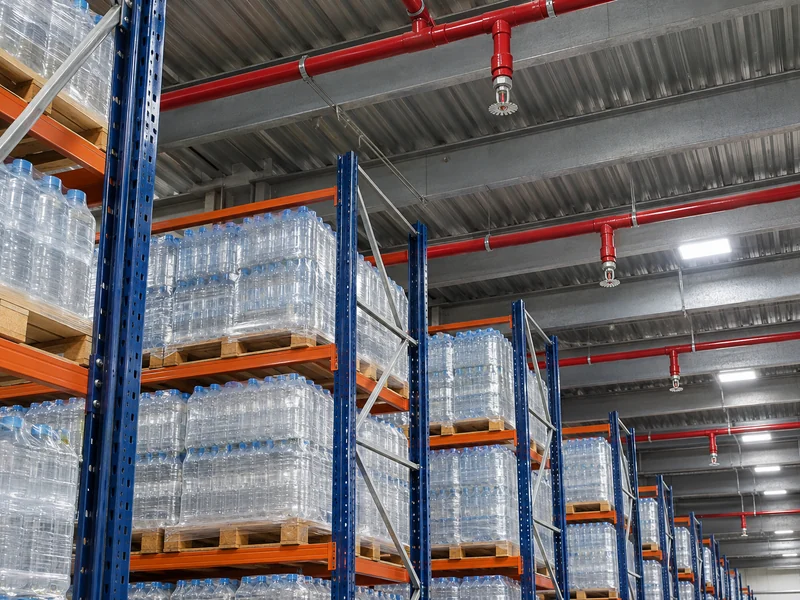
NFPA 13, the Standard for the Installation of Sprinkler Systems, sets commodity classes that drive the sprinkler design. FM Global Data Sheet 8-9 addresses storage of plastic commodities. Cartoned PET bottles and shrink-wrapped packs are judged by that plastic content and packaging. High-pile rack storage then pushes the design toward ESFR ceiling sprinklers or in-rack heads. The clear height you chose for the rack feeds straight into that decision. Rack layout feeds it too: the flue spaces between pallets let sprinkler water penetrate the stack, and blocking them with overhang or solid shelving changes the arrangement the design assumed.
Misclassifying bottled water as a non-combustible commodity is the error to avoid, because it under-sizes the sprinkler system for the plastic actually present. Confirm the commodity class and the sprinkler design with both your insurer and the local authority having jurisdiction before the roof height is locked. The general warehouse MEP coordination covers how fire protection ties into the frame and roof.
What does food-grade storage demand from the envelope?
Food-grade beverage storage falls under 21 CFR 117.20 holding requirements, which set performance targets for cleanable surfaces, pest exclusion, and condensate control rather than one fixed construction. The rule applies to holding as well as manufacturing. A finished-goods beverage warehouse is therefore in scope under 21 CFR Part 117, the FSMA human-food rule: the Subpart B CGMPs (including 117.20) apply to holding, and the Subpart C preventive-controls requirements apply unless a specific exemption or modified requirement, such as the qualified-facility or very-small-business provisions, covers the operation.
Section 117.20(b)(2) lets you prevent allergen cross-contact and contamination by location, time, partition, airflow, dust control, or enclosed systems. It is a performance standard. It does not mandate one wall build. For a warehouse running dairy-based and nut-based drinks beside ambient stock, that means a segregation plan the envelope can support. Section 117.20(b)(4) requires floors, walls, and ceilings that clean up and stay in repair. It also bars drip or condensate from fixtures, ducts, and pipes landing on food or packaging. Section 117.20(b)(5) calls for adequate lighting where food is held, plus shatter-resistant fixtures or protection over exposed product. In a beverage warehouse that means guarded or shatterproof high-bay fittings above the pick face, so a broken lamp cannot contaminate open cases.
Pest exclusion is the other half. Section 117.20(b)(7) calls for screening or other protection where necessary, and (a)(3) requires drained grounds so the yard does not breed pests. Dock seals, sealed penetrations, air curtains, and a perimeter inspection aisle are the common engineering answers. Food-grade warehousing audits such as SQF check that they work. The 21 CFR 117.20 text is the source for these provisions. The day-to-day rotation, traceability, and pest program sit with operations; the shell provides the surfaces and seals those programs rely on.
Which beverage warehouse design fits your product mix?
The building program that fits a beverage warehouse follows its product mix, and three common mixes point to three different priorities. Among the inputs to beverage warehouse design, the pallet load and the temperature program are locked first, because the slab and the envelope are irreversible once poured. The rack system can be re-engineered inside that capacity later.
- Ambient water and CSD hub: Prioritize slab point-load capacity and dense storage cube. If you store only ambient water and CSD on selective racks at modest height, a standard dry-warehouse slab and envelope already suffice. The beverage-specific upgrades earn their cost when loads, chilling, or PET height push past that baseline.
- Chilled juice and dairy RTD: Prioritize the temperature program and a vapor-tight insulated envelope before the frame, with condensation control at the docks.
- High-value wine and spirits: Prioritize security zoning and stable cool conditions, and choose selective access over storage density.
We coordinate the clear-span frame, column grid, and slab reactions around your rack layout and temperature zones. The shell arrives matched to the storage program instead of patched on site. If your pallet reactions and temperature zones are set, the next step is to hand the column grid and upright reactions to your shell manufacturer for verification against the steel warehouse buildings package.
FAQ
Can a standard dry warehouse store bottled water?
Yes, for ambient water and CSD, if the slab carries the rack upright reactions. The gap is floor capacity rather than temperature.
Do beverage warehouses need refrigeration?
Only for chilled products. Juice and dairy-based RTD need the chilled band; ambient water, CSD, and spirits do not, though cold-climate water stores still need freeze protection.
How high can beverage pallets be racked?
There is no universal height. Clear height, the sprinkler commodity class, and the rack supplier’s engineered design set it together; confirm the fire design before fixing the roof.
What floor finish handles beverage spills?
A sealed, chemical-resistant topping pitched to trapped drains. Verify it against your product’s sugar and acid load and the washdown chemicals, and detail the wall-base joint for the same exposure.
Is bottled water a fire hazard in storage?
The water is not. The PET bottles and shrink wrap are plastic commodities, and the sprinkler design follows the packaging rather than the liquid.