




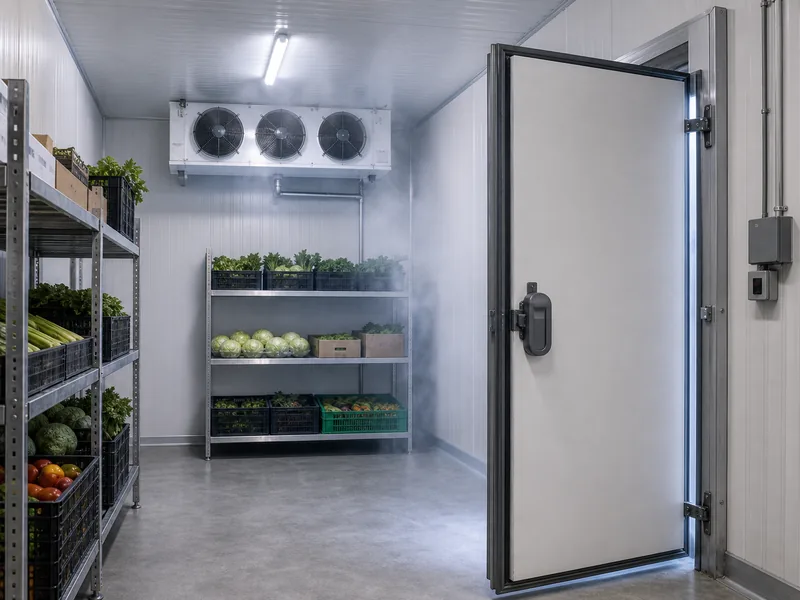
A coolroom that drifts off temperature, frosts up, or sweats is rarely suffering from one mysterious fault. Most coolroom problems trace back to a short list of recurring causes, and nearly all of them fall into two groups: the building envelope (door seals, insulation panels, and the vapor barrier that keeps moist air out) and the refrigeration system (refrigerant charge, coils, defrost, and controls). Knowing which group you are dealing with is the first move, because an envelope fault and a refrigeration fault can produce the same symptom, a room that will not get cold, while needing completely different repairs. This guide walks through the problems operators actually run into, what causes each one, and how to tell an envelope issue from a mechanical one before you call anyone out.
A Coolroom That Won’t Hold Temperature
Temperature that will not settle is the most frequent coolroom complaint, and it has causes on both the envelope and the refrigeration side. On the envelope side, a propped door, a worn gasket, or wet insulation lets warm air bleed in faster than the unit can remove it, so the room reads warm even while the refrigeration runs hard. On the mechanical side, low refrigerant charge, a fouled condenser coil, an iced evaporator, or a thermostat reading the wrong temperature all leave the system unable to pull the room down to setpoint. A quick way to separate the two is to watch the run pattern. A unit that runs almost constantly while the room stays warm points to refrigeration capacity or airflow. A room that holds fine until a busy stretch of door traffic warms it up points to the envelope and door discipline. Chilled storage usually sits somewhere around 0–10°C (32–50°F) depending on the product, and frozen rooms around −18°C (0°F) or below. For food held cold for safety, the FDA Food Code keeps cold-holding at or below 41°F (5°C), so a room drifting above that has become a food-safety problem, not just an inconvenience.
Frost and Ice Build-Up on Coils and Floor
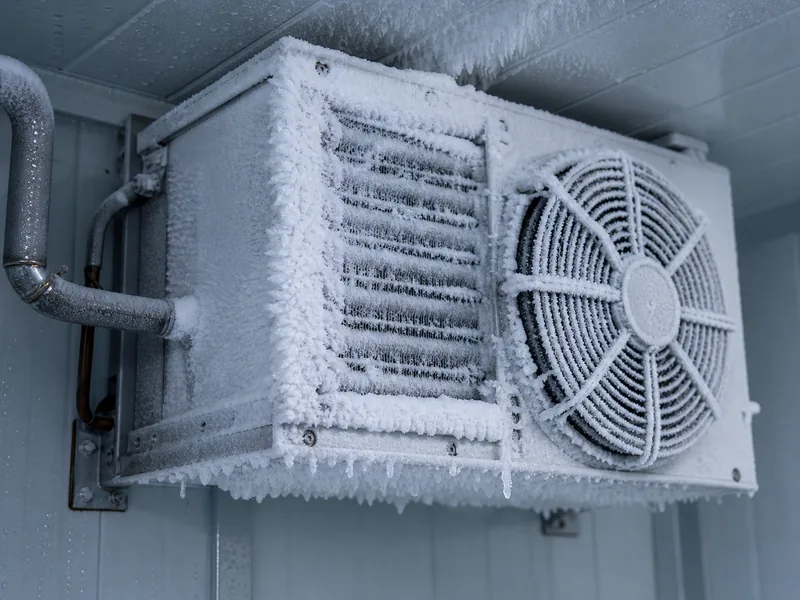
Frost inside a coolroom is a moisture problem first and a refrigeration problem second, which is the reverse of what many operators assume. Every door opening rolls warm humid air into the room, and that moisture condenses and freezes on the coldest surfaces it can reach, usually the evaporator coil but also the ceiling, the door frame, and the floor by the threshold. A thin, even frost on the evaporator is normal and the defrost cycle clears it; heavy or fast-returning ice usually means the defrost cycle has failed, a door is leaking, or humid outside air has found a path in. Ice on the floor and around the door is a different signal that points to air infiltration, and in freezer rooms it can also mean a failed under-slab heater is letting the ground freeze and heave. Before blaming the refrigeration, check the defrost timer and the door seals, because a recurring sheet of floor ice almost always traces back to the envelope rather than the compressor.
Condensation, Sweating Panels, and Mold
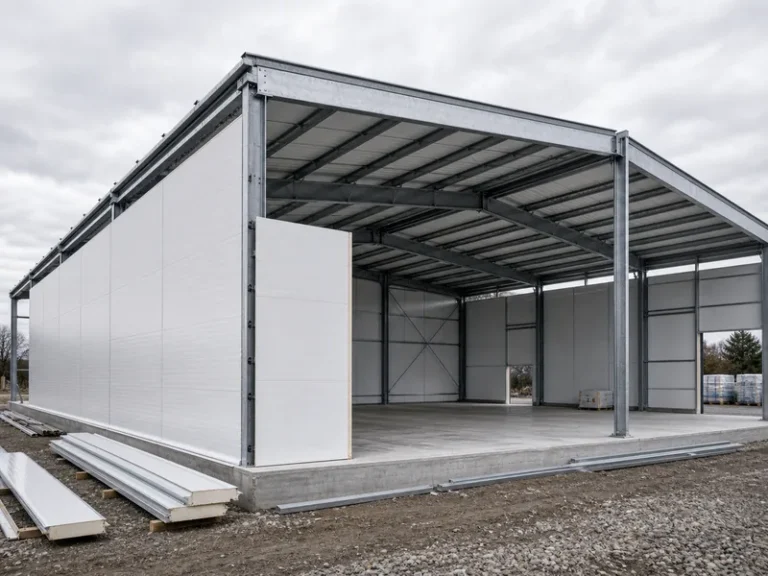
Condensation on coolroom panels means warm, moist air is reaching a surface below its dew point, and left alone it turns into the mold, corrosion, and rotting panel cores that cut a room’s life short. The root cause is almost always the vapor barrier: a coolroom panel has to stop water vapor, not only heat, and that barrier has to be continuous and sit on the warm, outside face of the insulation. Where the barrier is broken at a panel joint, a cable penetration, or a dented skin, vapor drives into the panel and wets the insulation. Wet insulation then loses much of its R-value, so the surface gets colder and sweats even harder. That feedback loop is why a small breach shows up first as a damp patch, then a moldy seam, then a soft panel.
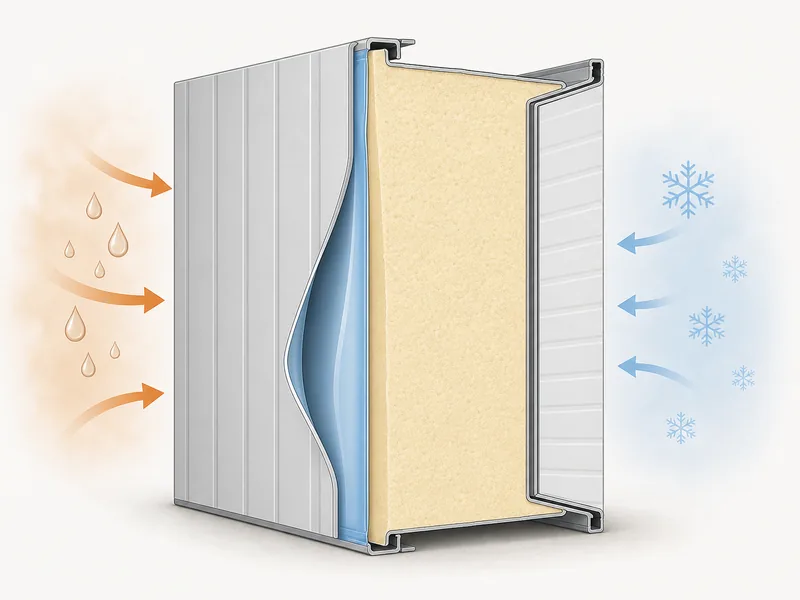
The fixes here are envelope work rather than refrigeration: reseal joints and penetrations, keep interior humidity in check, and repair any panel skin that has been forklift-dented or cut. Knowing how a vapor barrier is meant to work is the difference between treating the damp patch and stopping it.
Door Seals, Gaskets, and Cold-Air Loss
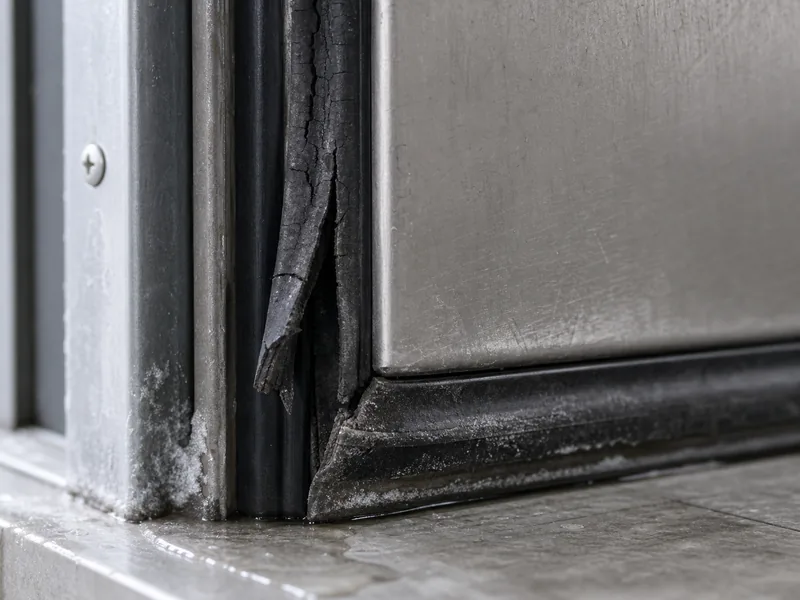
A failing door lets cold air leak out and humid air seep in, and because that feeds half the faults above, a worn seal is both easy to find and costly to leave alone. Gaskets harden, tear, and lose their spring with age; hinges sag until the door no longer pulls flush; and closers or strip curtains get propped open or torn during a busy service. There is a field check that needs no tools: close the door on a sheet of paper and try to pull it out, and if it slides free with no drag the gasket has lost its seal at that point, so you can walk the whole perimeter that way. A sagging door and a worn threshold sweep are the usual reason floor ice keeps returning at the entrance. Replacing a gasket or adjusting a closer is routine maintenance, and the payoff is steadier temperature, less frost, and a lower energy bill, which is why door checks belong on every service visit.
Refrigeration Faults That Need a Licensed Technician
Some coolroom faults sit inside the sealed refrigeration system, and these are the ones to diagnose by symptom and then hand to a qualified technician rather than open up yourself. Each has a fairly clear signature:
- A slow refrigerant leak shows as gradually weaker cooling, longer run times, and ice in odd patterns on the evaporator.
- A failing compressor announces itself with new noise, short-cycling, or tripped breakers.
- A seized condenser or evaporator fan kills airflow, so the room will not cool even on a full charge.
- A blocked condensate drain leaves water pooling on the floor.
Keeping the condenser coils clean and clear of dust and grease is fair game for the operator, since a fouled coil makes the whole system work harder, but anything involving refrigerant is regulated work: in the US, handling refrigerant requires EPA Section 608 certification, and opening the sealed system without it is both unsafe and against the rules. The practical division is to clean coils, clear drains, and check airflow in-house, and to call a licensed refrigeration technician for charge, compressor, and electrical faults.
Insulation and Envelope Faults Behind Rising Energy Use
A coolroom that costs more to run each month is usually flagging an envelope or maintenance fault well before the equipment fails outright. Energy creep has a few repeat offenders: leaking door seals, fouled condenser coils, an evaporator that keeps icing, and the one operators tend to overlook, insulation that has absorbed moisture and lost performance. Rigid panel cores such as PIR and PUR resist heat flow better per inch than lighter foams, but any panel loses much of its value once water reaches the core, which is why the condensation problem above and the energy problem here are really one fault at two stages. Good insulation for metal buildings only performs while it stays dry and unbroken. Thermal bridging adds to the load, because every metal fastener or structural member that runs straight through the insulation gives heat a shortcut, and on a poorly detailed room those bridges read as frost lines on the wall. Where operating costs keep climbing despite solid maintenance, the envelope is usually the limiting factor, and upgrading panel and seal quality does more than any control adjustment.
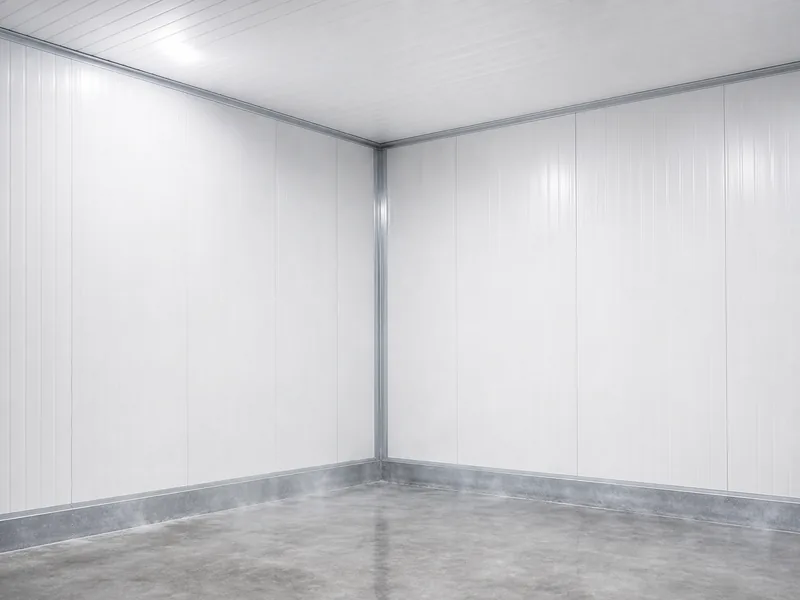
Where to Start When a Coolroom Acts Up
When a coolroom misbehaves, work from the envelope inward before assuming the equipment has failed. Start with the cheap, no-tool checks that catch a large share of faults: walk the door seals with the paper test, look for floor ice and damp seams that flag air leaks and a broken vapor barrier, and confirm the defrost cycle is actually clearing the coil. If those are sound and the room still will not hold temperature, the fault is more likely inside the sealed system, and that is the point to bring in a licensed refrigeration technician instead of guessing. The pattern to watch for is the fault that keeps returning: the seam that keeps sweating, or the floor that keeps icing. A fault that returns after every repair is usually the building telling you the envelope was never right. No service visit fixes a cold storage building that was sealed and insulated poorly during construction. On a recurring envelope problem, the durable fix lives in the panels, seals, and detailing, not the controls.
FAQ
Why is my coolroom not getting cold?
A coolroom that will not reach temperature splits fairly evenly between envelope and refrigeration causes, so check the easy envelope items first. Confirm the door seals and closes flush, look for an iced-over evaporator coil, and make sure the condenser coil is clean with clear airflow. If the door seals, the coils are clean, and the unit runs constantly but still cannot pull the room down, the likely causes are low refrigerant charge or a failing compressor, both of which are jobs for a licensed technician.
Why is there frost in my coolroom?
Frost signals that humid air is getting in and freezing on cold surfaces, not automatically that the refrigeration is broken. A light, even frost on the evaporator is normal and clears on defrost, while heavy or recurring ice points to a failed defrost cycle, a leaking door seal, or a gap in the vapor barrier. Floor ice near the door is almost always air infiltration, so check the door sweep and gasket before anything else.
What causes condensation on coolroom walls and ceiling?
Condensation forms when warm, moist air reaches a surface colder than its dew point, which in a coolroom means the vapor barrier or insulation is letting that air through. The fix is envelope work, sealing panel joints and penetrations and keeping interior humidity controlled, rather than dropping the temperature, which only makes the sweating worse.
What temperature should a coolroom be?
The right setpoint depends on what you store, with chilled rooms typically running around 0–10°C (32–50°F) and freezer rooms around −18°C (0°F) or colder. For food held cold for safety, the FDA Food Code sets cold-holding at or below 41°F (5°C), so that figure is a ceiling many food businesses cannot drift above rather than a target.
How often should a coolroom be serviced?
Most coolrooms should be professionally serviced at least twice a year, with heavy-use rooms checked every three to six months. Between visits, operator-level checks such as cleaning condenser coils, testing door seals, and clearing condensate drains head off a large share of the faults that otherwise build up unnoticed.
Further Reading
- Walk-In Coolers and Walk-In Freezers (U.S. Department of Energy) — U.S. DOE. Federal energy-efficiency standards and test procedures for walk-in coolers and freezers; useful for understanding why both equipment efficiency and the building envelope drive a coolroom’s running cost.
- ASHRAE (American Society of Heating, Refrigerating and Air-Conditioning Engineers) — ASHRAE. Standards and handbooks covering refrigeration load, insulation, and the dew-point and condensation control behind the moisture and temperature problems above.
- Significant New Alternatives Policy (SNAP) Program (U.S. EPA) — U.S. Environmental Protection Agency. Background on approved refrigerants and substitutes, relevant when a refrigerant leak means a system has to be recharged or converted by a certified technician.