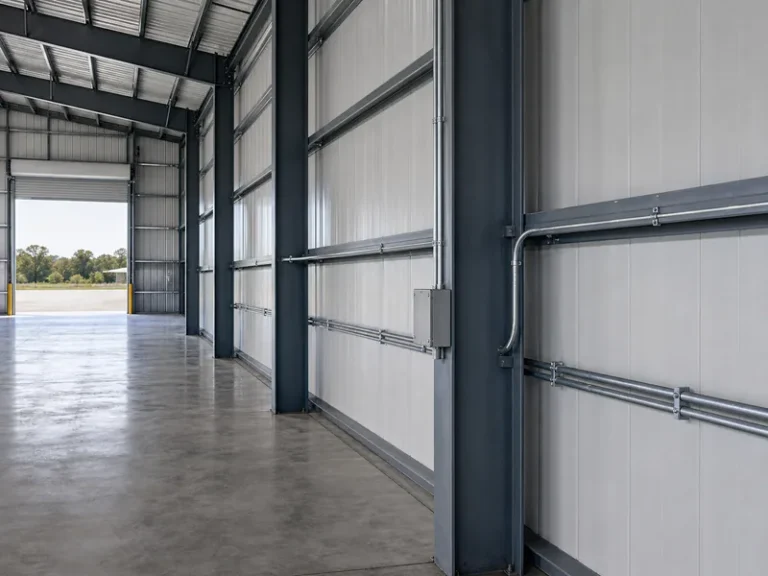





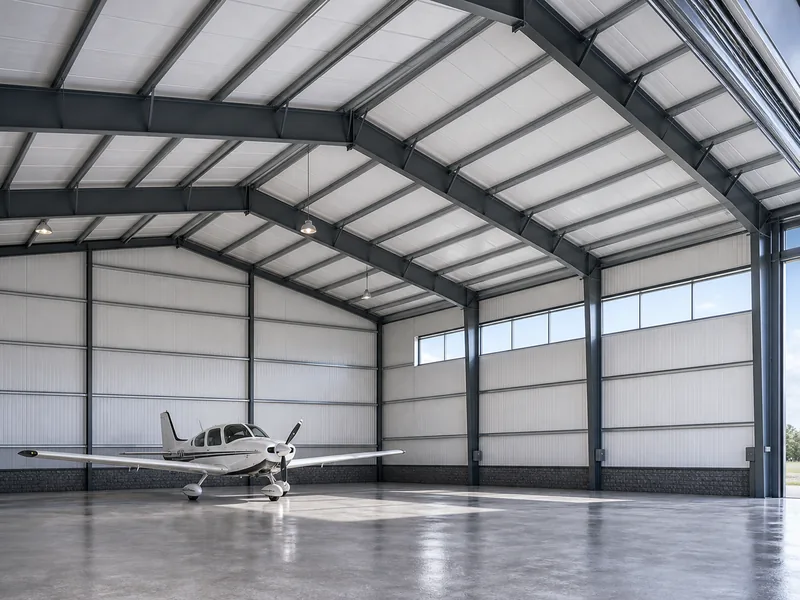
The right aircraft hangar insulation depends on three things you can settle up front: your climate, whether the space will be heated or cooled, and how much of the budget the envelope can take. Five options cover almost every hangar built today: reflective and radiant barriers, fiberglass batt, rigid board, closed-cell spray foam, and insulated metal panels. They separate cleanly once those three questions are answered. A reflective layer is often enough for an unheated tie-down hangar in a hot, dry state, while a humid or cold-climate hangar holding avionics usually needs continuous insulation and a vapor retarder. This guide compares the five options on R-value, moisture behavior, and cost, then covers the hangar door and condensation control. It does not cover frame design, door machinery, or HVAC sizing, which are separate decisions.
What to Settle Before Choosing Hangar Insulation
Three variables decide which hangar insulation fits: your climate zone, whether the hangar will be conditioned, and the moisture load you need to keep off the steel. Climate sets how much R-value the envelope has to carry and whether the priority is blocking summer radiant heat or holding winter warmth. The conditioning question is the bigger fork, because an unheated hangar and a climate-controlled one call for different materials, not just different thicknesses.
Insulation by itself does not stop condensation, and in an unconditioned hangar it can make the problem worse by holding humid air against cold metal. That single point reshuffles the whole decision: if the hangar will not be heated, cooled, or dehumidified, the goal is radiant control and weather-tightness rather than deep R-value. Insulation also never works alone, since the R-value, the air sealing, the vapor retarder, ventilation, and the door all interact, and a weak link in any one of them shows up as a cold wall or a wet one. The same physics behind any metal building insulation system applies here, only over a far larger volume and a much bigger door opening.
Budget enters last, because the use case usually narrows the field before price does. A reflective layer often ships with a steel hangar kit at little added cost, while spray foam and insulated panels sit at the top of the range. Settle the climate and conditioning questions, and the options below sort themselves into a short list.
The Main Aircraft Hangar Insulation Options
Aircraft hangar insulation options fall into five families, each with a different balance of R-value, moisture handling, and cost. The table compares them on the variables that actually drive the choice, and the sections below add the detail behind each row.
| Option | R-value behavior | Moisture behavior | Relative cost | Best-fit hangar |
|---|---|---|---|---|
| Reflective / radiant barrier | Low conductive R-value; reflects radiant heat | Needs an air gap; can act as an air layer if sealed | Low (often kit-included) | Hot, sunny climates; unheated tie-down storage |
| Fiberglass batt and blanket | Roughly R-13 to R-30 by thickness | Needs a facing or vapor retarder against the steel | Low to moderate | Moderate climates; semi-conditioned shops |
| Rigid board (polyiso / XPS) | Roughly R-5 to R-6 per inch | Moisture-resistant; joints must be taped and sealed | Moderate | Retrofits; continuous R added over framing |
| Closed-cell spray foam | Roughly R-6 to R-7 per inch; air-seals | Acts as its own vapor retarder at depth | High | Humid or cold climates; fully conditioned hangars |
| Insulated metal panels | Factory-rated by core and thickness | Continuous sealed faces resist condensation | High | New climate-controlled hangars; avionics or MRO |
Reflective and Radiant Barrier Systems
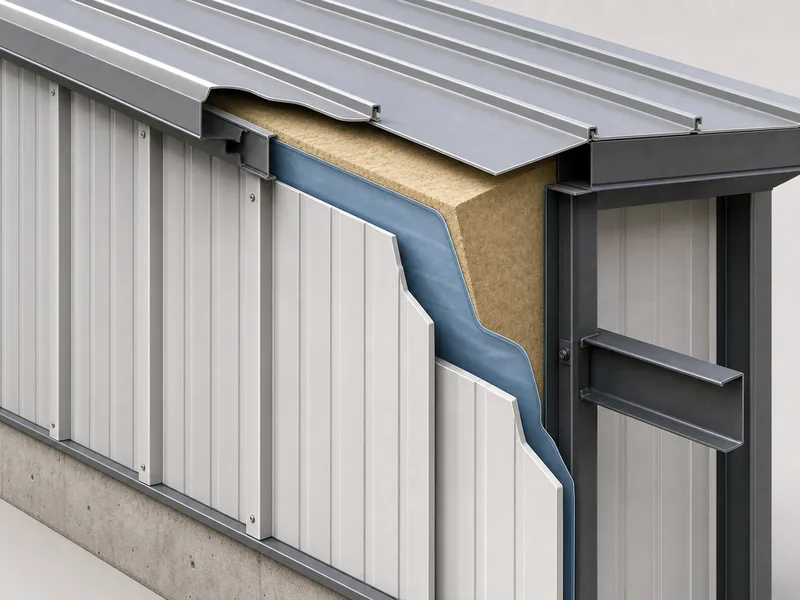
A radiant barrier reflects heat rather than resisting it, so its value shows up in hot, sunny climates and nearly disappears in a heating-dominated one. The reflective foil has to face an air gap to work. Laid tight against the roof panel with nothing behind it, it stops reflecting and heat conducts straight through. Double-bubble foil is the entry-level layer bundled with many steel hangar kits, and on its own it carries very little conductive R-value. Treat it as radiant control and an air seal rather than a substitute for thickness. In cooling-dominated regions the U.S. Department of Energy reports radiant barriers trimming cooling costs by roughly 5 to 10 percent.
Fiberglass Batt and Blanket
Fiberglass batt and blanket is the familiar metal-building insulation: rolls of glass wool faced with a vapor retarder, laid over the purlins and girts before the panels go on. Thickness sets the R-value, commonly in the R-13 to R-30 range and higher when layered, which makes it a straightforward way to hit a target on a budget. The facing has to face the conditioned side and seal at the laps, or warm, moist air slips past and finds the cold steel behind it. For an unheated or lightly heated hangar in a moderate climate, faced batt over the frame is often all the envelope needs.
Rigid Board (Polyiso and XPS)
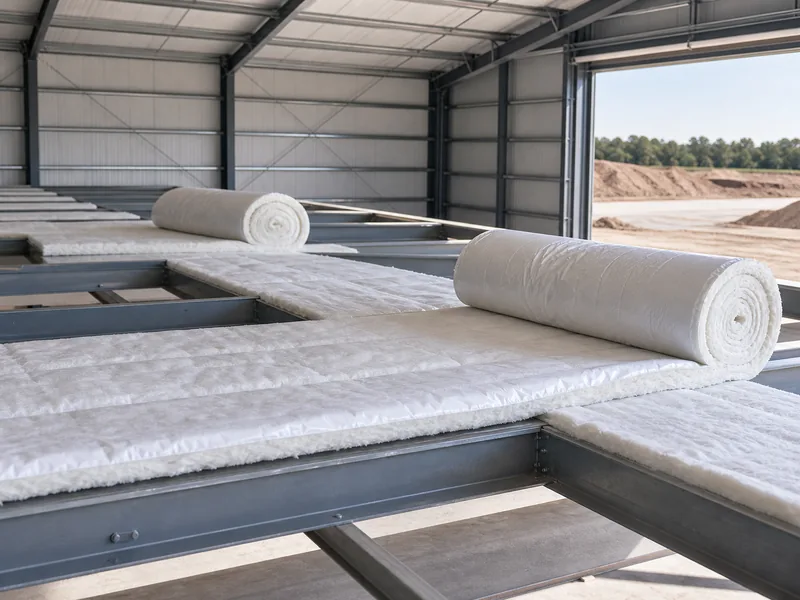
Rigid board adds continuous insulation that batt cannot, because it sits in an unbroken layer instead of compressing between framing. Polyiso runs about R-5 to R-6 per inch and XPS about R-5, both moisture-resistant, which is why board is a common retrofit choice when an existing hangar needs more R without tearing out the wall. Joints have to be taped or sealed, since an open seam becomes a thermal and air path that undercuts the rest of the layer. Board also pairs well over an existing reflective or batt layer when you are upgrading a hangar already in service.
Closed-Cell Spray Foam
Closed-cell spray foam gives the highest R-value per inch of the common options, roughly R-6 to R-7, and seals the envelope as it cures. That air seal is the real draw in a humid or cold-climate hangar, because at sufficient depth the foam also acts as its own vapor retarder, so warm interior air never reaches the cold panel to condense. The trade-offs are cost, permanence, and access. Cured foam bonds to the steel and is not peeled back later, and because it covers the frame and fasteners it adheres to, inspecting or repairing the panel behind it is harder. Building codes also generally call for a thermal or ignition barrier over foam plastic, so the assembly usually needs a cover layer rather than exposed foam. Open-cell foam costs less but stays vapor-permeable, which is why hangars being conditioned usually specify closed-cell.
Insulated Metal Panels
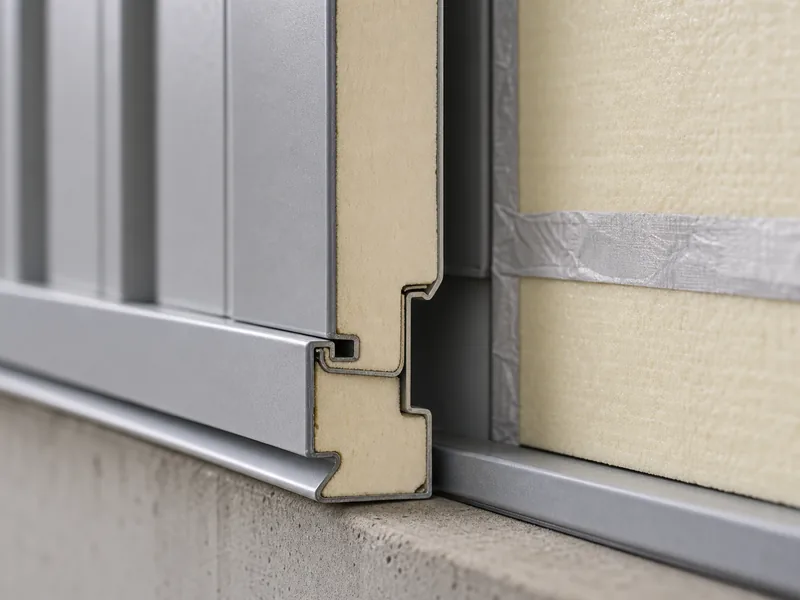
Insulated metal panels build the insulation into the wall and roof themselves, sandwiching a foam core between two steel faces that arrive factory-formed and rated. Because the faces are continuous and the joints interlock, panels resist condensation and air leakage without a separate vapor retarder, which suits a new climate-controlled hangar for avionics work or maintenance. Panels are specified by core type and thickness rather than field-installed R, so the rating is set at the factory and goes up in one step. The cost sits at the top of the range, and the decision usually rides on whether the hangar is being conditioned from day one.
Where the Hangar Door Fits In
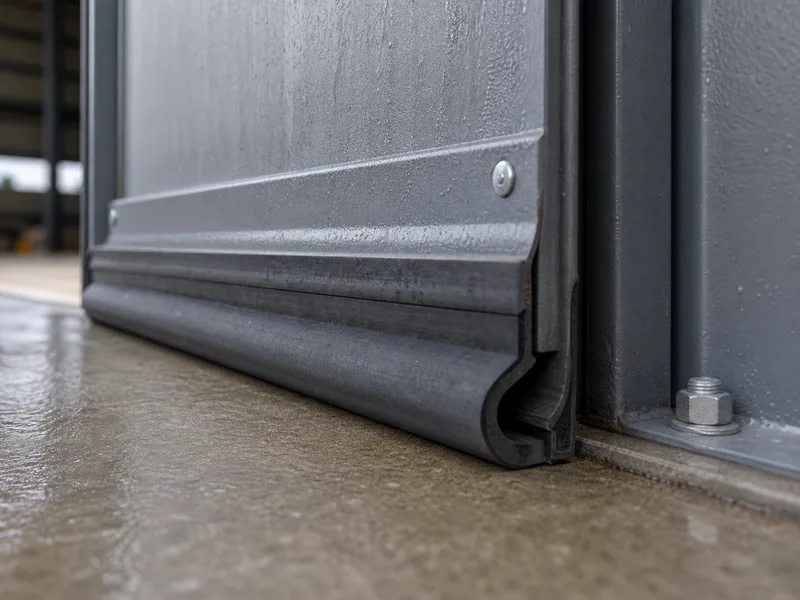
The hangar door is the largest single opening in the building, and it drives more heat loss and air infiltration than the walls do, which sets a hangar apart from an ordinary warehouse. A wall rated to a high R-value still bleeds conditioned air if the door leaks around its perimeter, so the header, jamb, and floor seals belong in the same spec conversation as the panels. Door size compounds the issue, because an opening tall and wide enough to clear a tail and wingspan leaves a large edge to seal.
Bi-fold and hydraulic doors can be insulated with blanket, board, or foam inside the door structure, but the gain only holds if the weatherseals close tight against the frame and floor. An unconditioned hangar usually leaves the door bare, since there is no conditioned air to keep in. In a conditioned hangar, an uninsulated or poorly sealed door is the weak point that drags down what the walls and roof achieve. That is why door insulation and sealing are planned alongside the envelope rather than after it.
Controlling Condensation in an Insulated Hangar
Condensation forms whenever a steel surface drops below the dew point of the air touching it, which is why moisture control, not raw R-value, is the harder half of a hangar envelope. In a cold climate the vapor retarder belongs on the warm, interior side of any permeable insulation, so humid inside air is stopped before it reaches the cold panel. Insulation alone will not hold the dew point off the steel. In an unconditioned hangar, adding insulation without heat or airflow can trap humid air and leave the space damper than bare metal that at least dried out between cold nights.
A conditioned hangar pairs the envelope with heating, dehumidification, or ventilation so interior surfaces stay above the dew point, and that is where insulation pays back as part of the building’s broader energy efficiency in metal buildings. Whether a hangar needs to be conditioned at all is one of the aircraft hangar construction requirements you set during design, well before insulation is ordered, because it changes the material, the vapor retarder, and the door spec together.
Matching Insulation to How the Hangar Is Used
Use decides the envelope more than climate does: an unheated tie-down hangar, a part-time workshop, and a climate-controlled avionics bay each land on a different option. An unheated hangar that only keeps weather off the aircraft is well served by a reflective layer or faced batt, since there is no conditioned air to protect. A part-time shop heated on working days leans toward batt or rigid board, enough R to make a heater effective without committing to a sealed envelope. A hangar holding avionics or supporting year-round maintenance is where closed-cell foam or insulated panels justify the cost, because stable temperature and humidity protect sensitive equipment.
Because the insulation method, the purlin and girt spacing, and the panel system all have to agree, the envelope is easiest to get right when it is specified with the frame instead of added afterward. A manufacturer that handles design, fabrication, and installation of a steel hangar building can coordinate the insulation cavity, fasteners, and vapor control before anything is cut. That coordination closes the retrofit gaps that show up when insulation is treated as a separate trade. Owners weighing the shell itself can compare the best materials for an airplane hangar alongside the insulation choice, since the two decisions move together.
Choosing Hangar Insulation in the Right Order
A hangar envelope is easiest to choose in stages: settle the climate and the conditioning decision first, then the material, then the door and the vapor retarder. Those first two answers eliminate most of the table on their own, leaving reflective or batt for unconditioned hangars and closed-cell foam or panels for conditioned ones. After the material, close the two gaps that undo good insulation, namely a door that leaks air and a vapor retarder on the wrong side of the wall. Cost scales along that path rather than driving it, so it reads more clearly when weighed against the full cost to build a hangar instead of the insulation line alone. Get the four moves in sequence, climate, conditioning, material, then the door and dew point, and the envelope holds up instead of sweating through its first humid night.
FAQ
Does an aircraft hangar need insulation?
An aircraft hangar needs insulation whenever the space will be heated, cooled, or kept dry for equipment, while an unheated tie-down hangar can often skip it. The deciding factor is condensation as much as comfort, since avionics and composite skins are sensitive to repeated moisture cycles even when no one is working inside.
Will insulation stop condensation in a hangar?
Insulation slows condensation but does not stop it on its own. Holding a steel surface above the dew point takes a vapor retarder on the warm side plus heating, dehumidification, or ventilation, and insulation without that climate control can even trap humid air and leave a bare-metal hangar damper.
Is spray foam a good choice for an aircraft hangar?
Closed-cell spray foam is a strong choice for a humid or cold-climate hangar that will be conditioned, because it air-seals and acts as its own vapor retarder. The trade-offs are higher cost, permanence, and harder repair access, since cured foam bonds to the panels and cannot be peeled back, so it suits hangars committed to climate control rather than occasional-use storage.
What R-value should hangar insulation be?
Hangar R-value follows the climate and whether the space is conditioned rather than a single fixed number. A lightly used hangar in a mild climate may do with faced batt in the R-13 to R-19 range, while a conditioned hangar in a cold or humid region pushes higher and relies on continuous insulation to avoid thermal breaks at the framing.
How do you insulate a metal hangar door?
A metal hangar door is insulated with blanket, board, or foam inside the door structure, matched to whatever the walls use. The larger gain is air-sealing, because weatherseals at the header, jambs, and floor keep the door from leaking conditioned air, which matters more on a door this size than squeezing out another point of R-value.
Further Reading
- Types of Insulation — U.S. Department of Energy — Government (DOE Energy Saver). Background on the batt, board, spray foam, and reflective categories compared here and how R-value is rated. General guidance, not hangar-specific.
- Radiant Barriers — U.S. Department of Energy — Government (DOE Energy Saver). Explains why a radiant barrier needs an air gap and works mainly in hot, cooling-dominated climates, supporting the reflective-layer section above.
- Metal Building Manufacturers Association (MBMA) — Industry association. Authority on metal building envelopes, insulation, and condensation control for steel buildings such as hangars.