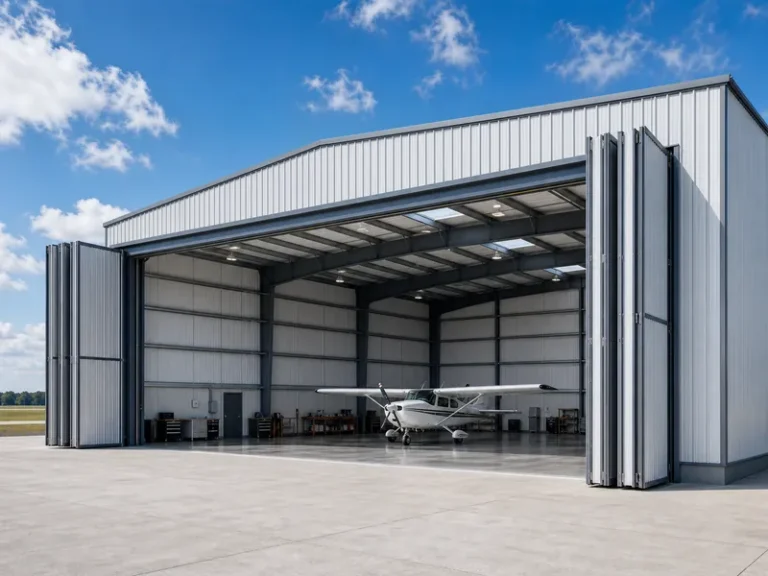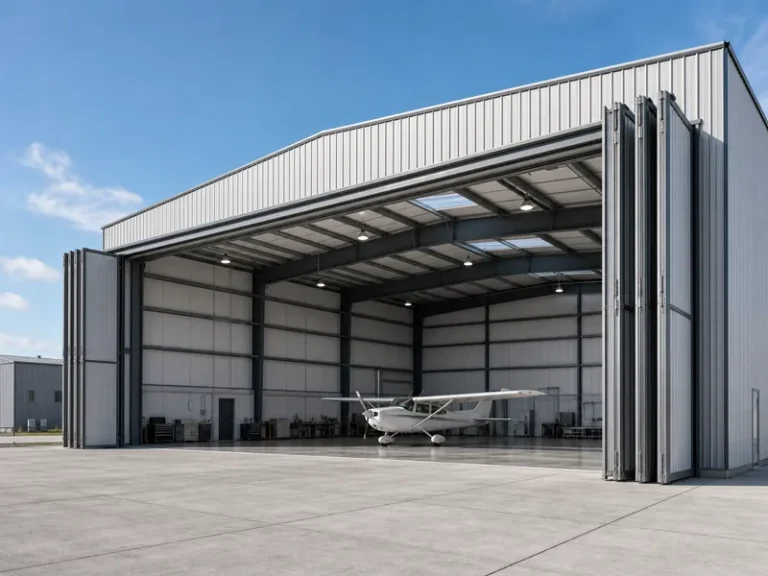






Building an aircraft hangar that an inspector will approve and a flight department will actually use means satisfying six overlapping sets of requirements at once: building and fire codes, structural and load design, door height and clearance, the foundation slab, fire suppression, and site permitting. Two of those, the door height and the hangar’s fire classification, are locked early and are expensive or impossible to change later, so they end up shaping almost everything else. A purpose-built airplane hangar building has to clear all six before the first column is erected.
Building Codes and Regulations That Govern Hangars
Hangar requirements come from three layers of authority that stack on top of each other: federal aviation rules, national consensus standards such as NFPA 409, and the local building and fire codes your authority having jurisdiction (AHJ) actually enforces. The International Building Code (IBC) adopts and points to NFPA 409 for hangars, the International Fire Code governs suppression and egress, and the AHJ is the office that reviews drawings and signs the permit. Knowing which layer a given rule comes from tells you who has the final say when two requirements appear to conflict, and it is usually the local AHJ.
NFPA 409 Hangar Groups and What Triggers Them
NFPA 409 sorts hangars into four groups, and the group your building falls into shapes how much fire suppression you have to install. Under commonly adopted editions, Group I carries the most demanding requirements and tends to be triggered by an aircraft access door taller than about 28 feet, a single fire area in the range of 40,000 square feet or more, or aircraft tail heights over roughly 28 feet; smaller fire areas and lower doors fall into Groups II through IV. Exact thresholds depend on the NFPA 409 and building-code editions your jurisdiction has adopted, so confirm them with the AHJ rather than treating any single number as fixed. Because the IBC ties suppression directly to this classification, the group is not a paperwork detail; it sets the suppression approach and a large share of the mechanical budget. The takeaway is practical: a door tall enough to clear a business jet’s tail can move a hangar into Group I on its own, so the classification should be settled before the structure is sized.
FAA and Airport Airspace Requirements
A hangar on or near a public-use airport may have to clear the Federal Aviation Administration in parallel with the local building department. Depending on the site’s location and height and the airport sponsor’s rules, a project can require filing FAA Form 7460-1, a Notice of Proposed Construction or Alteration, so the agency can review obstruction and airspace impact. The FAA’s Airplane Design Group (ADG) classification also informs the clearances a hangar and its apron provide, and FAA advisory circulars offer design and fire-protection guidance that airport sponsors often fold into their own minimum standards. Where it applies, filing early helps, because airspace review can run alongside structural design instead of holding it up.
Hangar Size and Door-Clearance Requirements by Aircraft Type
Hangar dimensions are driven by the largest aircraft you intend to shelter, not by a footprint you happen to like. The clear-span width has to cover the wingspan plus wingtip clearance, commonly about three feet per side under typical operating procedures, while the depth has to cover the aircraft’s length plus nose and tail clearance, often around five feet each. Door height is the single hardest constraint in the whole project: you cannot park an aircraft taller than the door opening, and unlike floor area, door height cannot be value-engineered once the frame is up.

| Aircraft class | Typical clear-span width | Typical depth | Typical door height |
|---|---|---|---|
| General aviation, single-engine | 40–60 ft | 30–40 ft | 12–14 ft |
| Twin-engine and light corporate | 60–80 ft | 40–60 ft | 14–18 ft |
| Corporate / business jet | 80–120 ft | 60–100 ft | 18–28 ft |
| Narrow-body or multi-aircraft bay | 120–150 ft+ | 100–150 ft | 28–40 ft |
These are typical planning ranges, not code minimums; the governing figures are the specific aircraft’s wingspan, length, and tail height plus clearance, confirmed against its FAA Airplane Design Group and the local airport’s standards. Sizing also feeds the budget directly, and the way those dimensions translate into dollars is covered in our guide to what it costs to build a hangar.
Structural and Load-Bearing Requirements
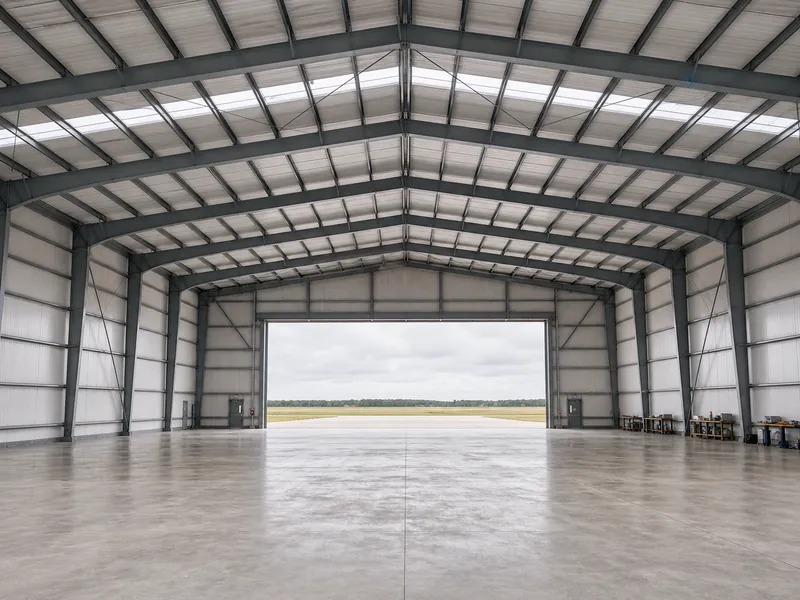
A hangar’s structure has to deliver a wide column-free interior while carrying the wind, snow, and seismic loads its site will ever see. That clear span is achieved with rigid steel frames or long-span trusses, so nothing interrupts the floor or the full width of the door opening, and the frame and its connections are engineered to the minimum design loads set by ASCE 7. Steel is the common structural choice here because it spans far and absorbs those environmental loads predictably; whether to build in steel or another material is its own decision, weighed in our comparison of steel versus wood for a hangar. Fabricating the heavy rigid frames and long-span members a hangar needs calls for a dedicated steel manufacturer. Qingdao KAFA Fabrication runs H-beam, box-section, and C/Z purlin lines that support clear-span steel frame fabrication for hangar-style buildings, and teams can request a quote with the aircraft’s dimensions and the airport’s design group in hand.
Foundation and Slab Requirements
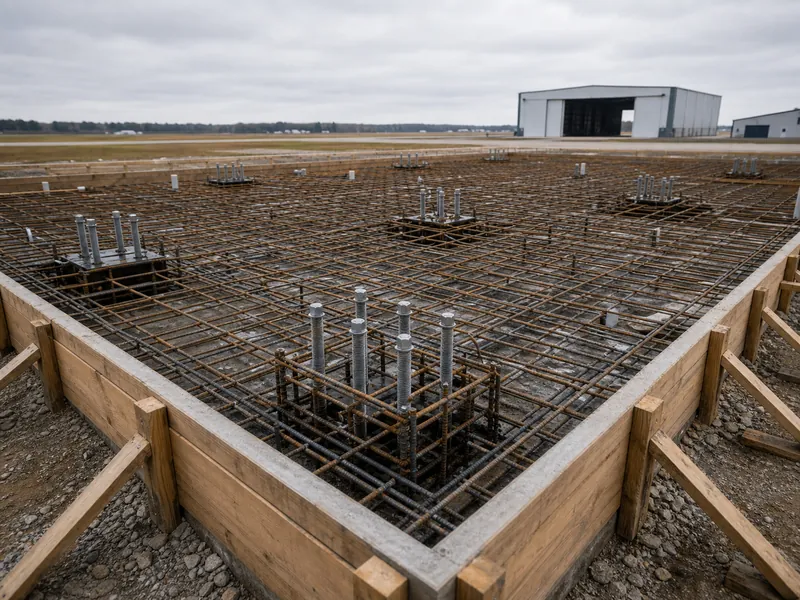
The foundation under a hangar carries three things at once: the aircraft’s concentrated wheel loads, the weight of maintenance equipment, and the building frame, all transferred into whatever soil the site provides. A reinforced concrete slab is engineered for those point loads, typically around six to eight inches thick, and thicker or more heavily reinforced where heavy jets or weak soils are involved. Geotechnical analysis comes first, because expansive clay and sandy coastal soils call for very different solutions, and a metal building foundation poured without regard for that soil report invites long-term cracking. Slab elevation and flatness matter beyond load, too: the large door tracks only run true over the building’s life if the slab is poured to tight tolerances.
Fire Protection and Suppression Requirements
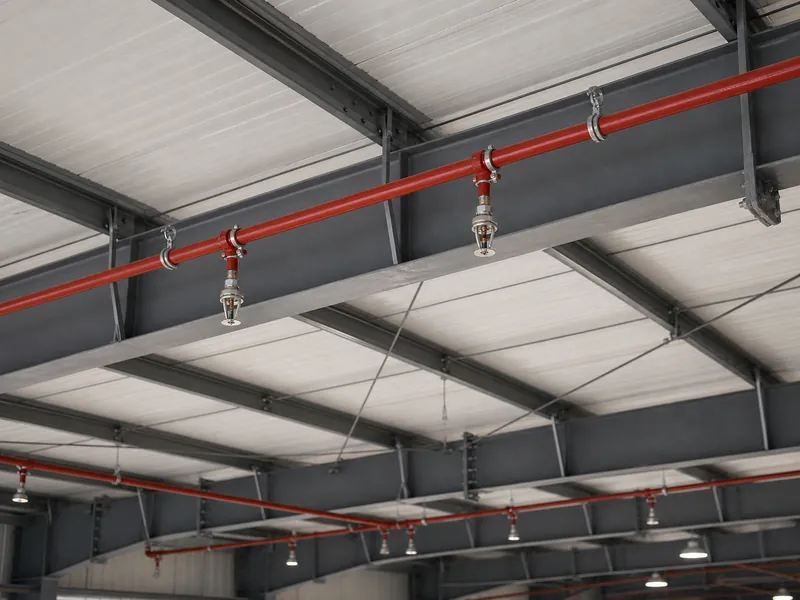
Fire suppression in a hangar is sized to its NFPA 409 group rather than chosen freely, because the standard ties the system type to the building’s fire area and door height. Group I hangars carry the heaviest requirements, and suppression has historically combined water with aqueous film-forming foam (AFFF) delivered from overhead systems or floor-level cannons positioned to flood the floor quickly. More recent editions have shifted that picture; the 2022 edition of NFPA 409, for instance, eased the blanket foam requirement for Group II hangars and opened the door to risk- and performance-based designs, along with an ignitable-liquid drainage option, though the edition your jurisdiction enforces governs what actually applies. Engineering the system itself is a specialty covered in our guide to steel building fire protection, but the classification that drives it is set during design, which is why door height and fire area come up so early.
Site, Zoning, and Permitting Requirements
Permitting a hangar usually runs on two parallel tracks: the local building department and, for sites near airports, the FAA. The approvals commonly break down like this:
- Building permit from the AHJ, based on stamped structural, mechanical, and fire-protection drawings.
- Fire marshal review of the suppression system, egress, and emergency access.
- FAA airspace review through Form 7460-1 where the site’s location or height triggers it.
- Zoning and land-use approval confirming a hangar is permitted on the parcel.
- Environmental and stormwater controls, including fuel-handling and drainage requirements.
- Accessibility provisions for any office, restroom, or public-facing space.
Sequencing these matters as much as completing them: zoning and, where it applies, the FAA filing belong at the front, because a setback or airspace problem found late can force a redesign rather than a revision.
Utility and Life-Safety System Requirements
Hangar utilities account for fuel vapors, large open volumes, and aircraft servicing, which pushes electrical and ventilation requirements past those of an ordinary warehouse. Areas near fueling or maintenance are treated as classified (hazardous) locations with electrical equipment rated accordingly, high-bay lighting is specified bright and even enough for inspection work, and ventilation and heating are sized to the building’s full volume rather than its floor area. Worker-facing operations also fall under OSHA workplace-safety rules, so the design has to leave room for compliant access, egress, and equipment clearances rather than treating life safety as an afterthought.
Conclusion
Two constraints decide the shape of everything else, so lock them first: the door height your largest aircraft needs, and the NFPA 409 group that the door height and fire area put you in. Those two numbers cascade into the structural span you have to engineer, the suppression system you have to install, and a large part of the permitting path you have to walk. From there, confirm the geotechnical report before finalizing the slab, and, if your site triggers FAA review, file Form 7460-1 early so airspace review overlaps the design rather than delaying it. The broader build sequence is laid out in our overview of airplane hangar construction. Settle the door height and hangar group first, and the rest of the requirements (span, slab, suppression, and permits) fall into a sequence you can actually build to.
FAQ
Do all aircraft hangars need a fire sprinkler system?
Fire suppression requirements depend on the hangar’s NFPA 409 group, which is set mainly by its fire area, construction type, and door height. Group I hangars (broadly, those with doors taller than about 28 feet or fire areas around 40,000 square feet and up) face the most rigorous requirements, and more recent editions have eased foam requirements for smaller Group II hangars; the exact thresholds follow the code edition your jurisdiction adopts. Confirm the classification with the AHJ rather than relying on the building’s intended use alone.
How thick does a hangar floor slab need to be?
A hangar slab is typically six to eight inches of reinforced concrete, with added thickness and reinforcement where heavy jets or weak soils are involved. The governing factor is the concentrated wheel and equipment point loads the slab must carry, confirmed by a geotechnical report rather than a single default number. Slab flatness also affects whether the main door tracks operate smoothly over time.
Do I need FAA approval to build a hangar?
An FAA airspace review through Form 7460-1 may be required where a hangar’s location or height affects airport airspace, and some jurisdictions want it resolved before they approve a permit. The filing lets the FAA assess obstruction and airspace impact, while the local building department and fire marshal handle the structure and suppression system separately. A hangar on private land well away from an airport may not trigger the FAA step, but local permits still apply.
What size hangar do I need for my aircraft?
Hangar size is set by your largest aircraft’s wingspan, length, and tail height plus clearance, not by a standard footprint. Single-engine aircraft commonly fit a 40–60 foot clear span, while corporate jets need 80–120 feet and noticeably taller doors. The aircraft’s FAA Airplane Design Group is the reference point that turns those dimensions into firm clearance requirements.
What is NFPA 409?
NFPA 409 is the National Fire Protection Association’s Standard on Aircraft Hangars, and it classifies hangars into four groups that determine their fire-protection requirements. Building codes such as the IBC reference it directly, so the classification carries real regulatory weight in most U.S. jurisdictions. The group a hangar lands in is driven mainly by its fire area, construction type, and door height.
Further Reading
- NFPA 409, Standard on Aircraft Hangars. National Fire Protection Association. The standard that classifies hangars into Groups I–IV and sets the fire-protection requirements referenced throughout this article.
- International Building Code. International Code Council. The model building code whose aircraft-hangar provisions tie suppression to NFPA 409 and are adopted across most U.S. jurisdictions.
- ASCE 7, Minimum Design Loads and Associated Criteria for Buildings and Other Structures. American Society of Civil Engineers. Defines the wind, snow, and seismic design loads a hangar’s structure must be engineered to meet.