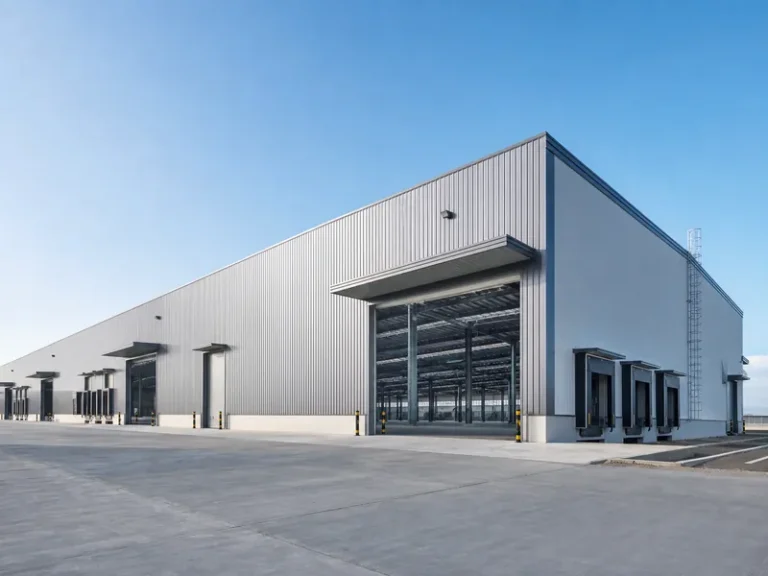





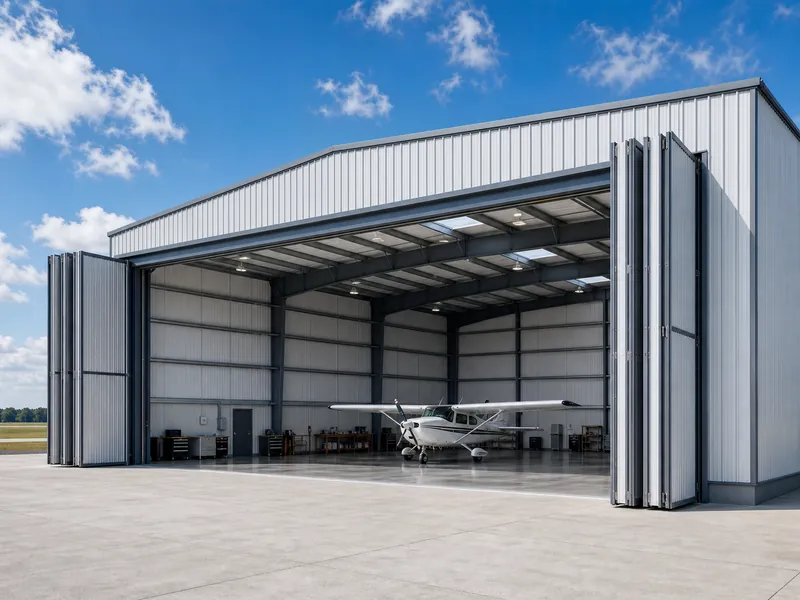
Airplane hangar construction goes wrong in a few predictable, expensive ways. The classic three: a slab poured before the door’s reaction loads are final, a clear span sized to the airframe instead of the wingspan plus tail and tow clearance, or — on a site that triggers an FAA airspace review — a steel package ordered before that review clears. None of these show up on a brochure, and all of them are cheaper to prevent than to fix. This guide walks the build the way it actually sequences — structure, doors, foundation, codes, cost, and order of operations — so the decisions that lock in early are the right ones. It does not re-price every option line by line; for that, the cost section below points to a dedicated breakdown.
The Clear-Span Steel Frame
A hangar is a clear-span problem before it is anything else — the building has to cover the aircraft with no interior columns in the way, and that single requirement decides the structural system. Pre-engineered rigid-frame steel dominates hangar work because it delivers wide column-free bays at a lower cost and faster erection than wood or concrete can reach at the same span. The frame is sized to the opening the aircraft needs, not to the aircraft’s body: you measure the widest wingspan, add wingtip clearance and tow-path room, and let the tail height set the door height. Get that backward and the airplane fits the floor but not the door.
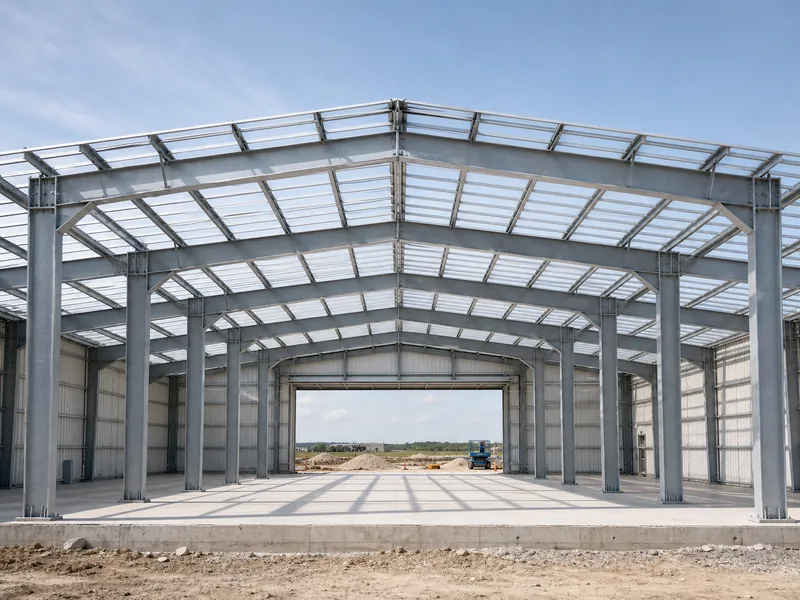
Spans scale with the mission. Single-engine pistons are usually comfortable in roughly 40 to 60 ft of clear width, twins in 60 to 80 ft, and corporate jets often need 80 to 120 ft or more, with multi-aircraft hangars pushing past 150 ft. Those bands come from aircraft geometry, so check them against your specific tail number rather than treating them as a spec. KAFA fabricates these as heavy rigid frames on an in-house H-beam line, which supports coordinated fabrication of the rigid-frame members a long-span steel aircraft hangar needs once the door loads hang off the end frame. The structural logic is shared with other long openings, and clear-span buildings cover the same trade-offs between span, eave height, and frame weight.
Hangar Doors and the Loads They Add
The hangar door is the most expensive single component, and the one the rest of the structure has to be designed around. Three families cover most projects: bi-fold doors that fold up against the header, horizontal sliding doors that run along the side walls, and hydraulic one-piece doors that swing the whole opening up on hinges. Each loads the frame differently. A bi-fold hangs its dead and wind load on the header and end-frame columns. A hydraulic door concentrates that load at the top of the frame. Sliding doors push it into reinforced girts and tracks along the walls.
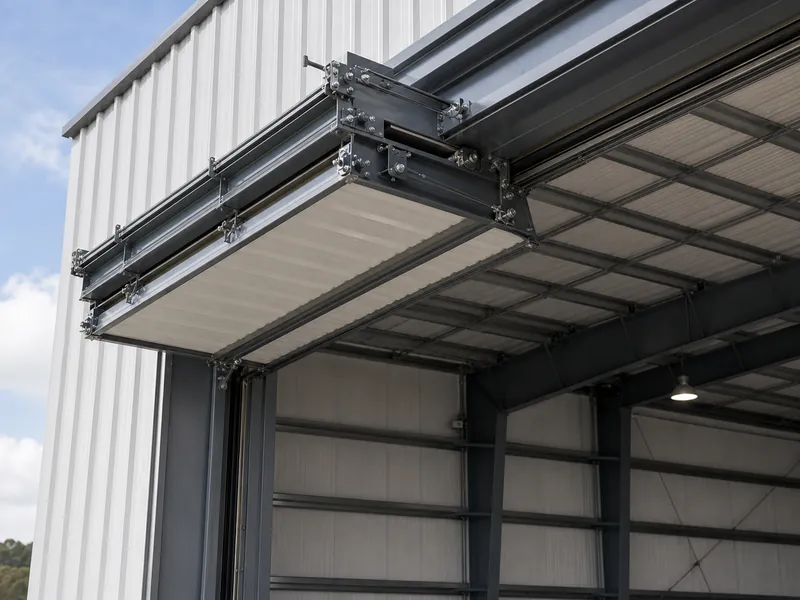
Wind is the hidden driver. A 100 ft door is a sail, and the frame, anchor bolts, and base plates all have to carry that lateral load back into the foundation. Because the opening width and eave height get fixed here and then feed back into frame design, the door is specified before the steel is ordered, not chosen afterward to fit a frame that is already detailed.
Foundation and Slab Built for the Door
The foundation does two jobs at once: it carries the building and it keeps the door operating, and the second job is where hangar slabs part ways with ordinary steel building foundation work. An aircraft-rated slab has to take point loads from jacks, tugs, and nose gear, hold the flatness a door’s bottom seal and track need, and absorb the door reaction loads concentrated at the jambs and end columns. Elevation and alignment have to be exact, because a door that binds or leaks usually traces back to a slab that was off by a fraction at the opening.
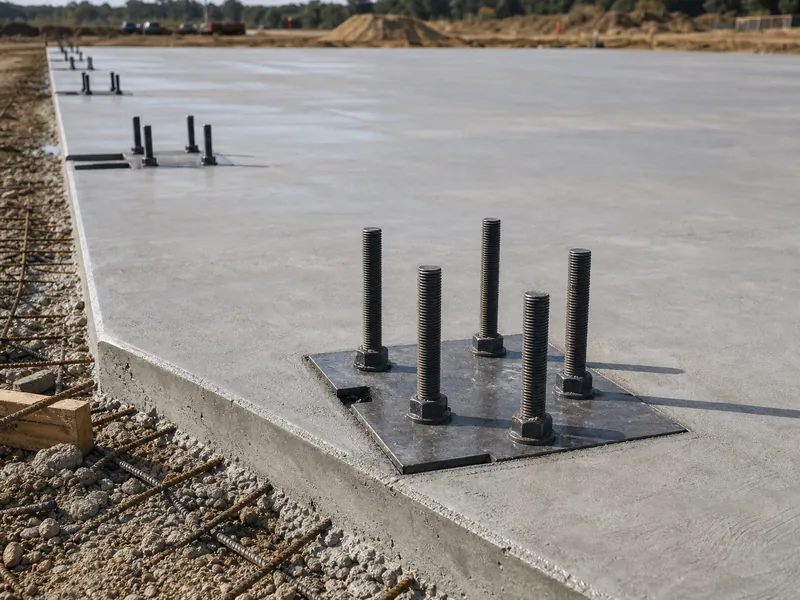
This is the classic rework trap. A slab poured before the door reactions and elevations are final is the usual reason a finished hangar needs concrete cut and re-poured. Soil also drives the detail: frost depth, bearing capacity, and expansive clays change the footings and, with them, the schedule. An aircraft-rated, reinforced slab generally costs more per square foot than a plain warehouse floor, so it belongs in the budget as its own line rather than folded into a flat “slab” allowance.
Codes, Airspace, and Fire Protection
Three separate authorities sign off on a hangar, and they do not coordinate with each other. The airport and the FAA, the local building department, and the fire code each gate the project on their own terms, so the order you satisfy them in matters as much as the requirements themselves.
Airspace can come first. A structure near an active airport may need an airspace review, and the FAA’s Obstruction Evaluation process uses Form 7460-1, “Notice of Proposed Construction or Alteration,” to judge whether a building affects navigable airspace. Where it applies, the determination can cap your eave or door height, so confirm whether Form 7460-1 is required before you finalize the frame. The building department then runs on the International Building Code, with structural loads taken from ASCE 7 — wind, snow, and seismic — which for a tall, wide-open hangar are anything but routine.
Fire protection can reshape a hangar budget late in design, because the suppression class is set by the building’s geometry rather than the owner’s preference. NFPA 409, the Standard on Aircraft Hangars, sorts hangars into Groups I through IV by door height and single-fire-area thresholds, and the group determines how the building has to be protected. A tall main door over a large single fire area pushes a hangar toward the most demanding group, which can require a foam suppression system instead of ordinary sprinklers. That choice belongs in the first design meeting, not a change order, so work the fire group and the steel building fire protection approach early enough that it does not rewrite the structure later.
What Airplane Hangar Construction Costs
General-aviation hangars are usually quoted in two very different bands depending on how finished they are. A bare steel shell package often runs about $15 to $25 per square foot, while a finished, turnkey hangar with doors, slab, and utilities is more often $60 to $120 per square foot. On a 15,000 sq ft hangar, that turnkey band works out to roughly $900,000 to $1.8 million. The spread tracks four things: the door system, the slab, site work, and finish level.
It helps to know what a per-square-foot figure usually does and does not carry:
- Usually inside a shell number: the rigid steel frame, purlins and girts, and roof and wall cladding.
- Usually billed separately: the door system, slab and foundation, site grading, utilities, insulation, fire suppression, permits, and any required FAA filing.
- What pushes the number up: tall doors, long clear spans, weak or sloped soils, tight sites, and any code-driven foam system.
Specialized facilities sit well above these bands — a climate-controlled maintenance hangar or a hangar condo carries finishes and systems a storage shell never will. Treat the figures here as common planning bands rather than quotes. Across kit-only and high-finish builds the full range runs wider, and the cost to build a hangar guide prices each piece by size and finish level.
Sequencing the Build to Avoid Rework
The order of operations is where hangar projects save or lose money, because a handful of decisions have to be locked before others can safely start. Run them out of order and the rework lands on the two most expensive elements — the slab and the steel.
- Clear permits and any required airspace review. Confirm zoning and airport ground-lease terms, and check whether an FAA Form 7460-1 filing applies, before design is final.
- Lock the door system and clear span. Both set the frame loads, so they cannot be left open.
- Engineer the frame and foundation as one package, then prepare and grade the site.
- Pour the slab to the door’s elevation and flatness, not to a generic floor tolerance.
- Erect the steel: anchor bolts, base plates, rigid frames, purlins, and girts.
- Close the envelope and hang the door, then commission the door before fit-out.
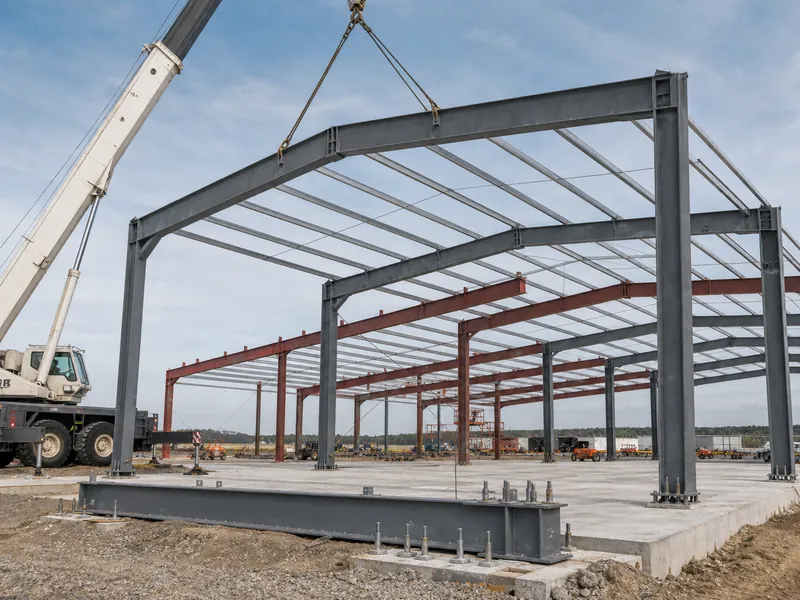
Systems and any climate control follow once the shell is closed; an insulated metal building envelope and the electrical, lighting, and fire-suppression work all go in after the roof and walls are watertight. The thread running through every step is the same: the door system and any required airspace determination get settled before the structural package is ordered.
Conclusion
Hangar construction rewards whoever settles the door early — and, on airport-adjacent sites, the airspace review with it. Those calls size the clear span, set the frame loads, and fix the slab elevation; lock them before anyone orders steel or pours concrete and the rest of the build follows without expensive reversals. Treat the cost bands here as planning numbers, then confirm them against your own door system, soil report, and NFPA 409 fire group before you commit a budget. Because the frame has to carry whatever door you hang on it, the steel and the door are best engineered as one package from the start. That pairing is what KAFA designs and fabricates in-house — and the point where it makes sense to get a free quote against your actual aircraft and site.
FAQ
How long does it take to build an airplane hangar?
A pre-engineered steel hangar usually runs a few months from foundation to fly-in, but the schedule is set by permitting and door lead time, not by the steel. The frame itself erects in weeks; the permits, any FAA airspace review, and a custom door package are the long poles. Filing the approvals and ordering the door early keeps the build from waiting on structure.
Do I need FAA approval to build a hangar?
An FAA airspace review is required only when a structure near an airport could affect navigable airspace — not for every hangar. The Obstruction Evaluation process (Form 7460-1) makes that call, and where it applies the result can cap your eave or door height. Checking whether it applies early keeps a late determination from forcing a frame redesign.
Is steel the right material for a hangar?
Steel wins most hangar projects on clear span rather than on price alone. Wide column-free openings are hard to reach economically in wood or concrete at the spans aircraft need, and steel erects faster. Wood can suit small private hangars, and concrete tilt-up shows up on large institutional jobs — often paired with a steel roof to keep the span open.
What size hangar do I need for my aircraft?
Size the hangar to the door opening, not to the floor. The width comes from the widest wingspan plus wingtip and tow clearance, and the tail height — not the fuselage — sets the door height. A single-engine piston is usually comfortable in a 40 to 60 ft clear span and corporate jets often need 80 to 120 ft, but the governing number is your own airframe’s published dimensions.
What raises hangar costs the most?
The door system and the slab move a hangar budget more than the frame does. A tall, wide door and an aircraft-rated, precisely leveled slab are where general-aviation projects overrun, followed by site work and any NFPA 409 foam suppression. The bare steel package is rarely the part that surprises an owner.
Further Reading
- NFPA 409, Standard on Aircraft Hangars — National Fire Protection Association. Defines the hangar Groups (I–IV) and the fire-suppression requirements triggered by a hangar’s door height and fire area; use it to confirm whether your project needs a foam system.
- FAA Obstruction Evaluation / Form 7460-1 — Federal Aviation Administration. The airspace-review process for building near an airport; start here to check whether your hangar height requires a Notice of Proposed Construction before the frame is finalized.
- Aviation Hangar design guide — Whole Building Design Guide, National Institute of Building Sciences. Pulls hangar types, clear-span structure, and the code framework (NFPA 409, IBC, FAA) together for design-stage planning.