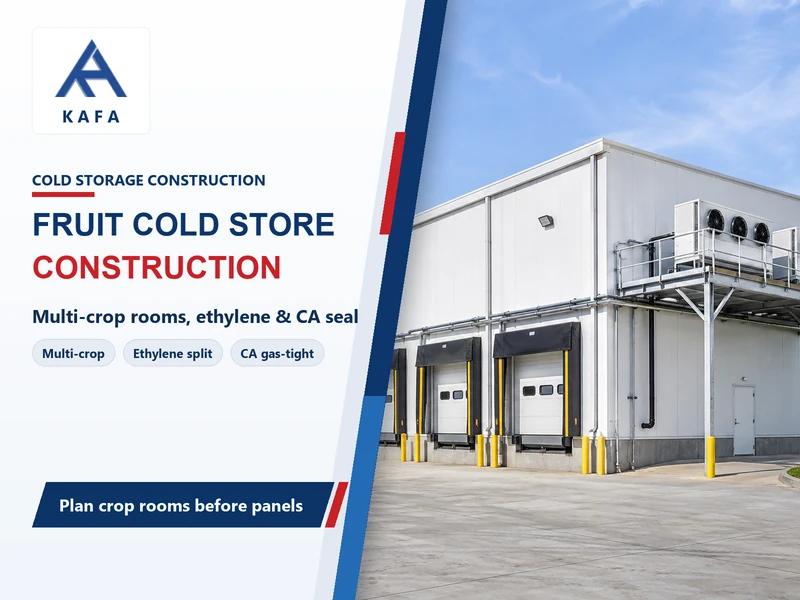
Fruit cold storage warehouse construction starts with the commodity storage program; the steel shell follows it. Most temperate fruit rooms hold −1 to 2 °C (30–36 °F) at 90–95% relative humidity. Chilling-sensitive tropical fruit needs warmer rooms, roughly 10–21 °C (50–70 °F) depending on crop and ripeness. Ethylene-producing crops such as apples and pears must be separated from sensitive crops such as kiwi and watermelon. Long-season apple stores add gas-tight controlled-atmosphere rooms. The envelope, floor insulation, and refrigeration capacity then follow the room program. The packing and ripening halls that feed these stores are a separate building problem.
How does fruit cold storage warehouse construction start?
Fruit cold storage warehouse construction starts with each crop’s storage program, because temperature and ethylene class fix the envelope and refrigeration before steel is ordered. The storage program schedules temperature range, relative humidity, ethylene class, and storage life for each room to cut post-harvest loss. Each room is an insulated panel box, polyurethane or PIR, with the panel thickness set by its temperature band. The cold storage building explainer covers the general anatomy, and the cold storage building construction guide covers the sequence. The fruit-specific input is the commodity schedule in the table below.
Two inputs are confirmed first: the temperature band and the ethylene class of each crop. They are the irreversible inputs to the room count, the envelope, and the floor. Door hardware and monitoring sensors can be refined later without cutting steel. The published storage-conditions table gives the starting values for each crop.
| Crop group | Temperature band | RH | Ethylene production | Ethylene sensitivity | Storage life | Construction note |
|---|---|---|---|---|---|---|
| Apples | −1 to 4 °C (30–40 °F) | 90–95% | High | Yes | 1–12 months | Chilling-sensitive cultivars at 2–4 °C (35–40 °F); CA candidate |
| Pears | −2 to 0 °C (29–31 °F) | 90–95% | High | Yes | 2–7 months | CA candidate; set the CA protocol by cultivar |
| Stone fruit (peach, nectarine, plum) | −1 to 0 °C (31–32 °F) | 90–95% | High | Peach/plum yes; nectarine no | 2–5 weeks | Short season; high producer |
| Grapes | −1 to 0 °C (31–32 °F) | 85% | Very low | Yes | 2–8 weeks | Lower RH than pome fruit |
| Berries (strawberry, blackberry, blueberry) | 0 to 2 °C (32–35 °F) | 90–95% | Very low | No | Strawberry 3–7 days; blackberry 2–3 days | Rapid precooling; strawberry and blackberry short dwell, blueberry longer |
| Citrus (orange, lemon, lime, grapefruit) | 4 to 16 °C (40–60 °F) | 90–95% | Very low | No | Weeks to months by crop | Warm band; chill points 38–50 °F |
| Bananas, green | 17 to 21 °C (62–70 °F) | 85–95% | Low | Yes | Ripening-controlled | Warm room; no sub-slab frost protection |
| Mango, papaya, pineapple | 10 to 13 °C (50–55 °F) | 85–95% | Mango/papaya medium; pineapple very low | Mango/papaya yes; pineapple no | 2–4 weeks | Warm room; chill points 45–50 °F |
Source: Engineering ToolBox, Fruits and Vegetables — Optimal Storage Conditions. Values are general postharvest guidance published in °F; °C conversions are rounded. Cultivar, maturity, and the buyer’s postharvest protocol govern the final setpoint.
Read the ethylene columns together with the temperature band. A crop can tolerate the cold and still be damaged by a neighbor’s gas. That coupling turns a single hall into a multi-room store.
Why do chilling-sensitive fruits need warmer rooms?
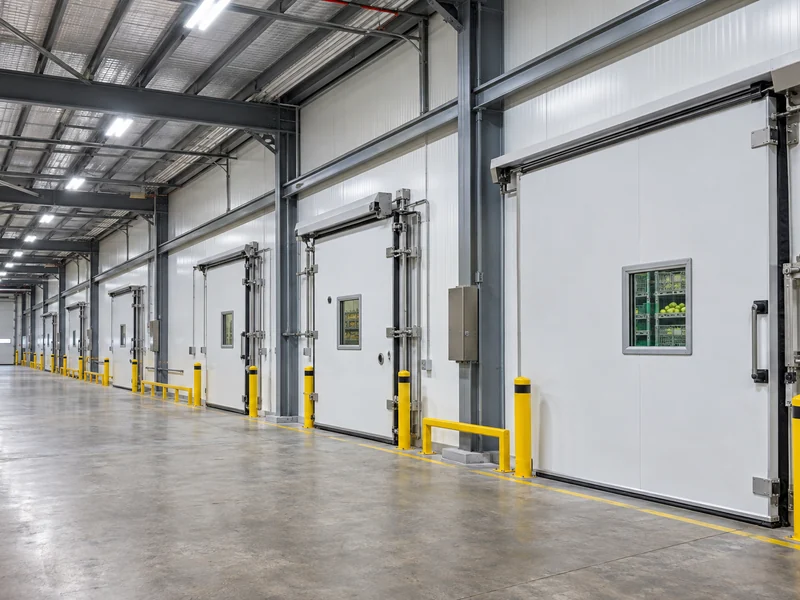
Chilling-sensitive tropical fruit such as bananas, mangoes, and papayas develops chilling injury below its crop-specific chill point. These rooms therefore run warmer than temperate fruit rooms. The chill point is the lowest temperature a crop tolerates without injury. The storage-conditions table gives chill points of 13 °C (56 °F) for green bananas and 10 °C (50 °F) for mangoes. Papayas and limes sit at 7 °C (45 °F).
Below those points the fruit shows surface pitting, discoloration, and failure to ripen. The damage appears only after the fruit leaves the store and shortens its shelf life at the destination. A banana room held at the apple setpoint of 0 °C loses the crop. The temperature log still reads correct for a cold store.
Two consequences follow for the building: a store handling both temperate and tropical fruit needs at least two room classes. No single setpoint satisfies both the 0 °C apple band and the 13–21 °C banana band. The warm rooms also change the envelope and the floor. A 13 °C banana room in a hot climate has a smaller temperature difference across the panel than a 0 °C apple room. It does not drive sub-slab frost protection the way a −18 °C freezer does. The refrigeration and the floor follow the warm band; the coldest room in the store does not set them.
How should ethylene shape room layout and airflow?
Ethylene-producing fruit such as apples and pears accelerates senescence in sensitive crops such as kiwi, watermelon, and leafy greens. The room layout separates producers from sensitive stock and controls shared airflow. The storage-conditions table classifies apples, pears, peaches, and plums as high ethylene producers, and kiwi, watermelon, and persimmon as very sensitive. Ripening bananas move from low to medium production as they color. Ripe kiwi is itself a high ethylene producer, while unripe kiwi is very sensitive. The ripeness stage therefore decides which side of the segregation a room sits on.
The layout rule follows directly from those ethylene classes. High producers get their own rooms or their own airflow zone, and sensitive crops never share a return-air path with them. Ethylene damage is quiet at first and easy to misread. Kiwi stored downwind of an apple room softens weeks before its schedule, and watermelon develops off-flavors the room thermostat never explains. The loss is read as a storage-life problem when it is an airflow problem.
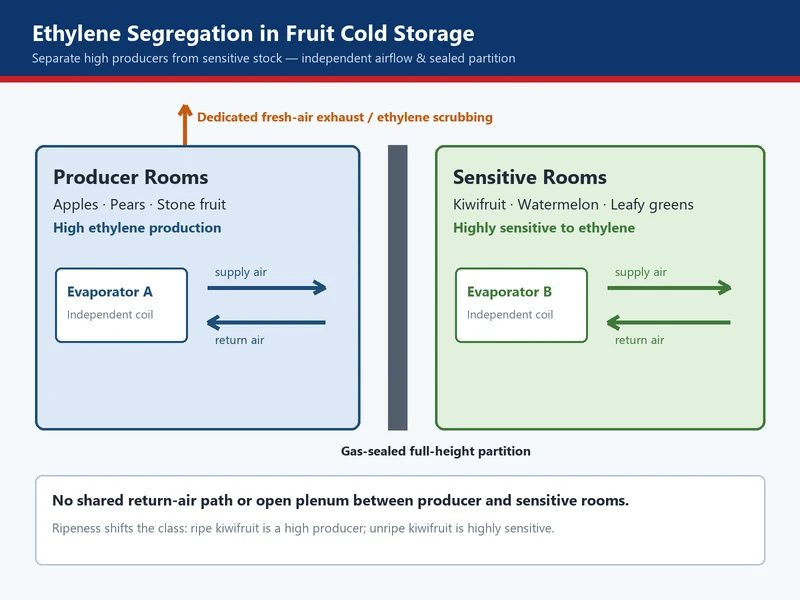
Where producers and sensitive stock sit in the same building, sealed partitions and independent evaporators separate the zones. Fresh-air ventilation or ethylene removal keeps producer rooms below the buyer’s threshold; the threshold itself is a storage-program input, set by the buyer. Once the rooms are separated, the operating discipline of stock rotation, temperature logging, and pest control follows the food industry warehouse management program.
When must rooms be built gas-tight for CA storage?
A fruit store needs gas-tight controlled-atmosphere rooms when its program includes long-season apple or pear storage. Holding a low-oxygen atmosphere is a construction package an ordinary chilled room does not carry. Controlled atmosphere slows respiration by holding oxygen below normal air and removing the carbon dioxide the fruit generates. The CA storage explainer covers the mechanism, the crop list, and the gas equipment. The building question is narrower: which rooms carry the gas-tight package, and how the shell is verified at handover.
If fruit moves out within a few weeks of harvest, a standard insulated chilled room is already sufficient. Gas-tight CA construction earns its cost primarily on long-season apple and pear programs. Size CA rooms by the harvest batch; the annual crop total does not set the room size. A CA room is filled once, sealed, and opened only when the whole room is sold. A room larger than one batch leaves headspace the gas system must condition.
| Storage scenario | CA worth building? | Condition and construction consequence |
|---|---|---|
| Apples or pears held for the long export season | Yes | Gas-tight envelope, sealed doors, pressure relief, leak-test commissioning; rooms sized by batch |
| Berries or stone fruit sold within 2–4 weeks | No | Standard chilled room; spend on rapid precooling instead |
| Bananas held green then ripened on demand | No | Ripening is driven by ethylene and temperature, independent of the oxygen level |
| Mixed orchard storing own fruit for local sale | Rarely | CA only if a long-season cultivar and a buyer protocol justify the sealed room |
A CA room adds sealed panel joints, gas-tight doors, pressure-relief protection, and a commissioning leak test to the ordinary chilled-room package. A CA room is a confined space with an oxygen-deficient atmosphere. US workplaces manage entry under OSHA’s 1910.146 standard, which defines oxygen deficiency as below 19.5% oxygen by volume. Other jurisdictions apply their own confined-space rules. Entry procedures, gas monitoring, and rescue planning belong in the handover documents; the refrigeration manual does not cover them.
How do field heat and pull-down size the refrigeration?
Field heat left in fruit at intake sets the pull-down load that sizes the refrigeration plant. Refrigeration capacity follows the intake temperature difference and the pull-down window, not the room volume alone. The precooling method is chosen by crop and dwell time:
- Forced-air precooling: Berries and grapes need rapid field-heat removal. Forced-air tunnels pull cold air through the pallet voids and meet the pull-down window that room cooling alone cannot.
- Room cooling: Apples and pears destined for long storage can cool in the storage room itself, where the refrigeration already holds the setpoint. The pull-down load is added to the holding load.
- Hydrocooling intake: Where the protocol calls for chilled-water cooling, the intake area needs water handling and drainage before the fruit enters the dry store.
The pull-down load is the field heat the plant must remove before the room reaches setpoint. In an illustrative calculation, take a 20,000 kg apple intake at 25 °C field temperature cooling to 1 °C. Use a representative specific heat of 3.6 kJ/(kg·K) for apples above freezing and a 24-hour pull-down window. The sensible load is:
Pull-down load (kW) = mass (kg) × specific heat (kJ/kg·K) × temperature drop (K) ÷ time (s)
20,000 × 3.6 × 24 ÷ 86,400 = about 20 kW.
That 20 kW is the fruit’s average sensible pull-down rate over the 24-hour window. The plant must also cover the higher initial peak, plus respiration, door infiltration, fan, and envelope loads. The compressors, condensers, and evaporators are sized for the sum, with backup power for the perishable load. Substitute your own intake mass, field temperature, and pull-down window in the same formula to size your plant.
Fruit rooms hold 90–95% relative humidity to prevent shrivel, so the plant manages moisture as well as heat. A coil surface below the room dew point condenses moisture and dries the air. To hold 90–95% RH, use a large coil surface with a small temperature difference, or add humidification. Door openings trade cold air for warm, moist intake air, which is why dock seals and rapid doors sit in the refrigeration budget. Monitoring sensors placed in the product stack show what the fruit experiences; supply-air readings miss it.
Refrigerant choice is now a regulatory input. The EPA’s AIM Act framework phases down HFC production and consumption and restricts high-GWP HFCs in new commercial refrigeration through the Technology Transitions rule. Ammonia and CO2 systems serve large industrial fruit stores; lower-GWP HFC blends serve smaller rooms. The plant’s energy efficiency is set by the pull-down schedule and the envelope together. The refrigerant decision fixes plant-room ventilation and leak detection before the shell is detailed.
What changes in the envelope and floor for fruit rooms?
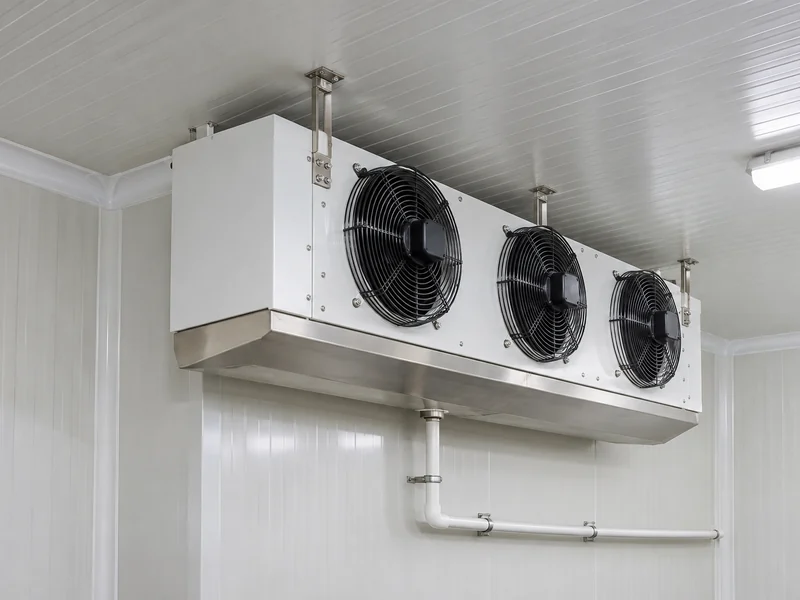
Fruit rooms held at high relative humidity shift the envelope’s critical detail from frost protection to condensation control. The moist interior air meets its dew point on the coldest surfaces rather than inside the panel. At 95% relative humidity and 0 °C, the room air is near its dew point. The evaporator coil, the door frames, and the thermal bridges at panel fasteners sit below that dew point, so moisture condenses on them. In a −18 °C freezer the vapor drive pushes moisture into the assembly and freezes it there. In a high-humidity fruit room the failure is surface condensation and drip.
That drip is a food-safety issue as well as a quality issue. FDA’s CGMP rule for food plants, 21 CFR 117.20, sets the construction standard. Drip or condensate from fixtures, ducts, and pipes must not contaminate food. Coil drip pans, insulated door frames, and thermal-break detailing at fasteners are the construction answers. Continuous vapor barrier sealing at joints and penetrations keeps the assembly dry. The mold starts where the condensate lands, not where the temperature log reads. A berry room at the correct setpoint still loses the top pallet layer when coil drip reaches it.
The floor insulation decision follows the room temperature band. A 0 °C apple room in a cold climate needs sub-slab insulation and frost protection to keep the soil from freezing and heaving. A 13 °C banana room does not need it. The slab carries the stacked pallet load and the forklift traffic. The wall-to-floor junction needs a sealed cove so wash-down water cannot sit at the panel base. The frost-protection and envelope design method follows the refrigerated warehouse design guidelines; the fruit-specific point is that the warm rooms skip it.
Wash-down and sanitation add two more details. 21 CFR 117.35 requires cleaning and sanitizing agents to be safe under their conditions of use. The rule also limits toxic materials in food-exposed areas to what cleaning, laboratory, and maintenance need. A separate chemical store is the design response. Wash-down drainage follows the plant-and-grounds provisions of 21 CFR 117.20. The recurring failure modes are condensate drip on the top pallet, thermal-bridge mold at fastener lines, and moisture return at the wall-base cove. Each one traces to a detail on the drawing rather than to the equipment.
Which fruit store profile fits your crop mix?
The fruit store profile that fits a holding follows its crop mix and storage duration, with the room program locked before the shell. The two inputs to lock first are the temperature band and the ethylene class of each crop. They are the irreversible inputs to the room count, the envelope, and the floor. The refrigeration plant and the gas-tight CA package converge after them. Fruit cold storage warehouse construction is therefore a program-first discipline: the commodity schedule is the design brief, and the steel shell is its consequence.
We confirm the commodity program against your buyer’s storage protocol before we release the structural design. We fabricate the steel-framed, insulated envelope and the gas-tight detailing that CA rooms depend on. The design follows the GB, EN, AISC, or AS/NZS code your project specifies.
- Long-season apple or pear exporter: Size the CA rooms by harvest batch and specify the gas-tight envelope with its leak-test commissioning. The steel cold storage buildings package carries the shell and sealing.
- Tropical fruit exporter: Build the warm rooms at the crop’s chill-point band and skip sub-slab frost protection. Budget ethylene management for ripening-adjacent stock.
- Berry grower selling within days: Spend on forced-air precooling and dock sealing. The short dwell makes rapid pull-down the priority.
- Mixed-crop cooperative: Separate producer and sensitive rooms with independent airflow. Confirm each room’s band against the storage-conditions table before the shell is ordered.
If your crop mix includes a long-season apple program, prepare a room-by-room storage schedule: commodity, band, ethylene class, and batch size. That schedule is the input the steel building design team needs to size the envelope and the plant.
| Term or phrase | What it refers to | Normalized action |
|---|---|---|
| Cold storage vs CA storage | An ordinary chilled room holds temperature and humidity; a CA room also holds a low-oxygen gas mix | Confirm the storage duration and crop protocol before paying for gas-tight construction |
| Chilled vs frozen | Fruit rooms are mostly chilled at −1 to 21 °C; frozen storage is a different class | Confirm whether any room is below 0 °C before specifying floor insulation and frost protection |
| Cold room vs warehouse | A cold room is one insulated, equipment-served box; a warehouse is the whole building with docks, structure, and fire compartments | Price and specify the room package and the building shell as two scopes |
FAQ
How cold is a fruit cold storage warehouse?
Temperate fruit rooms run −1 to 2 °C (30–36 °F); tropical fruit rooms run 10–21 °C (50–70 °F). The storage-conditions table gives the band for each crop, and the buyer’s protocol fixes the setpoint.
Can apples and bananas share one cold room?
No. Apples need −1 to 4 °C and release ethylene that damages bananas, which need 17–21 °C.
How much does it cost to build a fruit cold store?
Cost follows the room program: temperature band, CA package, and floor insulation drive the envelope and plant price. The cold storage warehouse construction cost guide breaks down the per-square-foot ranges; a fruit-specific quote needs the commodity schedule first.
What happens if a fruit room loses power?
The perishable load has no tolerance for a long outage. Backup power keeps the plant and the monitoring sensors running. The room’s thermal mass buys a limited window, so the outage plan is part of the handover.
Do fruit cold stores need a permit to operate?
The building needs local construction permits. For US-bound fruit, operation must comply with FDA’s CGMP rule (21 CFR 117), a sanitation requirement separate from an operating permit. CA rooms also add OSHA permit-space entry procedures. Confirm the local permit scope before the shell is ordered.