Seafood cold storage construction specifies a temperature-controlled store’s envelope, freezing capacity, and floor around the seafood it holds. The first decision is the temperature class, from chilled fresh fish to frozen and ultra-low sashimi tuna. Chilled fish sit near melting ice, frozen fish at −18 °C or colder, and fatty fish or sashimi-grade tuna colder still. Each class changes the insulation, refrigeration, and frost protection the building needs. A holding cold store is not a freezer, so freezing capacity is built as a separate room.
Which temperature classes define a seafood cold store?
Seafood cold storage spans four temperature classes, and each room’s class sets its insulation, refrigeration duty, and floor frost protection before any steel is ordered. The four classes are chilled, frozen, fatty-fish, and ultra-low sashimi; fatty-fish is a colder quality subdivision of frozen storage. One building can host several classes as separate rooms under a shared shell. The specifications are not interchangeable: each room’s envelope and plant follow its own class.
Chilled storage holds fresh fish at a temperature approaching that of melting ice, the wording used for fresh fishery products in EU Regulation 853/2004, as retained in UK law. A chiller room runs near 0 °C, often with flake or slurry ice around the fish. Frozen storage is the legal baseline for trade. The same regulation requires frozen fishery products to be kept at not more than −18 °C in all parts of the product. A narrow exception allows whole fish frozen in brine for canning at not more than −9 °C. The −18 °C figure is a legal baseline, not a quality optimum.
Fatty fish such as herring, salmon, and mackerel need colder holding than lean white fish for the same storage life, because their oils oxidize faster. FAO’s Torry Research Station note on cold storage of frozen fish recommends −20 °F, about −29 °C, for long-term storage in Britain (a 1965 recommendation). Its storage-life data show fatty fish keeping for less time than white fish at the same temperature. Ultra-low sashimi storage is a market-driven class above and beyond the legal baseline. Buyers of sashimi-grade tuna specify holding far below −18 °C to slow oxidation of the red pigment myoglobin. The room becomes a separate, colder class with its own envelope and refrigeration. Supplier guidance for special species runs −40 to −60 °C, but the binding setpoint is the buyer’s specification.
| Class | Holding temperature | Envelope and refrigeration | Floor and door |
|---|---|---|---|
| Chilled fresh | Near melting ice, about 0 °C | Standard insulated panel; modest refrigeration duty; ice or slurry handling | Slab with washdown falls and drainage; standard insulated doors |
| Frozen baseline | Not more than −18 °C in all parts (EU legal baseline) | Thicker insulation panel; refrigeration sized for steady ingress, not freezing | Frost protection under slab; insulated doors with tight seals |
| Fatty fish, long-term | Colder than baseline, toward −29 °C (FAO British recommendation) | Thicker panel again; lower evaporating temperature; tighter temperature stability | Same frost protection; door discipline to limit warm-air ingress |
| Ultra-low sashimi | Far below −18 °C, per buyer specification | Coldest class: thickest panel, two-stage or cascade refrigeration, strict vapor seal | Aggressive frost protection; minimal door openings, airlock preferred |
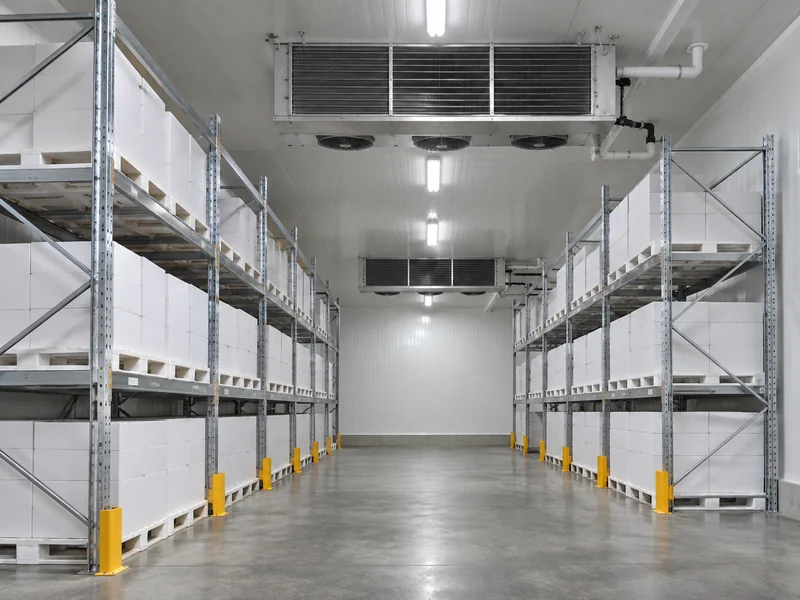
The class is the first input because it is costly to reverse. Panel thickness, refrigeration plant, and floor frost protection are built in, and changing them later means rebuilding. If you only hold short-term chilled fish for local distribution, a single chiller room near melting ice is enough. The fatty-fish and ultra-low classes earn their cost only when storage runs for months or the buyer specifies sashimi grade. For the basic definition of the building type, see what is a cold storage building; for the budget side, see cold storage warehouse construction cost.
Why does frozen seafood still deteriorate in storage?
Frozen seafood keeps deteriorating in storage because freezing slows but does not stop enzyme activity, fat oxidation, and dehydration. In fish cold storage the building’s job is to hold a steady low temperature, not merely to reach one. Temperature fluctuation warms the product surface each cycle and shortens storage life even when the average temperature looks correct.
Three mechanisms limit storage life, and each maps to a building requirement. Protein denaturation toughens and dries the flesh; it accelerates as temperature rises toward freezing. Fat oxidation turns the oils rancid, especially in fatty fish, and salt can speed it up. This is why fatty fish should not be brined before freezing. Dehydration, seen as freezer burn, removes water from the surface and accelerates both protein and fat damage. The FAO note is explicit that the lower and steadier the holding temperature, the longer the product keeps its quality.
| Product | Storage life, “good quality” at −20 °F (about −29 °C) | Data set |
|---|---|---|
| Cod, haddock (white fish) | 8–10 months | IIR, via FAO Torry Note 28 |
| Fatty fish (herring, salmon) | 6 months | IIR, via FAO Torry Note 28 |
| Smoked white fish | 7 months | TRS, via FAO Torry Note 28 |
The storage-life figures are quality periods, the window in which the stored product is as good as fresh. They apply to well-glazed or moisture-proof-packed fish held steady at −20 °F (TRS test conditions; the IIR rows are code-of-practice figures). They are not safety limits, and they do not transfer to −18 °C storage; warmer holding shortens them. The gap between the −18 °C legal baseline and the −29 °C quality recommendation is the design margin a long-term fatty-fish store should buy.
Two building decisions protect that margin. First, keep the temperature difference between the product and the cooling unit small. A large difference pulls water vapor out of the fish and deposits it as frost on the cooler, worsening freezer burn. The FAO note favors a large cooling surface in still air over a small fan-driven coil, so air circulation and coil sizing are quality decisions. Second, protect the product itself. Glazing, a thin skin of ice applied to unwrapped frozen fish, or vacuum packaging in a moisture-proof film, slows dehydration and oxidation. Glazing evaporates slowly and needs renewal, so the store layout must allow inspection access. Humidity control matters too: supplier guidance puts holding-room relative humidity around 85–90% to limit surface dehydration. Tight temperature monitoring turns these mechanisms into a storage-life contract the building can actually keep. This is the cold chain at rest: the product is only as good as the least steady room it passes through.
How do blast freezing and holding storage differ?
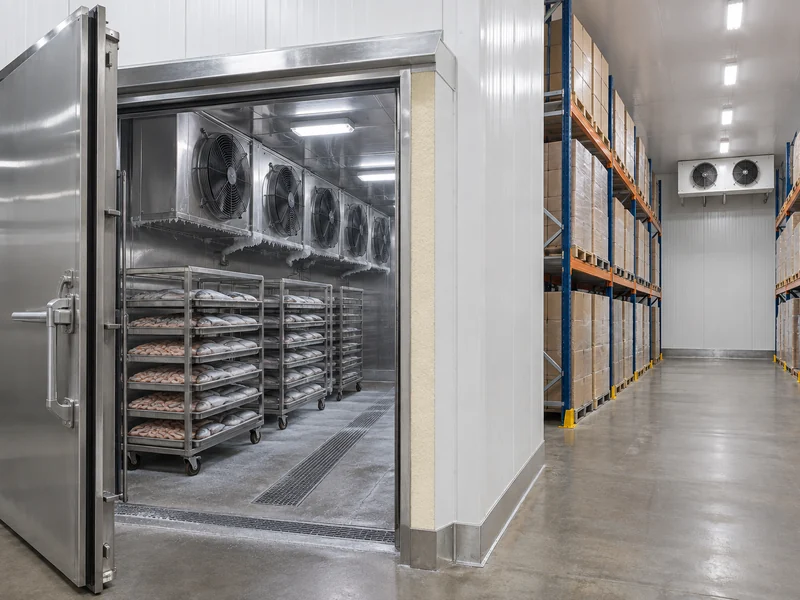
Blast freezing and holding storage are separate building scopes because freezing warm fish removes a large batch heat load that a holding cold store’s refrigeration is not sized to absorb. The FAO note states the rule plainly: never attempt to freeze fish in a cold store, and never put frozen fish warmer than the store directly into it. Cold storage plant rarely has reserve capacity for the extra heat.
A blast freezer, plate freezer, spiral freezer, or IQF line must pull the product quickly through the maximum ice-crystal formation zone. Supplier guidance puts this zone at roughly −1 °C to −5 °C, and the speed keeps cells from being torn by large crystals. The same supplier guidance puts blast air around −35 °C to −40 °C and insulated panel thickness for seafood rooms around 100–150 mm of PU or PIR. The freezing room is its own construction scope with its own refrigeration circuit, not a colder corner of the holding store.
In an illustrative calculation, freezing 1 kg of fish from +10 °C intake to −18 °C core sums three terms (approximate properties, also tabulated below). These are specific heat about 3.5 kJ/(kg·K) above freezing and 1.8 kJ/(kg·K) below, water fraction about 0.70, and water latent heat about 334 kJ/kg:
Freezing load per kg ≈ c_above × (T_intake − 0) + w × L + c_below × (0 − T_core)
Substituting the values: 3.5 × 10 + 0.70 × 334 + 1.8 × 18 = 35 + 234 + 32, about 301 kJ/kg, or roughly 300 MJ per tonne of fish. This is the product load only, one-directional heat removal from intake to core. It excludes fans, lights, infiltration, and packaging, and the property values are assumptions to replace with your own species data. Substitute your own intake and target core temperature into the same three-term sum to estimate the product freezing load per tonne. A holding store’s refrigeration system is sized for steady ingress in kW, while freezing is a batch energy duty of about 300 MJ per tonne. Compare them by dividing daily freezing tonnage by the pull-down hours. For a throughput-heavy store the batch duty dominates, so freezing needs its own room and evaporator circuit. A shared machinery room is possible if installed capacity covers both duties.
| Input | Value | Unit | Basis |
|---|---|---|---|
| Intake temperature | +10 | °C | Assumption, replace with catch/chill temperature |
| Target core temperature | −18 | °C | EU frozen baseline |
| Specific heat above freezing | 3.5 | kJ/(kg·K) | Approximate fish property |
| Specific heat below freezing | 1.8 | kJ/(kg·K) | Approximate fish property |
| Water fraction | 0.70 | kg/kg | Approximate fish property |
| Latent heat of fusion of water | 334 | kJ/kg | Physical constant |
Freezing also carries a legal treatment for raw-consumption fish. Where fishery products are to be eaten raw and have not had a heat treatment that kills viable parasites, the EU regulation requires a freezing treatment for parasites other than trematodes. The temperature in all parts of the product must reach not more than −20 °C for not less than 24 hours, or not more than −35 °C for not less than 15 hours. That treatment is a freezing-room function, with its own temperature recording, not something a holding store certifies. In the United States, FDA’s Fish and Fishery Products Hazards and Controls Guidance under the seafood HACCP regulation identifies histamine formation in scombroid species such as tuna and mackerel as a time–temperature hazard. Rapid pre-cooling and a chilled receiving boundary therefore matter before freezing. The general cold storage building construction sequence covers how the shell and panels go together.
What changes in seafood cold storage construction envelopes?
Seafood cold storage construction adds brine-resistant materials, a warm-side vapor barrier, and class-specific frost protection to the standard cold-store envelope. Salt and ultra-low temperatures attack the details a generic dry-cold store ignores. The baseline envelope method, panel selection, and refrigeration sizing are covered in the refrigerated warehouse design guidelines; the additions below are what seafood adds on top.
The vapor barrier comes first, and its position is fixed: on the warm face. Moisture drives from warm outside to cold inside and freezes where the insulation reaches 0 °C, destroying it from within. The FAO note calls for a vapor barrier on the warm face of the insulation and no barrier on the inside face. This lets construction moisture and any ingress dry inward. At ultra-low temperatures the vapor drive is stronger, so the seal must be continuous across every panel joint, penetration, and the wall-to-floor junction. The metal building vapor barrier principles apply, but seafood ULT rooms demand tighter continuity than a chilled produce store.
Corrosion is the next requirement, with two distinct sources needing two answers. A coastal site carries salt spray, an atmospheric exposure that ISO 9223 classifies in its corrosivity categories up to C5 and CX. The steel frame, fasteners, and panel facings there need a coating system rated for that category, as covered in galvanizing vs painting steel. ISO 9223 classifies atmospheric corrosivity only, not resistance to washdown chemicals; brine drip, sanitizers, and cleaning agents are a separate chemical exposure to verify against the specific agent, concentration, and contact time. Stainless or suitably coated fasteners and a corrosion-resistant floor cove handle the brine and washdown side. In a frozen store the cold face also sweats during defrost and door openings. The wall-to-floor junction and any penetration are the first places to re-check for corrosion and ice.
The floor is the third. Large low-temperature stores built directly on the ground often need ventilation under the floor insulation or underfloor heating to stop frost heave. Frost heave is the slow ice buildup that can lift and wreck the slab. For a chilled slab, underfloor ventilation is usually sufficient; for frozen and ultra-low rooms built on the ground, specify active underfloor heating or a ventilated sub-base. The slab itself must carry forklift and stacked-block loads and take washdown falls to drainage, detailed in concrete slab for steel building. Columns and purlins passing through the insulation must be insulated too, or they become cold spots where condensation and ice form. The metal building insulation system and its thermal breaks are specified to the temperature class.
One safety boundary belongs in the envelope scope: refrigerant machinery rooms and vessels can be permit-required confined spaces. Entry for defrost or vessel maintenance must be assessed against U.S. OSHA’s permit-required confined space standard, 29 CFR 1910.146, and the space classification is confirmed before that work is scheduled. This article covers the storage building, not the wet processing plant. Hygiene zoning, water and ice loads, and processing-room drainage belong to seafood processing plant design.
How do stacking and layout shape a seafood cold store?
A seafood cold store’s layout and stacking govern its heat leak and product quality. A compact store loses less heat through its envelope than a long, low one of the same volume. Stacked fish also needs air gaps to stay frozen evenly. Both effects are decided at the building layout.
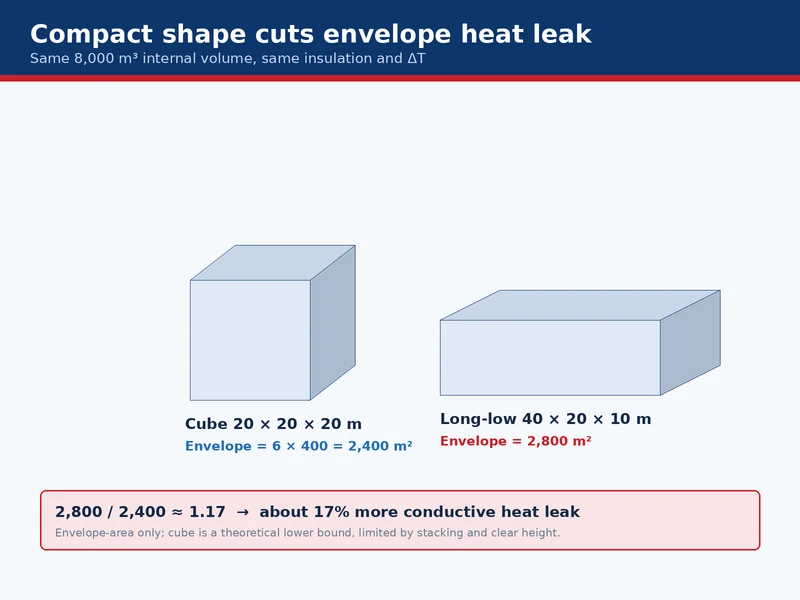
Take a worked example: two stores of the same 8,000 m³ internal volume. A cube-shaped store 20 m × 20 m × 20 m has an envelope area of 6 × 400 = 2,400 m². A long, low store 40 m × 20 m × 10 m holds the same volume but has an envelope area of 2 × (800 + 400 + 200) = 2,800 m². With the same insulation U-value and the same temperature difference, conductive heat leak scales with area, so the long, low store leaks about 2,800 / 2,400 ≈ 1.17 times as much, roughly 17% more. This is envelope area only, assuming identical insulation and temperature difference and ignoring ground-coupling differences; compactness is a free energy saving the layout buys. The FAO note makes the same argument for a near-cube store. Real stores are limited by stacking and clear height, so the cube is a theoretical lower bound on envelope area, not a design target.
Stacking protects the product within that envelope. The FAO note, citing the National Association of Frozen Food Producers, recommends products at least 4 inches off the floor, 8 inches away from walls, and 18 inches from roof cooling units. It also calls for 1-inch dunnage between every second tier. These gaps let cold air circulate around the goods and keep the warm wall and the cooling unit from directly damaging the product. Clear height must accommodate the stack plus that 18-inch clearance, so the steel shell’s eave height is a storage decision. Columns inside the store are insulated to avoid thermal bridges and ice, and the layout keeps the stack away from doorways where warm air enters.
Stock rotation closes the loop: frozen fish is date-stamped and moved first-in, first-out, and glazing is inspected regularly and renewed when required. The layout therefore needs inspection aisles and access to every block. These are food industry warehouse management practices, but the building enables them. A store packed wall-to-wall with no aisles cannot rotate stock or renew glaze.
What must the seafood cold store brief lock first?
The seafood cold store brief locks the temperature program and freezing capacity first. Both are costly-to-reverse inputs to the envelope, refrigeration, and floor that the steel shell must carry. That sequence is the practical core of seafood cold storage construction. The other decisions converge after them: panel thickness and vapor seal follow the class, frost protection the coldest room, and layout the stack and the freezing-versus-holding split. We confirm these inputs against the product specification before we release a structural design. A store sized for −18 °C cannot be cooled to sashimi temperatures by turning a dial.
Lock these seafood-specific inputs and the shell, freezing duty, and frost protection can be sized to the product:
- Product forms and species: whole fish, fillets, blocks, or shellfish, and the fatty-fish or sashimi share, because they set the temperature class.
- Temperature program per room: chilled, frozen, fatty-fish, or ultra-low setpoints, with the buyer specification for any sashimi room.
- Daily freezing intake and holding inventory: tonnes per day to freeze and tonnes to hold, as two separate quantities, because they size two separately sized duties.
- Freezing method and treatment: blast, plate, or IQF, and any parasite freezing treatment for raw-consumption fish, with its temperature recording.
- Site exposure and washdown regime: coastal salt category and the cleaning agents used, because they set the coating and fastener specification.
- Stack height, rotation, and glazing access: the clear height and aisle layout that keep stock rotating and glaze intact.
If your product mix includes a sashimi-grade ultra-low room, fix that room’s setpoint and freezing duty with us before the envelope is priced. Our steel cold storage buildings design and steel building design process covers this. If you only hold chilled or standard frozen fish, the baseline class and a separate holding store are the simpler, cheaper answer. The ultra-low upgrade is not worth buying.
FAQ
Does a seafood cold store need a separate blast freezer?
Yes, if you freeze fish on site. A holding cold store’s refrigeration handles steady heat ingress, while freezing warm fish is a separate batch load, so freezing needs its own blast freezer, plate freezer, or IQF room and refrigeration circuit. If you only receive already-frozen fish, a holding store alone is enough.
Do I need temperature recording in a seafood cold store?
Yes. The EU regulation requires freezer-vessel storage holds to carry a temperature-recording device, and FDA’s seafood HACCP framework expects monitoring of temperature controls. For a holding store, continuous recording plus regular product checks is what proves the cold chain held.
Why does frozen fish still get freezer burn?
Freezer burn is dehydration: water vapor leaves the fish surface and freezes on the cooling unit when the product-to-cooler temperature difference is large. Glazing or moisture-proof vacuum packaging slows it; a steady low temperature with a small coil difference limits it.
How long can fatty fish be kept frozen?
At a steady −20 °F, about −29 °C, the FAO note’s IIR data give fatty fish about 6 months of good-quality storage, versus 8–10 months for white fish. Warmer holding shortens that window, and these are quality periods, not safety limits.
Is a coastal seafood cold store more expensive to build?
The coastal site adds a corrosion-protection requirement to the same building type. Salt spray raises the atmospheric corrosivity category the frame and fixings must resist; brine and washdown add a chemical exposure verified separately. The temperature class still drives the envelope and refrigeration cost.