



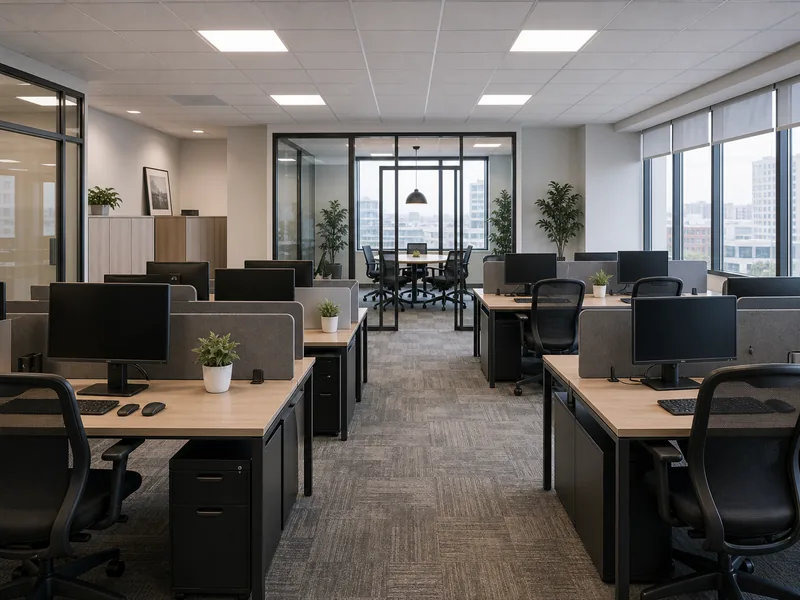
A 1,000-square-foot office usually holds 6 to 10 people. The realistic range runs from about 4 in a private-office layout to 12 in a dense open plan, and it climbs past 15 only when desks are shared across a hybrid schedule rather than assigned one-to-one. The spread is that wide for two reasons. First, “1,000 square feet” describes the floor you lease, not the floor you can furnish. Second, the seat count depends on how much of that floor goes to desks rather than meeting rooms, circulation, and a kitchen.
This guide plans a typical U.S. commercial office. It does not cover residential live-work units, lab or medical fit-outs with equipment clearances, or warehouse mezzanine offices, where different clearances and codes change the math.
What 1,000 Square Feet Actually Gives You to Work With
The 1,000 square feet on a lease is rentable area, and only about 800 to 900 of it is usable floor you can lay out. Rentable area is measured to the outside of the exterior walls and includes a proportional share of building common space such as the lobby, the corridors, and shared restrooms, which is the standard BOMA basis landlords quote. Once you subtract that loss factor of roughly 10 to 20 percent, a “1,000 sq ft” suite leaves around 850 square feet of usable floor inside your own walls.
That usable figure is where every capacity estimate should start. Counting desks against the full 1,000 overstates what fits by a person or two before you have drawn a single workstation. The practical move is to confirm the usable square footage on the stacking plan or test fit, not the headline rentable number, because the two routinely differ by the size of a small office.
Square Feet Per Person Sets the Density Band
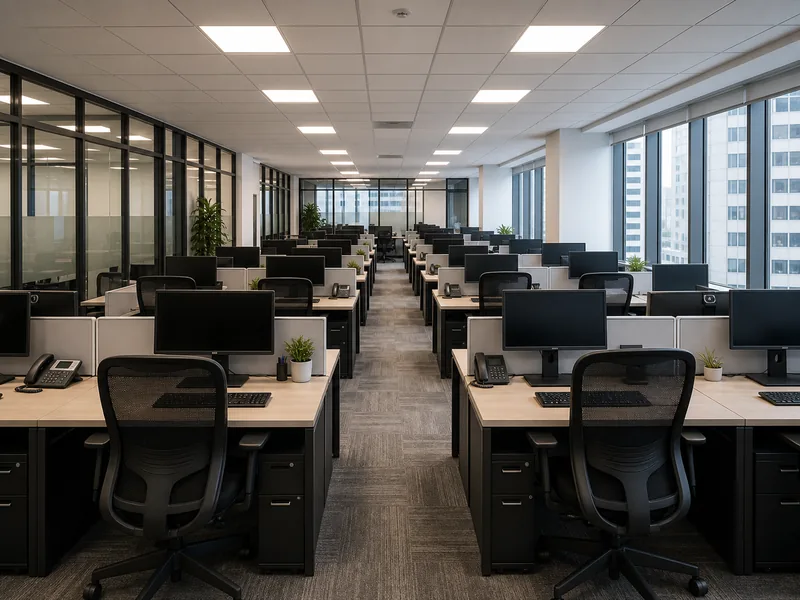
Capacity tracks one main variable: the square feet you allow per person, which falls into three density bands that cover almost every office. High density runs 80 to 150 square feet per person and means mostly open seating. Average density runs 150 to 250 and mixes workstations with some private offices. Low density runs 250 to 500 and is dominated by enclosed offices, the pattern you see in law and architecture firms.
Dividing 1,000 by each band gives the count directly:
| Density band | Sq ft per person | People in 1,000 sq ft |
|---|---|---|
| High (open plan) | 80–150 | ~7–12 |
| Average (mixed) | 150–250 | ~4–7 |
| Low (private offices) | 250–500 | ~2–4 |
Office type usually picks the band before culture does. A sales floor or call center lives at the dense end, around 80 to 100 square feet per person, which is the 10-to-12 case. A law firm or private professional practice sits at 250 and up, the 4-or-fewer case, before any exam-room or equipment clearances this guide does not size push it sparser still. Most modern offices now plan around 100 to 150 square feet per person, down from roughly 225 before 2020, as hybrid schedules and shared desks pushed densities up. JLL’s occupancy benchmarks describe the same drift, with target densities moving from about 165 toward 132 square feet per person. At 100 to 150 square feet each, 1,000 square feet lands squarely on the headline answer of 6 to 10 people.
Meeting Rooms, Kitchens, and Circulation Take the First Cut
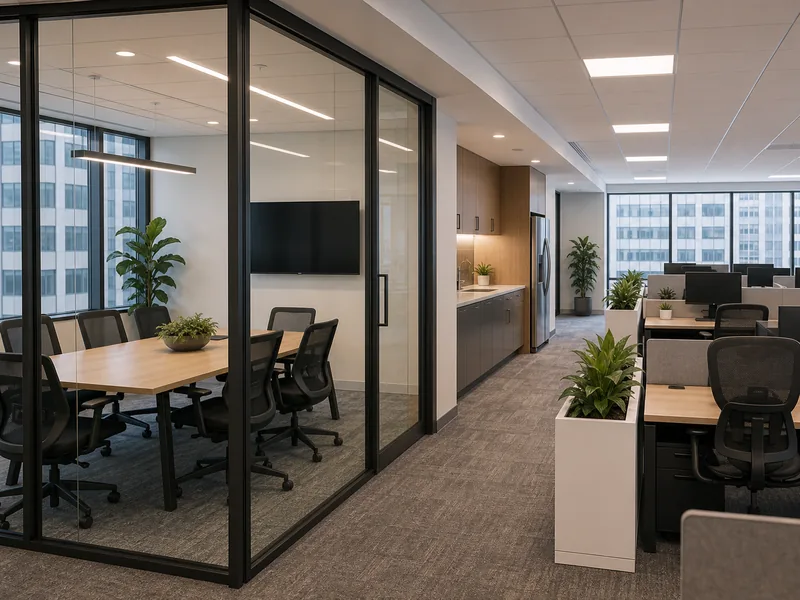
Before any desk goes in, a working office gives up floor to circulation, a meeting room, and a kitchen, often 30 to 45 percent of the usable area. Circulation alone runs 20 to 30 percent of usable space once you account for the aisles people need to reach desks and the clearances around doors. The amenities then take fixed bites: a small conference room, a kitchenette, a reception or storage nook.
The path from floor area to seats runs in one direction:
- Start with the leased area, 1,000 square feet.
- Subtract the loss factor to get usable area, about 850 square feet.
- Subtract circulation, a meeting room, a kitchen, and storage.
- Divide the desk area that remains by the per-workstation figure.
Planners consistently underestimate the meeting room. A table that seats eight reads like a 100-square-foot footprint, but once you add chair pull-out, a walking path, and a door swing, it needs closer to 250 square feet to function. The common allowances bear that out, and two independent space-planning sources put them in the same place:
- Open workstation: 60–110 sq ft per person
- Small private office: 90–150 sq ft
- Conference room: 50 sq ft plus 25 sq ft per seated person
- Reception or waiting area: 100–200 sq ft
- Break room: 75 sq ft plus 25 sq ft per seated person
Run that against 850 usable square feet and the headcount comes into focus. Take out roughly 200 for circulation, 150 for a small meeting room, 100 for a kitchenette, and 75 for reception or storage, and you are left with around 325 square feet for desks. At 60 to 110 square feet per workstation, that is three to five dedicated seats with the full set of amenities. Cut the meeting room and most of the kitchen, go open plan, and the same floor recovers six to ten desks. The amenities you keep, not the raw square footage, set the real number.
Open Plan or Private Offices Swings the Count Most
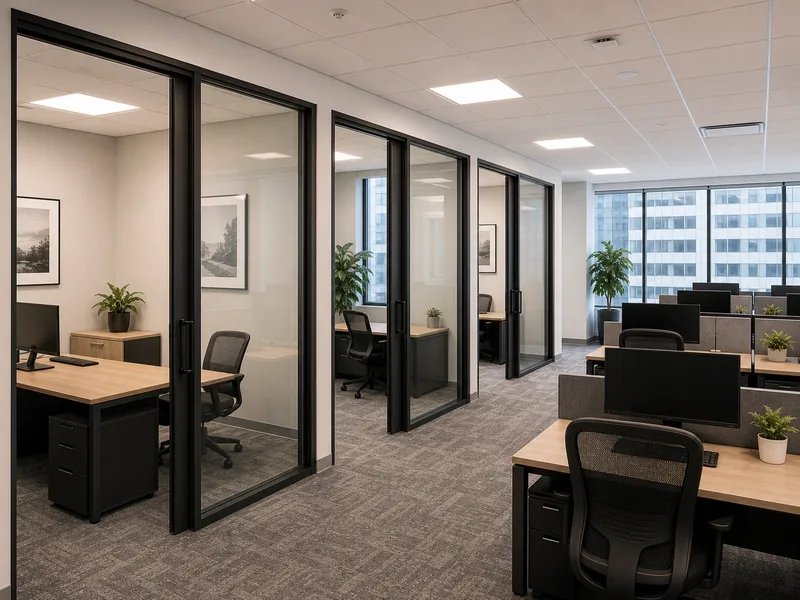
Layout moves the count more than any other single choice, because a private office spends 90 to 250 square feet on one person while an open workstation spends 60 to 110. Build out three private offices in 1,000 square feet and you have housed three people plus a small shared area; lay the same floor out as a bench-style open plan and you can seat ten to twelve. That single decision is why the same suite honestly answers “four” for one tenant and “twelve” for another.
Sharing desks stretches the number further. Hybrid teams commonly plan 3 to 7 desks for every 10 employees. A 1,000-square-foot office with eight or nine shared workstations can then carry a headcount of 15 or more, as long as everyone understands those are shared seats and not everyone is in on the same day. That is a scheduling choice, not extra floor.
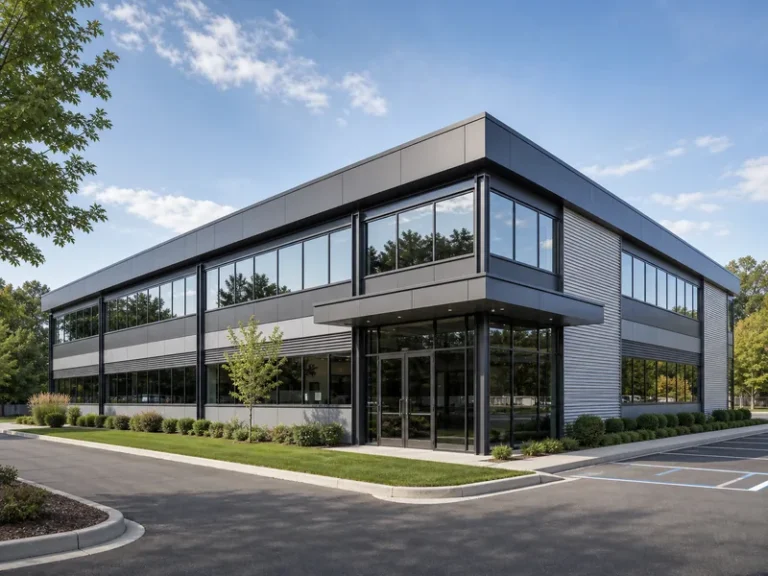
Structure shapes the ceiling on density too. An interior column does not just take its own footprint; it forces a circulation aisle and a desk setback around it, so a column landing in the middle of a small floor can cost more usable seats than its size suggests. This is where the building shell matters: clear-span framing leaves the floor plate open, which is why steel building design for offices favors column-free bays that let partitions and desks fall where the plan wants them instead of around posts.
Why Fire Code Is Rarely the Real Ceiling
Fire and building codes set a legal occupant load, but at 1,000 square feet that ceiling sits well above any comfortable layout. The International Building Code assigns business areas, its Group B classification, an occupant load factor of 150 gross square feet per person, a figure raised from 100 in the 2018 edition and kept in the 2024 code. Dividing 1,000 gross square feet by 150 yields a calculated occupant load of about 6 to 7, which is the number used to size exits, not a cap on how many desks you may install.
Exit rules confirm how much slack there is. A space with 49 or fewer occupants may use a single exit, and two exits are not required until you cross 50, so a 1,000-square-foot office carrying even 12 to 15 people stays comfortably under the threshold that would force a second door. Denser uses such as call centers can be approved at 50 gross square feet per person where the building official allows it, which only widens the gap. The final occupant load for any specific suite still depends on the local code edition, the number and arrangement of exits, the use group, and the authority having jurisdiction, so treat the 6-to-7 figure as a planning number and confirm it with the local reviewer. OSHA, the agency most people assume sets a square-foot minimum, sets none; its rules govern exit-route width, at least 28 inches, and keeping egress clear, not how many square feet each worker gets. For a room this size, the binding limit is usable area and layout, not the fire marshal.
Sizing a Steel Office Building Around Your Headcount
When the office is a building you are putting up rather than a suite you are leasing, the headcount math runs in reverse: you start from people and size the footprint. Multiply your target headcount by the per-person figure for the density you want. Twelve people at an average 175 square feet each points to a footprint of about 2,100 square feet, less if the plan is dense and 3,000 or more if private offices dominate. The same logic scales the purpose-built steel offices buildings that manufacturers design to a tenant’s program rather than to a fixed lease line.
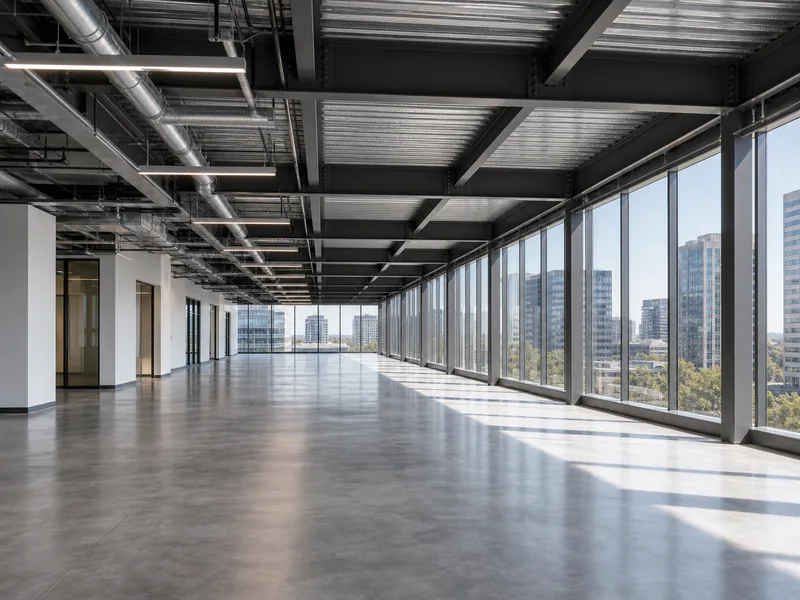
Building new also lets you remove the constraints a leased floor imposes. A clear-span steel office shell carries its loads in the perimeter frame, so the interior stays free of columns and the floor plate can be zoned for whatever density you settle on. That open shell also leaves room to grow into: adding a bay extends the floor plate when headcount climbs, without reworking interior columns. KAFA designs and fabricates that kind of steel office building, framing the bays around the floor plan instead of forcing the plan around the structure. If you are weighing whether to lease and fit out or to build an office building sized to your team, start from the headcount target. It feeds straight into both the metal building sizes you would order and the office building costs you would budget.
Turning the Range Into Your Number
The fastest way to replace the 6-to-10 range with your own number is to settle two figures in order: usable square feet first, then the per-person target. Confirm the usable area inside your walls, decide whether your culture wants 100 square feet per person or 200, and only then subtract the meeting room and kitchen you actually need. Those two numbers, not the rentable figure on the lease, decide whether 1,000 square feet seats six people in private offices or twelve at shared benches.
FAQ
How many desks fit in a 1,000 sq ft office?
About 6 to 10 dedicated desks fit in a 1,000-square-foot office at the current planning density of 100 to 150 square feet per person. The count drops to three to five once you add a conference room, a kitchen, and full circulation, and rises toward ten to twelve in an amenity-light open plan.
How many square feet per person do you need in an office?
Most offices now plan 100 to 150 square feet per person, down from about 225 before 2020. High-density open plans run as low as 80, while private-office layouts use 250 to 500, so the per-person figure is a choice about how open the workplace is.
Is 1,000 square feet of office the same as 1,000 usable square feet?
No, 1,000 rentable square feet usually leaves about 850 usable. Rentable area includes a share of lobbies, corridors, and shared restrooms under the standard BOMA measurement, a loss factor of roughly 10 to 20 percent, so capacity should be counted against the usable figure on the floor plan.
What is the occupant load of a 1,000 sq ft office?
The IBC occupant load of a 1,000-square-foot business space is about 6 to 7, using the Group B factor of 150 gross square feet per person. That figure sizes the required exits and depends on the local code, use group, and authority review; it is not a limit on desks, and a single exit is permitted up to 49 occupants.
Can 15 people work in 1,000 square feet?
Fifteen people can use a 1,000-square-foot office only when desks are shared across a hybrid schedule. With 8 or 9 shared workstations and a typical 3-to-7-desks-per-10-employees ratio, the headcount works because not everyone is on-site the same day; assigning 15 fixed desks would not.
Further Reading
- ICC – IBC 2024, Chapter 10 Means of Egress — International Code Council. The source for the Group B occupant load factor (150 gross sq ft) used to size exits in offices.
- BOMA International – Floor measurement standards — Building Owners and Managers Association. Defines usable versus rentable area, the basis for the loss factor between leased and layout-able floor.
- OSHA – 1910.36 Exit routes — U.S. Occupational Safety and Health Administration. Governs egress width and clearance for workplaces and confirms there is no federal square-foot-per-person minimum.