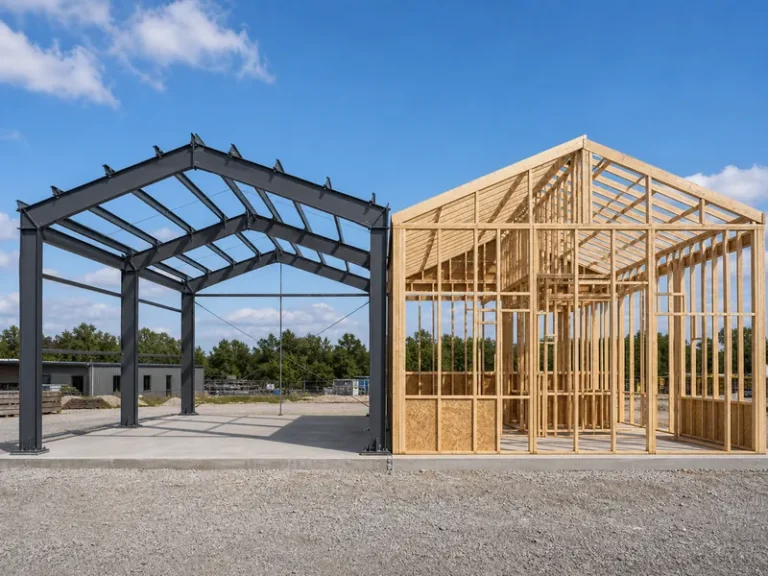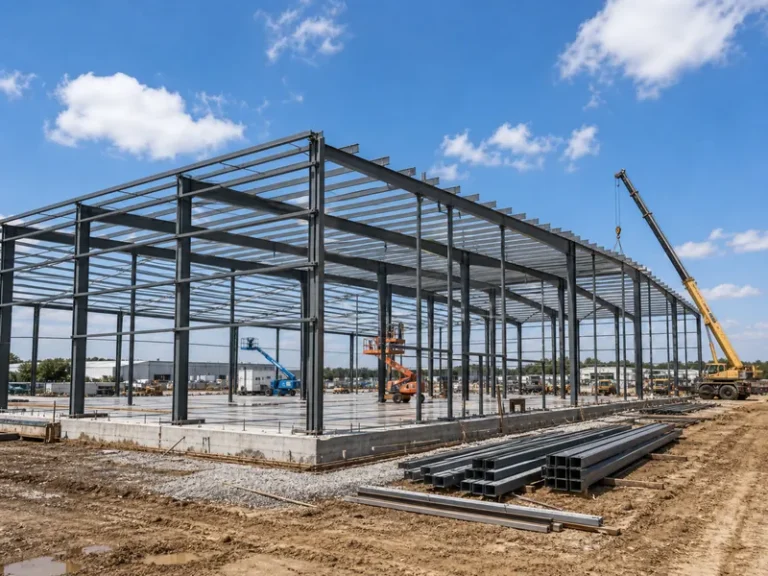





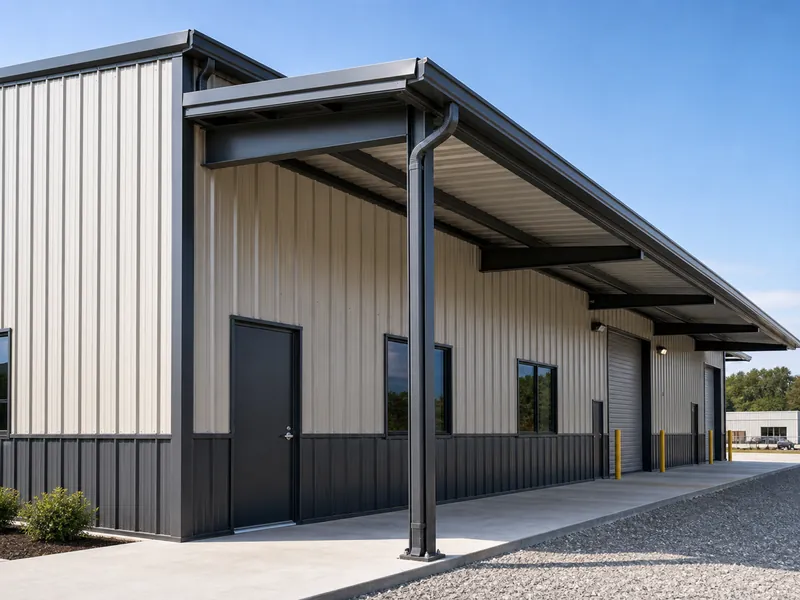
A steel building overhang is the section of roof that projects past the wall line, and how far it can reach depends far more on engineering than on preference. Factory-standard overhangs on a pre-engineered metal building are usually small, in the range of about 3 to 6 inches, just enough to throw water clear of the wall panels. When owners want real coverage, self-supporting eave and canopy extensions commonly run from about 2 feet up to 10 feet. A few engineered designs reach 14 or even 15 feet without a single support post. The ceiling on any of those numbers is set by wind uplift and snow load, not by the catalog. Overhangs also split into two families by location, sidewall and endwall, and the two behave differently enough that choosing the wrong one is a common, avoidable mistake.
This guide covers what an overhang is, where it goes, how far it can project, what carries it, and how to decide what to spec.
What a Steel Building Overhang Actually Is
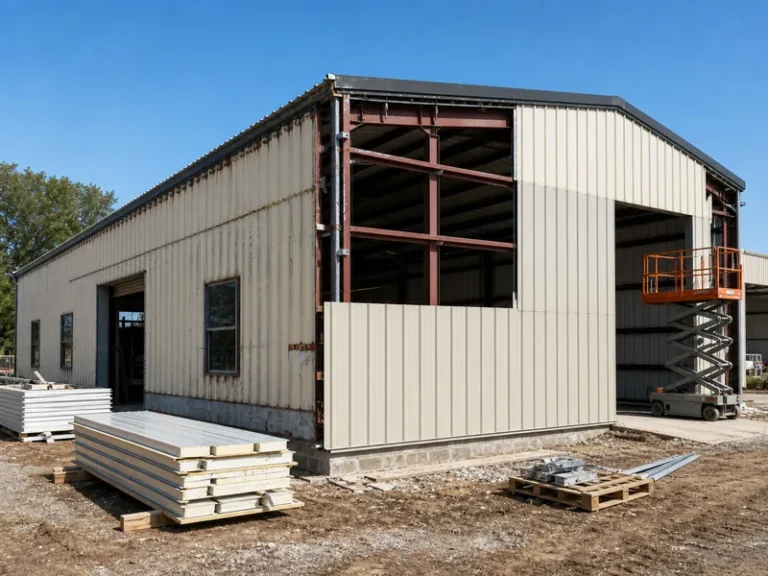
An overhang is the part of the roof that extends beyond the supporting wall, and on a steel building it is a deliberate, engineered assembly rather than a leftover roof edge. The visible piece is the projecting roof panel; underneath sits a soffit that encloses the underside, and a fascia trim closes off the leading edge. Together they shed water away from the wall, shade the cladding, and keep rain from sheeting down windows and doorways.
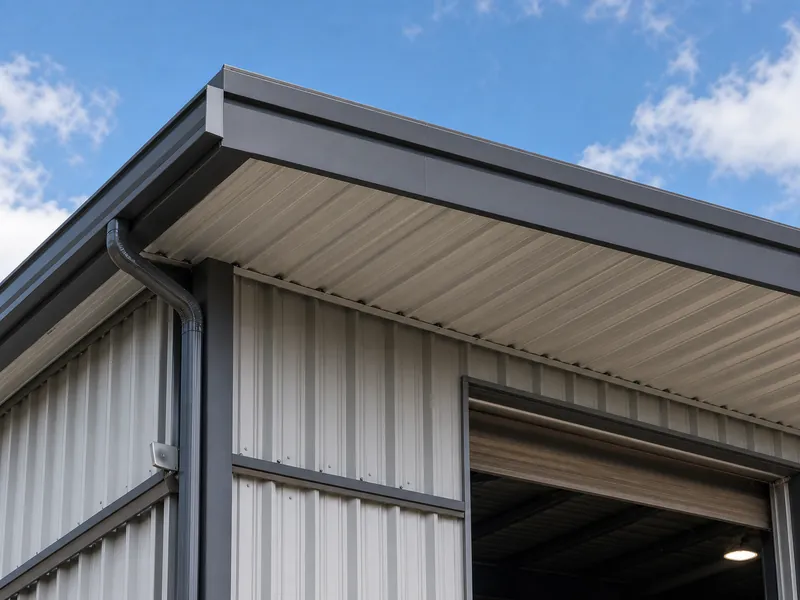
Separating an overhang from two things people often confuse it with helps before you spec anything. A lean-to is a separate single-slope structure hung off the main building columns, with its own roof and often its own posts, so it adds covered floor area, not just a projection. A canopy, in most manufacturers’ language, is an unsupported roof extension that shelters an entrance without floor-level columns. The terminology is not consistent across the industry, which is exactly why the labels deserve a second look before anything lands on a purchase order.
Where Overhangs Go: Sidewalls vs Endwalls
Overhang location is described relative to the building’s frame, and the sidewall-versus-endwall distinction drives both the name and the structural detailing. A sidewall runs the long direction of a pre-engineered building, parallel to the rigid frames; an endwall closes off the gable ends. An overhang on the sidewall is usually called an eave overhang or eave extension, because it projects from the eave line. An overhang on the endwall is a rake or gable extension, and because it is carried by running the roof purlins past the frame, several manufacturers label it a purlin extension.
Naming gets muddier from there. Some suppliers call any front-or-back sidewall projection a “canopy extension” and reserve “purlin extension” for the endwalls; others use “canopy” only for the piece over a door. When you compare quotes, set the label aside and ask two concrete questions: which wall does it project from, and does it carry its own load or lean on posts. Those two answers tell you what you are actually buying.
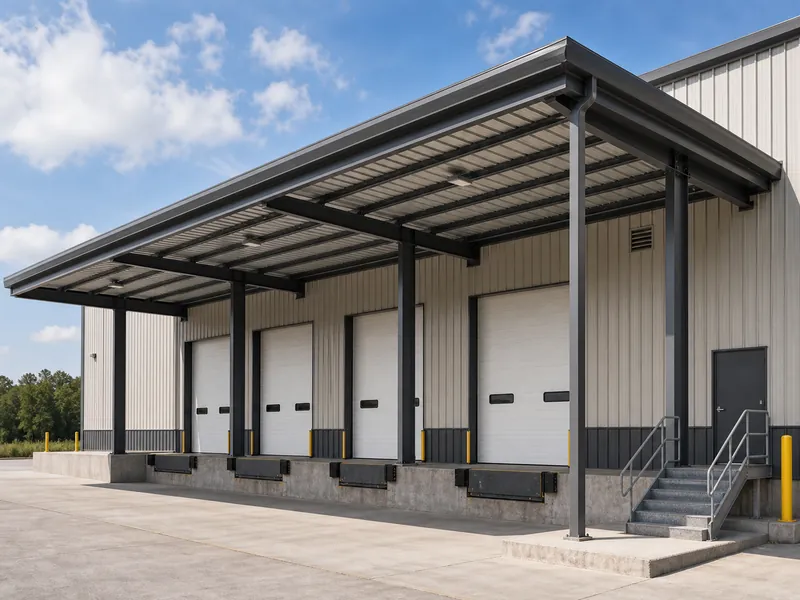
Most industrial metal buildings end up with overhangs in only a few spots that actually need them, not wrapped around the whole structure. A sidewall eave over a loading dock or an endwall canopy over a personnel door is the typical placement. Door canopies are the simplest case of all, factory-built light-gauge sections in fixed widths such as 30, 40, and 60 inches, made to shelter a single opening.
How Far a Steel Building Overhang Can Project
Projection distance is the number most buyers actually care about, and it splits cleanly by whether the extension supports itself. Small trim-style overhangs that simply run the roof panel a few inches past the wall sit in the 3-to-6-inch band and need no special framing. Once you want usable shelter, you move into self-supporting territory: sidewall eave overhangs are commonly offered from about 2 feet to 10 feet deep with the soffit included. Some manufacturers list endwall canopies in a similar 3-to-10-foot range. Unsupported canopy and purlin extensions, the kind that cantilever straight off the structure with no posts, generally top out near 5 feet on a standard building. The exact limit is tied to the wind load the frame was engineered for. Specialized connection designs stretch that envelope further, with a few suppliers advertising 14-foot self-supporting eaves and 15-foot post-free extensions.
The maximum is a moving target because of uplift. A roof overhang is a cantilever with wind pushing up on both faces, so the longer it projects, the more leverage the wind has on the connection back to the frame. A building engineered for a higher design wind load can carry a deeper unsupported overhang than the same building in a milder zone. That is why a vendor’s “up to X feet” only holds for a specific load case. Snow adds the opposite problem, pressing the cantilever downward, so fixed overhangs are sized to the local ground snow load as well. A single projection figure is best read as provisional, something the building’s wind and snow design, and the local building code, have to confirm before it goes on the drawings.
What Holds an Overhang Up
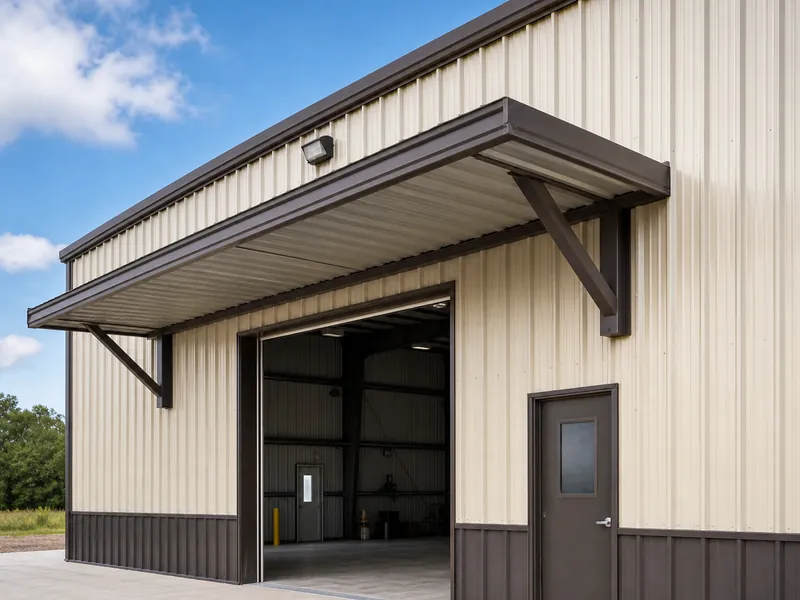
The framing behind an overhang is mostly secondary steel, and how cleanly it carries load depends on those members. On the sidewall, the eave strut and extended roof purlins form the cantilever; on the endwall, the purlins themselves run past the last frame to make the projection. Once an overhang reaches roughly 4 inches or more, it needs reinforcement to resist sagging under its own weight and snow and lifting under wind. On deeper self-supporting designs, that means brackets or stanchions spaced about every 16 to 24 inches under the panels. The soffit is typically a PBR or PBU steel panel, the same profile families used across the rest of the metal roof, trimmed out so the underside reads as finished rather than exposed.
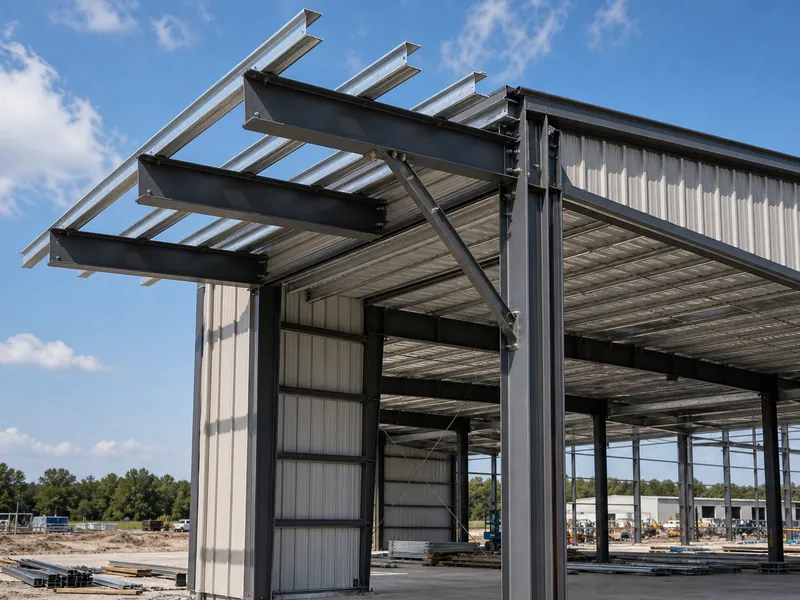
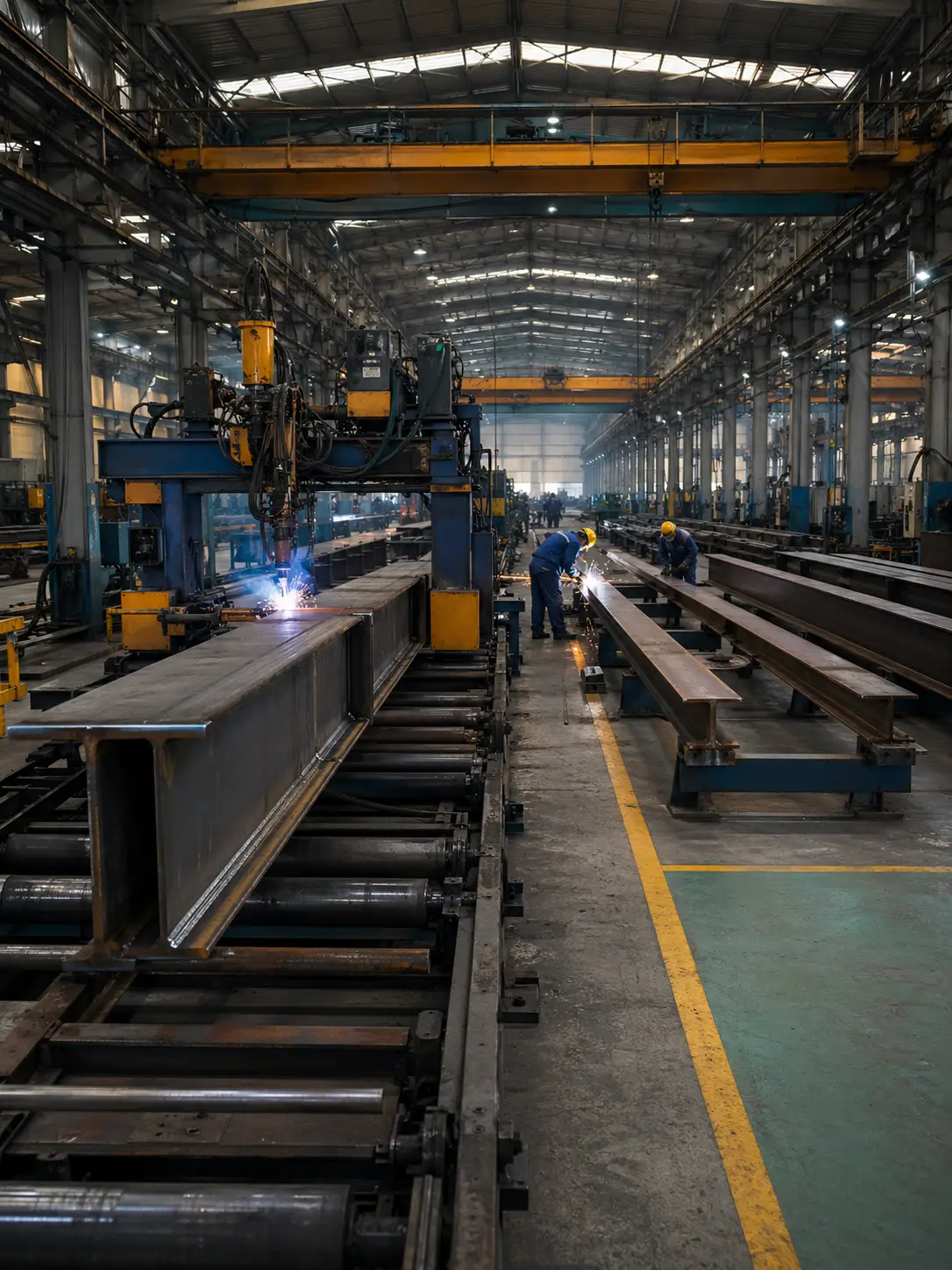
Because the projection lives or dies on those secondary members, it is far better detailed at the factory than improvised in the field. The eave struts, purlins, and extension brackets that carry it are standard metal building components. KAFA runs dedicated C/Z-section purlin lines, so they arrive cut, punched, and reinforced as a matched set, not pieced together on site. A self-supporting extension that arrives with its connections already engineered avoids the most damaging field error, a cantilever that was lengthened after the fact without anyone rechecking the uplift path.
Choosing the Right Overhang for Your Building
The right overhang follows from what you need it to do, then where, then how far, in that order. Start with purpose: a few inches of trim overhang is enough purely to protect wall panels and foundations from runoff, while sheltering a doorway, a loading dock, or an outdoor work area calls for a self-supporting extension measured in feet. Next fix the location, because a sidewall eave and an endwall purlin extension are detailed differently, and a door canopy is a different product again. Only then settle the projection, and leave that figure provisional until the building’s wind and snow design signs off on it.
Two checks save the most rework. Confirm whether the extension is self-supporting or needs posts, since posts change your foundation and the usable space underneath. And confirm the soffit and trim are included, because an “overhang” quoted without its soffit is just a bare panel edge. Settle both at the quoting stage and the overhang becomes a detail your fabricator engineers in, instead of a change order later.
Conclusion
Specifying a steel building overhang is a sequence, not a single choice. Lock the wind and snow design first, because that is the constraint every projection figure has to live within. Decide sidewall versus endwall next, since location sets the framing and the name. Size the projection last, confirming whether it carries itself or needs posts and whether the soffit is in the quote. Handle them in that order and a deep, post-free eave stops being a gamble and becomes an engineered part of the roof. Where the extensions are doing real work, having the purlins, eave struts, and brackets fabricated as one detailed package is what keeps a long cantilever predictable.
FAQ
How far can a steel building overhang extend?
Unsupported overhangs on a standard pre-engineered building generally reach about 5 feet. Self-supporting eave and canopy extensions are commonly offered up to 10 feet and, in specialized designs, as far as 14 to 15 feet without posts. The real limit is whatever the building’s wind uplift, snow load, and local code allow, so the same depth is not available on every building.
Do steel building overhangs need support posts?
Many do not. Eave overhangs and canopy extensions are frequently engineered as self-supporting cantilevers that need no external columns, which keeps the area beneath them clear. Past the self-supporting range, or where wind loads run high, posts or stanchions may be required, and that call belongs to the building’s structural design rather than to a catalog maximum.
What is the difference between an eave extension and a canopy?
An eave extension projects the roof along a sidewall and usually includes a soffit, while a canopy in most manufacturers’ usage is an unsupported roof extension that shelters an entrance. Because the terms are applied inconsistently, the reliable way to compare options is to ask which wall the extension projects from and whether it supports its own load.
Do overhangs change a building’s wind rating?
Overhangs raise the wind uplift the structure has to resist, because the projecting roof is loaded on both faces. A longer overhang is engineered into the frame’s wind design rather than added afterward. That is why a deeper projection can call for a heavier connection or a building rated for a higher design wind speed.
Is the soffit included with an overhang?
Not always, and it is worth confirming in writing. Self-supporting eave overhangs typically include a soffit panel that encloses the underside, but some basic extensions are quoted as a bare projecting panel. Since the soffit is what makes the underside weather-tight and finished, an overhang quoted without one is not a complete assembly.
Further Reading
- ASCE 7: Minimum Design Loads and Associated Criteria for Buildings and Other Structures — American Society of Civil Engineers. The wind-load standard behind the uplift limits that govern how far an overhang can safely project.
- Metal Building Manufacturers Association (MBMA) — Industry association whose Metal Building Systems Manual defines eave and rake extensions, canopies, and the secondary framing that carries them on pre-engineered buildings.
- International Building Code, Chapter 15: Roof Assemblies and Rooftop Structures — International Code Council. Code context for roof construction, including how projecting eaves and overhangs are treated.