




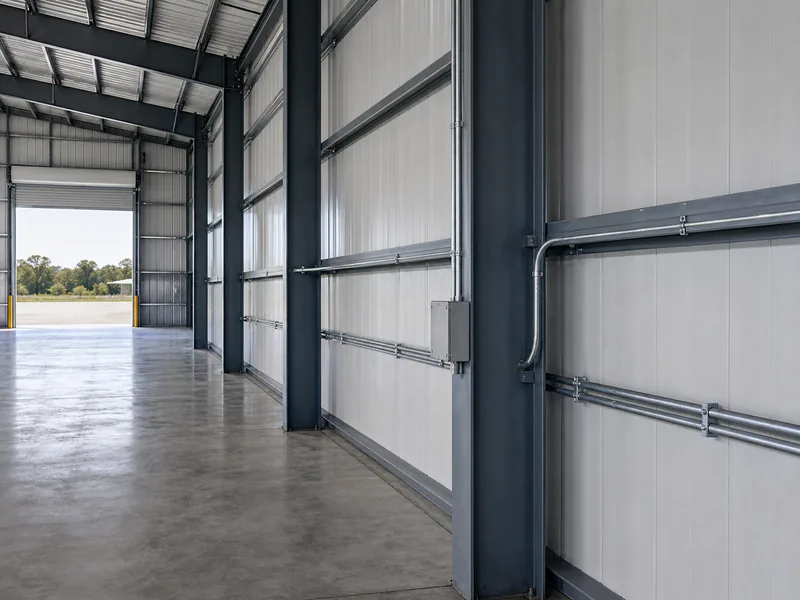
Wiring a metal building is mostly ordinary branch-circuit work, with three differences that the steel frame forces on you. You run conductors inside conduit fastened to the steel instead of fishing cable through the walls, you protect those conductors everywhere they pass near or through metal, and you tie the frame itself into the grounding system. Get those three right and the rest of the job follows the same rules as any other building: panels, outlets, lighting, and GFCI protection all answer to the National Electrical Code (NEC) and your local inspector.
Treat what follows as planning and coordination, not a substitute for a licensed electrician. The work has to meet your local electrical code, and in most places the service connection, panel, and final sign-off have to be handled by a licensed professional. With that boundary set, the job runs in a predictable order: understand why the frame changes things, plan circuits before the walls close, choose conduit and wire, mount the panel and run the raceway, ground and bond the steel, then test before energizing.
What Makes Wiring a Metal Building Different
A steel frame conducts electricity and has hard, cut edges, so the casual methods that pass in a wood-framed shop turn into a shock or short-circuit hazard in a metal building. In a stud wall you can staple non-metallic cable to wood and bury it in the cavity. Against steel, an unprotected conductor that chafes on a sheared purlin edge or a drilled hole can nick its insulation and energize the whole frame.
Three frame-driven issues drive every decision later in this article:
- Conductivity. The columns, rafters, girts, and purlins are all bonded metal. A fault that reaches the frame can put voltage on a large surface someone is touching, which is why grounding and bonding get their own section below.
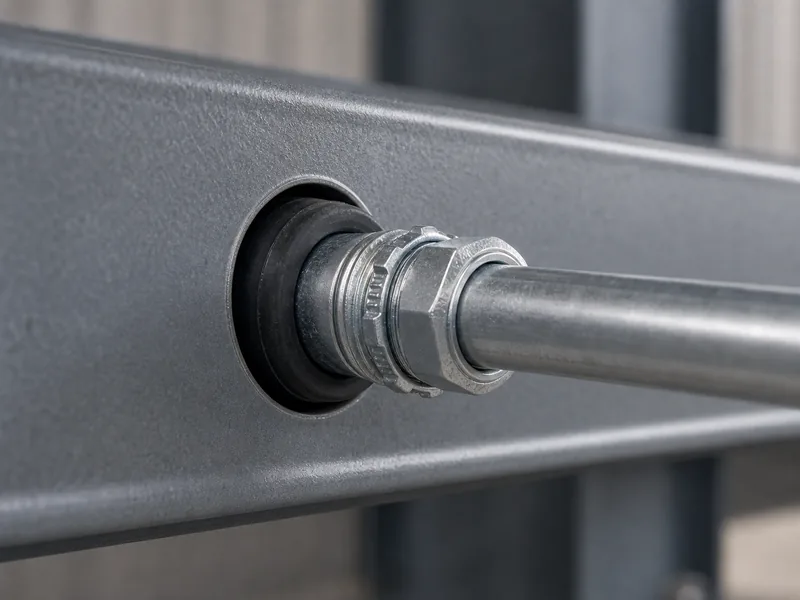
- Sharp edges. Holes punched or drilled in steel leave burrs. Any conductor passing through needs a bushing, grommet, or the protection of a conduit fitting at that point.
- Condensation. Steel shells in unconditioned space sweat when warm air meets cold metal. Moisture collects in low conduit runs and boxes and speeds up corrosion at fittings, so raceway choice and box ratings have to account for it.
None of this makes the building hard to wire. It just means the conductors live on the surface of the steel in a protective raceway, not hidden inside it.
Plan Circuits and Loads Before the Walls Close In
Electrical rough-in in a metal building has to happen before the interior liner panels and insulation go up, because you cannot fish a circuit through a finished steel wall the way you can through open wood framing. Map every outlet, switch, light, and piece of fixed equipment first, then group them into circuits and decide where the panel sits. Closing the building before this is done means reopening finished walls later to fix what got buried.
Plan the load around what the building actually does. A storage barn needs little; a working shop with a welder, compressor, and dust collector needs dedicated circuits sized to each motor, plus general-purpose receptacles. As a practical layout target, not a code rule, many shop owners set a receptacle every 10 to 15 feet of wall and space overhead fixtures so the floor is evenly lit. The right spacing still depends on the work, the ceiling height, and the fixtures you choose. If you are running high-bay LED fixtures to cut the lighting load, that choice also supports overall energy efficiency in metal buildings, so size the lighting circuits with the final fixture wattage in mind.
Timing matters as much as layout. Rough-in, then inspection, then insulation for metal buildings and liner panels, in that order. If the vapor barrier and insulation go up first, every later conduit penetration risks tearing the barrier and inviting condensation. On a large clear-span building such as a steel airplane hangar, home runs can stretch the full length of the bay and feed high-bay lighting. The panel location and main conduit path then deserve extra thought before anything closes in. Wiring is just one trade in the wider job of how to build a steel building, and it has a fixed slot in that sequence.
Choose Conduit and Wire for a Steel Shell
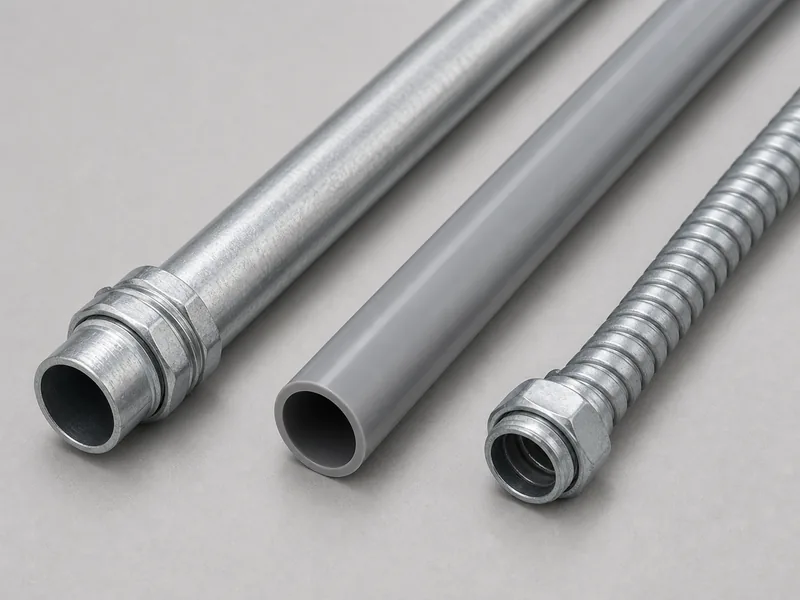
Conduit choice in a metal building is a trade-off between mechanical protection, moisture resistance, and whether you want the raceway itself to carry the equipment ground. Three raceways cover almost every run:
| Raceway | Best use in a metal building | Watch-outs |
|---|---|---|
| EMT (steel tubing) | Exposed runs along girts and purlins; can serve as the equipment grounding conductor | Ream cut ends and tighten every connector for ground continuity; can sweat in unconditioned space |
| Rigid PVC | Damp or condensation-prone areas and below-slab runs; non-conductive | Needs a separate ground conductor pulled inside; expands and contracts with temperature; less impact-resistant |
| MC cable | Short, flexible whips from a box to a fixture | Not for long exposed runs exposed to physical abuse; follow its support spacing |
For the conductors themselves, use individual THHN/THWN-2 wires pulled through the conduit. Non-metallic cable (Romex/NM-B) is built for protected wood-stud cavities and is not suited to exposed runs on steel, where a burr or impact can cut it. As examples that an electrician still sizes to the load, 14 AWG copper pairs with a 15-amp circuit and 12 AWG with a 20-amp circuit. Motor and feeder loads call for heavier conductors, and long runs may need an upsize for voltage drop.
A steel raceway like EMT can do double duty as the ground path, which simplifies the pull. That only holds if the joints stay tight, so commit to clean reaming and listed connectors rather than rely on luck later.
Mount the Panel and Run Conduit on the Frame
The service panel sets the capacity for everything downstream, so size it for the building’s real and future load and mount it where the main runs reach the frame cleanly. Light buildings often land on a 100-amp panel; shops and larger structures frequently step up to 200 amps, and leaving spare breaker spaces is cheaper now than a panel swap later. The exact service size depends on the connected load and should be confirmed against a load calculation, not guessed.
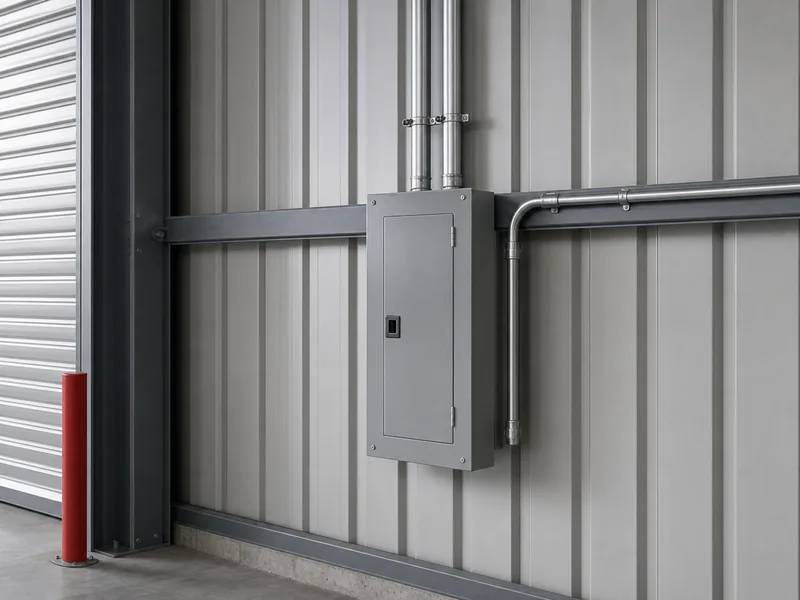
Conduit rides on the secondary steel. The girts and purlins are the metal building framing components you strap to. Run the raceway up an end wall from the panel, then along the framing to reach each drop. Support the conduit the way your code requires; for EMT that commonly means fastening within about 3 feet of each box and at regular intervals along the run, so nothing sags or pulls at a connector.
Every place a conductor or conduit passes through steel needs protection at that point: a bushing or grommet on a bare penetration, or a proper connector where conduit enters an enclosure. Use boxes rated for the location; selecting the right metal building electrical boxes for damp or exposed spots is its own decision, covered separately. Because the frame is engineered and fabricated to order, conduit attachment points and service-entrance openings can be designed into the secondary steel rather than field-drilled into primary members later. Coordinating that early with whoever fabricates your frame keeps holes out of load-bearing steel, and you can contact our team about designing those openings and attachment points into the steel.
Ground and Bond the Steel Frame
Grounding a metal building includes one step a wood building never needs: bonding the structural steel itself into the grounding system. Under the NEC, exposed structural metal that could become energized has to be bonded so a fault has a low-impedance path back to the panel and trips the breaker instead of leaving the frame live.
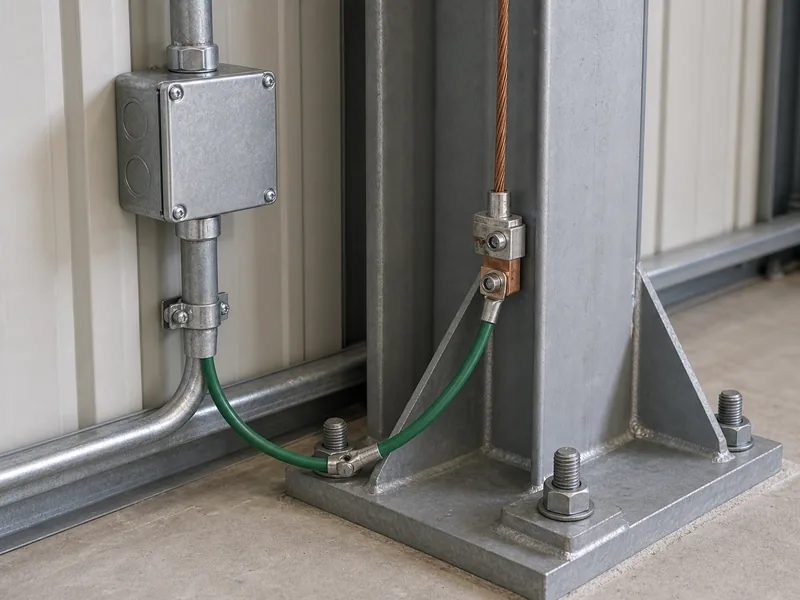
The grounding electrode itself is conventional. A common arrangement uses an 8-foot ground rod tied to the panel’s grounding bus with a copper grounding-electrode conductor, plus a second rod where a single one does not meet the code’s resistance threshold. Electrode and conductor sizing are set by the NEC and your AHJ, so treat any specific figure as a typical example your electrician verifies, not a universal rule. Every outlet, switch, and fixture then carries an equipment grounding conductor back to that bus.
Metal conduit can be that equipment grounding conductor. The NEC recognizes steel RMC, IMC, and EMT as equipment grounding conductors, so a continuous steel raceway grounds what it feeds, provided the connections are tight and the system is electrically continuous end to end. A loose coupling or a reamed-but-loose connector breaks that path silently, which is why bonding fittings and proper terminations matter more here than in a building where a green wire does all the work. Bond the structural steel, keep the raceway continuous, and the conductive frame becomes a safety asset instead of a hazard.
Test, Inspect, and Pass Rough-In
Before any circuit is energized, every run gets checked for continuity, correct grounding, and protection at each steel penetration. Work the system de-energized, verify the ground path is continuous through the conduit and to the rod, and confirm each penetration is bushed or connectored. GFCI protection is commonly required on receptacles in damp, outdoor, and shop-floor locations, and arc-fault protection applies where the code calls for it.
This is also where the permit and inspection come in. Most jurisdictions require the rough-in to be inspected before walls and insulation cover it, and many require a licensed electrician for the service connection, so check your local rules and the authority having jurisdiction (AHJ) before you start, not after. If any part of the panel, service, or grounding is beyond your experience, bring in a licensed electrician for that stage; the frame’s conductivity leaves little margin for a guess.
Conclusion
Two things cause the most rework when wiring a metal building, and both are avoidable. The first is closing the walls (insulation, vapor barrier, liner panels) before the rough-in is inspected, which buries problems you then have to reopen the building to fix. The second is treating the frame like an afterthought: skipping the structural-steel bond, or trusting loose conduit joints to carry the ground.
Sequence the job to beat both. Confirm the panel location and main conduit path against the frame layout, run and protect the raceway, get the rough-in inspected, and bond the steel before anything is energized or covered. Do those in order and the steel frame stops being the complication that needs working around and becomes the grounded, conduit-carrying backbone the whole system rides on.
FAQ
Can you run Romex (NM cable) in a metal building?
Non-metallic cable is not the right choice for exposed runs in a metal building. NM-B (Romex) is designed for protected wood-stud cavities, and on exposed steel it can chafe on burrs and sharp edges until the insulation fails. Run individual THHN/THWN-2 conductors in conduit instead; if NM is used at all, it must be protected and kept away from contact with the frame, which usually defeats the point.
Does metal conduit count as the ground in a metal building?
Yes, steel conduit can serve as the equipment grounding conductor. The NEC recognizes steel RMC, IMC, and EMT as equipment grounding conductors, so a continuous steel raceway grounds the devices it feeds. The catch is continuity: every coupling and connector must be tight, because one loose joint breaks the ground path without any visible sign.
What size wire and breaker do you need?
Wire size follows the circuit’s amperage and load. As common examples an electrician still verifies, 14 AWG copper goes with a 15-amp circuit and 12 AWG with a 20-amp circuit, with heavier conductors for motors, feeders, and the service. Long runs may need an upsize for voltage drop, so size each circuit against its actual load rather than defaulting everything to one gauge.
How do you keep condensation from affecting the wiring?
Condensation is managed by raceway choice, box ratings, and insulation timing. Steel buildings sweat in unconditioned space, so favor moisture-tolerant raceway in damp areas, use boxes rated for the location, and keep the insulation and vapor barrier intact by finishing rough-in before they go up. Penetrations made after the barrier is installed are a common path for moisture problems.
Do you need a licensed electrician and a permit?
Most jurisdictions require both for at least part of the work. The service connection and panel typically call for a licensed electrician, and the rough-in usually has to be inspected before it is covered. Rules vary by location, so confirm the permit and inspection requirements with your local authority having jurisdiction before starting.
Further Reading
- National Electrical Code (NFPA 70) — NFPA. The governing code for the wiring methods, conduit, grounding, and bonding described here; the version in force depends on your jurisdiction.
- Steel Conduit and EMT Proven to Meet the NEC — NEMA. Technical paper on steel RMC, IMC, and EMT performing as equipment grounding conductors under the NEC, supporting the grounding-and-bonding section here.
- Electrical Standards (29 CFR 1910 Subpart S) — OSHA. Workplace electrical-safety requirements relevant to shops and commercial metal buildings, including safe work practices and ground-fault protection.