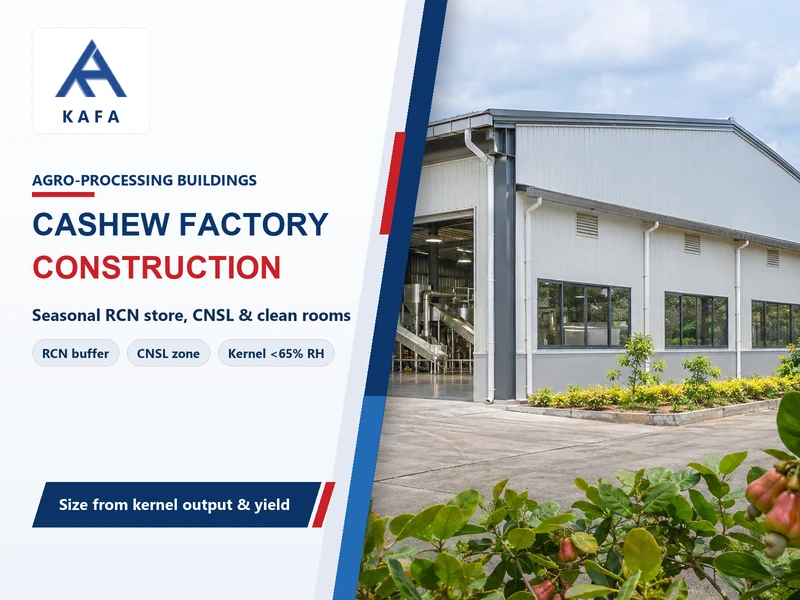
Cashew processing factory construction is driven by three loads most food plants never carry: a caustic shell liquid, a harvest-season raw-nut store, and a hall full of seated manual workers. The building program follows the mass balance from raw cashew nuts to graded kernels, not a generic hygiene layout. Fix the kernel output target and the raw-nut outturn first; they size the warehouse, the shelling hall, and the boiler before any steel is ordered.
Where does cashew processing factory construction begin?
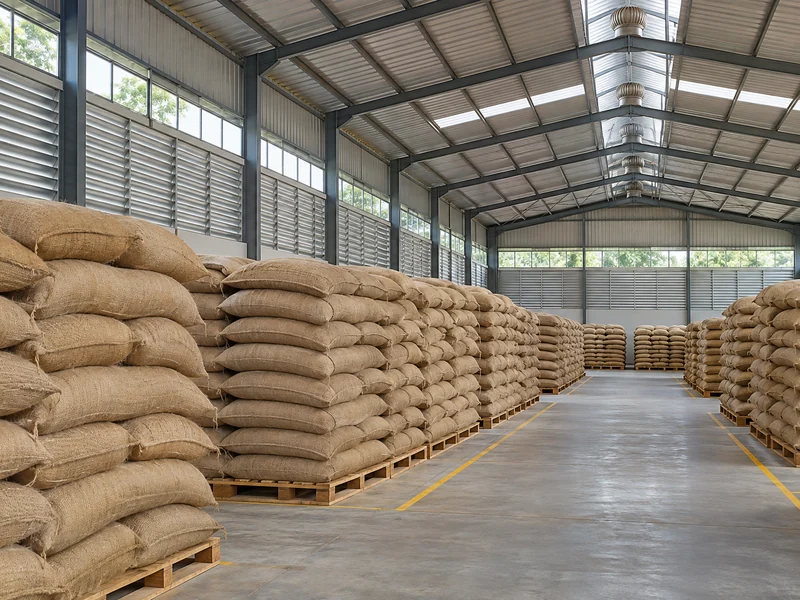
For a single-origin plant, raw cashew nut intake sets the first building dimension, because one harvest arrives in a few months while the plant shells all year. A plant importing raw nuts from several origins year-round flattens that peak. Growers sun-dry the nuts and bag them in gunny bags. The factory draws from that store across the off-season. The warehouse is therefore a seasonal buffer with the largest single footprint in the plant.
The mass balance fixes that volume. An open-access cashew shelling study puts the shell at about 70% of raw nut mass and the kernel plus testa at about 30%, with CNSL making up 35–40%. In an illustrative calculation for a 1 t/day kernel-plus-testa output, raw nut intake is 1 ÷ 0.30, or about 3.3 t/day. CNSL sits inside that shell fraction: of the 2.3 t/day of shell (3.3 × 0.70), 1.2–1.3 t/day is CNSL (3.3 × 0.35–0.40), leaving roughly 1.0–1.1 t/day of shell solids once the liquid is extracted. Substitute your own kernel target and cut-test outturn into the same division. Whole-kernel outturn falls below 30% once the testa is peeled, so size intake on your measured outturn.
Two consequences follow for the building. Shell mass exceeds kernel mass, so the shell yard and CNSL handling are primary rooms, and the intake is seasonal. At about 300 operating days a year, 3.3 t/day is roughly 1,000 t of raw nuts annually. If the harvest lands over four months and processing runs year-round, peak stock is about 1,000 × 8/12, or 667 t, on an assumed uniform drawdown. Net stack area equals peak stock divided by your measured stacked bulk density and stack height. Weigh a known-volume stack of bags to fix that density.
The store holding those 667 t is a ventilated, pest-proof agricultural steel building with a dry, raised floor. Bag stacking, aisle width, and intake doors follow standard warehouse building design. The cashew driver is the calendar, since a long off-season store needs more ventilation and fumigation-ready sealing than a fast-turning general warehouse. Fix these five inputs before the warehouse span is locked:
- Kernel output target: the daily graded-kernel tonnage the plant must ship.
- Raw-nut outturn: the whole-kernel yield measured by your own cut-test.
- Harvest and operating calendar: intake months versus processing months, which sets peak stock.
- Stacked bulk density and stack height: measured values that convert tonnes into net floor area.
- Bag or bulk format: gunny bags versus bulk bins, which changes stacking and intake handling.
Why does CNSL dictate the shelling hall design?
Cashew nut shell liquid is a dark, caustic, viscous oil that attacks both skin and concrete. The shelling hall is therefore a contained wet-hot zone. The study describes CNSL sitting in the softer mesocarp of the shell, and shelling must keep it off the kernel. That constraint forces a physical separation the clean kernel side cannot share.
Conditioning decides how much CNSL stays in the shell. Oil roasting immerses nuts in a heated CNSL bath at 180–190°C for about 2 minutes, drawing the liquid out for collection. Steaming instead uses 4–7 bar for 20–40 minutes, or atmospheric steam at 100°C for about 38 minutes, and leaves more CNSL in the shell. After either route the nuts dry in shade for 12–24 hours to make the shell brittle. Water content is the main lever on whole-kernel yield. Soaking makes the kernel flexible and less prone to cracking, and steaming intensifies that effect.
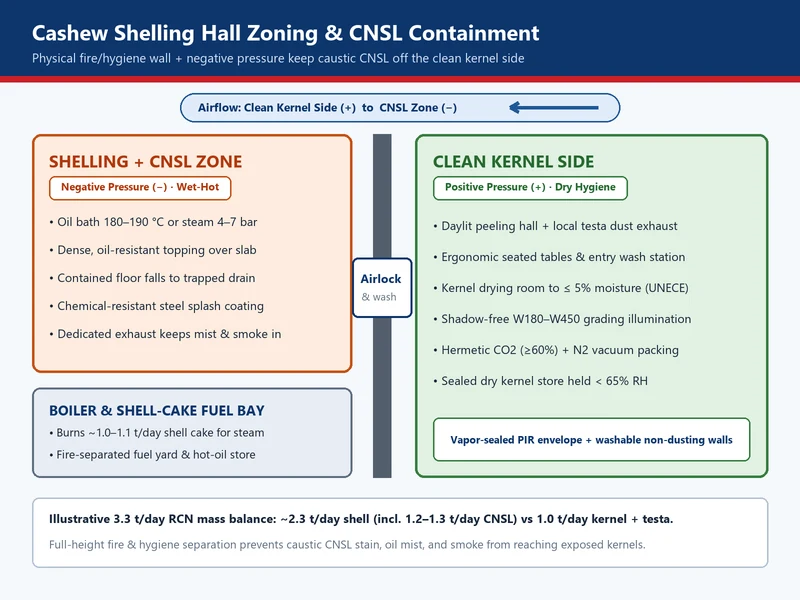
For the building, an oil-roasting line in cashew processing factory construction adds a hot combustible-oil store heated to 180–190°C and a fire load that needs containment and separation, not an open bay. The hall needs a contained floor with falls to a trapped drain. CNSL splashed on bare concrete stains it black and is hard to clean from the porous surface. A dense, oil-resistant topping over the concrete slab for a steel building keeps the oil out of the slab. Fire separation between the roasting bay, the CNSL store, and the kernel side follows steel building fire protection practice. Steel in the splash zone needs a coating system chosen for chemical contact, a decision framed in galvanizing versus painting steel. Keep the shelling hall under negative pressure relative to the kernel rooms so oil mist and smoke stay off the clean side.
What does a manual peeling hall need to protect workers?
In a labor-intensive export plant, the peeling and grading hall carries hundreds of seated piece-rate workers. Its daylight, air, and workstation geometry are health controls. A Kollam occupational-health survey sampled 360 cashew workers in 12 units that each employed 303–431 people. Shelling, peeling, and grading were done by women on piece rates. The survey found musculoskeletal disorders in 55.8%, chronic lung disease in 18.9%, and dermatological problems in 47.5% of workers.
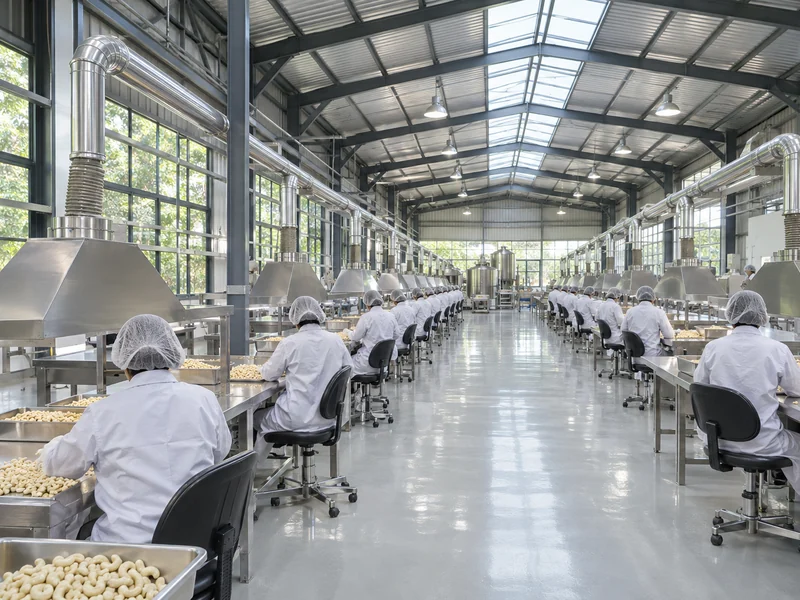
The prevalence figures are a building brief, because prolonged sitting and skipped rest breaks drive the musculoskeletal load. Workstation height, seat support, and rest areas are ergonomic inputs. Furnace smoke and CNSL contact drive the lung and skin load. The hall needs source extraction, generous daylight, and washing and protective-clothing facilities at the entry. Testa dust from peeling adds a respirable fraction that local exhaust must capture before it reaches the breathing zone. Air changes are sized from the worker count and process heat, and daylight from the glazing-to-floor ratio, through MEP for warehouse buildings design.
If you buy fully automatic shelling and peeling lines, these labor-hall provisions shrink to a fraction. A smaller mechanically ventilated room replaces the hundreds-of-seat hall. Choose the shelling/peeling line first: it sets the seat count, clear height, and floor loads the hall must carry, so the choice must land before the hall span and roof are ordered.
How do kernel grades set the drying and packing rooms?
Kernel grade is a count per pound, and holding that grade from dryer to carton forces low-moisture, low-humidity clean rooms on the dry side of the plant. The AFI Specifications for Cashew Kernels set the U.S. trade grades: W180 at 140–180 kernels per pound, W210 at 180–210, W240 at 220–240, W320 at 300–320, and W450 at 400–450. A whole kernel may lose no more than one-eighth of its mass. Butts and splits are defined by how the kernel breaks. Lower-size kernels in a whole grade are capped at 10% by weight.
Drying sets whether the grade survives peeling, since kernels dry until the testa turns brittle and the kernel reaches a safe moisture content. The UNECE cashew kernel standard, updated in 2023 and summarized in CBI’s cashew nuts market study, caps commercial kernel moisture at 5%. Grading then separates by count and color under consistent light. The grading room needs stable, shadow-free illumination over the tables. The dry-side rooms share one envelope logic:
| Room | Building provision | Key variable |
|---|---|---|
| Kernel drying | Heated, exhaust-vented room with moisture extraction | Target moisture at or below 5% |
| Grading | Stable shadow-free light over tables; cleanable surfaces | Grade count per pound; color class |
| Packing | Low-humidity room; hermetic seal station | CO2 at 60% minimum, balance nitrogen |
| Kernel store | Cool, dry, sealed; RH below 65% | Ambient RH; rancidity and mold risk |
Packaging is where the grade is locked in. AFI requires a hermetic, leakproof seal with food-grade CO2 at a minimum of 60% and nitrogen as the balance. Cartons must be at least 200-pound test or 32 ECT. CBI describes the common export format as 10–25 kg flexi-pouches, vacuum-sealed with CO2 and nitrogen, with one 25 kg pouch per carton and 700–750 cartons per full container load. A kernel packed warm sweats inside the seal as it cools, and the trapped moisture raises surface water activity. Let kernels cool to packing-room temperature, above the room dew point, before sealing. The kernel store stays cool and dry, with storage and transport relative humidity below 65% on CBI’s Codex-based advice. A sealed vapor barrier and metal building insulation hold that condition. Metal building interior wall finishing gives the cleanable, non-dusting surfaces the clean rooms need. Where a buyer asks for controlled cool storage, the thermal design follows refrigerated warehouse design guidelines rather than the ambient dry store above.
Where do steam, shell fuel, and effluent go?
Shell cake and CNSL are co-products of the same nut, and burning the cake raises the conditioning steam. The boiler room, fuel yard, and effluent route therefore belong in the building program from the start of cashew processing factory construction. The shell fraction from the illustrative mass balance is a fuel: burn it whole, or extract the 1.2–1.3 t/day of CNSL for sale and burn the remaining 1.0–1.1 t/day of shell cake in the boiler, closing a loop between the shelling hall and the utility room. The boiler room sits adjacent to the steam users and the shell yard, in a steel structure workshop bay sized for the boiler, its fuel feed, and ash removal.
The shell yard is a fire-load store, because loose shell cake piles hold heat and can smolder. The yard needs separation from the main shell, non-combustible boundaries, and access for turning or removal. If the plant extracts CNSL for sale instead of burning it in the shell, the extraction and storage area adds a hot-oil room with its own containment and fire separation. Steaming and soaking also produce a wet, organic effluent laden with fines and traces of CNSL. The drain route and any pretreatment depend on the receiving system: if it drains to a sewer, pretreat to the sewer authority’s limits; if to a watercourse, expect stricter limits and fuller treatment. Confirm the discharge limits with the authority that owns the receiving system before fixing the floor falls.
Which market-access rules change the building?
Export buyers audit the facility against food-safety and contaminant rules. Several of those rules translate into physical provisions. CBI reports that almost all European food importers require food-safety certification, and most buyers ask for a GFSI-recognized food safety certification scheme: IFS, BRCGS, FSSC 22000, or SQF, though EU law does not itself mandate it. Buyers audit the production site before trading. An audit-ready building needs pest-proof construction, cleanable surfaces, and documented separation of raw and finished flows. That is why the warehouse, shelling hall, and clean rooms are laid out as a one-way flow.
Aflatoxin limits set the storage climate; cadmium is controlled by sourcing and lot testing, independent of the building. Regulation (EU) 2023/915, as summarized by CBI, caps cadmium in cashew kernels placed on the EU market at 0.20 mg/kg and aflatoxin B1 in tree nuts at 5 μg/kg; those maximum levels do not apply to nuts for crushing and oil refining. Aflatoxin risk rises with moisture, so the dry, RH-controlled kernel store is a contaminant control. Cashew is a tree-nut allergen, and CBI notes that undeclared cashew triggers RASFF recalls. The packing line therefore needs allergen segregation and labeling control. For U.S. shipments, 21 CFR Part 117 sets current good manufacturing practice and risk-based preventive controls. The Codex code of hygienic practice for tree nuts is the international reference CBI advises following. Generic food-plant hygiene zoning, the raw-to-ready separation every food facility shares, sits outside this cashew-specific program. The operating side of stock rotation and traceability is covered in food industry warehouse management.
How does kernel output become a building program?
The cashew processing factory construction program converges when the kernel output target, the outturn, and the storage calendar are fixed together. Each one feeds the next room’s size, so the output target and outturn are confirmed first. They are the inputs to the mass balance, and the raw-nut warehouse they size is the least reversible room. Adding span or height later costs far more than sizing it right at the start. The automation choice and worker count can follow once the shelling and peeling method is set, but they must land before the hall frame is fabricated.
A caustic-oil splash zone never detailed into the slab, or a kernel store sized for a just-in-time harvest that arrives over four months, is expensive to correct after erection. Building cost is driven by the warehouse span and stack height, the shelling hall’s fire separation and oil-resistant floor, and the clean-room envelope, rather than by a generic per-square-metre rate. We turn the confirmed kernel target, outturn, and calendar into a room-by-room building program and a steel shell package. The steel building design and the steel industrial buildings scope then carry the process loads from the first drawing. If your outturn and storage calendar are still estimates, the next step is a cut-test and a harvest-month plan. Those two numbers set the warehouse before any other room.
FAQ
Can a cashew plant run fully automatic instead of manual?
Yes. Automatic shelling and peeling lines replace the hundreds-of-seat hall with a smaller mechanically ventilated room. The trade is capital for labor. Size the building for the chosen line before fabrication begins.
Do cashew kernels need cold storage?
Not usually. Kernels are a dry, ambient product held below 65% relative humidity and at or below 5% moisture. Cool storage is an option for long holds or hot climates, unlike meat or dairy.
How small can a cashew processing plant be?
The same mass balance scales down: a small manual plant processing about 1 t/day of raw nuts still yields roughly 0.7 t/day of shell and 0.3 t/day of kernel-plus-testa. The shell yard, CNSL handling, and seasonal store still need their own provisions, so the program does not collapse into a single shed.
Can an existing warehouse be retrofitted for cashew processing?
Partly. The dry store and packing rooms can fit a sound existing shell. The shelling hall needs an oil-resistant floor, fire separation, and extraction that most general warehouses lack. Check the slab, the fire rating, and the clear height before committing to a retrofit.
Why is CNSL a building problem and not just a product?
Because it is caustic and combustible before it is a saleable oil. It attacks concrete and skin in the shelling hall. The floor, drainage, coatings, and fire separation are designed around it whether or not the plant collects it for sale.