




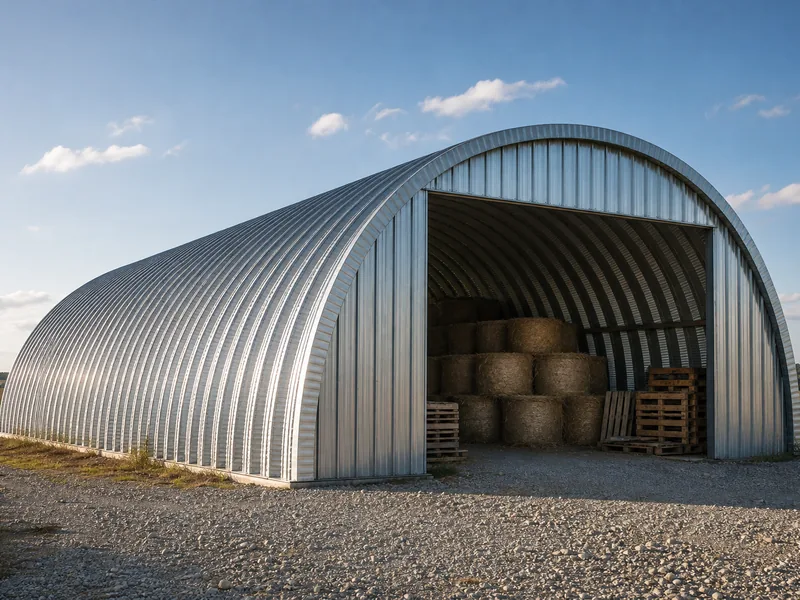
A Quonset building is a prefabricated steel shelter built from curved, corrugated panels that bolt together into a self-supporting arch. The shape traces back to the lightweight military huts mass-produced during World War II, but the modern version is a mainstream option for garages, farm storage, workshops, and, where they are finished for it, homes. What makes it useful in the right project is not nostalgia. It is the trade-off between low cost and a fixed curved geometry that suits some projects far better than others.
Cost scope note: Treat the ranges below as scope-specific planning numbers. Kit or shell figures exclude the slab, site work, delivery, permits, insulation, utilities, and interior finish unless the line item says otherwise. Heavy loads, poor soil, tight access, and custom openings can move a quote above the base band.
Before comparing prices, the first real decision is whether that curved geometry fits your clearance and edge-use needs. What follows covers the profile types, the uses and sizes they suit, realistic kit and installed costs, and the point where an arch stops being the right call. It does not walk through step-by-step assembly or local permitting, both of which depend on your site and jurisdiction.
What a Quonset Building Actually Is
A Quonset building, also called a Quonset hut, is a clear-span steel structure whose curved walls and roof form one continuous arch, with no interior posts breaking up the floor. The panels are usually corrugated galvanized or Galvalume steel, shipped flat and bolted together on site, which is why a simple kit needs less specialized labor than a framed building. How fast it goes up still depends on the span, crew, equipment, foundation, and inspections, so treat the schedule as a planning variable rather than a fixed selling point. The arch itself carries the load, so the whole interior stays open, a feature shared with other clear span buildings but achieved here with relatively little steel.
That open span is the core appeal. Because the curved skin is both structure and cladding, a simple Quonset shell can use less steel per square foot than a column-and-beam building of the same footprint. That is part of why it often sits at the low-cost end of the types of metal buildings on the market. The original huts proved the concept at scale; today the same geometry is sold in widths that run from small backyard spans up to roughly 70 feet and beyond in engineered versions.
Why the Arch Shape Drives the Main Trade-offs
The arch is responsible for almost every Quonset advantage and almost every limitation, so it helps to see both sides at once. On the benefit side, the curve sheds snow and wind efficiently, encloses a lot of volume for relatively little steel, and gives a column-free interior that is easy to rearrange. They are the same reasons steel has a clear role among the benefits of steel buildings for durability and low upkeep. Snow and wind ratings, though, depend on gauge, span, engineering, anchorage, foundation, and local code, not on the shape alone.
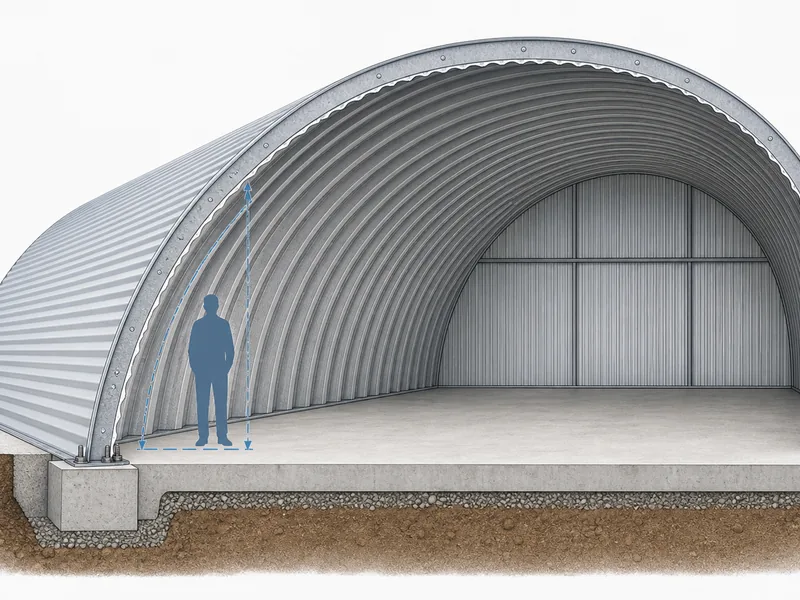
The cost of that same curve shows up at the walls. Where the arch meets the ground it leans inward, so the usable floor near the edges loses headroom. A person cannot stand upright against the wall, and shelving or vehicles sit farther in than the slab dimension suggests. Anyone who has laid out one of these interiors learns to plan storage and door openings around the curve rather than around the footprint.
Corrosion resistance is another point that gets oversold. Steel does not resist rust because it is steel; it resists rust because of its coating. That galvanized or Galvalume layer carries the typical corrosion warranty, which runs anywhere from about 20 to 50 years depending on the coating and the manufacturer. Scratches, cut edges, and standing water at the base are where that protection actually gets tested.
One more working detail that product photos tend to skip is condensation. A bare steel arch can sweat on its underside when warm, humid air inside meets a cold shell, and that condensation can damage stored goods. Anyone keeping moisture-sensitive items inside should plan for insulation or ventilation early, because adding either one against a curved wall after the fact is awkward and expensive.
Quonset Building Types and Which Profile Fits
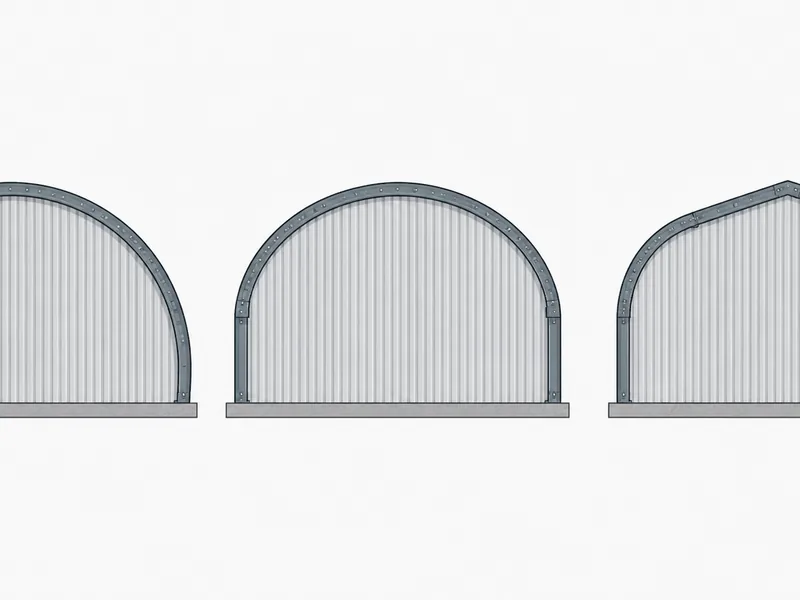
Quonset profiles differ mainly in wall shape, and the right one follows from how you plan to use the edges and how much snow you expect. Manufacturers use letters such as Q, S, P, A, or X, and the labels vary by brand, so compare the geometry rather than the letter on the brochure. Three shapes cover the practical choices.
| Profile | Shape | Best fit | Watch-out |
|---|---|---|---|
| Full-arch | Continuous half-round curve | Equipment and farm storage, low-cost cover | Little usable space at the walls |
| Straight-sidewall | Short vertical walls, then a curved roof | Workshops, garages, finished interiors | Costs somewhat more than a full arch |
| Pitched-roof / heavy-snow | Sloped, peaked roofline | Snow regions, conventional appearance | Capacity still set by gauge, span, and code |
Full-Arch Profiles
Full-arch models are the classic half-round shape, where the wall and roof are one continuous curve. They tend to enclose the most volume for the least material of the common profiles, which makes them a strong fit for equipment storage, barns, and general cover where wall-edge headroom does not matter much. They are the least convenient of the three when you need to mount things flat against a wall.
Straight-Sidewall Profiles
Straight-sidewall models add short vertical walls before the roof begins to curve. This recovers usable space at the edges and makes it easier to place standard doors, windows, and interior finishes, at a modest increase in material and price. For workshops, garages, and any interior that people move through daily, the recovered headroom usually justifies the added cost.
Pitched-Roof and Heavy-Snow Profiles
Pitched-roof models replace the rounded top with a sloped, peaked roofline. They are aimed at regions with heavy snow or at owners who want a more conventional building appearance. The steeper roof helps shed accumulation, but actual snow and wind ratings depend on gauge, span, engineering, anchorage, foundation, and local code, not on the profile alone.
Common Uses and the Sizes That Suit Them
Quonset buildings fit open storage, garages, workshops, and light commercial cover best, where clear floor area matters more than flat, full-height walls. Agricultural and equipment storage is a common use, where wide, tall clearance counts for more than finished walls. Workshops and garages come next, usually in mid widths where a straight-sidewall profile justifies its cost. Warehouses and commercial cover take the larger spans, and some owners finish smaller arches as homes or studios where residential code, insulation, ventilation, and interior finishing are planned for.
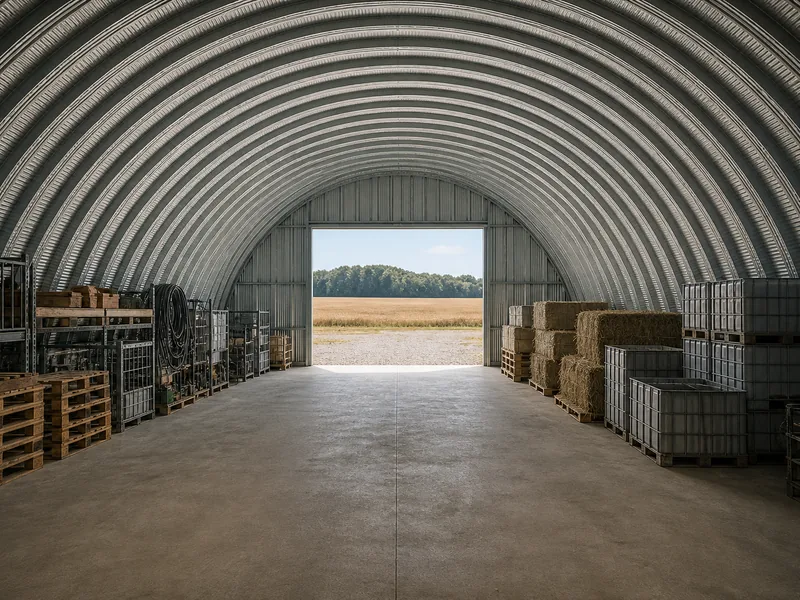
Width is the variable that does the most work, and it interacts with use. As a rough planning guide rather than a fixed rule, single-bay garages and shops often sit under roughly 30 feet wide, multi-vehicle and light commercial uses around 30 to 50 feet, and equipment storage or warehousing wider still into engineered spans. Choosing a size is less about the floor area you want and more about the clear width and edge headroom the use needs. That is the same logic that drives metal building sizes across the rest of the steel-building market. Taller stored items and wall-mounted equipment push you toward straight sidewalls or a larger arch than the raw square footage would suggest.
What a Quonset Building Costs
Quonset pricing splits into two very different numbers, and confusing them is a common budgeting mistake. The Quonset hut kit price, covering steel panels, hardware, and engineering, commonly runs in the range of about $14 to $28 per square foot, and that figure alone is what makes Quonsets look cheap. The installed or turnkey price, which adds the foundation, delivery, and erection, more often lands around $20 to $40 per square foot. As a rough order of magnitude, a 30-by-40 kit at 1,200 square feet might fall near $17,000 to $34,000 at the same $14-to-$28-per-square-foot kit basis. The same building finished and standing can reach $25,000 to $45,000 or more, depending heavily on the factors below.
| Quote basis | What it usually includes | Typical range | Watch-out |
|---|---|---|---|
| Kit only | Steel panels, hardware, engineering | ~$14–$28 / sq ft | Excludes foundation and erection |
| Installed / turnkey | Kit plus foundation, delivery, erection | ~$20–$40 / sq ft | Varies with site, openings, and finish |
Beyond size, a few variables drive the final number:
- Foundation: a gravel pad is cheap, while a full concrete slab is often one of the largest cost items after the kit itself.
- Customization: doors, windows, vents, skylights, and insulation each add cost and complicate the curved walls.
- Labor: DIY assembly can cut erection labor where it is allowed and practical, whereas professional erection is faster and is sometimes required on larger spans.
- Permits: fees and engineered drawings vary widely by jurisdiction.
- Location: delivery distance, site access, and local labor rates all feed into the total.
Larger buildings tend to cost less per square foot, so per-foot quotes are only comparable at the same size and specification. Use any single price as a starting point, and confirm whether a Quonset hut kit quote is a kit number or a finished number before you compare offers. Before asking for quotes at all, lock down the things that swing the price most: the profile, the foundation type, and the number and size of openings. A quote built on vague specifications rarely survives contact with the real plan.
When a Quonset Building Is the Wrong Choice
A Quonset stops being the economical choice at the point where its fixed curve fights your requirements. Very wide clear spans, full-height vertical walls across the whole floor, heavy crane loads, large or numerous door openings, and strict architectural or future-expansion requirements all erode the cost advantage. Past a certain point, a rigid-frame building can be both easier to fit out and more practical to use. The curved edges that save steel are the same edges that limit how you use the perimeter.
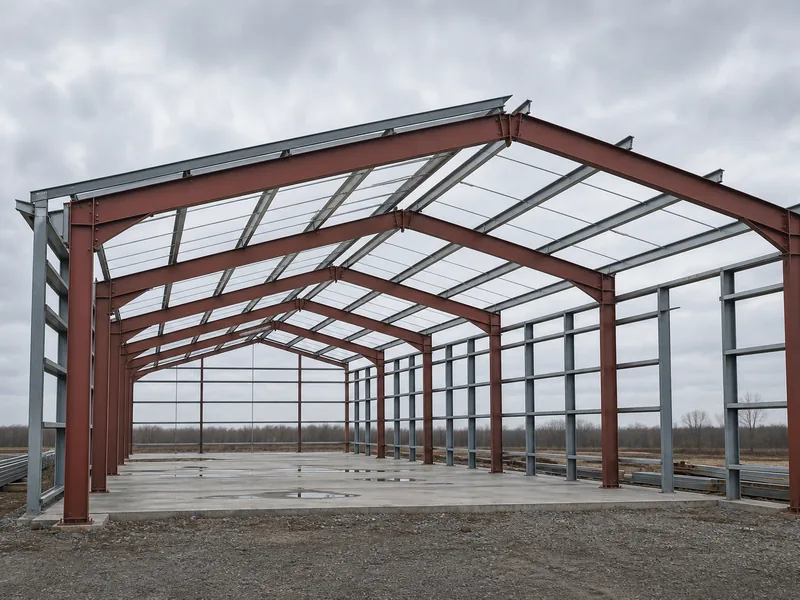
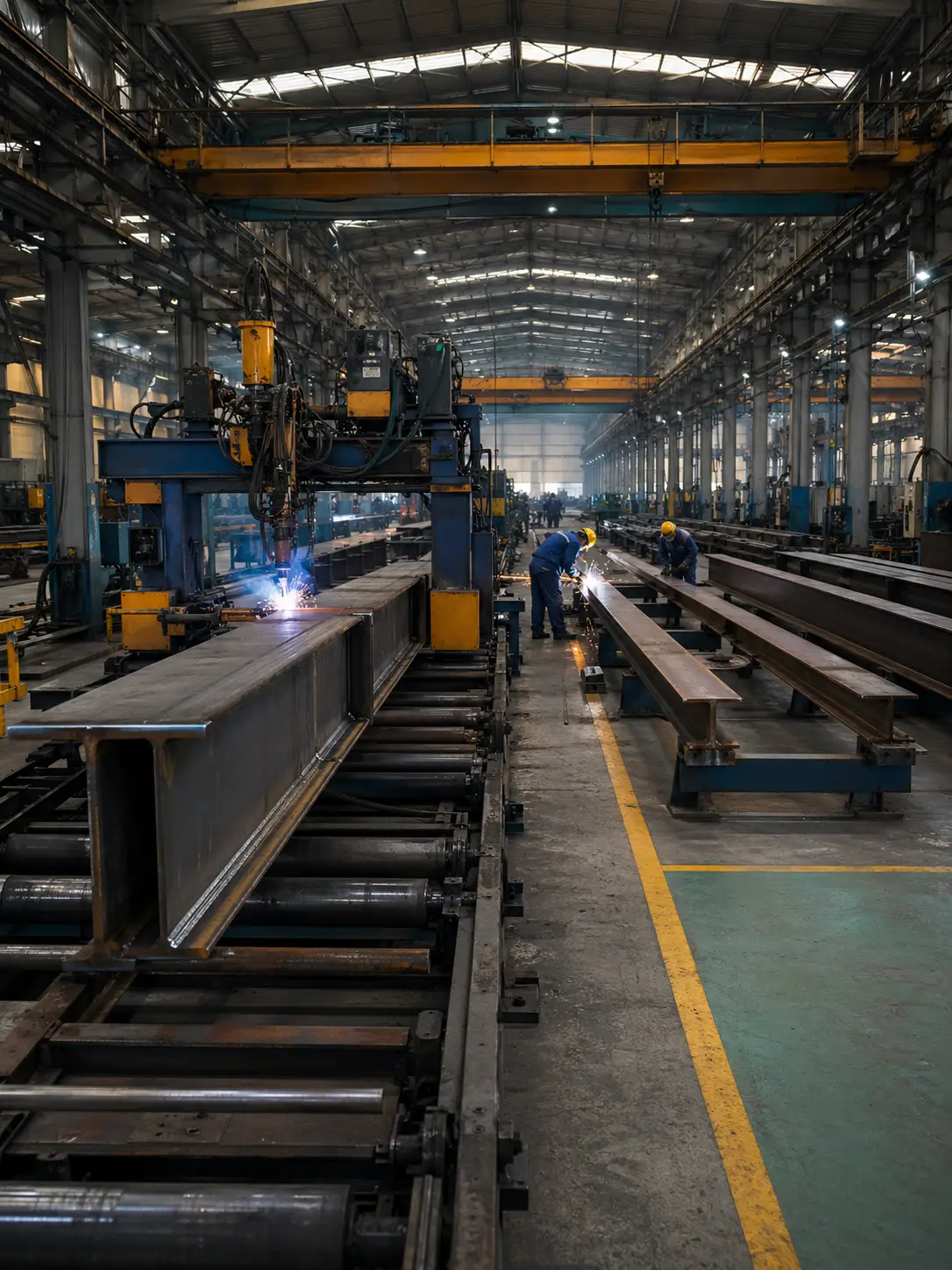
For those projects, an engineered column-and-beam system is often the better candidate. This is where custom metal structures built from H-beams, box sections, and purlins provide the flat walls, tall clearances, and long spans that an arch struggles to match efficiently. KAFA is a manufacturer qualified in the design, fabrication, and installation of light and heavy steel structures. It fabricates these systems on dedicated H-beam, box-section, C/Z-purlin, and profile-plate lines at a 20,000 m² Qingdao facility under documented quality procedures. That is the kind of engineered route useful to price once a Quonset’s geometry no longer fits the use.
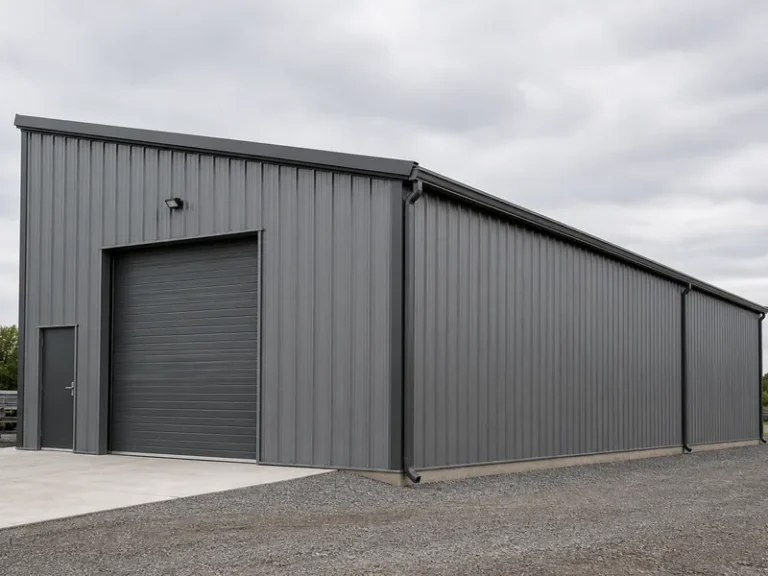
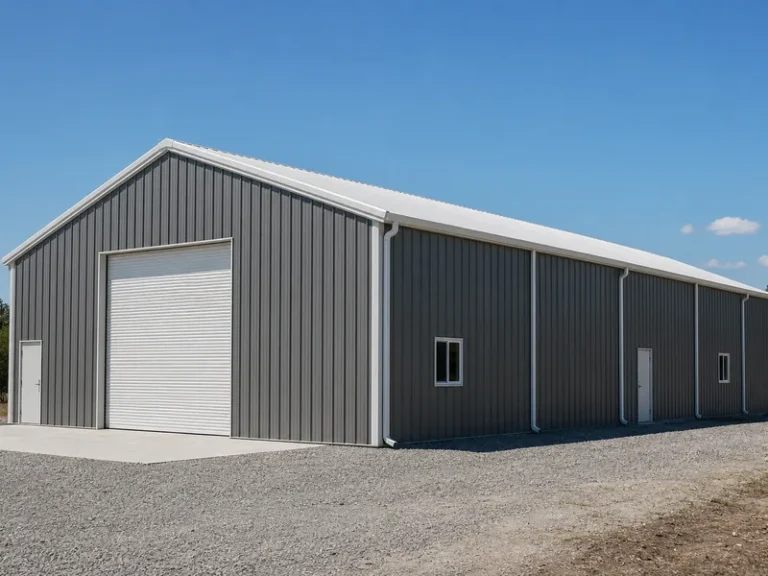
Where the same site needs storefront, office, or public-facing space, compare the arch with conventional commercial metal buildings before treating the lower shell price as the final answer.
Conclusion
Choosing a Quonset building depends on sequence: confirm the use and its hard constraints first, then the profile, then the budget basis. Start with the clear width and edge headroom the use truly needs. Those decide whether a full arch is fine or a straight-sidewall profile is worth the premium, and whether the span is even in Quonset territory at all. Only then compare prices, and only kit-to-kit or turnkey-to-turnkey, never one against the other.
The cost that often gets underestimated is not the kit; it is the foundation and the site work, which a per-square-foot kit quote never includes. If your project needs wide column-free spans behind full-height walls, price an engineered steel building alongside the arch before committing, because the curved geometry that makes a Quonset cheap is also what caps where it fits.
Frequently Asked Questions
How much does a Quonset building cost?
Kit prices commonly run about $14 to $28 per square foot, while a finished, installed building more often falls near $20 to $40 per square foot. The gap between those two numbers is the foundation, delivery, and erection, so always confirm which one a quote refers to before comparing.
Do the curved walls reduce usable space?
Curved walls do cut into usable floor space at the edges, because the arch leans inward where it meets the ground. Headroom near the walls is limited, which is why straight-sidewall profiles exist and why storage and door layouts should be planned around the curve rather than the slab size.
How long do Quonset buildings last?
A well-coated Quonset building can carry a corrosion warranty in the range of about 20 to 50 years, with the exact term set by the coating and the manufacturer. Real-world lifespan depends on maintenance, drainage at the base, and how quickly scratches or cut edges get addressed.
What are Quonset buildings best used for?
Quonset buildings suit open, column-free uses such as equipment and farm storage, workshops, garages, and warehouses. They are less convenient where you need flat, full-height walls or heavily finished interiors, since the curve limits the perimeter.
Are Quonset buildings cheaper than traditional steel buildings?
Quonset kits are often cheaper per square foot than rigid-frame steel buildings, mainly because a simple arch can use less steel and less labor. That advantage narrows or disappears at wide spans, full-height wall requirements, or heavy customization, where an engineered frame can end up more economical to finish.
Can you assemble a Quonset hut kit yourself?
Many Quonset kits are designed for owner assembly, since the panels bolt together and need no interior framing. Whether that is realistic for you depends on the span, the crew and equipment you can bring together, local permit and inspection rules, and whether a larger arch calls for professional erection.