




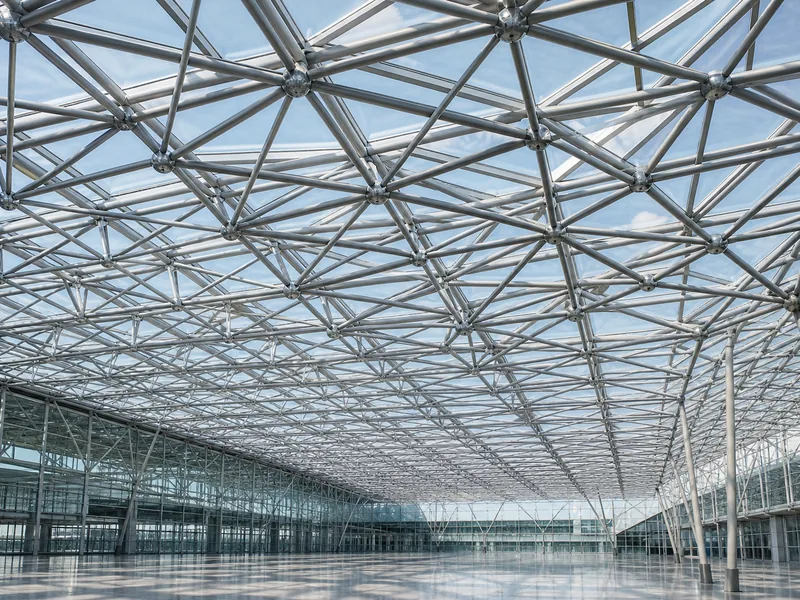
A space frame structure is a three-dimensional steel truss that spreads load through a triangulated grid of struts and nodes. That triangulation lets it roof clear spans approaching 100 m (about 330 ft) with no interior columns. Because every member carries force along its own length rather than bending, the system stays light even as the span grows. That is one reason it shows up on airport terminals, stadiums, and exhibition halls rather than ordinary sheds with closely spaced columns.
What Is a Space Frame Structure?
A space frame is a three-dimensional truss in which every member carries load only as axial tension or compression, never as bending. That single property separates it from a beam or a portal frame. Where a beam resists load by bending across its depth, a space frame resolves the same load into pushes and pulls along a lattice of straight bars. The geometry comes from the triangle, the only polygon that cannot change shape without changing the length of a side, so a frame built entirely from triangles stays rigid under uneven load.
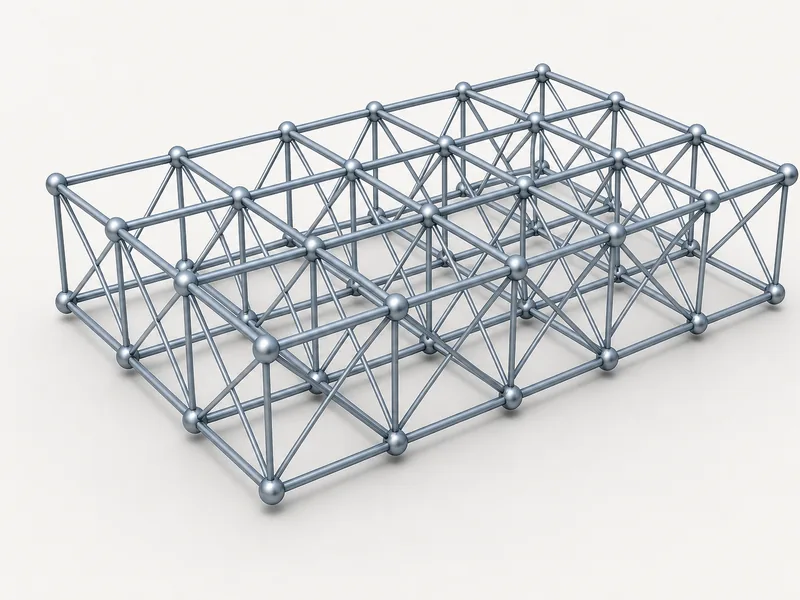
The simplest building block is the tetrahedron (four nodes joined by six members), and a space frame is, in effect, that unit repeated across a surface. A flat planar truss does the same job in two dimensions. Extending the triangulation into a third dimension gives a space frame its stiffness in every direction and its tolerance for point loads anywhere on the grid. When one member is overloaded, neighboring members share the force, so the structure carries a redundancy that a single line of beams does not.
Components of a Space Frame: Struts and Nodes
Two part families make up every space frame: the linear members that carry axial force, and the nodes that lock those members together at exact angles. The members are usually circular hollow sections (CHS), because a tube resists compression equally in all directions. Its wall thickness can be varied to match the force while the outside diameter stays constant, which helps when hundreds of bars must look identical but do different work. Rectangular hollow sections appear where connections or cladding details call for flat faces.
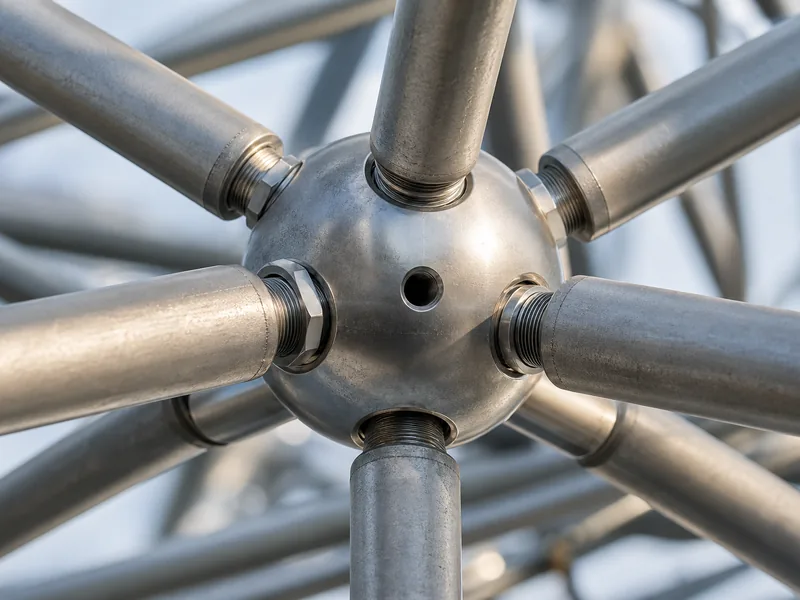
The node is where a space frame is won or lost. Each joint receives several members arriving from different directions and has to hold each at the angle the model assumes, because the whole load path depends on those angles being correct. The best-known proprietary connector is the MERO ball joint, a machined steel sphere with threaded ports that Max Mengeringhausen introduced in Germany in 1943, the first use of space trusses in architecture. Common alternatives include bolted ball nodes and welded hollow-sphere nodes, along with named systems such as the octet truss patented by Buckminster Fuller in 1961. The connector chosen sets the fabrication tolerance, the erection method, and a large part of the cost.
Types of Space Frame Structures
Space frames are grouped two ways: by how many grid layers they use, and by how the surface curves. The layer count drives stiffness and span, while the curvature drives the architectural form. Most large roofs in the field are double-layer flat grids, with curved single-layer grids kept for feature roofs and domes.
| Grid type | What it is | Typical role |
|---|---|---|
| Single-layer grid | One layer of members on the roof surface | Curved roofs, domes, and feature forms over shorter spans; lighter but less stiff |
| Double-layer grid | Two parallel grids joined by diagonal web members | The workhorse for large flat roofs; high stiffness, small deflection, longest spans |
| Triple-layer grid | Three parallel grids linked by diagonals | Very large or heavily loaded flat roofs where two layers are not deep enough |
By curvature, the common forms are the flat (plane) cover used over rectangular halls, the barrel vault that curves in one direction, and the spherical dome that curves in two. A flat double-layer grid is the default for a stadium concourse or an exhibition hall. A barrel vault or dome is chosen when the architecture wants a curved profile or when the shape itself adds stiffness.
Common Applications of Space Frames
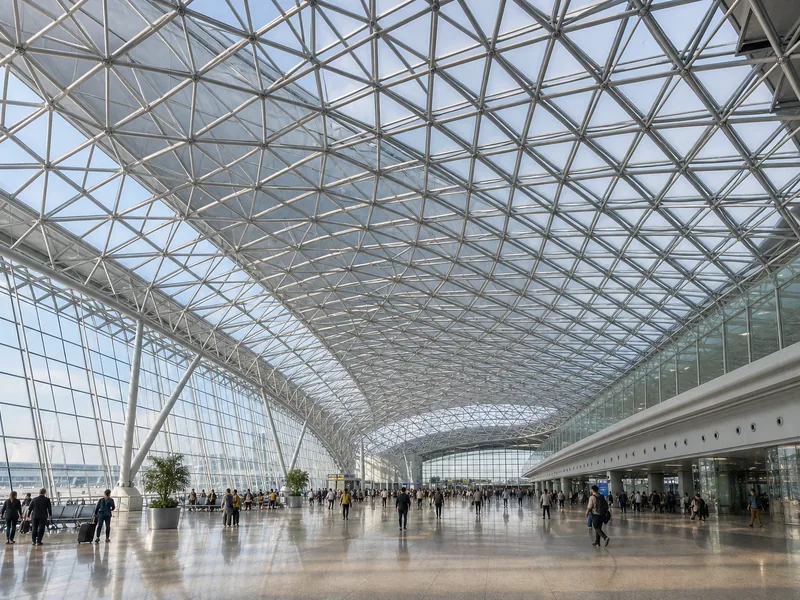
Space frames suit buildings that need a wide, column-free roof over a large or irregular floor plan. The clear interior is the point: airport terminals, sports stadiums, exhibition and conference halls, aircraft hangars, shopping malls, and swimming pools all need long clear-span buildings where columns would block sightlines, circulation, or aircraft movement. Beijing Daxing International Airport and the Eden Project are two widely cited roofs built on space-frame grids.
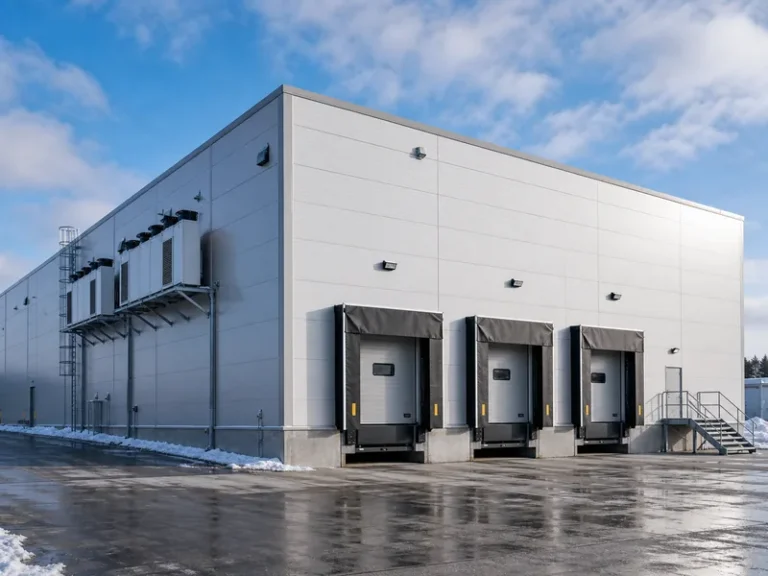
Industrial buildings use the same logic when spans get large. A high-bay warehouse that has to keep racking aisles clear, or an airplane hangar building that must clear a wingspan, both benefit from the column-free reach a space frame gives. Even a temperature-controlled facility such as a cold storage building may use a long-span roof so that pallet layouts and forklift routes are not fixed by column lines. For moderate spans, though, a simpler portal frame or planar truss is usually more economical than a full space grid.
Where the footprint is rectangular and the span is moderate, a conventional warehouse building on portal frames will almost always cost less than a space frame. The system pays off when the span is genuinely large, the plan is irregular, or the roof shape is part of the architecture.
Designing a Space Frame: Spans, Depth, and Loads
A space frame design starts from three numbers: the clear span, the grid depth, and the loads the roof must carry. Steel trusses become an economical long-span solution above roughly 20 m and are used up to around 100 m, and a space frame extends that range while staying shallow. For a double-layer grid, structural engineers typically set the depth between about one-fifteenth and one-twenty-fifth of the span, roughly 4% to 7%, so a 60 m roof is usually about 2.4 to 4 m deep. A planar truss covering the same span is normally deeper, around one-tenth to one-fifteenth of the span, which is part of why a three-dimensional grid is chosen when headroom or depth is constrained.
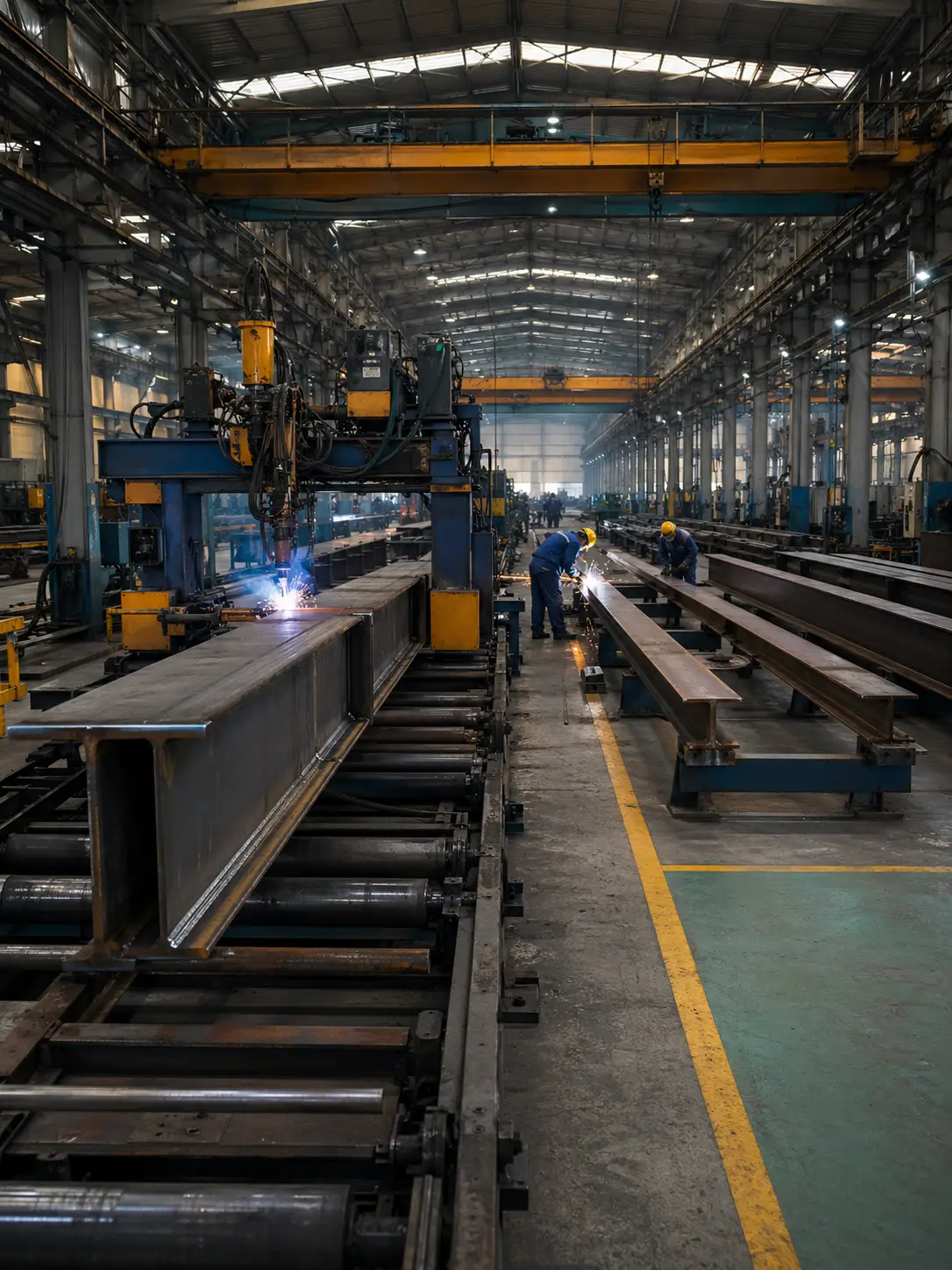
Loads set the member and node sizes. A roof has to carry its own weight plus live load, snow, wind uplift, and seismic demand, all governed by a loads standard such as ASCE 7. The building code, the IBC in the United States, sets how those cases combine. The grid module, meaning the spacing of the nodes, is tuned together with the depth so that member forces stay within efficient tube sizes and deflection stays within limits. Because the geometry only works if every node sits where the model places it, fabrication tolerance, not raw tonnage, is the controlling discipline. A fabricator that runs dedicated H-beam, box-section, and profile-plate lines under ISO 9001:2015 quality management, such as KAFA’s Qingdao plant, holds member straightness and node accuracy to the model. Getting the load calculation right before fabrication keeps the erected grid matching the analysis model.
Advantages and Limitations of Space Frames
The case for a space frame rests on reach and weight; the case against it rests on precision and erection effort. On the plus side, the triangulated grid spans far with little material and keeps the interior column-free. It distributes load in three dimensions, so a single overloaded member is backed up by its neighbors, and it is built from repeated factory-made parts that bolt together quickly on site. The same modularity lets a grid follow flat, vaulted, or domed shapes without a custom beam for every bay.
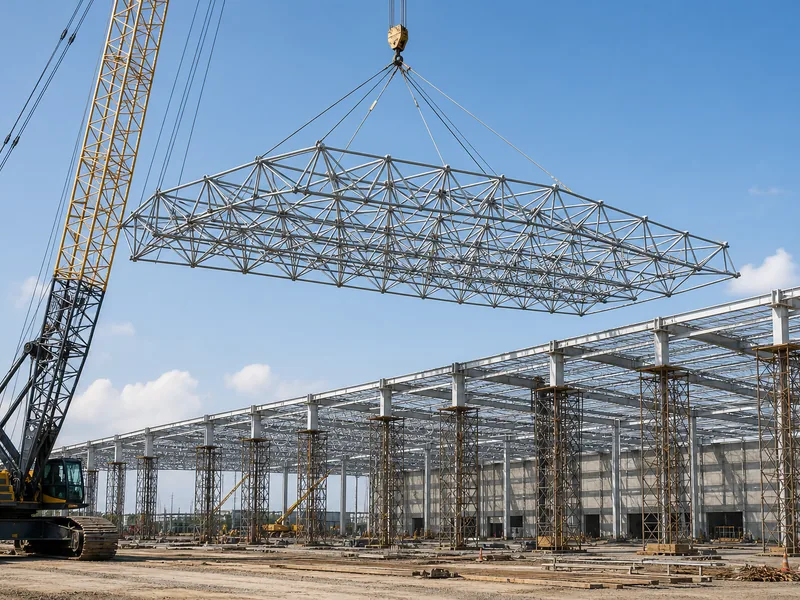
The limitations are real, and each needs planning. Every node has to be fabricated and set to tight tolerance, so the engineering and shop work cost more per tonne than a plain portal frame. A large grid needs skilled erection and often temporary shoring while it is assembled and lifted. The exposed steel usually needs fire protection, the many nodes and joints have to be detailed for water-tightness and drainage, and a finished grid is harder to alter later than a framed bay. None of these rule out a space frame; together they decide whether its span advantage is worth the added complexity for a particular building.
When a Space Frame Makes Sense
Choose a space frame when the span is large, the interior must stay column-free, and the roof geometry is complex enough to justify three-dimensional framing. At that point its light weight, redundancy, and architectural freedom outweigh the higher fabrication cost. For a rectangular building at a moderate span, including most warehouses, workshops, and single-tenant industrial sheds, a portal frame or a planar truss will carry the roof for less money and less site complexity. That trade-off is explored in portal frame vs truss and steel web truss building selection. The decision rule is simple: span and geometry first, cost second. Size the structure to the clear span you actually need, then compare framing systems on total installed cost. If you are weighing a space frame against simpler framing for a specific span and loading, you can request a quote with your dimensions, roof shape, and load requirements to compare options on equal terms.
FAQ
What is a space frame structure in simple terms?
A space frame is a three-dimensional grid of straight steel bars joined at nodes, where each bar only pushes or pulls rather than bends. That lattice behaves like one stiff plate, so it can roof a wide area while using far less steel than solid beams of the same reach.
How far can a space frame span?
A space frame can roof clear spans up to roughly 100 m without interior columns, and steel trusses generally become economical once the span passes about 20 m. The practical upper limit depends on the depth available, the loads, and the node system rather than on a single fixed figure.
What is the difference between a space frame and a truss?
A truss is usually a flat, two-dimensional frame that carries load in one plane, while a space frame extends the same triangulation into three dimensions and carries load in every direction. The three-dimensional grid is stiffer for its depth and spreads point loads better, which is why it is chosen for very large or irregular roofs.
What materials are space frames made from?
Most space frames use steel circular hollow sections for the members because a tube resists compression evenly and its wall thickness can change while the diameter stays constant. Nodes are machined or cast steel connectors, such as MERO-type balls, bolted balls, or welded hollow spheres, and aluminum is sometimes used where weight matters more than cost.
Single-layer or double-layer grid: which should I use?
A double-layer grid is the default for large flat roofs because it is stiff and deflects little, while a single-layer grid suits curved roofs and domes over shorter spans where the curvature itself adds stiffness. The choice follows the span and the roof shape, with triple-layer grids kept for very large or heavily loaded spans.
What drives the cost of a space frame?
Cost is driven mainly by the number of nodes and members, the span and depth, the node system, the steel finish and fire protection, and the erection method, rather than by floor area alone. A larger span with more joints raises both the fabrication and the site labor, which is why a moderate-span building is usually cheaper to roof with a portal frame or a planar truss.
Further Reading
- Trusses — SteelConstruction.info — SCI/BCSA industry guidance on steel trusses for long-span roofs; supports the 20–100 m economical span range and the span-to-depth guidance used above.
- ASCE 7, Minimum Design Loads and Associated Criteria for Buildings and Other Structures — the ASCE/SEI standard defining the wind, snow, and seismic loads a roof space frame must be designed to carry.
- International Building Code (IBC) — ICC — the model code that sets structural-safety and permitting requirements for large-span roof structures in the United States.