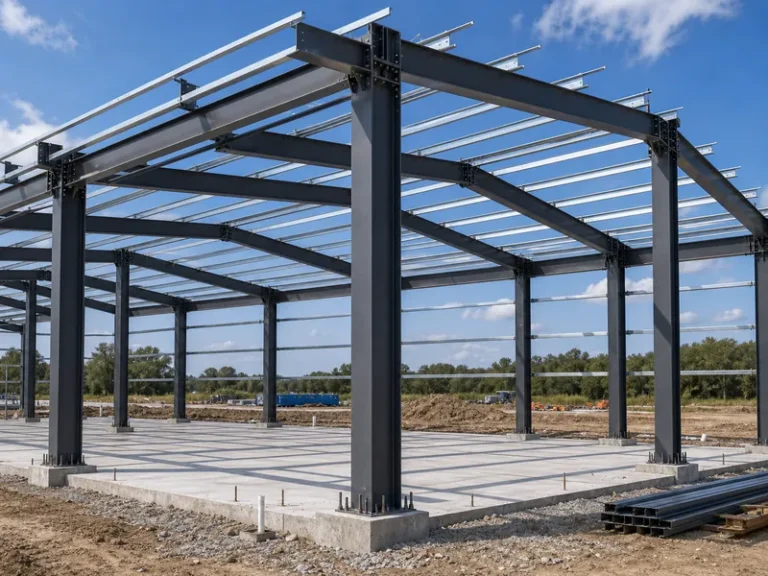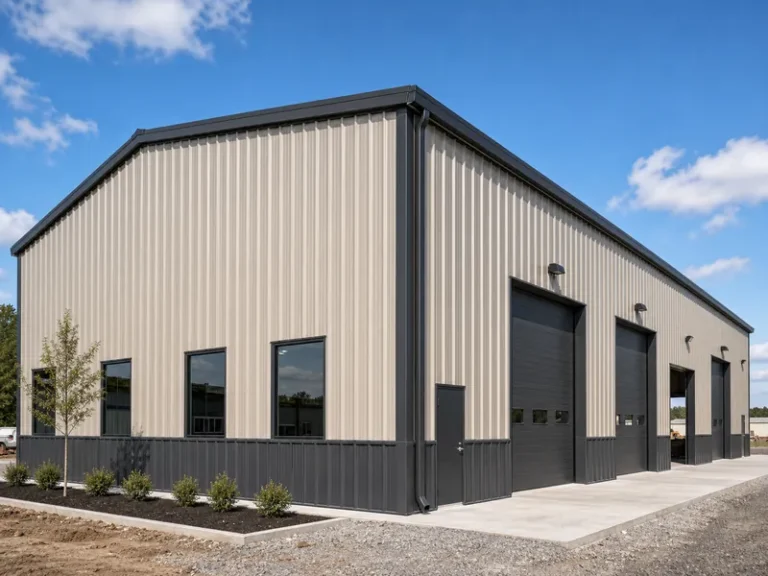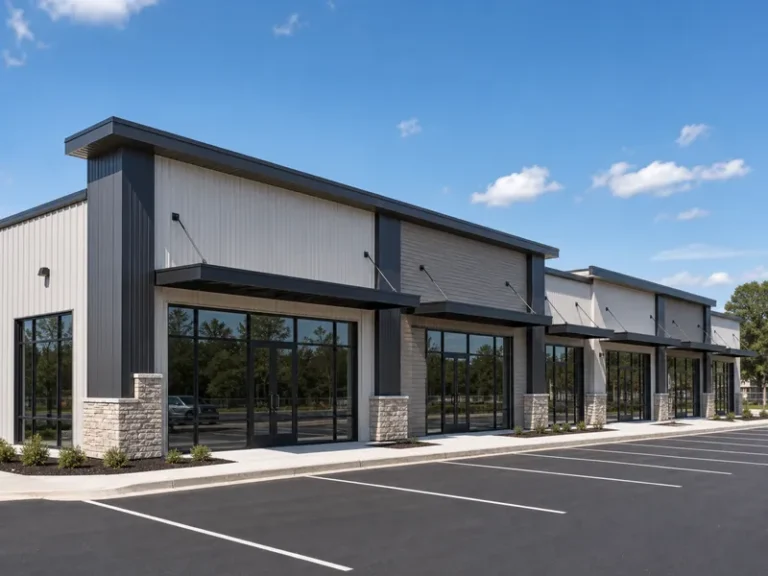





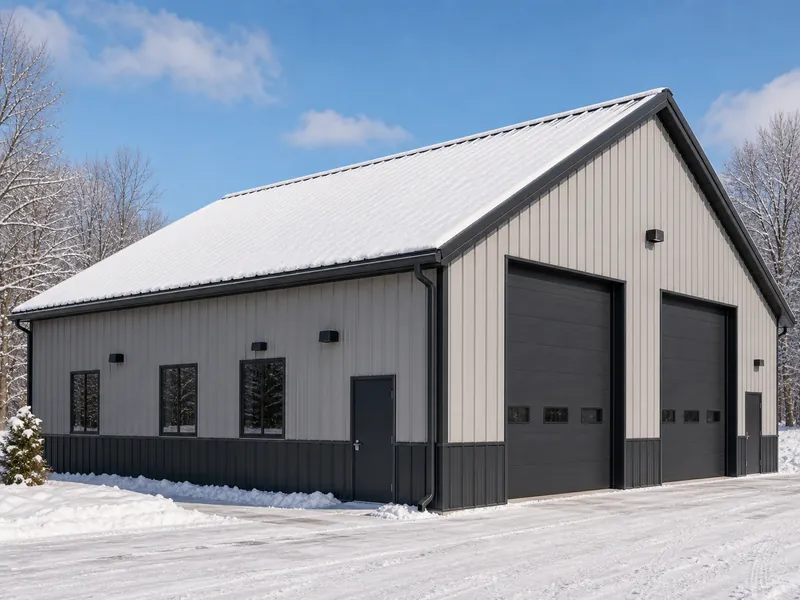
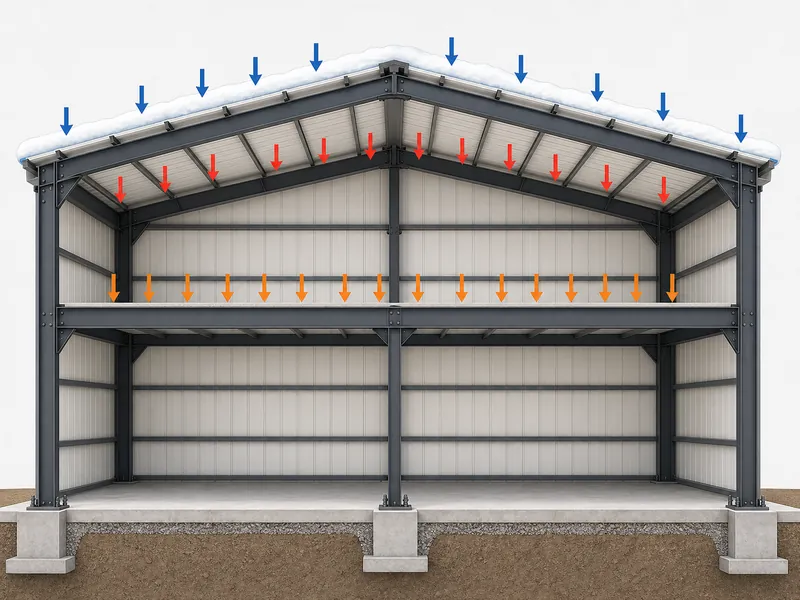
Every steel building carries three kinds of weight at once, and they are not interchangeable. Dead load is the permanent self-weight of the structure itself: the rigid frame, the roof and wall panels, the purlins, and anything bolted on for good. Live load is the changing weight a building picks up from how it gets used, such as people, stored goods, and movable equipment. Snow load is the seasonal weight of snow and ice sitting on the roof. Codes treat it as its own environmental load rather than lumping it in with ordinary live load. Telling the three apart matters because each one behaves differently. Together they set the size of the frame, the spacing of the purlins, and the slope of the roof on any commercial metal building.
What Dead Load Is in a Steel Building
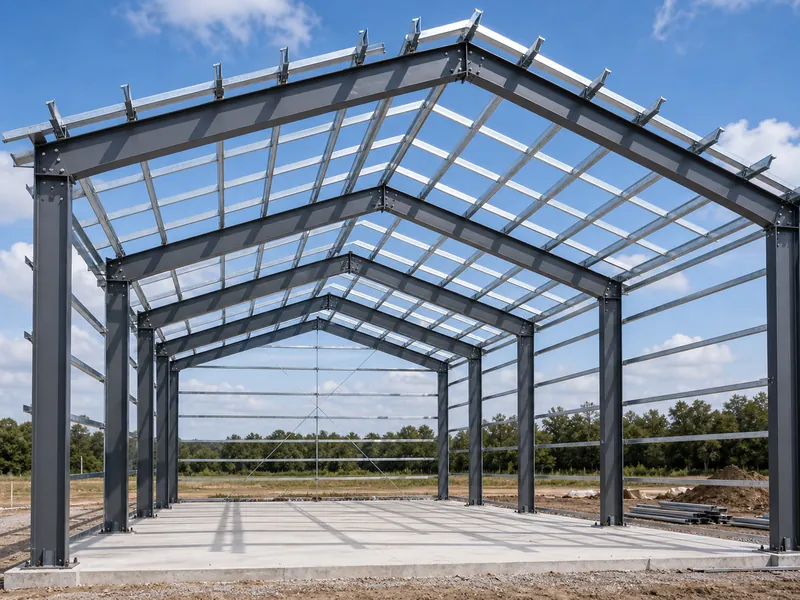
Dead load is the permanent, predictable weight a steel building carries from its own materials and anything permanently attached to it. In a pre-engineered steel frame, that means the rigid frame columns and rafters, the roof and wall cladding, and the C- and Z-section purlins and girts that hold the panels. Fixed items count too, such as ductwork, sprinkler lines, ceilings, and insulation. Designers usually group the weight of those permanently mounted services under a single “collateral load” allowance so nothing gets left out. The useful trait of dead load is that it barely changes once the building is standing, so it can be estimated closely from the material take-off. That predictability is why building codes apply a smaller safety factor to dead load than to the weights that move.
What Live Load Is and Why It Changes
Unlike dead load, live load varies with how a building is occupied and used, which makes it much harder to predict. It covers people, furniture, stored inventory, forklifts, and any equipment that can be added, moved, or removed over the life of the building. Roofs carry a live load too, mainly the workers, tools, and materials present during construction and later maintenance. That is why a roof is designed for a minimum live load even in places that never see snow. Because use varies so widely, codes set minimum live loads by occupancy instead of leaving it to guesswork. Figures commonly land near 40 psf for residential floors, around 50 psf for offices, and higher again for retail or storage. Some uses push the number much further. An overhead crane running down a workshop adds a heavy, moving live load that the frame and runway beams have to be sized for from the start.
What Snow Load Is and What Drives It
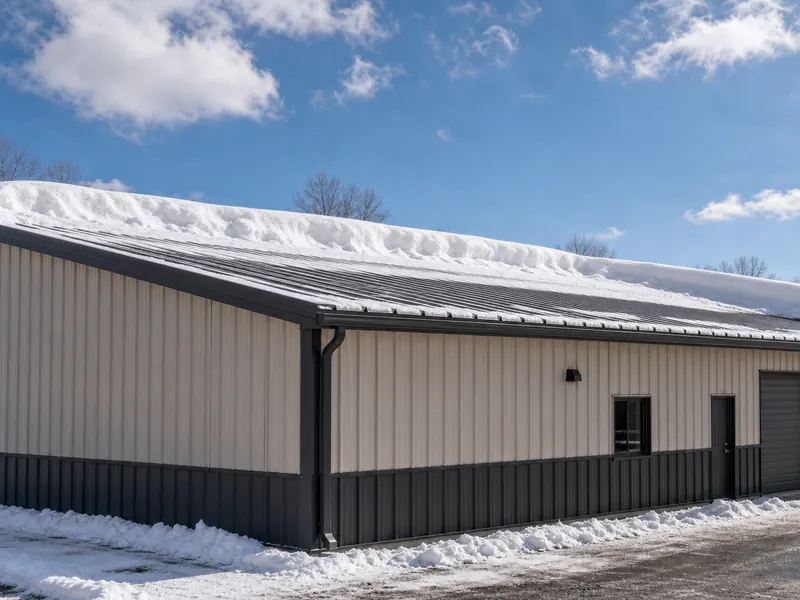
Snow load reflects the weight of accumulated snow and ice on a roof, and codes treat it as a separate environmental load instead of folding it into ordinary live load. The reason for the split is behavior. Roof live load is brief, movable maintenance and access loading. Snow, by contrast, can sit for weeks, build up in layers, and drift into deep pockets against parapets or wherever the roof steps up or down. How much snow a roof must carry starts from the ground snow load mapped for the site. That figure ranges from almost nothing across the warm South to well over 50–70 psf in northern and mountain regions, and the site-specific value comes from ASCE 7 or the local building code, not a rule of thumb. From there, roof pitch adjusts the figure: a steeper slope sheds snow and lowers the balanced load, though it also raises the question of where sliding snow lands and how drifts form. Exposure, the heat escaping through the roof, and the building’s importance category move the number further. For a wide clear-span steel roof with no interior columns, snow is often the load that governs how heavy the purlins and rafters need to be.
How Dead, Live, and Snow Loads Differ
The clearest way to separate the three loads is to line them up against the questions a designer asks: where the weight comes from, how much it varies, and how the code treats it.
| Load | Where it comes from | Changes over time? | Where it acts | How design handles it |
|---|---|---|---|---|
| Dead load | The building’s own materials and permanently attached items | No, essentially constant | The whole structure: frame, floors, roof | Estimated closely from materials; smaller load factor |
| Live load | Occupancy and use: people, contents, movable equipment | Yes, with use and over time | Floors and roofs | Code minimum set by occupancy; larger load factor |
| Snow load | Accumulated snow and ice (weather) | Yes, by season and location | The roof | From site ground snow load, adjusted for pitch and exposure; larger load factor |
This is also where a frequent mix-up clears up: snow is not simply “roof live load.” A roof’s live load covers the people and tools that show up briefly for maintenance, while snow load reflects weather that can pile on for an entire season. In cold regions the snow figure is usually the larger of the two. Keeping them on separate lines lets a designer check each against the conditions that produce it.
How the Three Loads Work Together in Design
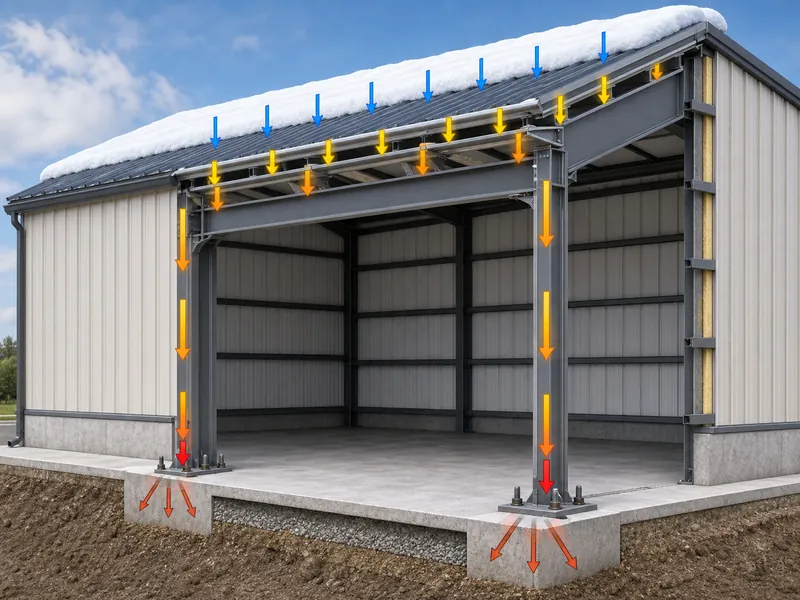
In design, the three loads are never checked in isolation. They are added in code-defined load combinations, each multiplied by a factor that reflects how predictable it is. ASCE 7 spells out several of these combinations rather than one, and a building has to be checked against every relevant case. A basic strength combination looks like 1.2D + 1.6L. Dead load (D) takes the smaller 1.2 factor because its weight is well known, while live load (L) takes a larger 1.6 because it varies. Snow does not simply ride inside that one formula. It enters its own combinations, where depending on the code case it can replace the roof live load or add to other effects, and it carries its own factor. The standard behind all of this is ASCE 7 (Minimum Design Loads and Associated Criteria for Buildings and Other Structures), which defines both the minimum loads and how they combine. The International Building Code adopts it by reference in Chapter 16, where dead, live, and snow loads each get their own section. Sound steel building design traces every one of these loads along a continuous path: snow and roof live load land on the panels, transfer into the purlins, and run down the rigid frame into the steel building foundation. The foundation has to be sized for the same combinations. Lateral forces such as wind load and seismic load enter their own combinations on top of the vertical ones. Even so, the gravity trio of dead, live, and snow sets the everyday sizing of frame and purlins.
What to Confirm With Your Steel Building Manufacturer
Before a steel building goes into fabrication, the owner’s real task is to confirm the design loads. The frame and purlins are sized around them, so changing them afterward means re-engineering and added cost. A short checklist covers most of it:
- Ground snow load for the exact site, taken from ASCE 7 or the local code rather than a neighboring town’s number; this is the most location-sensitive input of the three.
- The live load for the actual use, not a generic one. A building used for storage or light manufacturing carries far more than the office it might be quoted as.
- Collateral (dead) load allowances for anything you plan to hang from the frame later: HVAC units, sprinkler lines, ceilings, a crane, or rooftop solar.
- Planned expansion or added equipment, since loading up a finished frame is one of the costliest changes to make.
This is where the manufacturer’s role turns concrete. A steel structure builder converts those numbers into member sizes, purlin spacing, and connection details. KAFA, for instance, fabricates H-beam rigid frames and C/Z-section purlins under ISO 9001:2015 quality management, sizing each member to the snow, live, and collateral loads the owner confirms. Accurate figures up front let a manufacturer design and fabricate a frame matched to the building’s real working life instead of a default assumption.
Conclusion
The three loads rank differently depending on where and how you build, so the first figure to settle is not the same for every project. In a cold or mountain region, the site’s ground snow load is the one to fix first, since it usually outweighs roof live load and drives the purlin and frame sizing. In a mild climate, the building’s use matters more than snow, through the live and collateral loads it brings. Dead load sits beneath both: predictable, but only if every permanently attached item is counted. That gives a clear sequence to follow: establish the site snow load, define the real occupancy live load, tally the collateral dead load, and let the structural design combine them. Then confirm with whoever fabricates the steel that the frame, purlins, and foundation were checked against that exact set rather than a default one.
FAQ
Is snow load a live load or its own load?
Snow load is treated as its own environmental load, separate from live load. Older or informal usage sometimes calls it a “roof live load,” but standards such as ASCE 7 and IBC Chapter 16 give snow its own provisions because it behaves differently. It accumulates, drifts, and can sit for a whole season, unlike the brief maintenance traffic that roof live load represents.
Which load is usually the largest on a steel building?
Which load dominates depends on climate and use rather than a fixed ranking. In snow country, snow load is frequently the largest roof load and drives the frame. In warm regions with heavy occupancy or equipment, live and collateral loads often matter more, while dead load stays the steady baseline underneath both. This is why two identical-looking buildings in different states can have very different frame sizes.
Does a steeper roof pitch reduce snow load?
A steeper roof pitch does reduce the balanced snow load a roof is designed for, because snow sheds more readily off a slope. The trade-off is that sliding snow has to land somewhere safe, and drift loads at roof steps or parapets can still be heavy regardless of pitch. A steep roof lowers the snow demand but does not erase it.
Who calculates the dead, live, and snow loads for my building?
A structural engineer establishes the design loads, drawing snow and wind figures from ASCE 7 or the local code and live loads from the building’s occupancy. For a pre-engineered steel building, the manufacturer’s engineering team typically applies those loads to size the frame, purlins, and connections. That is why the owner needs to supply correct site and use information before fabrication begins.
Further Reading
- ASCE 7: Minimum Design Loads and Associated Criteria for Buildings and Other Structures — American Society of Civil Engineers. The standard that defines dead, live, and snow loads and the combinations used to design for them.
- International Building Code, Chapter 16: Structural Design — International Code Council. The adopted code that sets minimum dead, live, and snow load requirements in the United States.
- MBMA Design Resources: Metal Building Systems Manual — Metal Building Manufacturers Association. Industry guidance on applying snow, live, and other design loads to metal building systems.